A foundational introduction to momentum, impulse, and the Impulse-Momentum Theorem, exploring how forces acting over time change an object's motion through real-world examples like sports and safety features.
Designed to increase \(\Delta t\). Stretching the stopping time reduces the impact Force (\(F\)) on passengers.
Sports Follow-Through
Keeps club in contact for more time. Increases total impulse, resulting in a larger \(\Delta p\) and higher speed.
Bending Knees
Allows you to stop over a longer duration, spreading force safely through muscles instead of stiff bones.
Key Secret: If you want to survive a crash, increase the time! If you want to hit it far, increase the time!
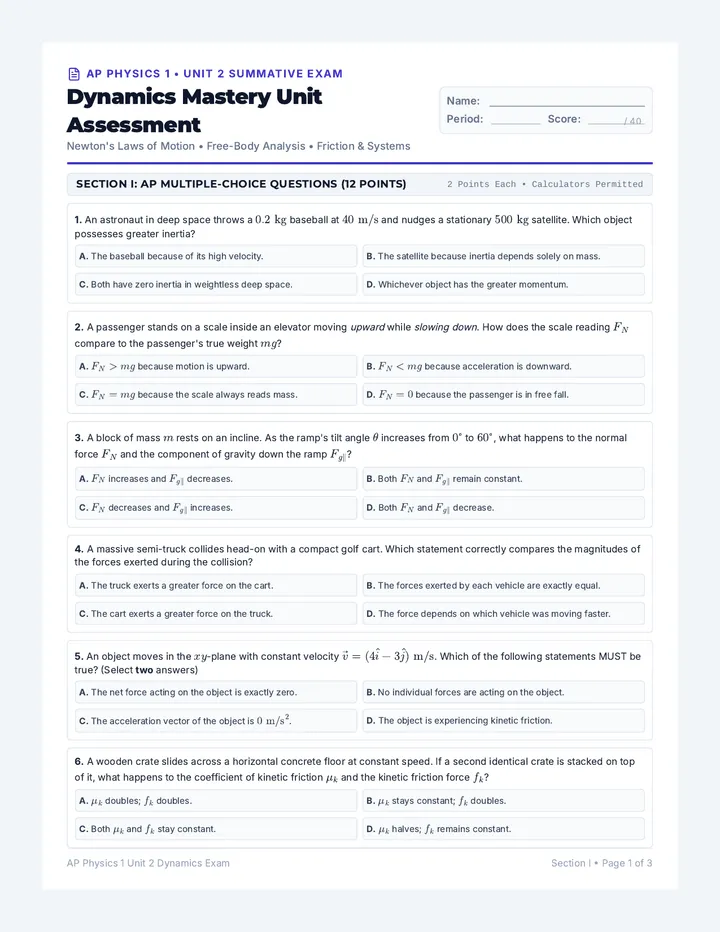
9. Momentum is what type of quantity?
Scalar
Vector
Temperature
Massless
10. If an object is at rest, its momentum is:
Infinite
1 kg·m/s
Negative
0 kg·m/s
11. Which has the same units as impulse?
Change in momentum
Power
Kinetic Energy
Force
12. A car stops by hitting a wall vs a haystack. The impulse is:
Greater for the wall
Greater for the haystack
The same for both
Zero for both
PART 4: CALCULATION STATION
1. Finding Momentum
A 2,000 kg car travels north at 15 m/s. What is its momentum?
2. Finding Impulse
A player kicks a ball with 150 N for 0.05 s. What is the impulse?
3. Change in Momentum
A 0.15 kg ball at 40 m/s hits a glove and stops. What is \(\Delta p\)?
4. Solving for Force
Using Problem 3, if the ball stops in 0.02 s, what is the force?
5. Finding Velocity
A 10 kg object has a momentum of 50 kg·m/s. Calculate its velocity.
6. Finding Mass
A ball rolling at 4 m/s has a momentum of 12 kg·m/s. What is its mass?
7. Simple Impulse
A force of 200 N is applied to a crate for 3 s. What is the impulse?
8. Solving for Force
An impulse of 100 N·s is delivered over 0.5 s. What was the average force?
9. Velocity Change
A 2 kg car speeds up from 1 m/s to 5 m/s. What is its change in momentum (\(\Delta p\))?
10. Final Velocity
A 5 kg object at rest is pushed with an impulse of 20 N·s. What is its final velocity?
PART 5: CONCEPTUAL CHALLENGES
1. Landing Safety
Imagine you have to jump off a high wall onto the ground. Why is it much safer to bend your knees when you land instead of keeping your legs stiff? Explain using the terms Force, Time, and Impulse.
2. Sand Pit Landing
Why do long-jumpers land in a pit of sand rather than on a hard asphalt track? Use the Impulse-Momentum Theorem to explain the safety benefit for the athlete.
3. Follow-Through Strategy
A tennis player "follows through" on their serve. If the force they apply remains the same, how does the follow-through affect the final speed of the ball? Explain using the concept of impulse.
4. The Rug vs. Tile Mystery
A glass falls on a tile floor and shatters. An identical glass falls from the same height onto a thick rug and survives. Since both glasses had the same change in momentum, why does one break and the other not?