Building Blocks Slides Unit 1 • Part 1
Foundations of Chemistry
Building Blocks of Matter
What is the universe made of? Exploring matter, elements, and the architecture of the atom.
Lesson 1: Matter, Elements & Atoms 01 / 05
The Big Picture: Matter
02 / 05
Key Definition
Matter
Anything that has mass and takes up space.
From the air you breathe to distant stars, everything physical is matter!
Has Mass
It contains a measurable quantity of substance.
Takes Up Space
It occupies volume in three dimensions.
Turn and Talk: Is sunlight matter? Is air matter? Why or why not?
Elements: Pure Substances
03 / 05
Vocabulary Term
Element
A pure substance that can exist as a single atom.
Examples: Gold (Au), Oxygen (O), Carbon (C), Iron (Fe)
Contrast Concept
Compound
Made of more than one kind of atom bonded (stuck) together.
Examples: Water (H₂O), Table Salt (NaCl), Carbon Dioxide (CO₂)
Key Takeaway: An element contains only one type of atomic identity!
The Atom & Subatomic Particles
04 / 05
Fundamental Unit
Atom
A tiny unit of matter; the smallest particle that has the properties of a particular element.
Internal Components
Subatomic Particle
Tiny bits of matter that are smaller than atoms and make up parts of atoms.
The three main types: protons, neutrons, and electrons.
Can you break an atom and still keep the element's properties? No! The atom is the limit.
Quick Check: Lesson 1 Terms
05 / 05
1. Matter
Anything with mass that takes up physical space.
2. Element
A substance capable of existing as a single atom.
3. Atom
Smallest particle that retains element properties.
4. Subatomic Particle
Particles smaller than atoms (protons, neutrons, electrons).
Get ready to apply these terms on your Building Blocks Worksheet !
Building Blocks Worksheet Atomic Foundations • Lesson 1
Building Blocks Worksheet
Core Vocabulary
Name:
Date:
Period:
Word Bank
Matter
Element
Atom
Subatomic Particle
1
Part 1: Match Key Definitions
Write the letter of the correct term on the blank line next to its definition.
1. Anything that has mass and takes up physical space.
2. Tiny bits of matter smaller than atoms (protons, neutrons, electrons).
3. Smallest particle having the properties of a particular element.
4. Substance capable of existing as an individual single atom.
A. Subatomic Particle
B. Matter
C. Element
D. Atom
2
Part 2: Sentence Completion
Fill in the blank with the appropriate word from the word bank to complete each statement.
1. Water is composed of hydrogen and oxygen bonded together, whereas gold is an because it consists of a single type of atom.
2. Scientists understand that an individual is the smallest unit possessing unique elemental traits.
3. Unlike light or heat, solids, liquids, and gases are all forms of because they possess mass and occupy volume.
4. A proton or a neutron is classified as a that resides inside the nucleus.
3
Part 3: Deep Review & Explanation
Explain the difference between an element and a compound :
Why is an atom described as the "smallest particle that has properties of a particular element"?
Atomic Foundations Unit • Worksheet 1 Page 1 of 1
Inside The Nucleus Slides Unit 1 • Part 2
Nuclear Anatomy & Identification
Inside the Nucleus
How protons and neutrons determine an atom's identity, mass, and location on the periodic table.
Lesson 2: Protons, Neutrons, Atomic Number & Mass 01 / 05
Protons: The Identity Particle
02 / 05
Key Definition
Proton
Subatomic particles in the nucleus with a positive charge.
The number of protons defines what kind of element the atom is!
1 Proton = Hydrogen (H)
Every atom with 1 proton is always hydrogen.
6 Protons = Carbon (C)
Every atom with 6 protons is always carbon.
79 Protons = Gold (Au)
Change the proton count, and you change the element!
Crucial Rule: An atom's chemical identity is locked to its proton count.
Neutrons: The Neutral Partner
03 / 05
Key Definition
Neutron
Subatomic particles with a mass of 1 atomic mass unit and no electrical charge.
Together with protons, neutrons make up the dense nucleus of atoms.
0
Zero Electrical Charge
Neutrons are neutral—they carry neither (+) nor (-).
1
1 Atomic Mass Unit
Neutrons add substantial mass to the nucleus.
Why Neutrons Matter: They provide nuclear stability, keeping positive protons from repelling each other!
Atomic Number & The Periodic Table
04 / 05
Key Definition
Atomic Number
The number of protons in the nucleus of a specific kind of atom.
How the Table is Organized
The periodic table of elements is arranged in a sequence that increases by one as you look from left to right and top to bottom.
1
H
2
He
3
Li
4
Be
Formula: Atomic Number = Number of Protons
Atomic Mass: Weighing the Nucleus
05 / 05
Key Definition
Atomic Mass
The total number of protons and neutrons in the nucleus of an atom.
Together, this number describes how much mass the atom has.
The Mass Formula
Atomic Mass = Protons + Neutrons
Nuclear Math Worksheet Atomic Foundations • Lesson 2
Nuclear Math Worksheet
Nucleus & Mass
Name:
Date:
Period:
Word Bank
Proton
Neutron
Atomic Number
Atomic Mass
1
Part 1: Match Key Definitions
Write the letter of the matching term next to each definition.
1. Subatomic particles in the nucleus with a positive charge that define the element.
2. Subatomic particles with a mass of 1 atomic unit and no electrical charge.
3. The number of protons in the nucleus of a specific kind of atom.
4. The total number of protons and neutrons in the nucleus describing total mass.
A. Atomic Mass
B. Proton
C. Neutron
D. Atomic Number
2
Part 2: Sentence Completion
Fill in each blank with the term from the word bank that best completes the sentence.
1. The periodic table arranges elements by an increasing , which moves up by one for each sequential box.
2. Because it possesses neither a positive nor a negative charge, a is electrically neutral.
3. If you change the number of s in a nucleus, you alter the element itself into something different.
4. To determine the of an atom, you add together the total number of protons and neutrons.
3
Part 3: Nuclear Calculation Table
Use the rules: Atomic Number = Protons and Atomic Mass = Protons + Neutrons to fill in missing values.
Element Protons Neutrons Atomic Number Atomic Mass Helium (He) 2 2 Carbon (C) 6 6 Nitrogen (N) 7 7 Oxygen (O) 8 8
Atomic Foundations Unit • Worksheet 2 Page 1 of 1
Charges and Variations Slides Unit 1 • Part 3
Electrons & Variations
Charges and Variations
Discovering electron shells, electrical charge balance, ion formation, and isotopic variants.
Lesson 3: Electrons, Charges, Ions & Isotopes 01 / 05
Electrons: Outer Energy Shells
02 / 05
Key Definition
Electron
A tiny subatomic particle with virtually no mass and a negative charge.
Electrons exist in shells (energy levels) orbiting around the nucleus!
-
Negative Charge (-1)
Each electron precisely balances one positive proton.
~0
Virtually Zero Mass
Over 1,800 times lighter than a proton or neutron.
Location: Electrons do not sit in the nucleus; they orbit in surrounding electron shells!
Charge & Ions
03 / 05
Neutral
Balanced Charge
Protons = Electrons
Total electrical charge equals zero.
Net Charge: 0
Positive Ion
Lost Electron(s)
Protons > Electrons
Fewer electrons than protons creates a net positive charge.
Net Charge: +1 or +2
Negative Ion
Gained Electron(s)
Electrons > Protons
More electrons than protons creates a net negative charge.
Net Charge: -1 or -2
Definition of Ion: An atom with different numbers of protons and electrons.
Isotopes: Neutron Variations
04 / 05
Key Definition
Isotope
When atoms of a particular element have different numbers of neutrons.
Different isotopes are the same kind of atom with different atomic masses!
Example: Carbon Isotopes
Carbon-12
6 Protons + 6 Neutrons
Mass: 12
Carbon-14
6 Protons + 8 Neutrons
Mass: 14
Compare: Ions change electron counts (charge). Isotopes change neutron counts (mass).
The Complete Atomic Picture
05 / 05
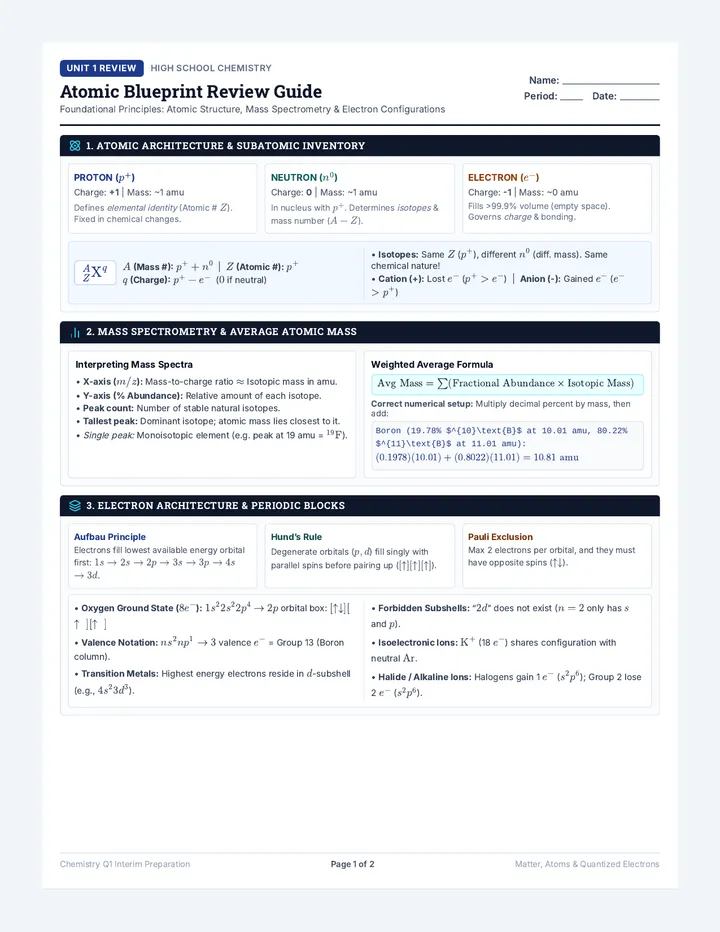
Proton (p⁺)
Charge: +1
Mass: 1 amu
Determines element identity
Neutron (n⁰)
Atomic Mastery Worksheet Atomic Foundations • Lesson 3
Charges & Variations Worksheet
Electrons & Ions
Name:
Date:
Period:
Lesson 3 Word Bank
Electron
Charge
Ion
Isotope
1
Part 1: Match Definitions
Write the letter of the matching term next to each definition.
1. Tiny subatomic particle with virtually no mass and a negative charge that exists in shells.
2. The electrical state resulting from the balance (or imbalance) of protons and electrons in an atom.
3. An atom with different numbers of protons and electrons, carrying a net positive or negative charge.
4. Atoms of a particular element that have different numbers of neutrons and therefore different masses.
A. Isotope
B. Electron
C. Charge
D. Ion
2
Part 2: Sentence Completion
Fill in the blank with the appropriate term from the word bank.
1. If an atom is neutral, it will have a number of protons precisely matched by its count of s.
2. An atom that has gained two extra electrons acquires a negative and is officially called a negative ion.
3. When an atom loses an electron, it has more protons than electrons and transforms into a positive .
4. Carbon-12 and Carbon-14 both have 6 protons, but each is a distinct because their neutron counts differ.
3
Part 3: Scenario Analysis
An atom of Sodium (Na) has 11 protons and 10 electrons. Is it a neutral atom, a positive ion, or a negative ion? Explain why:
How do isotopes prove that two atoms can belong to the exact same element even if they have different atomic masses?
Atomic Foundations Unit • Worksheet 3 Page 1 of 2
Atomic Foundations • Cumulative Assessment
12-Term Atomic Vocabulary Mastery
Unit Review
4
Part 4: All-Term Matching Challenge
Match each definition to its lettered term from the bank on the right.
1. Anything that has mass and takes up space.
2. Tiny unit of matter; smallest particle with element properties.