Giant Bones Investigation Handout OpenSciEd Unit 8.6 • Lesson 1 Investigation
Mystery of the Giant Penguin Fossil
Name:
Date:
Period:
Field Site Briefing: Paracas Peninsula, Peru (36 Million Years Ago) Paleontologists uncovered an exceptionally preserved penguin fossil nicknamed "Pedro" (Inkayacu paracasensis ). Unlike modern penguins, Pedro lived during an exceptionally warm Eocene climate along tropical coasts. Examine the morphological trait dataset below to compare ancient Pedro with two distinct living species.
Comparative Trait Dataset
Trait Feature Ancient Pedro (Fossil) Modern Emperor Penguin Galápagos Penguin Standing Height ~1.5 meters (5.0 ft) ~1.1 meters (3.6 ft) ~0.49 meters (1.6 ft) Estimated Mass 55 – 60 kg (120–132 lbs) 22 – 45 kg (49–99 lbs) 1.7 – 2.6 kg (4–6 lbs) Beak Shape Long, spear-like (31 cm), straight Stout, curved tip (8 cm) Slender, hooked tip (6 cm) Flipper Skeleton Dense flattened bone, long paddles Rigid bladed wing, highly fused Compact hydrofoil wing Habitat Climate Warm tropical coastal waters (~28°C) Antarctic ice shelf (-40°C to -10°C) Equatorial islands (15°C to 28°C) Feather Color Reddish-brown & grey melanosomes Classic black & white tuxedo plumage Blackish-grey & white plumage
Part 1: Scientist Notice & Wonder Protocol
WHAT DO YOU NOTICE? (Observations & Patterns)
WHAT DO YOU WONDER? (Questions & Hypotheses)
Investigation Worksheet • Page 2
Developing an Initial Explanatory Model
NGSS MS-LS4-1 & MS-LS4-2
Modeling Prompt: How could ancient 5-foot giant penguins living in warm equatorial waters be connected to modern penguins living in freezing Antarctic or tiny Galápagos habitats? Diagram your current thinking below.
Diagrammatic Thinking Canvas Include: (1) Past environment, (2) Present environments, (3) Changing body structures, (4) Time arrows
[Past: 36 Million Years Ago] [Environmental Shifts / Pressures] [Present Day Populations]
Part 3: Driving Questions for Our Unit Board
Formulate two testable questions we need to investigate to explain how traits in populations change over many generations:
Q1:
Q2:
Initial Hypothesis Checklist: Are traits fixed forever, or do traits vary within a population? Next Step: Lesson 2 Climate Shifts
Giant Bones Slide Deck OpenSciEd Unit 8.6 • Natural Selection
Lesson 1 of 9
Anchor Phenomenon Launch
The Mystery of the Giant Ancient Penguin
How could five-foot giant penguins from tropical ancient beaches be connected to modern species living on freezing ice shelves?
45-Minute Investigation Ready your Field Investigation Handout
Fossil Profile • Pedro
36 Million Years Ago • Paracas, Peru
Fossil Identification
Inkayacu paracasensis
Discovered preserved in desert coastal rock in Peru with intact fossilized feather scales and melanosomes.
Height: 1.5 m (5.0 ft)
Weight: ~60 kg (132 lbs)
Beak: 31 cm spear-like
Ancient Environment
Warm Tropical Waters
Pedro swam in ocean waters averaging 28°C (82°F)—dramatically warmer than modern Antarctic waters (-2°C to 2°C).
Surprise Finding: Fossilized feathers contained reddish-brown and gray pigmentation, not tuxedo black-and-white!
Record trait measurements into your Comparative Trait Dataset table now.
Modern Comparisons
Two Extremes of Survival
Antarctic Specialist
Emperor Penguin
Survives wind chills below -40°C on sea ice. Thick dense blubber, down feathers, rigid wing hydrofoils.
Height: 1.1 m (3.6 ft)
Mass: 35 kg (77 lbs)
Plumage: Black / White Tuxedo
Equatorial Survivor
Galápagos Penguin
The only penguin north of the equator. Slender body sheds excess heat; hunts along cool ocean upwellings.
Height: 0.49 m (1.6 ft)
Mass: 2.2 kg (5 lbs)
Adaptation: Heat Panting & Bare Skin
Notice the enormous differences in size, body mass, and beak shapes. What could cause such drastic changes?
Investigation Protocol
15-Minute Collaborative Work
1
Notice & Wonder
List at least 3 direct factual observations (Notice) and 3 driving questions (Wonder) on Page 1.
Partner Discussion: 5 mins
2
Initial Model
Sketch your idea on Page 2: How did populations change from Pedro's era to modern penguins?
Independent Sketch: 5 mins
Climate Shift Lab Sheet OpenSciEd Unit 8.6 • Lesson 2 Lab
Ocean Climate & Predator Pressures
Name:
Date:
Period:
Around 34 million years ago, the opening of the Drake Passage formed the Antarctic Circumpolar Current, causing global ocean temperatures to plummet. Concurrently, predatory marine mammals (toothed whales, seals) evolved. Analyze how these changes transformed survival demands.
Dataset A: Cenozoic Ocean Temperature & Marine Shifts
Geologic Epoch Time Window Avg Coastal Sea Temp Dominant Prey Available Primary Marine Predators Late Eocene (Pedro's Era) 36 – 34 Mya 26°C – 28°C (Tropical) Abundant large coastal fish Small warm-water sharks Oligocene / Early Miocene 33 – 20 Mya 14°C – 18°C (Cooling) Schooling pelagic fish, squid Early predatory pinnipeds (seals) Late Pleistocene to Present 2 Mya – Present -1.8°C – 12°C (Cold/Frigid) Dense krill swarms, silverfish Orcas, Leopard seals, Fur seals
Part 1: Environmental Trend Analysis
1. Identify the pattern in ocean surface temperature over the past 36 million years and cite numerical data:
2. How did the shift from small ancient sharks to modern apex predators (leopard seals, orcas) change the swimming and agility demands placed on penguins?
Investigation Worksheet • Page 2
Body Size, Heat Retention, & Daily Energy Budgets
Math Connection
In cold marine water, animals lose body heat 25 times faster than in air. Larger animals have lower surface-area-to-volume (\(SA/V\)) ratios, keeping heat in, but require vastly more daily calories to swim and maintain muscle mass.
Dataset B: Metabolic & Energetic Demands by Body Mass
Organism Model Body Mass Relative \(SA/V\) Ratio Daily Calorie Requirement Daily Prey Required Pedro Model (Giant) 60 kg 0.45 (Slow Heat Loss) ~9,200 kcal/day ~6.5 kg of fish/day Emperor Penguin 35 kg 0.58 (Moderate Heat Loss) ~5,400 kcal/day ~3.8 kg fish & squid Adélie Penguin
Trait Variety Data Sheet OpenSciEd Unit 8.6 • Lesson 3 Activity
Trait Distribution in Populations
Name:
Date:
Period:
Prior to any major environmental catastrophe or climate cooling, natural populations already possess genetic variation. Below are measurements of flipper length from a fossilized flock sample of 30 ancient coastal penguins.
Sample Dataset (Flipper Length in cm)
4244454546 4647474748 4848484949 4949495050 5050515151 5252535456
Notice: Even within one colony, lengths vary from 42 cm to 56 cm.
Trait Bin Frequencies
Length Bin Tally Count 41 – 43 cm 44 – 46 cm 47 – 49 cm 50 – 52 cm 53 – 56 cm
Construct Frequency Histogram
Shade bars to match the bin counts
129630
41-43
44-46
47-49
50-52
53-56
Flipper Length Bins (cm) • Normal Bell Distribution
Investigation Worksheet • Page 2
Heritable Traits vs Acquired Characteristics
Core Concept
Natural selection can only act on heritable traits (coded in DNA and passed to offspring). Trait changes acquired during an individual's lifetime cannot be inherited by offspring.
Trait Sorting Challenge: Mark with [H] Heritable or [A] Acquired
Type Observed Biological Trait Scenario Scientific Justification [ _____ ] Flipper bone density determined by genetic collagen synthesis genes. Passed down through parental DNA during reproduction. [ _____ ] A scar on a flipper caused by an escape from an ancient shark bite. Physical injury occurring after birth; DNA unaltered. [ _____ ] Melanosome shape and density controlling red-brown vs black feather colors. Genetic alleles inherited from mother and father penguins. [ _____ ] Stronger shoulder swimming muscles built up after a long migration season. Muscle conditioning gained during life through physical exercise.
Selection Simulation Protocol OpenSciEd Unit 8.6 • Lesson 4 Simulation
Predator Pressure Simulation
Name:
Date:
Period:
Simulation Objective: Observe how environmental pressures (predation and foraging difficulty) alter the proportion of traits over 4 successive generations. Each survivor produces 2 offspring inheriting the parent's body morph.
The Three Population Body Morphs
Morph A: Heavy Giant
High heat retention, slow turning speed, high calorie requirement (needs 6 food tokens).
Morph B: Streamlined Medium
Balanced heat retention, rapid burst swimming, moderate calorie need (needs 3 food tokens).
Morph C: Compact Agile
High maneuverability, escapes ambush predators easily, low food need (needs 1 food token).
4-Generation Population Census Tracker
Generation & Event Morph A (Giant) Morph B (Medium) Morph C (Compact) Total Flock Gen 0: Warm Water Starting Baseline 10 (33%) 10 (33%) 10 (33%) 30 (100%) Gen 1 Survivors (Cold Front Arrives) [ _____ ] [ _____ ] [ _____ ] [ _____ ] Gen 2 Survivors (Fast Predators Hunt) [ _____ ] [ _____ ] [ _____ ] [ _____ ] Gen 3 Survivors (Scarce Fish Schools) [ _____ ] [ _____ ] [ _____ ] [ _____ ]
Rule: In each generation, non-survivors are removed. Surviving individuals duplicate to represent reproduction.
Simulation Worksheet • Page 2
Differential Reproductive Success Analysis
NGSS MS-LS4-4
Natural selection occurs when individuals with advantageous traits survive in higher proportions and leave more offspring than individuals without those traits.
Percentage Trend Comparison (Gen 0 vs Gen 3)
Generation 0 Proportions
Morph A (Giant): 33.3%
Morph B (Medium): 33.3%
Morph C (Compact): 33.3%
Generation 3 Final Proportions (Calculate)
Morph A %:
Morph B %:
Morph C %:
1. Why did the proportion of Morph A penguins decline over time? Refer explicitly to both
Superbug Resistance Analysis OpenSciEd Unit 8.6 • Lesson 5 Case Study
Microevolution in Action: Superbugs
Name:
Date:
Period:
While penguins took millions of years to adapt to cooling oceans, bacteria reproduce every 20 minutes. Can the exact same process of natural selection happen right before our eyes in modern hospitals?
Zone of Inhibition Lab Trial (Disk Diffusion Assay)
Day 1: First Dose
Clear Zone
Zone Diameter: 28 mm 99% susceptible killed
Day 5: Partial Course
Zone
Zone Diameter: 14 mm Moderate resistance
Day 10: Resistant Colony
Zone Diameter: 0 mm Complete resistance
1. Did the antibiotic "cause" the bacteria to mutate in order to defend themselves, or were resistant variations already present before the antibiotic was introduced? Explain:
Core Scientific Law: Environmental selective pressures do NOT create traits; they select for preexisting advantageous traits!
Case Study Analysis • Page 2
Cross-System Evolutionary Synthesis
Connecting Systems
Compare the mechanism of natural selection across two drastically different biological systems: microscopic bacteria in a patient and ancient penguins in the Cenozoic oceans.
The Four Pillars of Natural Selection Matrix
Pillar Bacteria in Hospital Penguins in Cooling Ocean 1. Preexisting Variation Variation in bacterial cell-wall protein pumps and thickness. Variation in body mass, flipper length, and blubber insulation. 2. Environmental Pressure Antibiotic medicine attacking cell walls Frigid waters & apex marine predators 3. Differential Survival Susceptible bacteria lyse and die; resistant pump variants survive. Heavy slow giants starve or are preyed upon; agile streamlined morphs survive. 4. Reproduction & Shift Resistant bacteria divide rapidly; next generation is entirely resistant. Survivors reproduce over generations; modern population is compact and streamlined.
2. Synthesis Argument: Why does natural selection take thousands or millions of years in birds, but only a few days or weeks in bacteria? (Hint: Consider generational turnover time).
Crosscutting Concept: Patterns & Cause and Effect across Scales Up Next: Lesson 6 Shifted Population Graphs
Population Shift Math Lab OpenSciEd Unit 8.6 • Lesson 6 Math Lab
Tracking Population Shifts Over Deep Time
Name:
Date:
Period:
Paleontologists excavated three sedimentary rock layers in South America containing fossil penguins spanning 35 million years. Analyze the quantitative shift in average adult body mass across these three geologic time slices.
Fossil Strata Body Mass Distribution Data
Geologic Stratum Age of Rock Mass Range (kg) Colony Mean (\(\mu\)) Primary Environmental Condition Layer 1: Otuma Formation 35 Million Years 48 – 65 kg 58.2 kg Warm shelf waters, slow predators Layer 2: Pisco Formation 18 Million Years 18 – 35 kg 26.4 kg Cooling currents, early seals Layer 3: Modern Shoreline Present Day 2.0 – 4.5 kg 3.8 kg Cold Humboldt current, fast orcas
Visualizing the Directional Shift in Body Mass
35 Mya (\(\mu=58\text{kg}\))
18 Mya (\(\mu=26\text{kg}\))
Present (\(\mu=3.8\text{kg}\))
0 kg (Small Body) ← DIRECTIONAL SHIFT TOWARD SMALLER MASS OVER TIME ← 70 kg (Giant Body)
1. Calculate the total net change in mean body mass (\(\Delta \bar{x}\)) from Layer 1 to Layer 3, and state whether the shift favored smaller or larger body size:
Math Lab • Page 2
Patterns of Natural Selection
Mathematical Models
Scientists classify natural selection into three major graphical distribution patterns based on how the population curve changes over time.
Directional Selection
One extreme trait is favored over all others, shifting the entire curve left or right.
Example: Penguin mass shrinking
Stabilizing Selection
Average traits are favored; both extreme trait ends are selected against. Curve narrows.
Example: Human birth weight
Disruptive Selection
Both extreme traits are favored; middle average individuals are selected against. Bimodal split.
Example: Very small or very big beaks
2. Classify: Which of the three patterns above best represents what happened to penguin body size over the last 35 million years? Cite evidence from the strata data table on Page 1:
3. Predictive Thinking: If Antarctic ocean waters rapidly warm by 3°C over the next century, what trait shift would you predict for modern Emperor penguin blubber thickness?
Comparative Anatomy Investigation OpenSciEd Unit 8.6 • Lesson 7 Lab
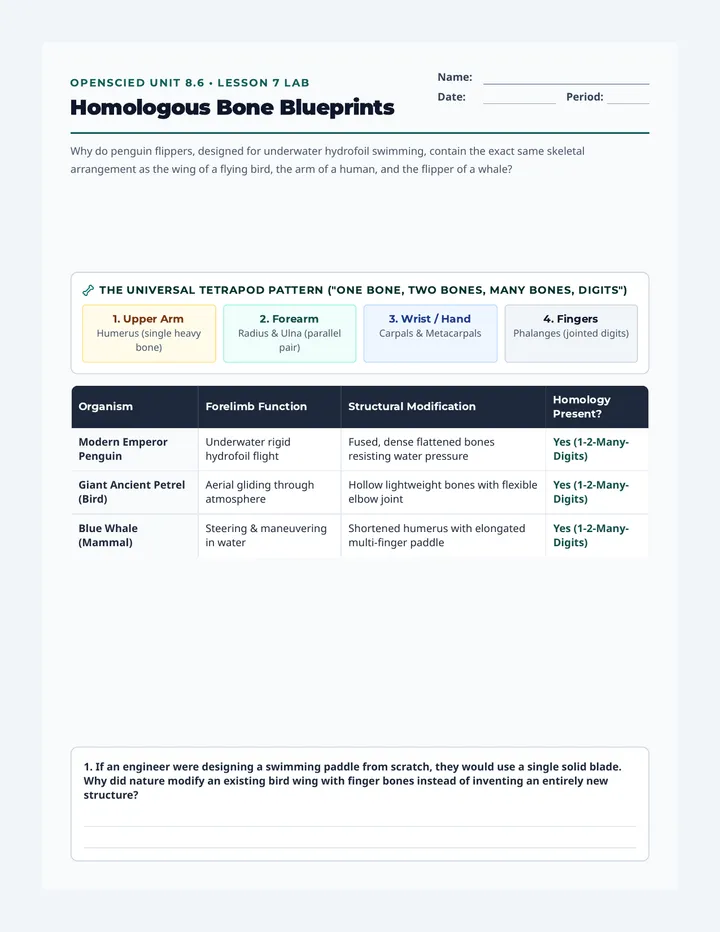
Homologous Bone Blueprints
Name:
Date:
Period:
Why do penguin flippers, designed for underwater hydrofoil swimming, contain the exact same skeletal arrangement as the wing of a flying bird, the arm of a human, and the flipper of a whale?
The Universal Tetrapod Pattern ("One Bone, Two Bones, Many Bones, Digits")
1. Upper Arm Humerus (single heavy bone)
2. Forearm Radius & Ulna (parallel pair)
3. Wrist / Hand Carpals & Metacarpals
4. Fingers Phalanges (jointed digits)
Organism Forelimb Function Structural Modification Homology Present? Modern Emperor Penguin Underwater rigid hydrofoil flight Fused, dense flattened bones resisting water pressure Yes (1-2-Many-Digits) Giant Ancient Petrel (Bird) Aerial gliding through atmosphere Hollow lightweight bones with flexible elbow joint Yes (1-2-Many-Digits) Blue Whale (Mammal) Steering & maneuvering in water Shortened humerus with elongated multi-finger paddle Yes (1-2-Many-Digits)
1. If an engineer were designing a swimming paddle from scratch, they would use a single solid blade. Why did nature modify an existing bird wing with finger bones instead of inventing an entirely new structure?
Comparative Anatomy • Page 2
Embryological Evidence of Deep Ancestry
NGSS MS-LS4-3
Early embryos of diverse vertebrate species reveal shared developmental stages that disappear or specialize before hatching or birth.
Developmental Stage Comparison Matrix
Embryonic Structure Early Penguin Embryo Early Human Embryo Early Fish Embryo Pharyngeal Pouches (Gill slits) Present (develops into ear/throat) Present (develops into jaw/inner ear) Present (develops into functioning gills) Post-Anal Tail Present (reduces into pygostyle) Present (reduces into coccyx tailbone) Present (develops into swimming tail) Limb Bud Separation Individual separated digits visible Individual separated digits visible
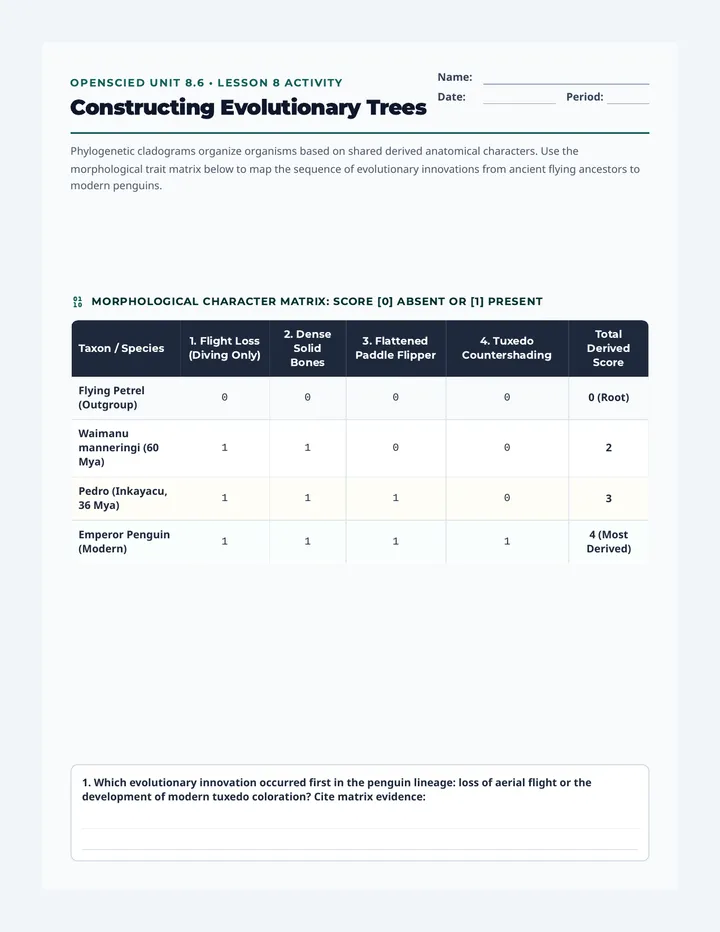
Cladogram Construction Guide OpenSciEd Unit 8.6 • Lesson 8 Activity
Constructing Evolutionary Trees
Name:
Date:
Period:
Phylogenetic cladograms organize organisms based on shared derived anatomical characters. Use the morphological trait matrix below to map the sequence of evolutionary innovations from ancient flying ancestors to modern penguins.
Morphological Character Matrix: Score [0] Absent or [1] Present
Taxon / Species 1. Flight Loss (Diving Only) 2. Dense Solid Bones 3. Flattened Paddle Flipper 4. Tuxedo Countershading Total Derived Score Flying Petrel (Outgroup) 0 0 0 0 0 (Root) Waimanu manneringi (60 Mya) 1 1 0 0 2 Pedro (Inkayacu, 36 Mya) 1 1 1 0 3 Emperor Penguin (Modern) 1 1 1 1 4 (Most Derived)
1. Which evolutionary innovation occurred first in the penguin lineage: loss of aerial flight or the development of modern tuxedo coloration? Cite matrix evidence:
Tree Activity • Page 2
Interpreting Cladogram Nodes & Common Ancestors
NGSS MS-LS4-2
A node on a cladogram represents the most recent common ancestor shared by descendant branches. Species at tips of branches are contemporaries or extinct endpoints, not ancestors of one another.
The Avian Evolutionary Branching Tree
Root
• Flying Seabird (Outgroup)
• Waimanu (Flightless, 60 Mya)
• Pedro / Inkayacu (Giant Paddle, 36 Mya)
• Modern Emperor & Galápagos Penguins
Critical Concept: Pedro sits on an extinct branch of giant penguins. Pedro is an evolutionary cousin that shares a common ancestor with modern penguins, NOT the direct parent of today's birds!
2. Explain why it is scientifically inaccurate to say "Emperor penguins evolved from Pedro":
MS-LS4-2 Evolutionary Cladograms & Common Descent Up Next: Lesson 9 Culminating Assessment
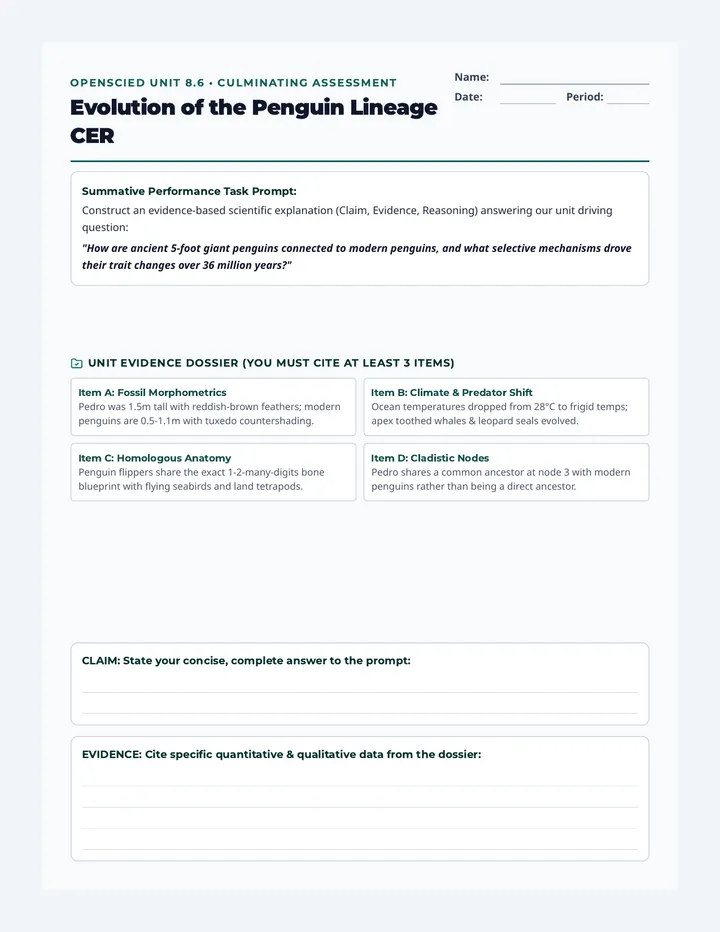
Culminating CER Assessment OpenSciEd Unit 8.6 • Culminating Assessment
Evolution of the Penguin Lineage CER
Name:
Date:
Period:
Summative Performance Task Prompt: Construct an evidence-based scientific explanation (Claim, Evidence, Reasoning) answering our unit driving question: "How are ancient 5-foot giant penguins connected to modern penguins, and what selective mechanisms drove their trait changes over 36 million years?"
Unit Evidence Dossier (You must cite at least 3 items)
Item A: Fossil Morphometrics Pedro was 1.5m tall with reddish-brown feathers; modern penguins are 0.5-1.1m with tuxedo countershading.
Item B: Climate & Predator Shift Ocean temperatures dropped from 28°C to frigid temps; apex toothed whales & leopard seals evolved.
Item C: Homologous Anatomy Penguin flippers share the exact 1-2-many-digits bone blueprint with flying seabirds and land tetrapods.
Item D: Cladistic Nodes Pedro shares a common ancestor at node 3 with modern penguins rather than being a direct ancestor.
CLAIM: State your concise, complete answer to the prompt:
EVIDENCE: Cite specific quantitative & qualitative data from the dossier:
Culminating CER • Page 2
Scientific Reasoning & Analytic Rubric
Evaluation Gate
SCIENTIFIC REASONING: Connect your evidence to natural selection principles (variation, selection pressure, differential reproduction, deep time):
NGSS 4-Level Analytic Assessment Rubric
Dimension 4 - Exceeds 3 - Meets 2 - Developing 1 - Beginning Claim (MS-LS4-1) Defines common ancestry & selective adaptation with precision. Accurately links ancient fossils to modern species. Claim is partially complete or ambiguous. Claim missing or scientifically flawed. Evidence (MS-LS4-2) Synthesizes 3+ quantitative & qualitative dossier facts. Cites 2 clear evidence items with data points. Cites only 1 evidence piece or generalities. No empirical evidence cited. Reasoning (MS-LS4-4) Flawlessly details the 4 pillars of natural selection and deep time. Explains how pressure favored advantageous heritable traits. Contains misconceptions (e.g. voluntary adaptation). Restates evidence without scientific reasoning.