Web of Life Worksheet
Biology Foundations Credit Recovery Ecology • Unit 4
Kami Digital Edition Page 1 of 2
Web of Life: Ecosystems & Energy
Biotic & Abiotic Factors, Food Webs, and Energy Flow
Kami Tip: Highlight key ideas as you read!
Movie Connection (Hoppers): In the movie Hoppers, Mabel explores nature through a robotic beaver. In the wild, beavers act as "ecosystem engineers" that transform dry valleys into vibrant wetlands. Read below to learn how living things and energy connect in an ecosystem!
Key Vocabulary Bank
5 essential terms defined in plain English
Ecosystem
All the living things and non-living elements interacting together in an area.
Producer
An autotroph (plants/algae) that makes its own food using sunlight.
Consumer
A heterotroph (animal) that gets energy by eating other organisms.
Food Web
A network of connected food chains showing how energy flows.
Keystone Species
A species that holds an entire ecosystem together; its loss disrupts the whole habitat.
Introductory Reading: How Energy Flows Through Living Systems
Read passage before answering questions on Page 2
1 Living and Non-Living Parts: Biotic vs. Abiotic Factors
Every ecosystem on Earth is built from two connected parts. Biotic factors are the living or once-living parts of an environment, including trees, beavers, marsh birds, fish, and soil bacteria. Abiotic factors are the non-living physical and chemical parts, such as sunlight, water temperature, soil minerals, rocks, and air. Organisms constantly depend on abiotic factors to survive and grow.
2 Solar Fuel: Producers and Consumers
Almost all energy in ecosystems starts with sunlight. Producers (autotrophs), such as pond algae, grasses, and willow trees, capture sunlight to produce glucose through photosynthesis. Animals cannot make their own food, so they are consumers (heterotrophs). Herbivores eat only plants, carnivores hunt other animals, and omnivores consume both plants and meat. Energy moves upward as one living thing eats another.
3 Single Paths vs. Connected Networks: Food Chains & Food Webs
A food chain shows a single straight line of energy transfer (for example: pond algae → insect → trout → bald eagle). But in real habitats, feeding is rarely a single line. Predators hunt many prey types, and prey are eaten by multiple predators. A food web weaves multiple overlapping food chains together, revealing how an impact on one population ripples across the entire ecosystem.
4 Nature's Architects: Keystone Species & Engineers
Some species have an outsized impact on their habitat. Beavers are classic keystone species and "ecosystem engineers." By cutting trees and building dams, beavers flood streams into rich wetland ponds. These ponds store fresh water, prevent soil erosion, and create homes for ducks, frogs, and fish. When a keystone species is removed, the entire habitat can quickly unravel.
5 The Recycling Crew: Decomposers
When plants shed leaves or animals die, decomposers (such as mushrooms, fungi, and soil microbes) go to work. Decomposers break down dead organic remains, recycling essential nitrogen and phosphorus back into the soil and water. Producers absorb these recycled nutrients, beginning the cycle of life all over again.
Finished reading? Switch to Page 2 and use Kami's Text [T] or Drawing tool to respond. Scroll to Page 2 →
Part 2
Review & Application Questions
Complete digitally using Kami tools (Text Box, Highlighter, or Drawing).
Total Score: _____ / 20
Section A: Multiple Choice (2 pts each • 10 total pts)
Use Kami's Drawing or Highlighter tool to mark your answer
1. Which is an abiotic factor in a beaver pond?
A Water temperature and sunlight
B Willow tree branches and bark
C Microscopic soil bacteria
D Trout swimming in the pond
2. Why are pond algae classified as producers?
A They hunt smaller insects for food
B They make their own food using sunlight
C They break down dead tree logs in mud
D They absorb glucose from consumers
3. How is a food web different from a food chain?
A A food web connects overlapping chains
B A food web only tracks one straight path
C Food chains only contain top predators
D Food webs exclude all producers
4. In Hoppers and nature, beavers are engineers because:
A They migrate across oceans every winter
B They alter the habitat by damming water
C They hunt wolves and birds of prey
D They can survive without abiotic factors
5. What happens if all decomposers are removed?
Consider the recycling of nutrients in soil.
A Plants double their growth
B Dead matter piles & nutrients deplete
C Consumers become producers
D The sun stops radiating energy
Section B: Fill-in-the-Blank (2 pts each • 6 total pts)
Click inside each box with the Kami Text tool [T] to type
Word Bank:
Abiotic Decomposers Herbivore Food Web Producers
A beaver that eats only willow bark, aquatic pond lilies, and green leaves is classified as an .
Non-living environmental factors like water temperature, rocks, and sunlight are called factors.
Organisms like mushrooms and bacteria that break down dead materials to recycle nutrients are called .
Section C: Short Application Prompt (4 points total)
Use the Kami Text tool [T] to type your response
Question 9: Explain what happens to the rest of the food web if a top predator or a keystone species is completely removed from an ecosystem.
Guiding Checklist: (1) What happens to prey/herbivore numbers? (2) How are plants and habitats affected? (3) What is the final effect on biodiversity?
Evaluation Breakdown: Sec A: /10 Sec B: /6 Sec C: /4
Digital Submission via LMS
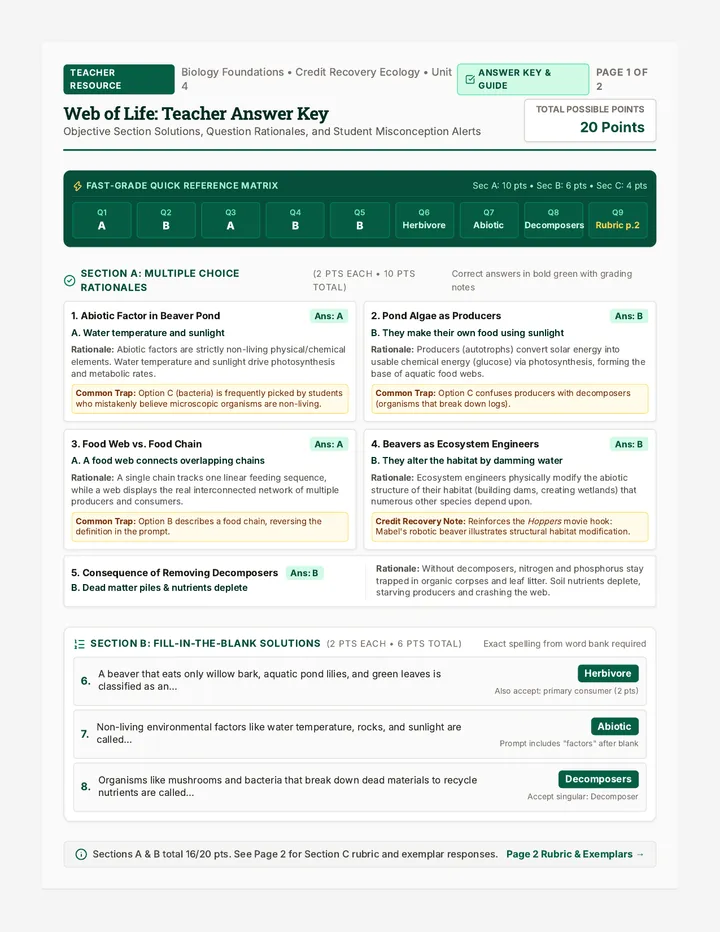
Web of Life Answer Key
Teacher Resource Biology Foundations • Credit Recovery Ecology • Unit 4
Answer Key & Guide Page 1 of 2
Web of Life: Teacher Answer Key
Objective Section Solutions, Question Rationales, and Student Misconception Alerts
Total Possible Points 20 Points
Fast-Grade Quick Reference Matrix Sec A: 10 pts • Sec B: 6 pts • Sec C: 4 pts
Q1 A
Q2 B
Q3 A
Q4 B
Q5 B
Q6 Herbivore
Q7 Abiotic
Q8 Decomposers
Q9 Rubric p.2
Section A: Multiple Choice Rationales (2 pts each • 10 pts total)
Correct answers in bold green with grading notes
1. Abiotic Factor in Beaver Pond Ans: A
A. Water temperature and sunlight
Rationale: Abiotic factors are strictly non-living physical/chemical elements. Water temperature and sunlight drive photosynthesis and metabolic rates.
Common Trap: Option C (bacteria) is frequently picked by students who mistakenly believe microscopic organisms are non-living.
2. Pond Algae as Producers Ans: B
B. They make their own food using sunlight
Rationale: Producers (autotrophs) convert solar energy into usable chemical energy (glucose) via photosynthesis, forming the base of aquatic food webs.
Common Trap: Option C confuses producers with decomposers (organisms that break down logs).
3. Food Web vs. Food Chain Ans: A
A. A food web connects overlapping chains
Rationale: A single chain tracks one linear feeding sequence, while a web displays the real interconnected network of multiple producers and consumers.
Common Trap: Option B describes a food chain, reversing the definition in the prompt.
4. Beavers as Ecosystem Engineers Ans: B
B. They alter the habitat by damming water
Rationale: Ecosystem engineers physically modify the abiotic structure of their habitat (building dams, creating wetlands) that numerous other species depend upon.
Credit Recovery Note: Reinforces the Hoppers movie hook: Mabel's robotic beaver illustrates structural habitat modification.
5. Consequence of Removing Decomposers Ans: B
B. Dead matter piles & nutrients deplete
Rationale: Without decomposers, nitrogen and phosphorus stay trapped in organic corpses and leaf litter. Soil nutrients deplete, starving producers and crashing the web.