Atomic Anatomy Worksheet Grade 8 Science Atom Academy • Practice Sheet 1
Name:
Date:
Period:
Atomic Anatomy
Focus: Matter, fundamental atomic architecture, and subatomic components.
Total: _____ / 15 pts
Word Bank Use each term once
matter
atom
subatomic particle
proton
electron
A
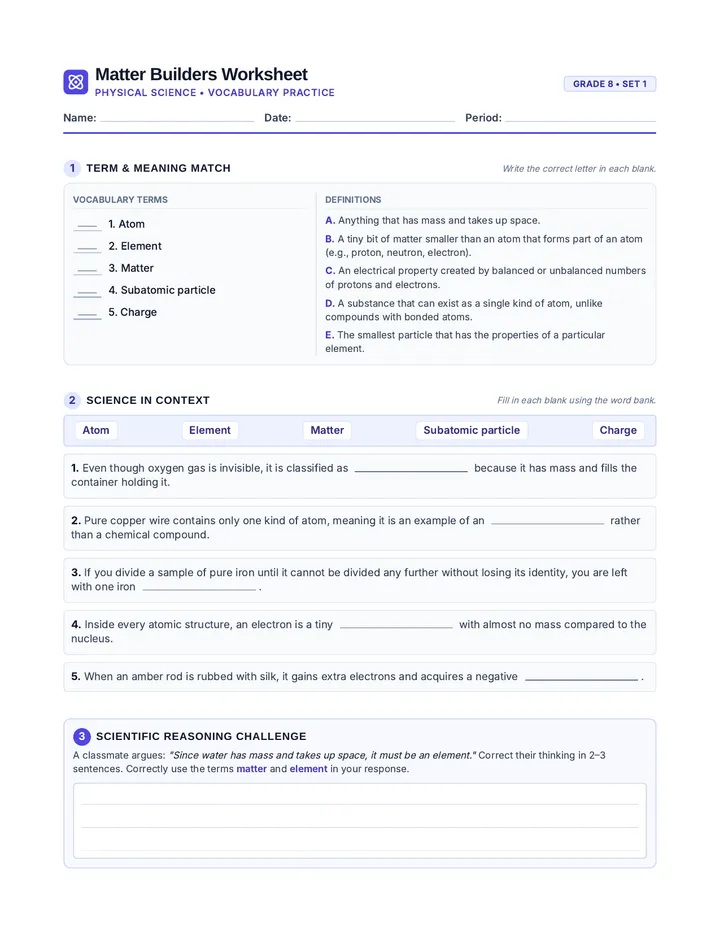
Match the Meaning
Write the letter of the matching definition on the line (5 pts)
matter
atom
subatomic particle
proton
electron
A. The basic unit of a chemical element, consisting of a nucleus and orbiting electrons.
B. A subatomic particle with a negative charge found in the electron cloud outside the nucleus.
C. Anything in the universe that has mass and takes up space (volume).
D. A positively charged particle located in the dense center (nucleus) of an atom.
E. Any structural unit smaller than an atom (such as a proton, neutron, or electron).
B
Context Clues in Action
Fill in each blank with the correct term from the word bank (5 pts)
All physical objects around us, from the water in a flask to the air we breathe, are composed of because they possess mass and occupy space.
If you cut a sheet of pure gold into microscopic pieces, the smallest indivisible piece that still behaves chemically like gold is a single gold .
Physicists use particle colliders to smash atoms apart so they can observe each tiny that makes up the nucleus.
Every hydrogen atom in the universe contains exactly one positively charged residing at the center of its nucleus.
When static electricity forms from rubbing a balloon on hair, tiny negatively charged particles transfer from hair strands to the rubber surface.
C
Contextual Application & Explanation
Construct a scientific explanation (5 pts)
Explain how an atom is structured. In your response, clearly describe where each subatomic particle (specifically the proton and electron ) is located and how they contribute to matter :
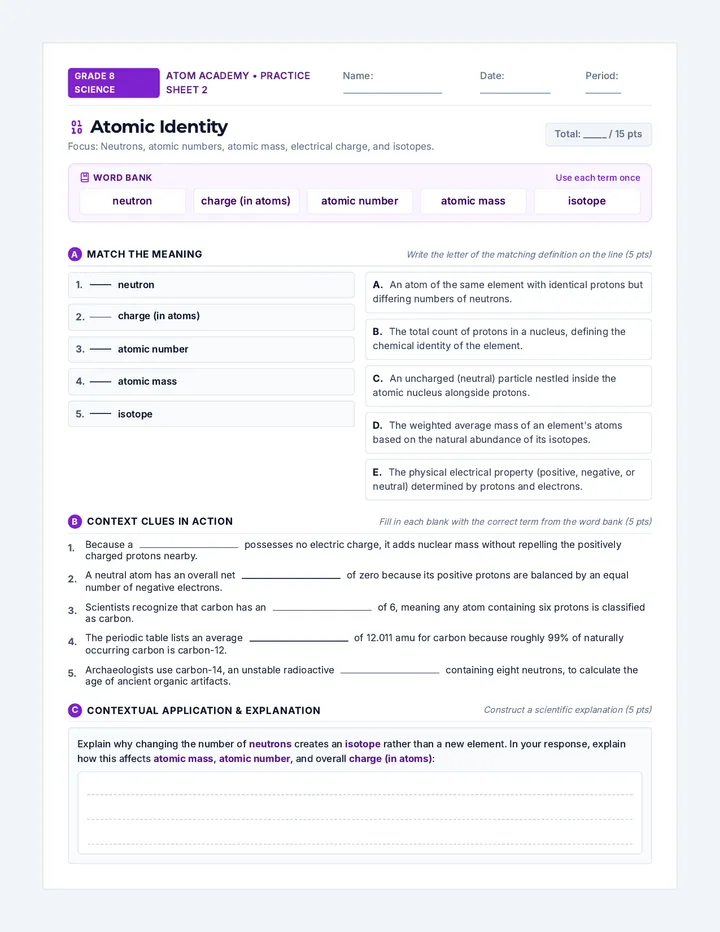
Atomic Identity Worksheet Grade 8 Science Atom Academy • Practice Sheet 2
Name:
Date:
Period:
Atomic Identity
Focus: Neutrons, atomic numbers, atomic mass, electrical charge, and isotopes.
Total: _____ / 15 pts
Word Bank Use each term once
neutron
charge (in atoms)
atomic number
atomic mass
isotope
A
Match the Meaning
Write the letter of the matching definition on the line (5 pts)
neutron
charge (in atoms)
atomic number
atomic mass
isotope
A. An atom of the same element with identical protons but differing numbers of neutrons.
B. The total count of protons in a nucleus, defining the chemical identity of the element.
C. An uncharged (neutral) particle nestled inside the atomic nucleus alongside protons.
D. The weighted average mass of an element's atoms based on the natural abundance of its isotopes.
E. The physical electrical property (positive, negative, or neutral) determined by protons and electrons.
B
Context Clues in Action
Fill in each blank with the correct term from the word bank (5 pts)
Because a possesses no electric charge, it adds nuclear mass without repelling the positively charged protons nearby.
A neutral atom has an overall net of zero because its positive protons are balanced by an equal number of negative electrons.
Scientists recognize that carbon has an of 6, meaning any atom containing six protons is classified as carbon.
The periodic table lists an average of 12.011 amu for carbon because roughly 99% of naturally occurring carbon is carbon-12.
Archaeologists use carbon-14, an unstable radioactive containing eight neutrons, to calculate the age of ancient organic artifacts.
C
Contextual Application & Explanation
Construct a scientific explanation (5 pts)
Explain why changing the number of neutrons creates an isotope rather than a new element. In your response, explain how this affects
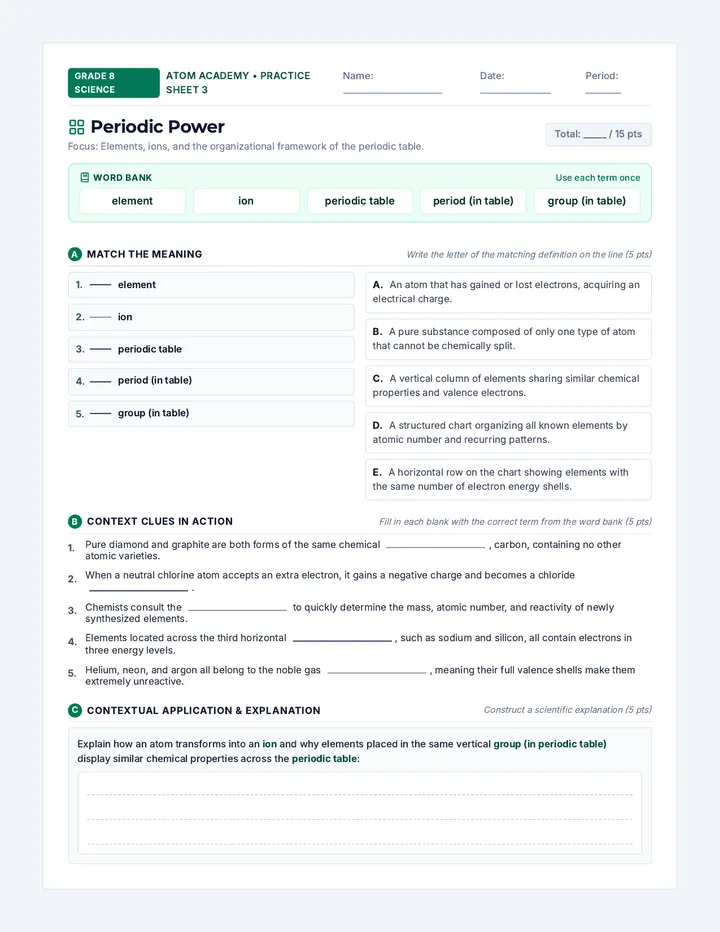
Periodic Power Worksheet Grade 8 Science Atom Academy • Practice Sheet 3
Name:
Date:
Period:
Periodic Power
Focus: Elements, ions, and the organizational framework of the periodic table.
Total: _____ / 15 pts
Word Bank Use each term once
element
ion
periodic table
period (in table)
group (in table)
A
Match the Meaning
Write the letter of the matching definition on the line (5 pts)
element
ion
periodic table
period (in table)
group (in table)
A. An atom that has gained or lost electrons, acquiring an electrical charge.
B. A pure substance composed of only one type of atom that cannot be chemically split.
C. A vertical column of elements sharing similar chemical properties and valence electrons.
D. A structured chart organizing all known elements by atomic number and recurring patterns.
E. A horizontal row on the chart showing elements with the same number of electron energy shells.
B
Context Clues in Action
Fill in each blank with the correct term from the word bank (5 pts)
Pure diamond and graphite are both forms of the same chemical , carbon, containing no other atomic varieties.
When a neutral chlorine atom accepts an extra electron, it gains a negative charge and becomes a chloride .
Chemists consult the to quickly determine the mass, atomic number, and reactivity of newly synthesized elements.
Elements located across the third horizontal , such as sodium and silicon, all contain electrons in three energy levels.
Helium, neon, and argon all belong to the noble gas , meaning their full valence shells make them extremely unreactive.
C
Contextual Application & Explanation
Construct a scientific explanation (5 pts)
Explain how an atom transforms into an ion and why elements placed in the same vertical group (in periodic table) display similar chemical properties across the