Syllogisms, deductive validity, and the principles of inductive probability for evaluating evidence-based claims. Targets common logical fallacies and the construction of sound, persuasive arguments.
An interactive slide deck focusing on part-whole and part-part analogies for seventh graders, emphasizing the strategy of formulating the relationship before viewing multiple-choice options.
A highly condensed and academically rigorous pacing plan and gifted student adaptation guide for Amplify ELA Grade 6 Unit 6B. It compresses the 32 original lessons into a streamlined 24-25 day calendar designed specifically for high-ability fifth graders.
A foundational language and logic lesson for first graders to master the concept of negation ('not') through playful categorization activities.
An immersive, high-energy introductory hook lesson for Charming as a Verb that engages rising 10th-grade summer school students through NYC hustle culture, the social psychology of 'charm', and an author interview on performance anxiety and self-belief.
A complete 9th-grade English Language Arts STAAR prep lesson focused on analyzing the characteristics and structural elements of argumentative texts. It includes high-impact graphic organizers for concept mapping and target-text analysis alongside a high-interest practice passage with margin-notated questions.
An introductory hook lesson for Charming as a Verb that leverages the author's background, Haiti-to-NYC immigrant perspective, and satirical writing style to engage rising 10th graders in low-stakes, active learning stations and discussion.
An end-of-year ELA creative writing project where students act as narrative architects to outline, scaffold with sentence starters, and draft their very own original story.
A complete history webquest lesson bundle designed for late elementary students to independently research diverse historical figures. Students act as research detectives to discover the lives, struggles, and lasting legacies of inventors, activists, and leaders.
An English listening and speaking lesson where students analyze a crime news broadcast, practice using past simple and past continuous, and debate the ethics of citizen intervention.
Students explore principles of visual design, contrast, and visual hierarchy to design and sketch an advocacy poster that supports their persuasive argument.
Students translate their scientific evidence into a structured, persuasive editorial or proposal, mastering rhetorical appeals and learning to counter opposing viewpoints.
Students investigate the science of light pollution, explore its ecological effects on wildlife and human health, and analyze real-world data to formulate their core argumentative thesis.
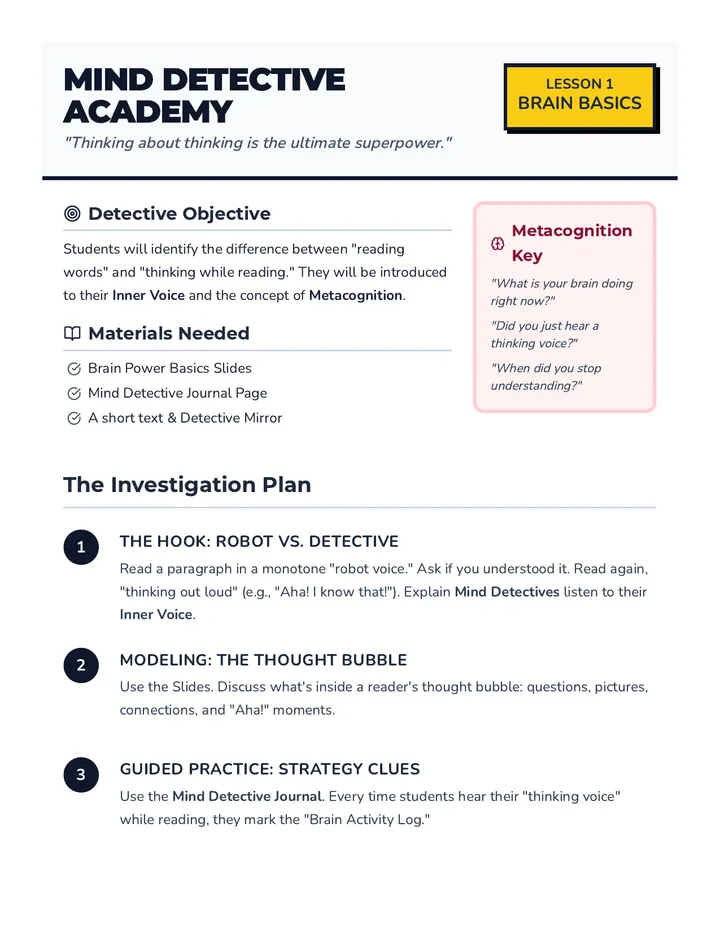
A 12-lesson comprehension mastery program focused on metacognition, reasoning, and evidence-based thinking. Students progress from basic thinking awareness to complex deductive reasoning and synthesis. Inspired by Reading Detective and Comprehension Connections.
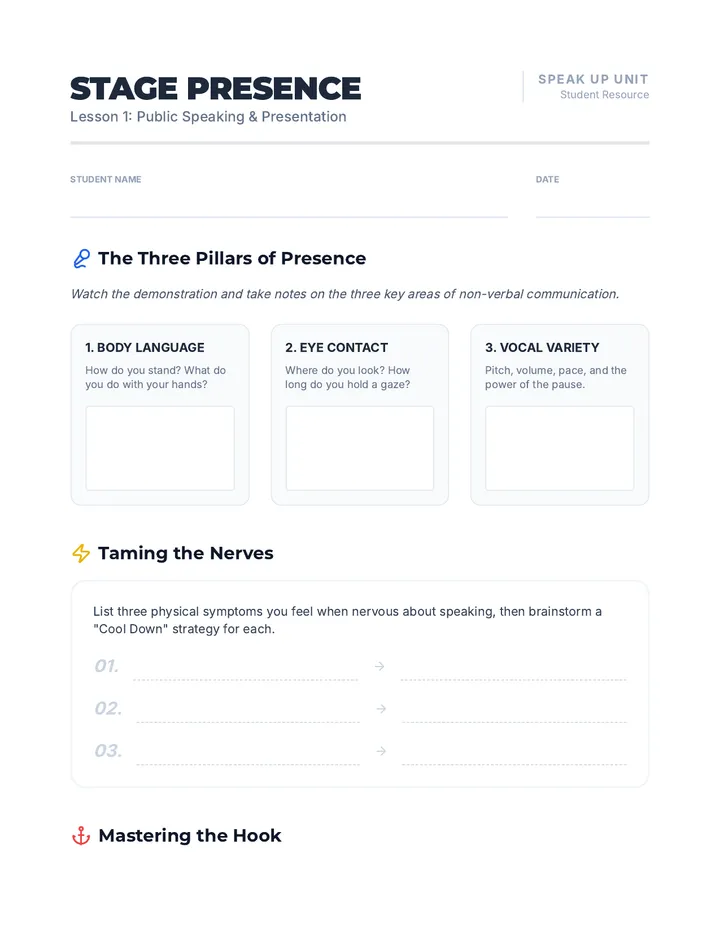
A comprehensive 5-day introductory unit on speech and debate, covering public speaking, argumentation, logic, research, and competitive formats.
A graduate-level sequence focused on integrating deductive, inductive, and analogical reasoning into a cohesive defensive strategy for academic and professional contexts.
A high-intensity vocabulary sequence for 10th graders focusing on the logic of analogies. Students progress from basic pattern recognition to designing their own complex logic puzzles, treating language as a series of solvable equations.
A 12th-grade ELA unit focused on the logical sequencing of ideas within dense informational texts and complex arguments. Students analyze how the ordering of premises and evidence determines the validity and rhetorical impact of a text.
A high-level bridging of English Language Arts and formal logic, focusing on the structural patterns of reasoning through analogies. Students move from basic symbolic notation to complex deductive puzzles, treating language with mathematical precision.
A 9th-grade English Language Arts sequence that bridges formal logic with argumentative writing. Students learn to use valid argument forms like Modus Ponens, Modus Tollens, and Hypothetical Syllogisms as structural blueprints for high-quality, undeniable writing.
A foundational sequence for 9th-grade students on the structures of deductive reasoning, focusing on categorical syllogisms, validity, and soundness to enhance critical thinking and analytical writing.
A high-level ELA unit for 11th graders that bridges formal logic and argumentative writing. Students move from identifying hidden premises (enthymemes) to constructing complex essays built on valid deductive frameworks like Modus Ponens and Modus Tollens.
A comprehensive 11th Grade ELA sequence on formal logic, focusing on identifying structural fallacies (Affirming the Consequent, Denying the Antecedent, Undistributed Middle) and repairing invalid arguments. Students act as 'logic doctors' to diagnose and fix flawed reasoning in various rhetorical contexts.
A high-school ELA sequence that treats argumentative writing like geometric proofs, focusing on formal logic structures like axioms, modus ponens, and proofs by contradiction to build unassailable positions.
A professional, teacher-facing pacing guide and gifted adaptation planner for Amplify ELA Grade 6 Unit 6B. Compresses the 32-day curriculum into an academically rigorous 24-25 day calendar designed for high-ability fifth graders.
A 2-page complete teacher answer key and facilitation guide providing exact fill-in-the-blank answers, sample student text-evidence sentences, and answers for task cards 1-12.
A 3-page print-ready sheet containing 12 differentiated task cards (Bronze, Silver, Gold levels) based on 8th-grade historical and literary scenarios, featuring dashed cutting borders, clear icons, and structured task boxes.
A 2-page student interactive guided notes packet featuring cloze passages, tool check-lists, a visual analysis practice based on the gym bag prompt, and two textual analysis case studies with specific text evidence lines.
A 2-page print-ready teacher answer key and instructional facilitation guide. It provides exemplary student responses, transition questions to prompt deeper thinking, and a grading rubric for Case Files 1, 2, and 3.
A 2-page print-ready student worksheet featuring 1 guided and 2 independent scenarios applying the Fact -> So What? -> Therefore inference strategy. Includes visual strategy summaries and clear, lined response boxes with minimal scaffolding.
A teacher's guide and answer key for the Clue Hunter lesson. It includes instructional strategies, sample student responses for the worksheet, and discussion prompts to deepen understanding of non-fiction inference.
A 2-page detective-themed worksheet where students analyze three non-fiction snippets. They must identify specific text clues and combine them with prior knowledge to draw a logical conclusion for each case.
A 6-slide presentation for a mini-lesson on drawing conclusions from non-fiction. It introduces a detective-themed framework, a simple equation for inference, and provides two guided case studies for class discussion.
A teacher's guide on helping ELL students avoid the "literal trap" and master implicit meaning questions on the ELA Regents.
A presentation deck explaining the concept of inference (implicit meaning) using specific examples from the June and August 2025 ELA Regents exams.
Teacher answer key and rationale guide for the Inference Detectives worksheet.