Lenny.com
Explore
Create
ActivitiesNewMathEnglish Language ArtsScience & EngineeringSocial StudiesGlobal LanguagesHealth & Physical EducationSpecial EducationCounseling & Life SkillsArts & CreativityESL
Lenny.com
Lenny.com
Explore
Create
ActivitiesNewMathEnglish Language ArtsScience & EngineeringSocial StudiesGlobal LanguagesHealth & Physical EducationSpecial EducationCounseling & Life SkillsArts & CreativityESL
Lenny.com
Lenny.com

Solutions

Lenny for EducatorsLenny for SchoolsLenny for Districts

Product

ExploreSign inCreateSupportAbout

Resources

Getting startedMTSS Acceleration Program

© 2026 Lenny Learning Inc.

TermsPrivacyAccessibility
LinkedInInstagramX
Lenny

Sentence Variety

Structural integration of simple, compound, and complex sentence types. Builds skills in varying sentence openers, lengths, and transitions to improve writing rhythm and clarity.

English Language ArtsPhonics & Reading FoundationsLetter IdentificationLearn Letters A-ZLowercase and Uppercase LettersConsonants and VowelsLetter-Sound AssociationsLetter-Sound Associations: LowercaseLetter-Sound Associations: UppercaseBeginning and Ending SoundsRhymingBlending And SegmentingShort VowelsShort Vowel SoundsConsonant BlendsConsonant DigraphsBlends, Digraphs, and TrigraphsDigraphs, Blends, and Silent LettersLong Vowel SoundsLong Vowel PatternsShort and Long VowelsShort and Long Vowel PatternsSilent EVowel SoundsVowel TeamsR-Controlled VowelsDiphthongs: Oi, Oy, Ou, OwVariant VowelsVariant, Diphthong, And R Vowel PatternsSoft G And CSight WordsIrregular WordsWord RecognitionSyllablesSyllable TypesTwo-Syllable WordsMultisyllabic WordsPhoneme ManipulationDecodable TextsVocabularyAction WordsQuestion WordsNouns and AdjectivesClassify WordsCompound WordsSynonyms and AntonymsHomophonesHomophones and HomonymsShades of MeaningContext CluesPrefixes and SuffixesGreek and Latin RootsAnalogiesIdioms and AdagesForeign Words and ExpressionsWord Choice and UsageReference SkillsReading ComprehensionRead-Along Literary TextsRead-Along Informational TextsReality vs. FictionStory ElementsCharacterSequenceMain IdeaCause And EffectCompare And ContrastReading StrategiesText StructureAuthor's PurposeAuthor's Purpose And ToneAuthor's PerspectivePoint Of ViewThemeInference And ThemeInference And AnalysisPoetry ElementsLiterary DevicesAnalyzing LiteratureAnalyzing Informational TextsComparing TextsAudience, Purpose, And ToneBusiness DocumentsNovel StudyNonfiction Book StudyGrammar & MechanicsSentencesNounsVerbsAdjectivesPronounsCapitalizationPunctuationContractionsConjunctionsPrepositionsArticlesAdjectives And AdverbsVerb TypesVerb TensePronouns And AntecedentsPronoun TypesSubject-Verb AgreementDirect And Indirect ObjectsSentences, Fragments, And Run-OnsPhrases And ClausesCommasSemicolons, Colons, And CommasDashes, Hyphens, And EllipsesSpellingAbbreviationsFormattingVerb Tense And MoodMisplaced ModifiersWritingDescriptive DetailsCreative WritingOpinion WritingTopic SentencesOrganizing WritingLinking WordsSentence VarietyIntroductions And ConclusionsPersuasive And Opinion WritingExpository WritingPersuasive StrategiesDeveloping And Supporting ArgumentsTopic Sentences And Thesis StatementsSummarizingResearch SkillsEditing And RevisingActive And Passive Voice=Writing Clearly And ConciselyDebate & Public SpeakingPublic Speaking BasicsPersuasive TechniquesClaims and EvidenceTypes of ArgumentsReasoning TypesLogical FallaciesTopic ResearchOrganizing EvidenceDebate Speech OrganizationAttacking and Defending ArgumentsClash and EngagementImpact CalculusQuestioning and Cross-ExaminationCritical ThinkingInformal LogicFormal LogicInductive Reasoning

Videos

Understanding Simple and Compound Sentences

Understanding Simple and Compound Sentences

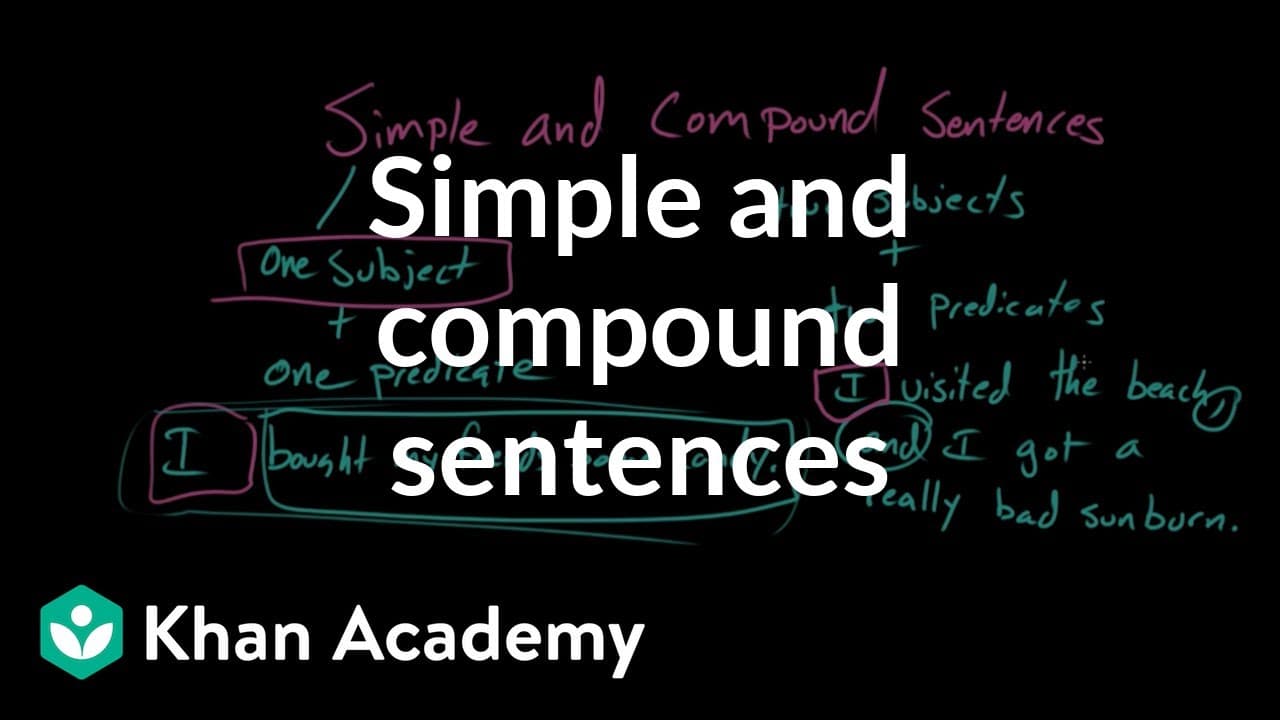
In this engaging grammar tutorial, David and Paige explain the structural differences between simple and compound sentences. Using a digital whiteboard, they break down the core components of sentence construction, defining a simple sentence as consisting of a single subject and predicate, while a compound sentence combines two or more independent clauses joined by a conjunction. The video dives into technical grammar terminology in an accessible way, introducing concepts like "independent clauses" and "predicates." A significant portion of the video is dedicated to a common point of confusion: the difference between a compound sentence (two complete thoughts joined together) and a simple sentence with a compound predicate (one subject doing two things). Through specific examples about buying candy and getting sunburned, the narrators visually diagram these differences. For educators, this resource serves as an excellent tool for improving student writing fluency. It moves beyond basic definitions to help students understand sentence variety and the mechanics of combining ideas. The visual diagramming of subjects and predicates provides a clear model for students to analyze their own writing, making it particularly useful for lessons on syntax, editing, and avoiding run-on sentences.

Khan AcademyKhan Academy

4mins 29s

How to Build Better Sentences with Prepositional Phrases

How to Build Better Sentences with Prepositional Phrases

This educational video provides a clear and structured guide to understanding and using prepositional phrases to enhance sentence complexity. It begins by reviewing the basic building blocks of a complete sentence—the subject and the predicate—using the example "Superman caught the robber." The video then identifies a problem: simple sentences often lack specific details. To solve this, the narrator introduces prepositional phrases as tools to provide essential information about time, place, direction, and detail. Key themes include the definition and function of prepositions (words positioned "before" an object), the structure of a prepositional phrase (preposition + object), and the distinction between prepositions of time (e.g., "after," "during") and place (e.g., "behind," "under"). The video categorizes how these phrases function, showing examples of location, direction, time reference, and adding specific details. It emphasizes that a prepositional phrase never stands alone but works to modify the main sentence. For educators, this video is an excellent resource for bridging the gap between simple sentence construction and more descriptive writing. It features guided practice sessions where viewers pause to identify appropriate phrases to answer "when" and "where" questions. This makes it particularly useful for writing workshops focused on "expanding sentences" or grammar units dedicated to parts of speech. The visual style, utilizing hand-drawn text and cartoons on a green screen, helps visual learners deconstruct sentence parts effectively.
GrammarSongs by MelissaGrammarSongs by Melissa

6mins 26s

How and When to Use Dashes in Writing

How and When to Use Dashes in Writing

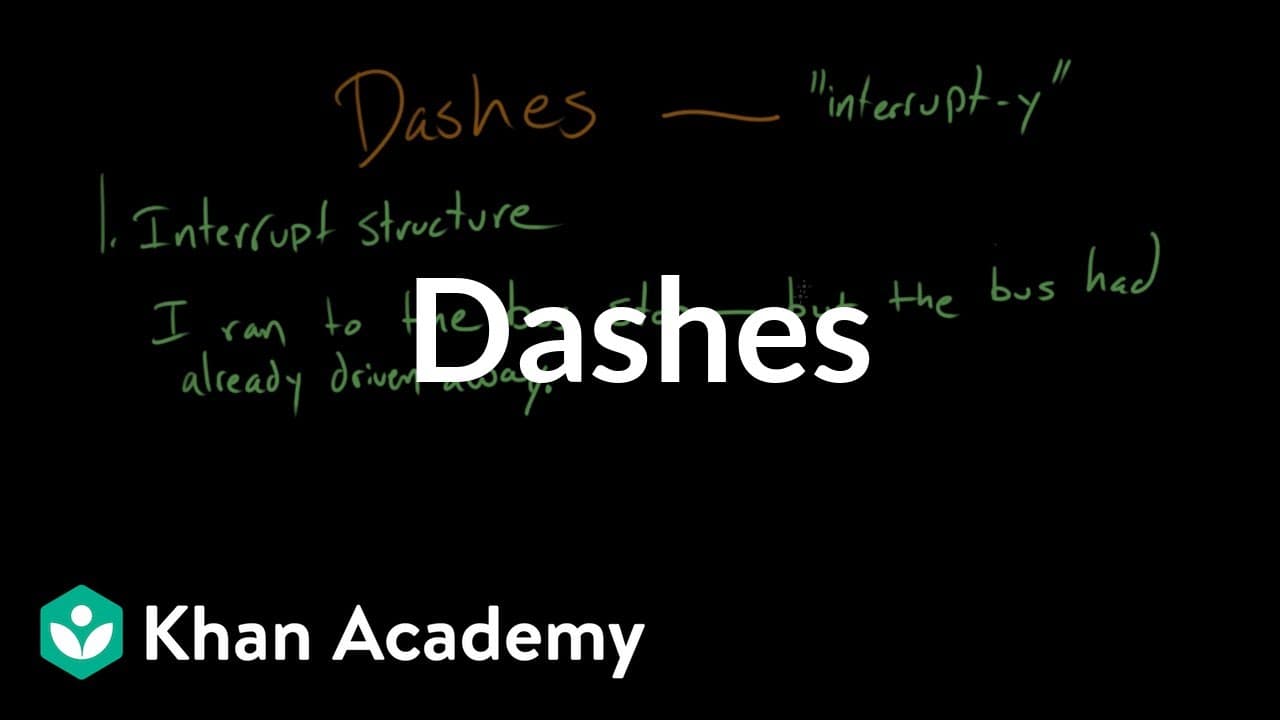
In this engaging grammar tutorial, Khan Academy educators David and Paige explore the versatile world of dashes. The video clearly distinguishes the dash from the hyphen and outlines its four primary functions in English writing: marking interruptions in sentence structure, acting as parenthetical pairs, serving as a substitute for a colon to introduce ideas, and indicating abrupt interruptions in speech. through handwritten examples and conversational dialogue, the hosts demonstrate how dashes can change the "flavor" or pacing of a sentence compared to other punctuation marks. Key themes include the nuance of punctuation, sentence structure, and the stylistic choices writers make. The video introduces the concept of the dash as a dramatic "actor" that can perform the roles of commas, parentheses, and colons, but with a more emphatic or abrupt tone. It also touches briefly on formatting conventions, such as spacing rules according to style guides like the Chicago Manual of Style. This video is highly valuable for English Language Arts classrooms as it moves beyond basic punctuation rules to discuss style and voice. It provides clear, concrete examples that help students understand not just *how* to use a dash, but *why* they might choose it over other options to create specific effects like suspense, emphasis, or naturalistic dialogue. It is an excellent resource for refining student writing and encouraging more complex sentence structures.

Khan AcademyKhan Academy

6mins 20s

How Subordinating Conjunctions Connect Independent and Dependent Clauses

How Subordinating Conjunctions Connect Independent and Dependent Clauses

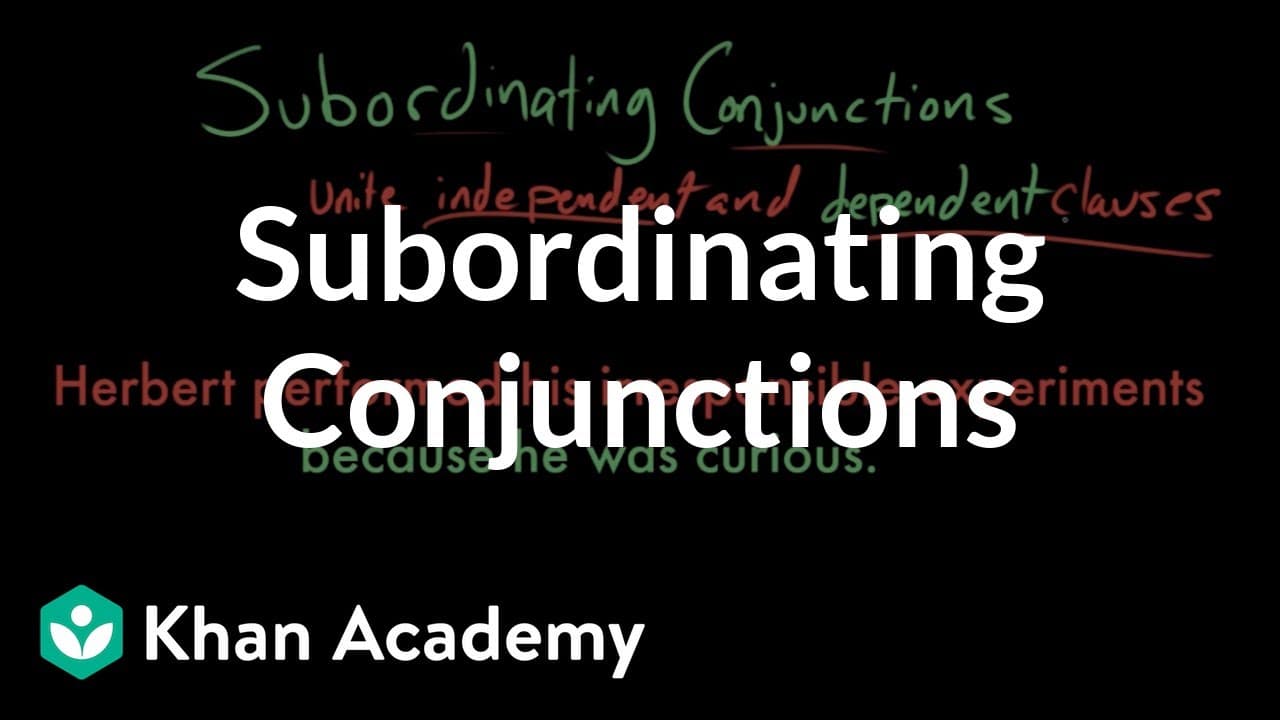
This educational video provides a clear and comprehensive introduction to subordinating conjunctions and their role in sentence structure. The narrator breaks down the fundamental difference between independent and dependent clauses, explaining that while all sentences are clauses, not all clauses are sentences. Using the helpful analogy of a tree (independent clause) and a ladder (dependent clause), the video demonstrates how subordinating conjunctions function to connect these two types of clauses to add context and detail to writing. The content covers key grammatical concepts including the definition of a clause (subject plus verb), the identifying features of sentence fragments, and the distinction between coordinating conjunctions (FANBOYS) and subordinating conjunctions. Through humorous example sentences involving characters like Herbert and Sir Reginald, viewers learn practical tests—such as the "Yeah? So what?" test—to identify dependent clauses and determine if a sentence is grammatically complete. For educators, this video is an excellent resource for teaching complex sentence structure and helping students avoid sentence fragments. It simplifies abstract grammatical terms into tangible concepts using visual aids and memorable analogies. The video concludes with a comprehensive list of common subordinating conjunctions, making it a useful reference tool for students looking to add variety and sophistication to their writing.

Khan AcademyKhan Academy

5mins 27s

Mastering Parallel Structure in Writing

Mastering Parallel Structure in Writing

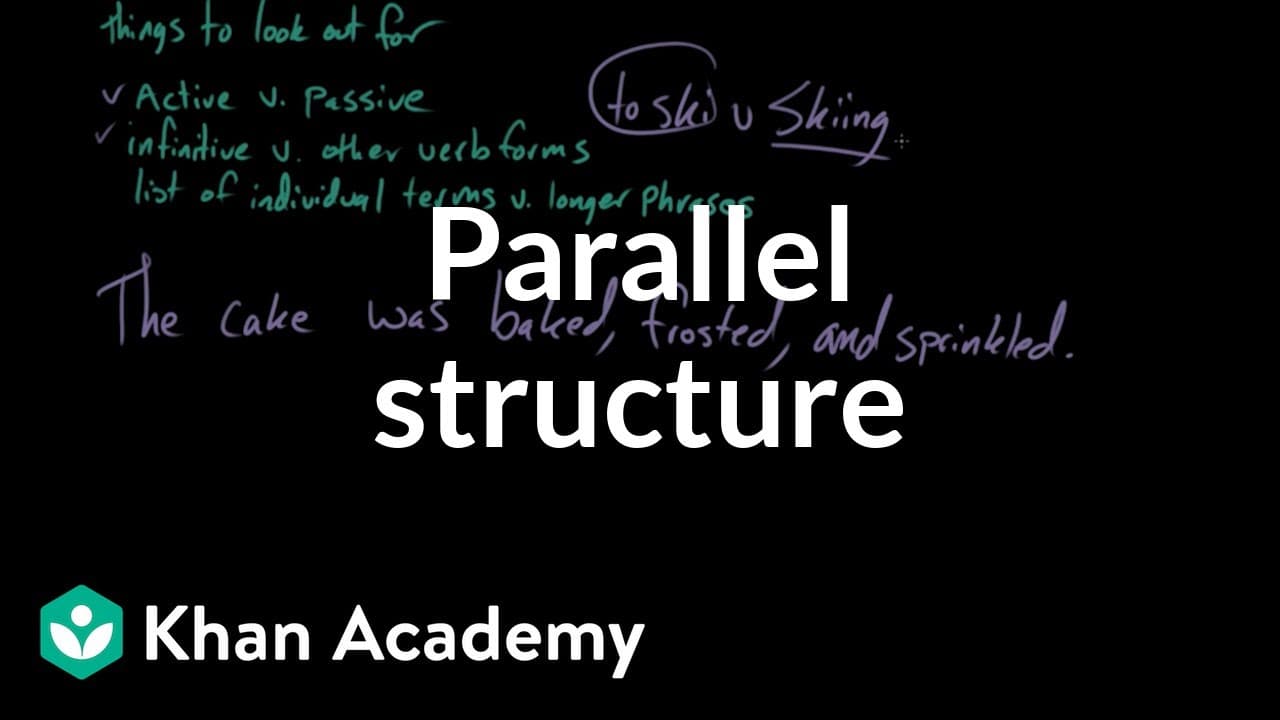
This educational video provides a clear and engaging guide to understanding parallel structure in writing. Hosted by David, Rosie, and Paige, the lesson distinguishes parallel structure as a stylistic choice rather than a strict grammatical rule, emphasizing how it creates harmony and flow in sentences. Through handwritten visual examples on a blackboard, the instructors demonstrate how to align items in a list—whether they are nouns, verbs, or phrases—to ensure they match in form.

Khan AcademyKhan Academy

5mins 5s

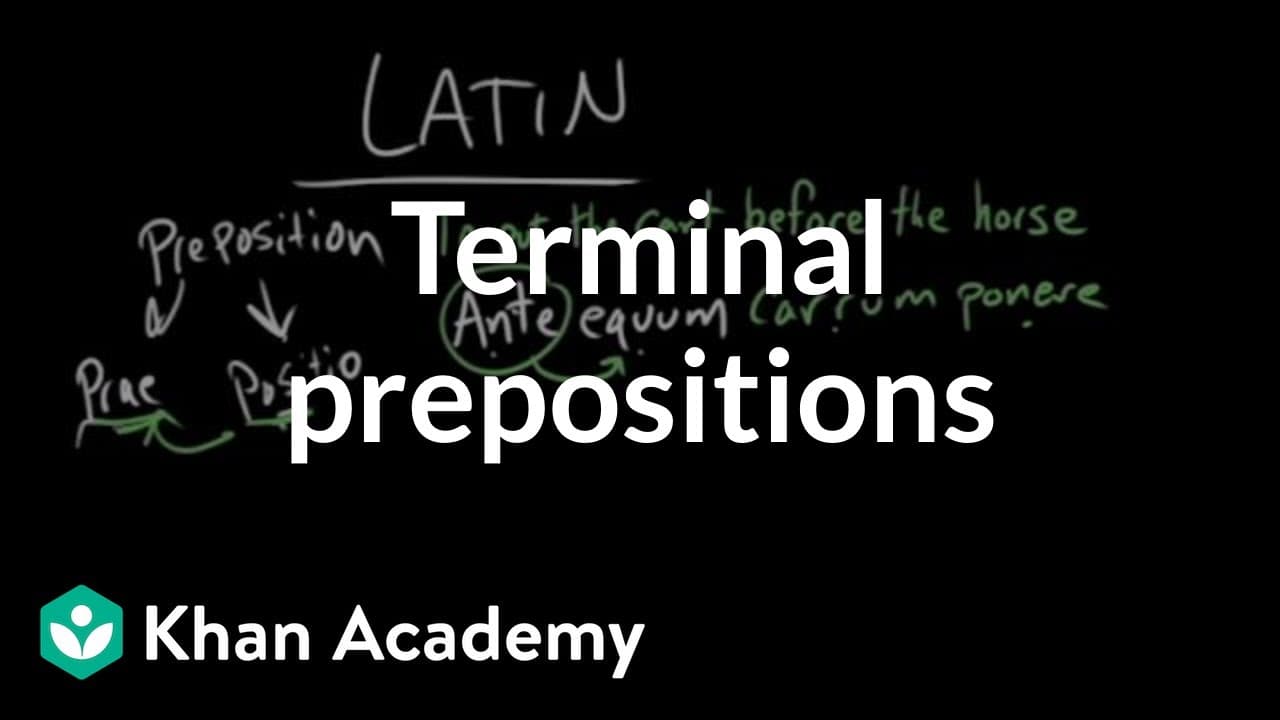
Why Ending Sentences with Prepositions Is Actually Okay

Why Ending Sentences with Prepositions Is Actually Okay

This engaging video debunks the persistent grammar myth that ending a sentence with a preposition is incorrect. Through a blend of linguistic history and humor, the narrator explains that this rule is actually a stylistic preference rather than a grammatical necessity, tracing its origins back to 18th-century attempts to force English to behave like Latin. The video explores the history of the English language, highlighting the influence of Bishop Robert Lowth and the "Latinization" of English grammar rules. It uses clear examples to demonstrate how avoiding terminal prepositions often leads to awkward, unnatural phrasing, famously illustrated by a quote attributed to Winston Churchill regarding "up with which I will not put." For educators, this resource serves as an excellent tool for teaching the difference between grammar and style, the history of the English language, and the importance of natural syntax. It encourages students to think critically about language rules and empowers them to write with greater clarity and confidence, moving away from archaic prescriptions that don't fit the Germanic roots of English.

Khan AcademyKhan Academy

6mins 44s

Materials

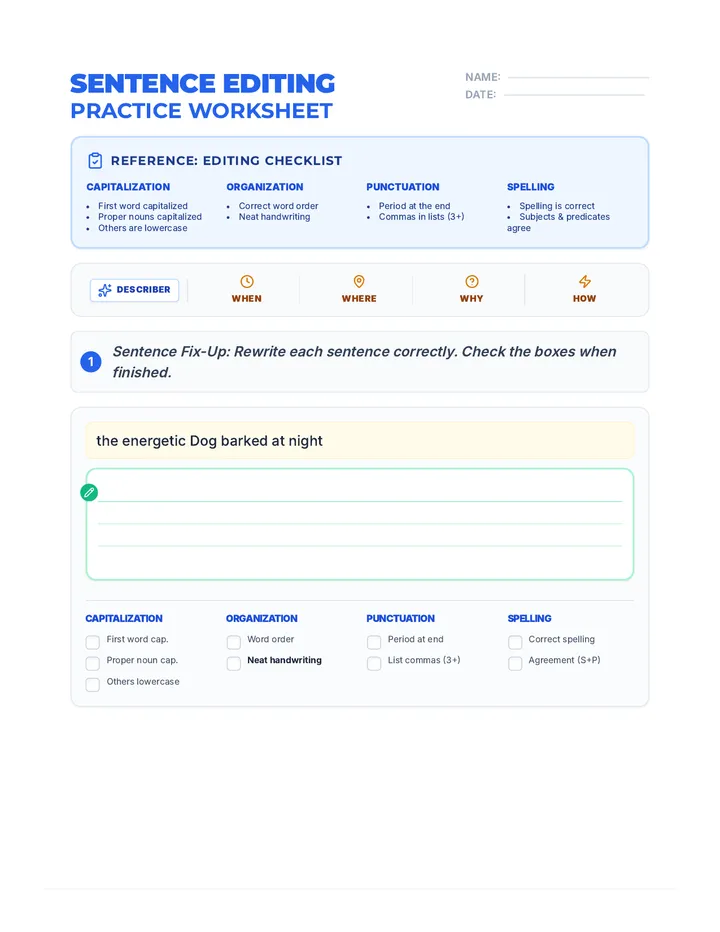
Sentence Editing Practice Worksheet

Sentence Editing Practice Worksheet

An extensive 6-page worksheet for sentence building and correction. Features an editing checklist for review at the top of Page 1, followed by four 'Sentence Fix-Up' items and six complex frames. All tasks include 4 handwriting lines and a standardized checklist with increased font sizes for better legibility. Subtitle removed and font sizes polished for classroom use.

EV

Erin Venuti

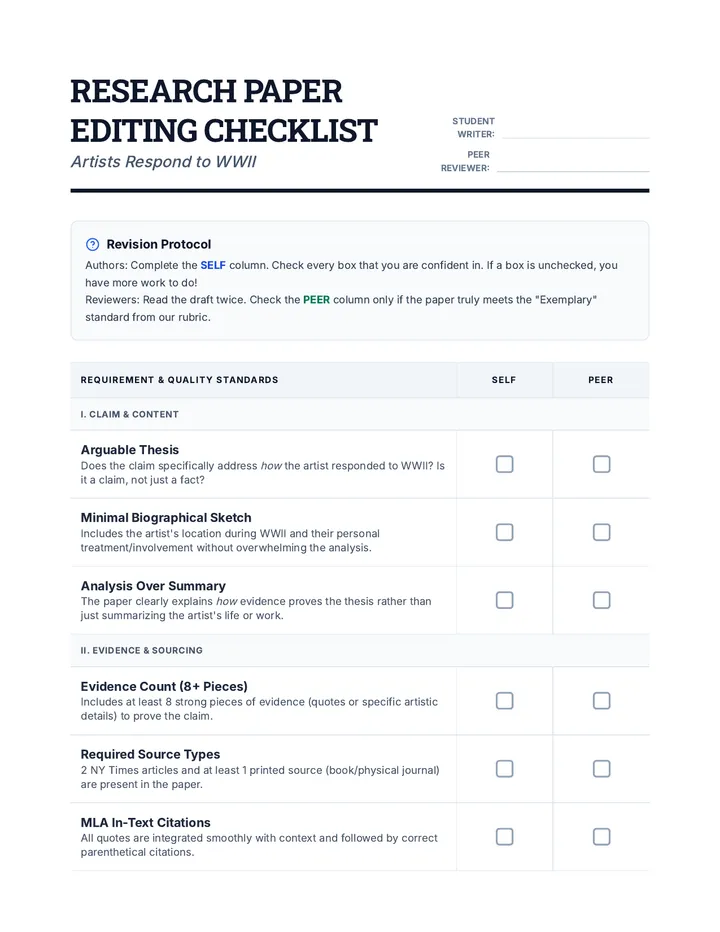
Research Paper Editing Checklist

Research Paper Editing Checklist

A comprehensive self and peer editing checklist for the WWII Artists research paper. The "MLA Format & Length" requirement has been updated to specify that 6 sources are required for the standard research paper.

F

fgraham

Style Sculptor Writing Handout

Style Sculptor Writing Handout

A beautifully formatted, printable 2-page student worksheet designed to teach sentence variety and vocabulary elevation. It breaks down the user's draft as a diagnostic case study, provides stylistic tools (such as inverted conditionals and subordinating openers), shows a fully polished version of the user's paragraph, and concludes with a clean practice workspace.

A

ALees

War Canvas Checklist Document

War Canvas Checklist Document

A comprehensive self and peer editing checklist for the WWII Artists research paper, featuring standard requirements, an Honors-specific section, and targeted feedback areas aligned with the project rubric. Updated for consistency in terminology (using 'claim' instead of 'argument').

F

fgraham

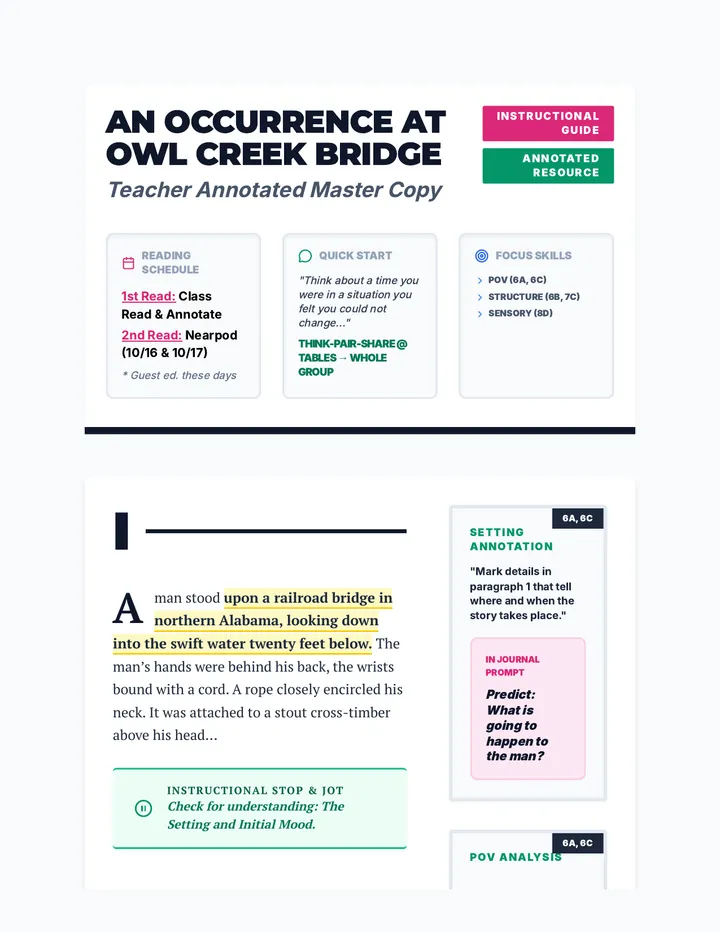
Owl Creek Teacher Copy

Owl Creek Teacher Copy

A comprehensive annotated teacher copy of Ambrose Bierce's "An Occurrence at Owl Creek Bridge." This material includes instructional strategies, chunked text indicators, teacher sidebars with specific discussion questions, and a planning guide for an Extended Constructed Response (ECR).

LF

Lindsey Foulks

ELD Five Academic Syllabus Handout

ELD Five Academic Syllabus Handout

A clean, professional 2-page Word document-style High School ELD 5 syllabus. Features the 4 Key Language Uses, explicit writing expansion strategies, course expectations, grading policy, and student agreement in a clean, print-friendly layout.

Sequences

Lesson Plan 1 Introduction

Literary Device Detectives

A comprehensive multi-unit sequence for 3rd and 4th grade students covering key literary devices: Introduction to Figurative Language, Onomatopoeia, Similes, Metaphors, Personification, and Idioms. Each unit provides 5 lesson plans, interactive notebook resources, and a wide variety of activities and stories designed to improve descriptive writing and reading comprehension.

JS

Janette Sullivan

105
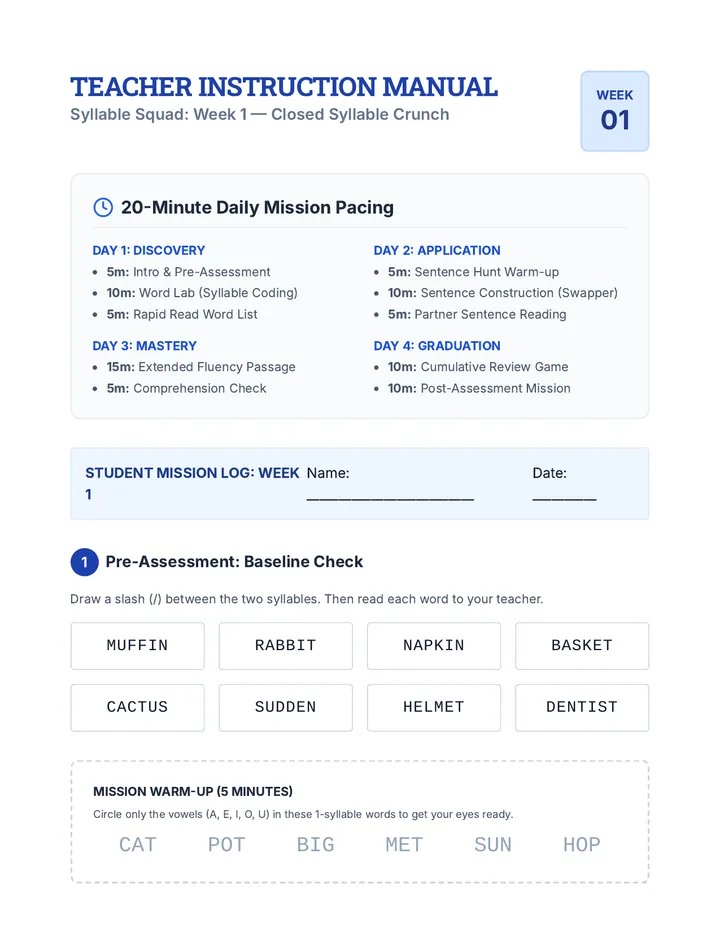
Week 1 Closed Syllable Manual

Syllable Squad Decoding Mission

A comprehensive 5-week phonics intervention focused on decoding two-syllable words across five major syllable types. Each week includes a pre-assessment, daily lessons with specific targets, student practice sheets, and a post-assessment.

KJ

Kelsey Jacobs

29
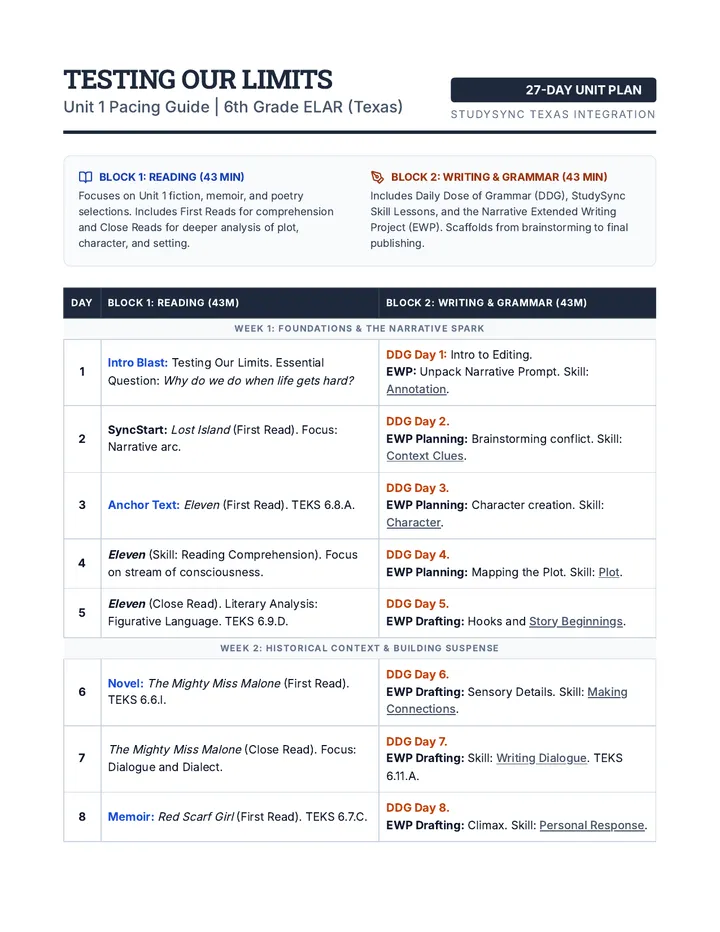
Unit 1 Pacing Guide Document

Testing Our Limits Unit Sequence

A 27-day instructional sequence for 6th Grade ELAR Unit 1: Testing Our Limits, featuring dual blocks for Reading and Writing with daily grammar and skill scaffolding.

DM

Dawn Mustian

81
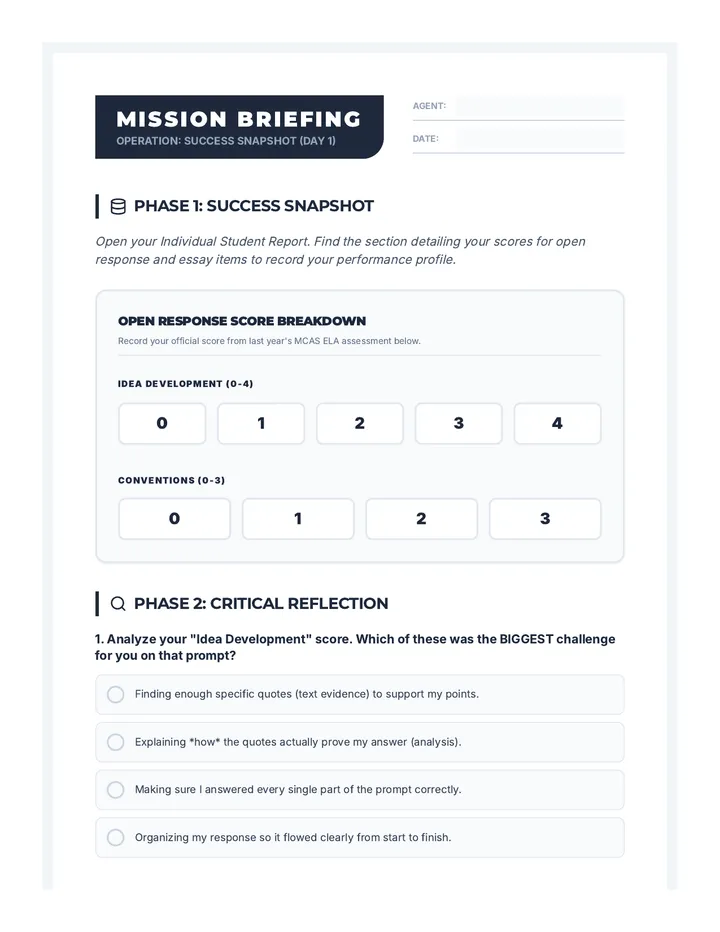
Mission Briefing Worksheet

Mastery Mission

A project-based learning unit designed to help middle school students analyze their past MCAS ELA performance, deconstruct scoring rubrics, and create a personalized strategy playbook for upcoming assessments. Students move from 'investigating' their scores to 'rebooting' their responses and 'finalizing' their test-taking toolkit.

M

mhbutterworth

18
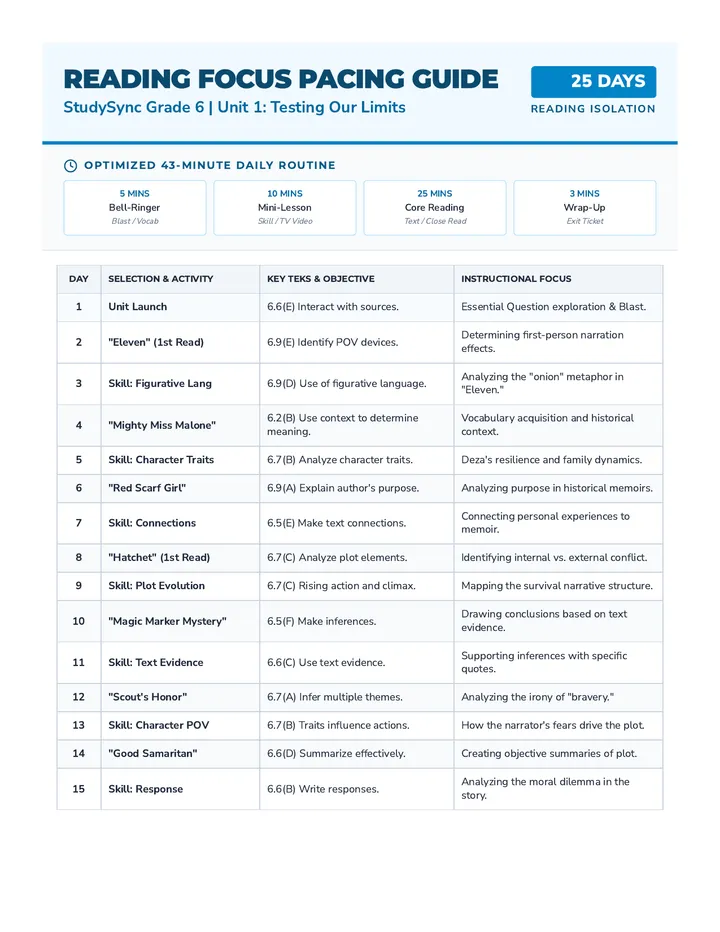
Reading Focus Pacing Guide

Testing Our Limits Unit

A 25-day comprehensive unit for StudySync Grade 6 that explores the theme of courage and resilience through isolated reading and writing tracks, aligned to ELA TEKS.

DM

Dawn Mustian

79
Story Crafters Overview Teacher Guide

Story Crafters Workshop

A 10-day immersion into narrative writing for upper elementary students, focusing on craft, structure, and grammar conventions.

SS

Summer Say

20

Lessons

Awakening Words Bell Ringer

Stolen Seconds

A comprehensive lesson exploring Tanith Lee's 'Awake,' a subversion of Sleeping Beauty, focusing on structural choices and source material transformation (RL.5 and RL.9). Students will analyze character conflict and the concept of 'the gift of time.'

V

vivianbelarmino

25
Narrative Navigator Slides

Journal Journey Cultural Bridge

An advanced 8th-grade ELA lesson exploring the intersection of Filipino and American identities through personal narrative. Students analyze the immigrant experience, master advanced vocabulary via a 'Quiz Bee,' and draft narratives that bridge their cultural heritage with their current journey.

V

vivianbelarmino

13
Second Proof Assessment Plus Added Question

The Editors Desk

A comprehensive lesson on advanced revising and editing for 10th grade, focusing on organizational structure, parallel construction, sentence effectiveness, and grammatical precision. Students will learn to transform drafts into polished, professional pieces of writing.

SM

Samantha Moore

6
Precision Prose Teacher Guide

Precision Prose

A 60-minute ELA lesson focused on analyzing author's diction and drawing logical inferences using excerpts from the Grade 7 Interim Assessment. Students will explore how specific word choices shape meaning and tone through guided and independent practice.

RC

Rachel Cohen

9
Rivers and Roads Answer Key

Rivers and Roads

A comprehensive ELA lesson for 8th grade exploring themes of displacement, identity, and resilience through the analysis of Andrew Jackson's Indian Removal Speech, a Trail of Tears diary entry, and the poems 'Maps' and 'The Negro Speaks of Rivers'. Students engage with Tier 2 and advanced vocabulary, comparative analysis, and a creative choice board.

V

vivianbelarmino

10
Paragraph Mastery Slides

Paragraph Architecture

A senior secondary literacy lesson focused on advanced paragraph construction techniques including Kernel Sentences, the Seldon Method, and sentence upgrading for high-level analysis.

E

elizabeth.metzke

20