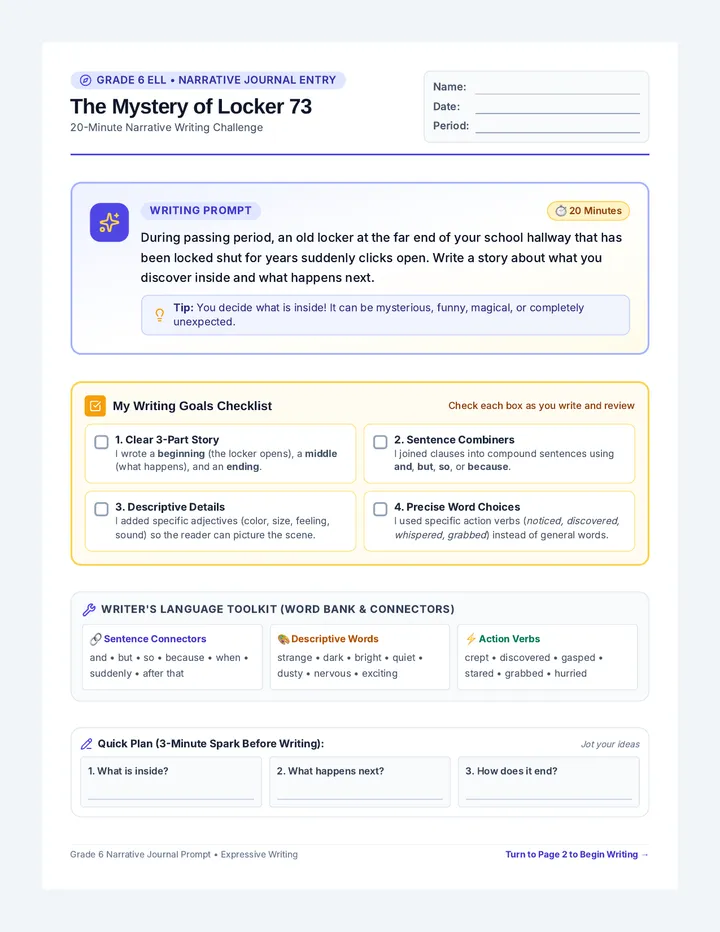
Story Crafters Overview Teacher GuideStory Crafters Workshop A 10-Day Narrative Writing Unit Overview Teacher Guide Unit Goals Develop a complete original narrative with a clear plot arc. Create dynamic characters with internal and external traits. Use sensory details to create immersive settings. Master conventions: sentence structure, dialogue, and punctuation. Apply "Show, Don't Tell" revision techniques. Essential Questions How do writers find and grow small-moment ideas? How does a writer's choice of detail transport the reader? How do conventions clarify a writer's meaning? Why is revision the "real" writing work? The 10-Day Roadmap DayLesson FocusKey Activity / Product01Idea SparksGenerating "What If" questions & Small Moment Seeds.02Plot PeaksStory Arc Mapping (Exposition → Resolution).03Character BuildingCharacter Sketch: External traits vs. Internal desires.04Vivid SettingsSensory Charts for the story's main locations.05Sentence PowerSentence Boot Camp: Fixing run-ons & varying lengths.06Hooking the ReaderDrafting 3 different leads for the same story.07The HeartDrafting the Rising Action and Climax.08Revision WorkshopShow, Don't Tell transformation practice.09Editing LabChecklist-driven final polish for conventions.10Author ShowcaseFinal sharing circles and peer celebrations. Conventions Throughout While Day 5 and Day 9 focus heavily on grammar and editing, encourage students to monitor their punctuation and capitalization from the first draft. Use "Mentor Sentences" during morning meetings to reinforce these skills daily. Scaffolding Suggestions For reluctant writers, provide sentence starters for the brainstorming phase. For advanced writers, challenge them to experiment with non-linear plot structures (starting with a flashback) or complex internal monologues.
Idea Sparks SlidesIdea Sparks Finding Your Story's Heart What is a Narrative? A narrative is a story told from a specific point of view. "Stories are the way we make sense of the world." Must-Have Ingredients: Characters Setting Conflict (Problem) Resolution The "What If?" Method Every great story starts with a simple, curious question that sparks a world of possibilities. 🏠 What if your house could fly? 🐕 What if your dog could speak? ⏳ What if you found a time machine? Big Topics vs. Small Moments 🍉 The Watermelon A huge, broad topic like "My Summer Vacation." It's too big to tell well! 🌱 The Seed A tiny, specific moment like "The time I caught my first fish." This is where the story lives! Your Turn to Spark! Open your notebooks. We are going to find 5 "seeds" today. Think about: A time you were surprised A "What If?" question about school A mystery you want to solve
Idea Sparks WorksheetIdea Sparks Name: ____________________________ Date: ________________ 1 The "What If?" Spark Think of three creative questions that start with "What if...". Let your imagination run wild! Q1. Q2. Q3. 2 Small Moment Seeds Don't write about a whole watermelon (a big topic). Pick a specific seed (a small moment). List three small moments from your life or your imagination. Moment #1: Moment #2: My Story Choice Look at all your ideas above. Which one makes you most excited to write? Circle it and write the main topic below.
Plot Peaks SlidesPlot Peaks The Map of Your Story The Story Mountain 1. Exposition 2. Rising Action 3. CLIMAX (The Peak) 4. Falling Action 5. Resolution Step 1 The Exposition This is where you set the stage. You introduce: The Main Character The Setting The "Normal Life" before the problem starts "In a small village nestled between two sleeping volcanoes, a young girl named Maya lived in a house made of glass..." Rising Action The character tries to solve the problem but faces roadblocks. The tension grows higher and higher! 1 2 3 The Climax The most exciting moment! The "Big Showdown" or the "Turning Point" where the character must make a choice. The character changes or the problem is finally faced head-on. The Resolution How did the story end? How did the character change? Tie up the loose ends! A New Normal begins...
Plot Peaks WorksheetPlot Peaks Map Name: ____________________________ Date: ________________ Every great story follows a journey! Use the mountain map below to plan the major events of your story. Keep your notes brief—just enough to help you remember the big moments. 3. The Climax (Peak) 2c. Rising Action 2b. Rising Action 2a. Rising Action 1. Exposition (The Start) 4. Falling Action 5. Resolution (The End)
Character Building SlidesCharacter Building Creating People, Not Just Names The Character Iceberg External Traits (Above Water) What we see on the outside: Height, eye color, clothes, how they walk, their voice. Internal Traits (Below Water) What's hidden inside: Fears, dreams, kindness, temper, secret hopes, memories. VISIBLE HIDDEN What do they WANT? Every character needs a goal. This is what drives the story forward! Protection To keep a family secret safe. Achievement To win the championship game. Belonging To finally find a best friend. Nobody's Perfect A character without a flaw is boring! Give them a struggle: They are painfully shy. They lose their temper too easily. They are always late for everything. Character Casting Take a moment to close your eyes and see your main character. What are they wearing? What are they thinking about right now? Time to create your Character Sketch!
Character Profile WorksheetCharacter Profile Name: ____________________________ Date: ________________ The Visible Self What does your character look like? What are they wearing? How do they move? Character Name Age / Size / Appearance Clothes / Items Carried Voice / Quirks The Hidden Heart What's going on inside? What drives them? What do they fear? Personality Traits (Internal) Biggest Fear Biggest Desire (Goal) Flaw / Struggle Quick Sketch Draw your character in action!
Vivid Settings SlidesVivid Settings Painting with Words More Than a Map A setting is the Time and Place of your story. Good writers don't just name the place; they make the reader feel like they are standing in it. Time Weather Place Mood The 5-Sense Rule To make a setting come alive, use at least three different senses in your description. Sight Sound Smell Touch Taste Word Magic Upgrade Boring "It was a dark and spooky forest." Vivid "The ancient oaks twisted like gnarled fingers, blocking the moon. The damp smell of rotting leaves hung heavy in the silent air." Ready for a Field Trip? We aren't leaving the room, but your imagination is! Let's fill out your Sensory Sketchpad for your story's world. Start Sketching!
Sensory Sketchpad WorksheetSensory Sketchpad Name: ____________________________ Date: ________________ Transport Your Reader! Choose the most important location in your story. Close your eyes and "visit" it. What do you experience? Use the sensory boxes below to collect details that will make your reader feel like they are right there with your character. The Location Name: SIGHT Colors, shapes, lighting, hidden details... SOUND Loud noises, faint whispers, nature, machines... SMELL Fresh, stale, sweet, metallic, earthy... TOUCH Temperature, texture, wind, pressure... The Setting Hook Write one powerful sentence that uses two senses at once to describe this place.
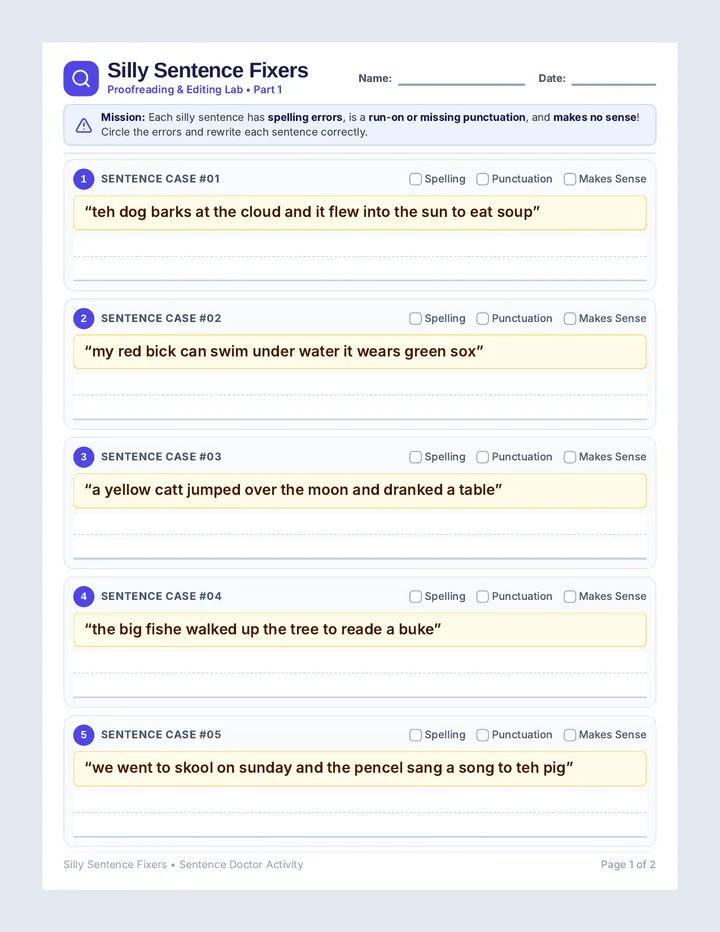
Sentence Power SlidesSentence Power Building the Foundation What is a Complete Sentence? The Subject The Who or What the sentence is about. The dragon... The Predicate The Action or what is happening. ...guarded the treasure. The Fragment Ghost A fragment is a broken sentence. It's missing either a subject or a predicate. Fragment "Into the dark cave." Fixed! "They crawled into the dark cave." The Run-On Monster A run-on is when two sentences are mashed together without the right punctuation. The Problem "I went to the store I bought an apple." Use a Period (.) Use a Semicolon (;) Use a Comma + Fanboys Your Sentence Toolkit . Stop ? Question ! Exclaim , Pause Sentence Boot Camp Starts Now!
Sentence Power WorksheetSentence Boot Camp Name: ____________________________ Date: ________________ 1 The Fragment Fixer These sentences are broken! Add either a Subject or a Predicate to make them complete. Broken Fragment: "Running through the tall grass." My Fixed Sentence: Broken Fragment: "The ancient map on the wall." My Fixed Sentence: 2 The Run-On Rescue These sentences never stop! Use a period (.) or comma + FANBOYS to rescue them. "The dragon roared loudly the knight pulled out his shiny sword he was very afraid." Write your Rescued Paragraph Below: 3 Punctuation Power-Up Read your story draft (exposition). Circle three periods and three capital letters to show you are watching your conventions! If you find a mistake, fix it now. Capitals Check Punctuation Check Subject Check
Hooking the Reader SlidesHooking the Reader The Art of the Perfect Lead The 10-Second Rule A reader decides to keep reading or put your story down in the first few sentences. Your mission: Catch them like a fish on a hook! Don't start with: "One day I woke up and went to the park..." Do start with: "The ground began to shake, and my cereal bowl slid right off the table." Hook Toolkit Dialogue "Run! Don't look back!" my brother screamed. Sound (Onomatopoeia) CRUNCH. The old wooden stairs groaned under my feet. Action I dived under the bed just as the door handle turned. Question Have you ever seen a cat that could disappear? The Exposition Draft After your hook, you need to establish your Setting and Characters. Use your Sensory Sketchpad and Character Profile! ⚓ The Hook 📍 The Setting 👤 The Character Try 3 Different Hooks Don't settle for your first idea. Try a Dialogue lead, an Action lead, and a Sound lead. Which one pulls the reader in more? Open your Drafting Leads worksheet!
Drafting Leads WorksheetDrafting My Lead Name: ____________________________ Date: ________________ The Bait and the Hook A great story deserves a great start. Instead of just picking your first idea, try out three different "hooks" for your story. Then, choose the one that you think will grab your reader's attention the most. OPTION 1: DIALOGUE (Characters talking) Example: "Whatever you do, don't open that blue box," Grandpa warned. OPTION 2: ACTION (Something happening) Example: I sprinted across the bridge just as the first stone crumbled into the river below. OPTION 3: SOUND (Onomatopoeia) Example: POP! The silence of the library was shattered by the sound of my gum bubble bursting. The Final Hook My Choice Write the lead you've chosen to use for your story below. Make sure it uses strong verbs!
The Heart of the Story SlidesThe Heart Drafting the Climax Building Tension The Rising Action is a staircase. Each step gets harder and more intense! Don't make it too easy for your character. If they win right away, there is no story! 1 Obstacle One 2 Bigger Problem 3 Turning Point The Big Moment The Climax is the peak of your mountain. It is where everything comes to a head. The Golden Rule: The main character must ACT. They cannot just be saved by someone else. They have to make a choice! Pacing the Heart During the most exciting part, slow down your writing. Use short, punchy sentences to make the reader's heart race. "He held his breath. The door creaked. Silence. Then, a roar." Slow Motion Technique Describe one small action in great detail to build suspense. Face the Fire! Today, you draft the most important part of your story. Don't hold back. Make it intense, make it scary, or make it hilarious! Time to Draft the Heart!
Climax Drafting WorksheetThe Heart of My Story Name: ____________________________ Date: ________________ Building the Pressure Before you draft, list 3 steps of rising action. Each one should be more intense than the last! 1 2 3 Drafting the Climax Slow down your writing! Describe the movements, the thoughts, and the choice your character has to make. This is the peak of your story. The Action Checkpoint: Rising Action Steps Main Character Acts Sentence Pacing (Short/Punchy)
Revision Workshop SlidesRevision Workshop The Real Work of Writing Revise vs. Edit Revision RE-VISION: Seeing your story with new eyes. Changing words, adding details, and making the story better. Editing Fixing spelling and grammar. We do this at the very end. Today is about the ART, not the rules! Show, Don't Tell Don't just name a feeling. Describe the character's actions and body language so the reader feels it too. Telling (Boring) "Leo was very angry." Showing (Powerful) "Leo's face turned beet red and he slammed his fist onto the table, making the glasses rattle." Verbs are the Engines Writers use Vivid Verbs to create a clearer picture. Get rid of boring verbs like "said," "went," or "looked." Instead of "Sprinting"... Hurtled, Dashed, Bolted Word Surgery "He walked." "He crept." "She said." "She hissed." "It was loud." "It thundered." Transformation Time Grab your Revision Worksheet. We are going to transform "Telling" sentences into "Showing" masterpieces! Let's Revise!
Revision Workshop WorksheetRevision Workshop Name: ____________________________ Date: ________________ Mastering the Art of "Showing" Transform these "telling" sentences into "showing" sentences. Describe actions, body language, and feelings without naming the emotion! Telling (The Boring Way): "The boy was scared." Showing (The Author Way): Telling (The Boring Way): "It was really cold outside." Showing (The Author Way): Vivid Verb Surgery Replace the boring verbs in the paragraph below with "Power Verbs." The wolf went toward the village. He looked at the houses. He said a loud growl. Replacement 1: Replacement 2: Replacement 3: Revision Checklist: I removed "very" and "really" I used at least 3 vivid verbs I "showed" a character's feeling
Editing Lab SlidesEditing Lab The Final Polish Cleaning the Lens Editing is fixing the Conventions of your writing. It makes your story easy for others to read. "Good conventions are invisible. Bad conventions are all the reader can see." CUPS Checklist: Capitalization Usage Punctuation Spelling Punctuating Dialogue When a character speaks, you need to use "Quotation Marks" and a new paragraph for each speaker. "I can't believe we found it!" Sarah shouted. Leo whispered back, "Keep your voice down." The Peer Review Writers always have a Second Pair of Eyes look at their work. Today you will trade drafts. Rule 1: Be Kind. Rule 2: Be Specific. Rule 3: Help them fix!. Trading Places Use a colored pencil to circle errors and write suggestions in the margins. Enter the Lab Take your Editing Checklist. Go through your story word by word. Is it ready for the world to see? Final Polish Time!
Editing Lab Checklist WorksheetThe Editing Lab Name: ____________________________ Date: ________________ Self-Edit Checklist Read your story slowly. Check each box as you find and fix errors. C Capitalization I checked the start of every sentence, proper nouns (names, places), and the word "I". Done U Usage My sentences make sense. I didn't mix up words like "their/there/they're" or "to/too/two". Done P Punctuation Every sentence has a stop sign (. ! ?). I used quotation marks for dialogue. Done S Spelling I circled words I'm not sure about and checked them with a dictionary or word wall. Done Peer Editor Note Trade your story with a partner. Editor, please write one specific thing you loved about their story and one convention they should double-check. One thing I loved: Double-check this convention:
Author Showcase Slides PresentationAuthor Showcase Welcome to the Story Crafters Gallery Sharing Our Stories Today, your work moves from your notebook to the world. "There is no greater agony than bearing an untold story inside you." — Maya Angelou How to Share: Read clearly. Make eye contact. Listen with respect. Offer Peer Praise. Spreading the Spark As you listen to your classmates, fill out a Praise Card. What specific part of their story made you say "WOW"? Focus on: ✨ A "Show, Don't Tell" moment ✨ A vivid setting detail ✨ A surprising plot twist ✨ A powerful lead Great Authors! The Writer's Reflection Think back to Day 1. How has your story changed since then? What is the proudest moment of your workshop journey? "Writing is a muscle. The more you use it, the stronger it gets." You are Authors. Congratulations on your Publication! Celebrate Now!