Lenny.com
Explore
Create
ActivitiesNewMathEnglish Language ArtsScience & EngineeringSocial StudiesGlobal LanguagesHealth & Physical EducationSpecial EducationCounseling & Life SkillsArts & CreativityESL
Lenny.com
Lenny.com
Explore
Create
ActivitiesNewMathEnglish Language ArtsScience & EngineeringSocial StudiesGlobal LanguagesHealth & Physical EducationSpecial EducationCounseling & Life SkillsArts & CreativityESL
Lenny.com
Lenny.com

Solutions

Lenny for EducatorsLenny for SchoolsLenny for Districts

Product

ExploreSign inCreateSupportAbout

Resources

Getting startedMTSS Acceleration Program

© 2026 Lenny Learning Inc.

TermsPrivacyAccessibility
LinkedInInstagramX
Lenny

Author's Purpose

Distinguishes between persuasive, informative, and entertaining texts using specific textual evidence. Strengthens comprehension by examining how word choice and structure align with a writer's intent.

English Language ArtsPhonics & Reading FoundationsLetter IdentificationLearn Letters A-ZLowercase and Uppercase LettersConsonants and VowelsLetter-Sound AssociationsLetter-Sound Associations: LowercaseLetter-Sound Associations: UppercaseBeginning and Ending SoundsRhymingBlending And SegmentingShort VowelsShort Vowel SoundsConsonant BlendsConsonant DigraphsBlends, Digraphs, and TrigraphsDigraphs, Blends, and Silent LettersLong Vowel SoundsLong Vowel PatternsShort and Long VowelsShort and Long Vowel PatternsSilent EVowel SoundsVowel TeamsR-Controlled VowelsDiphthongs: Oi, Oy, Ou, OwVariant VowelsVariant, Diphthong, And R Vowel PatternsSoft G And CSight WordsIrregular WordsWord RecognitionSyllablesSyllable TypesTwo-Syllable WordsMultisyllabic WordsPhoneme ManipulationDecodable TextsVocabularyAction WordsQuestion WordsNouns and AdjectivesClassify WordsCompound WordsSynonyms and AntonymsHomophonesHomophones and HomonymsShades of MeaningContext CluesPrefixes and SuffixesGreek and Latin RootsAnalogiesIdioms and AdagesForeign Words and ExpressionsWord Choice and UsageReference SkillsReading ComprehensionRead-Along Literary TextsRead-Along Informational TextsReality vs. FictionStory ElementsCharacterSequenceMain IdeaCause And EffectCompare And ContrastReading StrategiesText StructureAuthor's PurposeAuthor's Purpose And ToneAuthor's PerspectivePoint Of ViewThemeInference And ThemeInference And AnalysisPoetry ElementsLiterary DevicesAnalyzing LiteratureAnalyzing Informational TextsComparing TextsAudience, Purpose, And ToneBusiness DocumentsNovel StudyNonfiction Book StudyGrammar & MechanicsSentencesNounsVerbsAdjectivesPronounsCapitalizationPunctuationContractionsConjunctionsPrepositionsArticlesAdjectives And AdverbsVerb TypesVerb TensePronouns And AntecedentsPronoun TypesSubject-Verb AgreementDirect And Indirect ObjectsSentences, Fragments, And Run-OnsPhrases And ClausesCommasSemicolons, Colons, And CommasDashes, Hyphens, And EllipsesSpellingAbbreviationsFormattingVerb Tense And MoodMisplaced ModifiersWritingDescriptive DetailsCreative WritingOpinion WritingTopic SentencesOrganizing WritingLinking WordsSentence VarietyIntroductions And ConclusionsPersuasive And Opinion WritingExpository WritingPersuasive StrategiesDeveloping And Supporting ArgumentsTopic Sentences And Thesis StatementsSummarizingResearch SkillsEditing And RevisingActive And Passive Voice=Writing Clearly And ConciselyDebate & Public SpeakingPublic Speaking BasicsPersuasive TechniquesClaims and EvidenceTypes of ArgumentsReasoning TypesLogical FallaciesTopic ResearchOrganizing EvidenceDebate Speech OrganizationAttacking and Defending ArgumentsClash and EngagementImpact CalculusQuestioning and Cross-ExaminationCritical ThinkingInformal LogicFormal LogicInductive Reasoning

Videos

Understanding Point of View and Tone Through Text Messages

Understanding Point of View and Tone Through Text Messages

This video uses a relatable text message conversation between two friends to teach students about literary point of view, tone, and perspective-taking. A narrator guides viewers through an unfolding drama between Liz, who wants to hang out spontaneously, and Kim, who keeps saying no. By analyzing the word choice and brevity of the text messages, the narrator demonstrates how characters' differing situations influence their perspectives and communication styles. The video explores key themes of empathy, miscommunication in digital spaces, and the difference between explicit statements and implied meanings. It highlights how a lack of context can lead to false assumptions, as seen when Liz interprets Kim's refusal as dislike rather than an inability to be spontaneous due to family responsibilities. The resolution teaches students to look beyond surface-level reactions to understand the underlying reality of others. For the classroom, this is an excellent tool for English Language Arts lessons on analyzing character interactions and determining point of view. It also serves as a strong social-emotional learning resource regarding digital citizenship and empathy. Teachers can use the video to spark discussions about how text-based communication strips away tone, leading to conflicts that can only be resolved by understanding another person's "reality" or context.

Miacademy & MiaPrep Learning ChannelMiacademy & MiaPrep Learning Channel

5mins 35s

Baking a Story: Part-Whole Relationships in Literature

Baking a Story: Part-Whole Relationships in Literature

In this engaging educational video, Justin uses a relatable analogy—baking a birthday cake—to explain the complex literary concept of part-whole relationships. The video begins with a narrative about planning a surprise party and segues into a text message conversation between a character named Liz and her mother. As Liz encounters a missing ingredient (buttermilk) while baking, Justin explains the scientific function of that ingredient, setting the stage for a deeper analytical connection.

Miacademy & MiaPrep Learning ChannelMiacademy & MiaPrep Learning Channel

8mins 58s

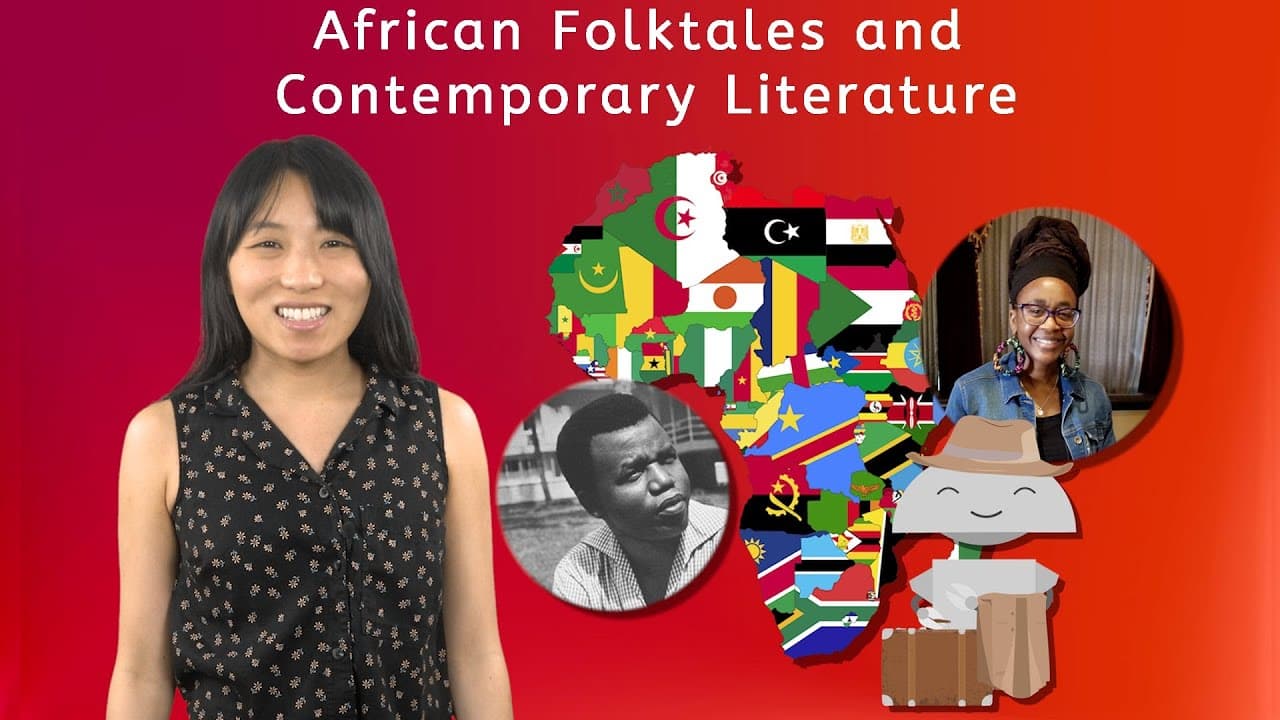
Exploring African Folktales and Contemporary Literature

Exploring African Folktales and Contemporary Literature

This educational video provides a comprehensive overview of African literary traditions, starting with the oral history of folktales and moving through the colonial, post-colonial, and modern eras of written literature. Set against the backdrop of Lagos, Nigeria, the narrator guides viewers through the cultural significance of storytelling, using the famous trickster character Anansi the Spider as a primary example of folklore that imparts moral lessons and preserves history. The video delves into complex historical themes, explaining how the Colonial and Post-Colonial periods shaped the narratives of African authors. It introduces key literary figures such as Chinua Achebe, Tsitsi Dangarembga, and Chimamanda Ngozi Adichie, categorized by the historical eras they represent. The content breaks down how political events, specifically the struggle for independence and the challenges of rebuilding nations, directly influenced the themes explored in African literature. Designed for middle and high school students, this resource is an excellent tool for Language Arts and World History classrooms. It connects geography, history, and literature, offering students a framework to understand how societal changes impact storytelling. The video includes built-in pause points for reading and reflection, making it ready-made for interactive classroom lessons on world cultures, literary archetypes, and historical analysis.

Miacademy & MiaPrep Learning ChannelMiacademy & MiaPrep Learning Channel

10mins 43s

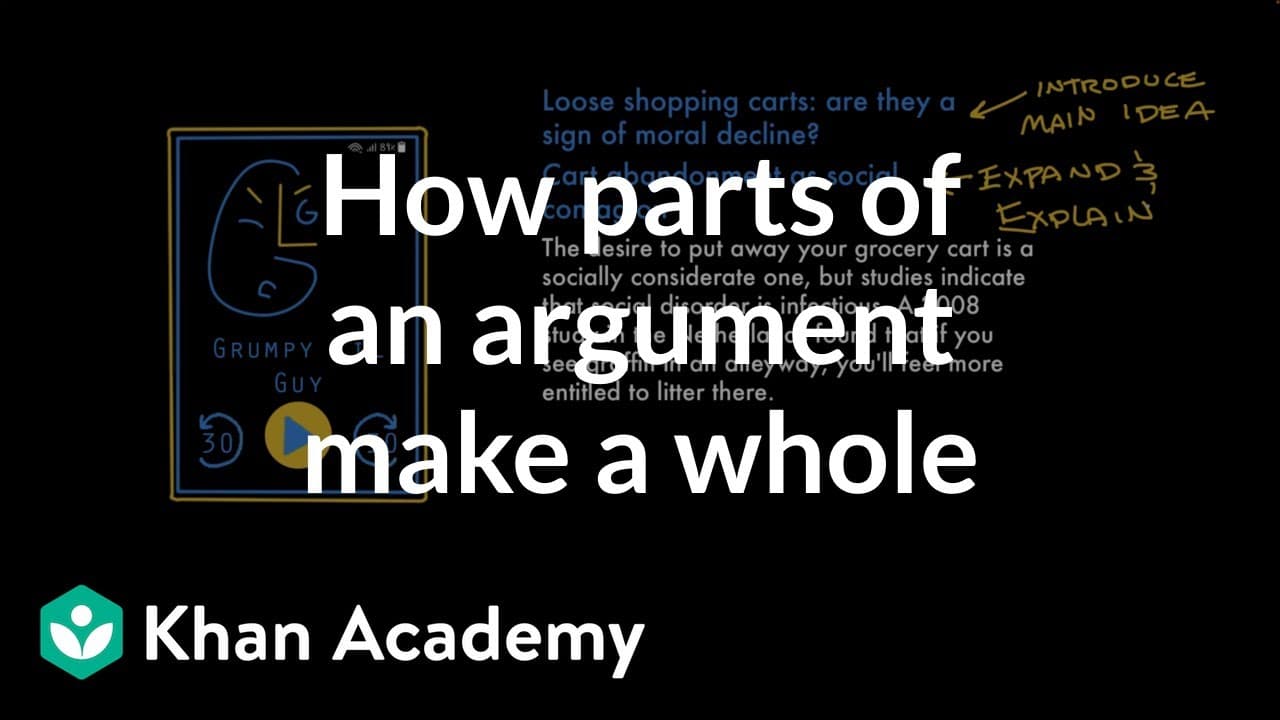
How Authors Develop Claims and Arguments

How Authors Develop Claims and Arguments

This engaging video lesson uses a fictional podcast called "Grumpy Lil Guy" to teach students how authors structure arguments and develop claims across a text. The narrator breaks down the podcast episode into distinct sections, analyzing how the host introduces a claim, expands on it with research, provides specific examples, and addresses counter-arguments. By treating the text analysis as a "pause and discuss" session, the video makes abstract rhetorical concepts concrete and accessible. The core themes explore rhetorical structure, argumentative writing, and critical reading. It specifically focuses on identifying the function of different paragraphs within a larger text—moving from the "what" (the claim) to the "why" (explanation), the "proof" (examples), and the "defense" (counter-arguments). It also touches on the concept of civic responsibility through the humorous example of returning shopping carts. For educators, this video is an excellent tool for Middle and High School ELA classrooms. It models the exact type of analytical thinking required for standardized testing and essay writing but does so with humor and a relatable format. Teachers can use this to introduce the components of a strong argument before asking students to write their own or to help students visualize how to trace an author's line of reasoning in informational texts.

Khan AcademyKhan Academy

4mins 33s

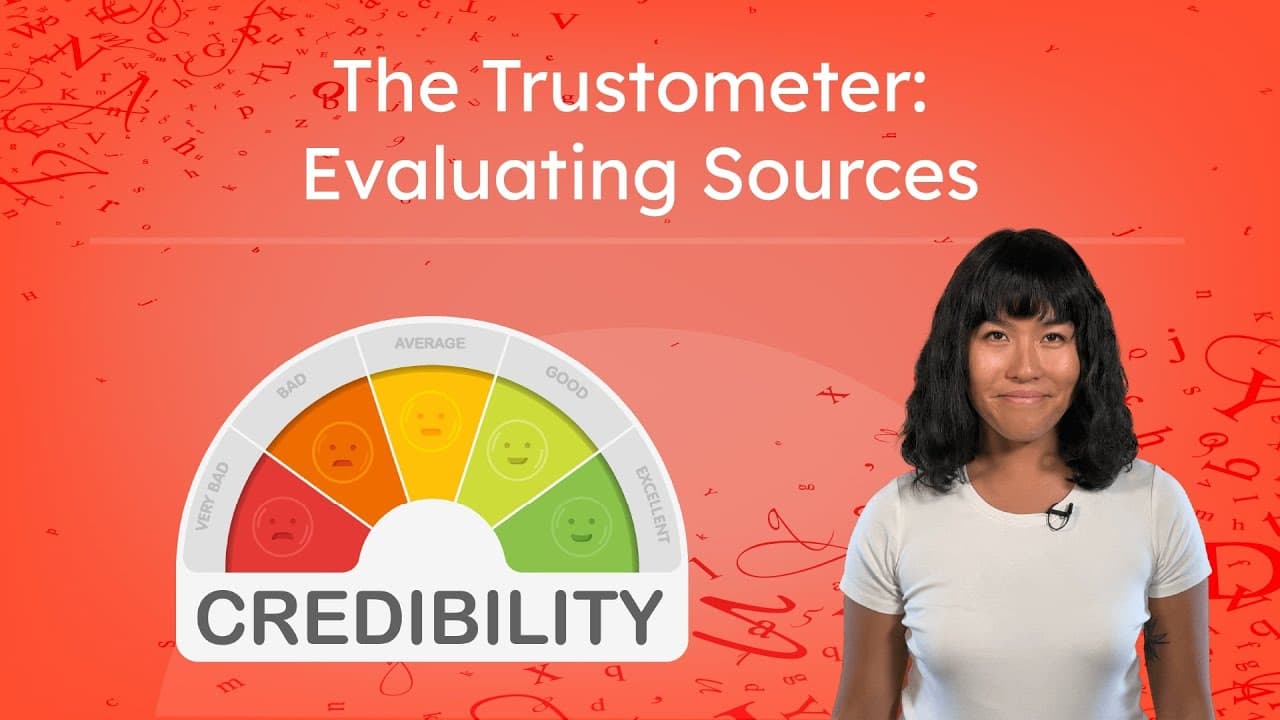
How to Evaluate Sources and Detect Bias

How to Evaluate Sources and Detect Bias

This comprehensive video guide teaches students the essential skills of information literacy, specifically focusing on how to evaluate sources for credibility and how to identify bias. Using a relatable research question about social media's impact on teen mental health, the narrator introduces a fictional tool called the "Trustometer" to demonstrate the critical thinking process required to assess information. The video breaks down source evaluation into four key criteria: Author's Credibility, Purpose, Timeliness, and Accuracy.

Miacademy & MiaPrep Learning ChannelMiacademy & MiaPrep Learning Channel

14mins 8s

Thinking Like a Detective: Assessing Logic and Evidence

Thinking Like a Detective: Assessing Logic and Evidence

This engaging educational video uses a relatable scenario—interpreting a text message conversation about a crush—to teach students the fundamentals of logical reasoning and evidence evaluation. The host begins by referencing Sherlock Holmes to introduce the concept of using facts to build a logical conclusion. The core of the video analyzes a dialogue between two friends, Liz and Maya, where Liz jumps to conclusions based on weak evidence, allowing the narrator to demonstrate the difference between insufficient facts and a solid argument. Key themes include critical thinking, distinguishing relevant from irrelevant details, identifying sufficient evidence, and assessing the validity of an argument. The video explicitly connects these skills to reading comprehension strategies like finding the main idea and analyzing word choice. It models the internal monologue of a critical thinker who questions whether the "pieces of the puzzle" actually fit together. For educators, this video serves as an excellent hook for units on argumentative writing, debate, or reading comprehension. It takes an abstract concept (assessing reasoning) and applies it to a social situation students instinctively understand, making the learning concrete. It can be used to spark discussions about what constitutes "proof" in both literature and real-world arguments, helping students move beyond surface-level assumptions.

Miacademy & MiaPrep Learning ChannelMiacademy & MiaPrep Learning Channel

5mins 33s

Materials

Text Features Explorer Worksheet

Text Features Explorer Worksheet

A full-page 3rd-grade animal text features worksheet featuring 8 prominent visual picture clues and dedicated answer spaces, with the third column removed to maximize visual clarity and handwriting space.

BA

Becky Arkins

Morning Spark Student Packet

Morning Spark Student Packet

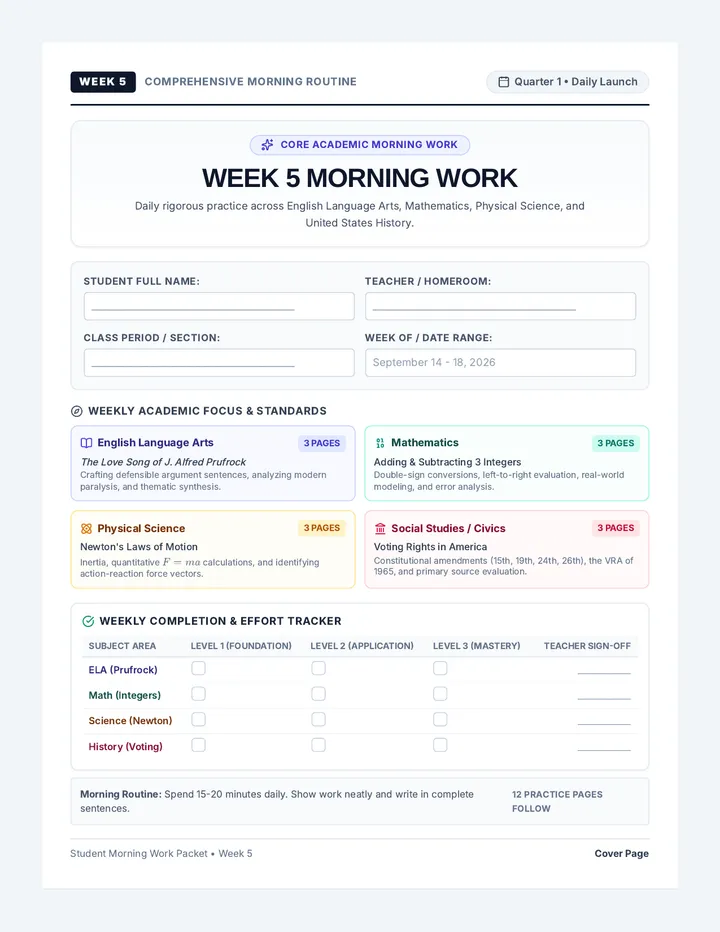
A complete 13-page student morning work packet for Week 5, beginning with an all-inclusive Cover Page and Weekly Progress Tracker, followed by 12 differentiated practice pages across four core subjects (ELA, Mathematics, Science, and US History) with scaffolded, moderate, and independent tiers.

K

kyle.hill

ILEARN Caminos Blueprint Guide

ILEARN Caminos Blueprint Guide

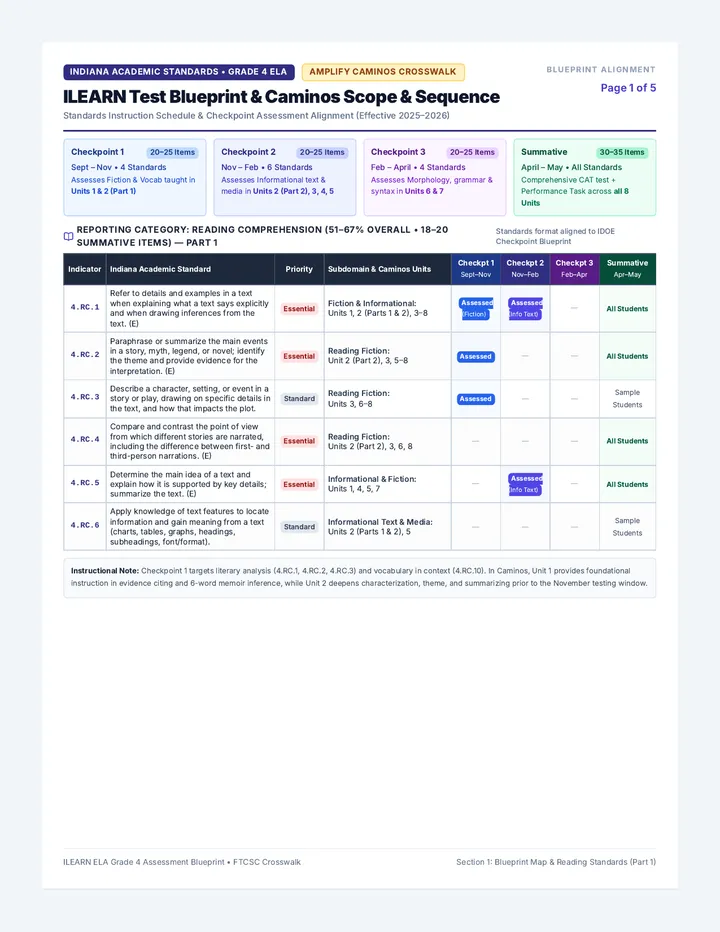
Comprehensive Grade 4 ILEARN Test Blueprint and Amplify Caminos Scope & Sequence crosswalk. Formatted to match the state ILEARN checkpoint blueprint, showing exactly when Indiana Academic Standards (Reading, Vocabulary, Writing, Grammar, and Communication) are taught across Units 1–8 and assessed in Checkpoints 1, 2, 3, and the Summative Assessment.

A

Amy.Hacker

Acorn Detective Story Worksheet

Acorn Detective Story Worksheet

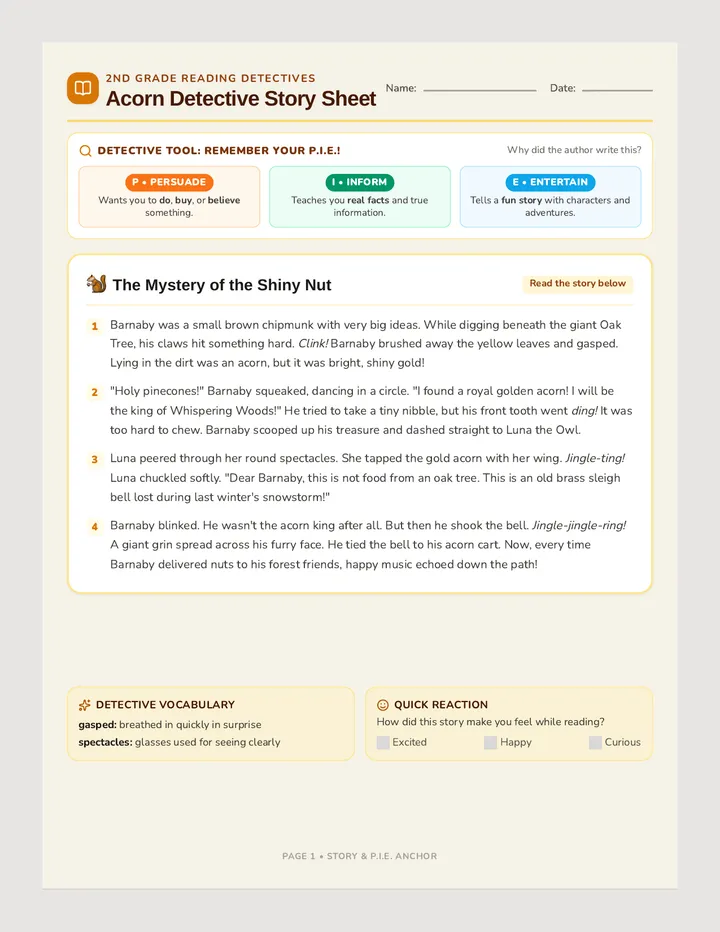
A 2nd-grade reading comprehension and author's purpose printable worksheet featuring an original short story, PIE anchor definitions, text-evidence questions, and purpose-switching activities.

C

cottonc

Book Buddy Contract Bookmarks

Book Buddy Contract Bookmarks

A high-contrast black and white printable sheet featuring three vertical bookmarks in a portrait layout. Each bookmark is 7 inches long (672px) and serves as a book care contract with smaller icons positioned above larger promise text and a signature line.

LA

Lynne Aftuck

Giver Chapters 14-15 One Pager-REVISED-v2-FINAL

Giver Chapters 14-15 One Pager-REVISED-v2-FINAL

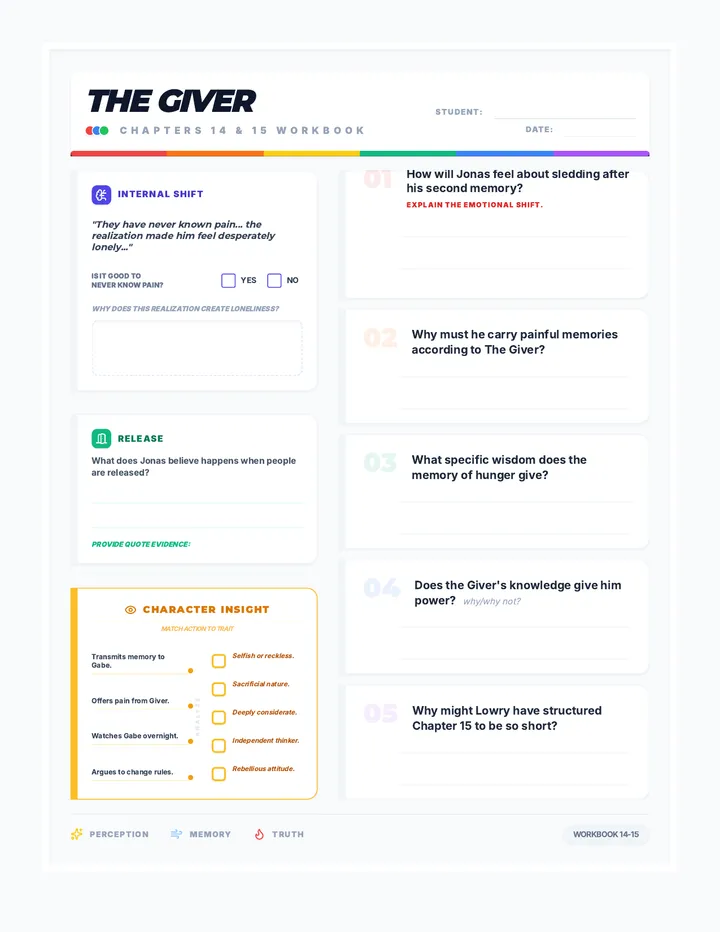
A final, refined one-page workbook for Chapters 14-15 of The Giver. This version has been strictly optimized for height by reducing margins and padding to ensure everything fits perfectly on a single page, while featuring a vibrant full-spectrum rainbow theme to represent Jonas's awakening to color and deep memory.

BC

Brenda Coombs

Sequences

Invention Quest Slides

Frindle Frenzy Novel Study

A 9-day novel study for 'Frindle' by Andrew Clements, aligned to 3rd Grade ELAR TEKS, focusing on character development, vocabulary, and plot analysis.

LH

Lucy Hellerman

56
Prophecy and Power Slides

Shadows and Crowns

A series of lessons exploring Shakespeare's Macbeth, specifically designed for 10th-grade emergent bilingual students to master complex characterization and thematic elements.

DC

Dylan Clark

30
Question Anatomy Slides

Insight Investigators

A 6-week reading intervention unit for 5th graders focused on making inferences, analyzing questions, and using text evidence. Themes include mysteries, sports (baseball and basketball), and dragons to engage high-interest readers.

MK

Meg Keene

48
Copenhagen Clues Slides

Resistance Chronicles

A 9-day novel study for Number the Stars centered on 5th Grade ELAR TEKS, focusing on character development, plot analysis, and historical context through the lens of a Resistance Secret File.

LH

Lucy Hellerman

79
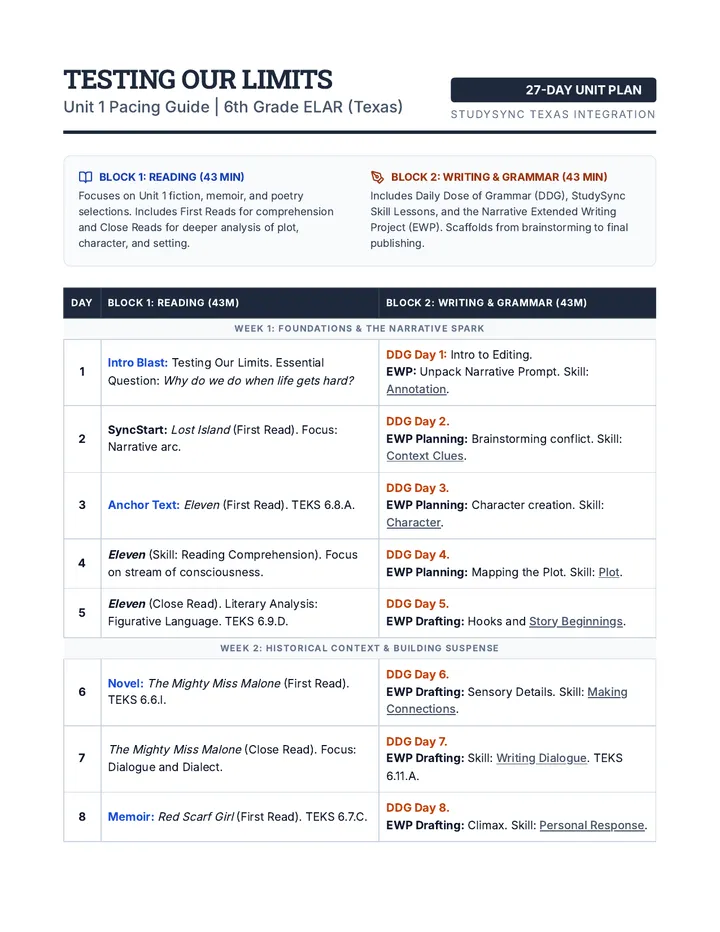
Unit 1 Pacing Guide Document

Testing Our Limits Unit Sequence

A 27-day instructional sequence for 6th Grade ELAR Unit 1: Testing Our Limits, featuring dual blocks for Reading and Writing with daily grammar and skill scaffolding.

DM

Dawn Mustian

81
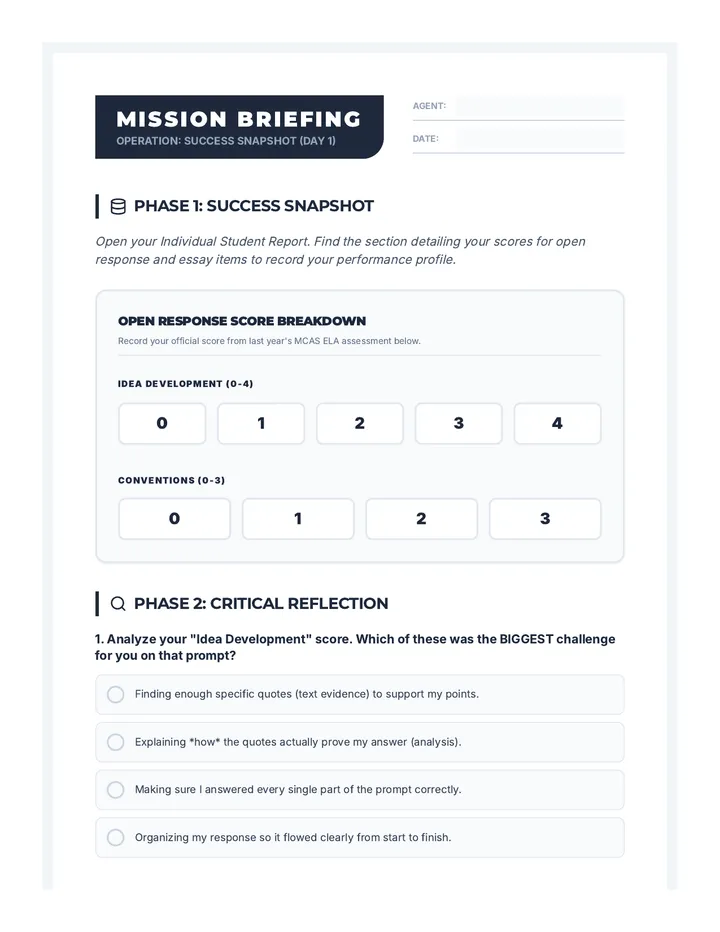
Mission Briefing Worksheet

Mastery Mission

A project-based learning unit designed to help middle school students analyze their past MCAS ELA performance, deconstruct scoring rubrics, and create a personalized strategy playbook for upcoming assessments. Students move from 'investigating' their scores to 'rebooting' their responses and 'finalizing' their test-taking toolkit.

M

mhbutterworth

18