Lenny.com
Explore
Create
ActivitiesNewMathEnglish Language ArtsScience & EngineeringSocial StudiesGlobal LanguagesHealth & Physical EducationSpecial EducationCounseling & Life SkillsArts & CreativityESL
Lenny.com
Lenny.com
Explore
Create
ActivitiesNewMathEnglish Language ArtsScience & EngineeringSocial StudiesGlobal LanguagesHealth & Physical EducationSpecial EducationCounseling & Life SkillsArts & CreativityESL
Lenny.com
Lenny.com

Solutions

Lenny for EducatorsLenny for SchoolsLenny for Districts

Product

ExploreSign inCreateSupportAbout

Resources

Getting startedMTSS Acceleration Program

© 2026 Lenny Learning Inc.

TermsPrivacyAccessibility
LinkedInInstagramX
Lenny

Contractions

Formation of shortened word forms using apostrophes to replace omitted letters. Strengthens usage skills through identification of common pairs and differentiation from possessive nouns.

English Language ArtsPhonics & Reading FoundationsLetter IdentificationLearn Letters A-ZLowercase and Uppercase LettersConsonants and VowelsLetter-Sound AssociationsLetter-Sound Associations: LowercaseLetter-Sound Associations: UppercaseBeginning and Ending SoundsRhymingBlending And SegmentingShort VowelsShort Vowel SoundsConsonant BlendsConsonant DigraphsBlends, Digraphs, and TrigraphsDigraphs, Blends, and Silent LettersLong Vowel SoundsLong Vowel PatternsShort and Long VowelsShort and Long Vowel PatternsSilent EVowel SoundsVowel TeamsR-Controlled VowelsDiphthongs: Oi, Oy, Ou, OwVariant VowelsVariant, Diphthong, And R Vowel PatternsSoft G And CSight WordsIrregular WordsWord RecognitionSyllablesSyllable TypesTwo-Syllable WordsMultisyllabic WordsPhoneme ManipulationDecodable TextsVocabularyAction WordsQuestion WordsNouns and AdjectivesClassify WordsCompound WordsSynonyms and AntonymsHomophonesHomophones and HomonymsShades of MeaningContext CluesPrefixes and SuffixesGreek and Latin RootsAnalogiesIdioms and AdagesForeign Words and ExpressionsWord Choice and UsageReference SkillsReading ComprehensionRead-Along Literary TextsRead-Along Informational TextsReality vs. FictionStory ElementsCharacterSequenceMain IdeaCause And EffectCompare And ContrastReading StrategiesText StructureAuthor's PurposeAuthor's Purpose And ToneAuthor's PerspectivePoint Of ViewThemeInference And ThemeInference And AnalysisPoetry ElementsLiterary DevicesAnalyzing LiteratureAnalyzing Informational TextsComparing TextsAudience, Purpose, And ToneBusiness DocumentsNovel StudyNonfiction Book StudyGrammar & MechanicsSentencesNounsVerbsAdjectivesPronounsCapitalizationPunctuationContractionsConjunctionsPrepositionsArticlesAdjectives And AdverbsVerb TypesVerb TensePronouns And AntecedentsPronoun TypesSubject-Verb AgreementDirect And Indirect ObjectsSentences, Fragments, And Run-OnsPhrases And ClausesCommasSemicolons, Colons, And CommasDashes, Hyphens, And EllipsesSpellingAbbreviationsFormattingVerb Tense And MoodMisplaced ModifiersWritingDescriptive DetailsCreative WritingOpinion WritingTopic SentencesOrganizing WritingLinking WordsSentence VarietyIntroductions And ConclusionsPersuasive And Opinion WritingExpository WritingPersuasive StrategiesDeveloping And Supporting ArgumentsTopic Sentences And Thesis StatementsSummarizingResearch SkillsEditing And RevisingActive And Passive Voice=Writing Clearly And ConciselyDebate & Public SpeakingPublic Speaking BasicsPersuasive TechniquesClaims and EvidenceTypes of ArgumentsReasoning TypesLogical FallaciesTopic ResearchOrganizing EvidenceDebate Speech OrganizationAttacking and Defending ArgumentsClash and EngagementImpact CalculusQuestioning and Cross-ExaminationCritical ThinkingInformal LogicFormal LogicInductive Reasoning

Videos

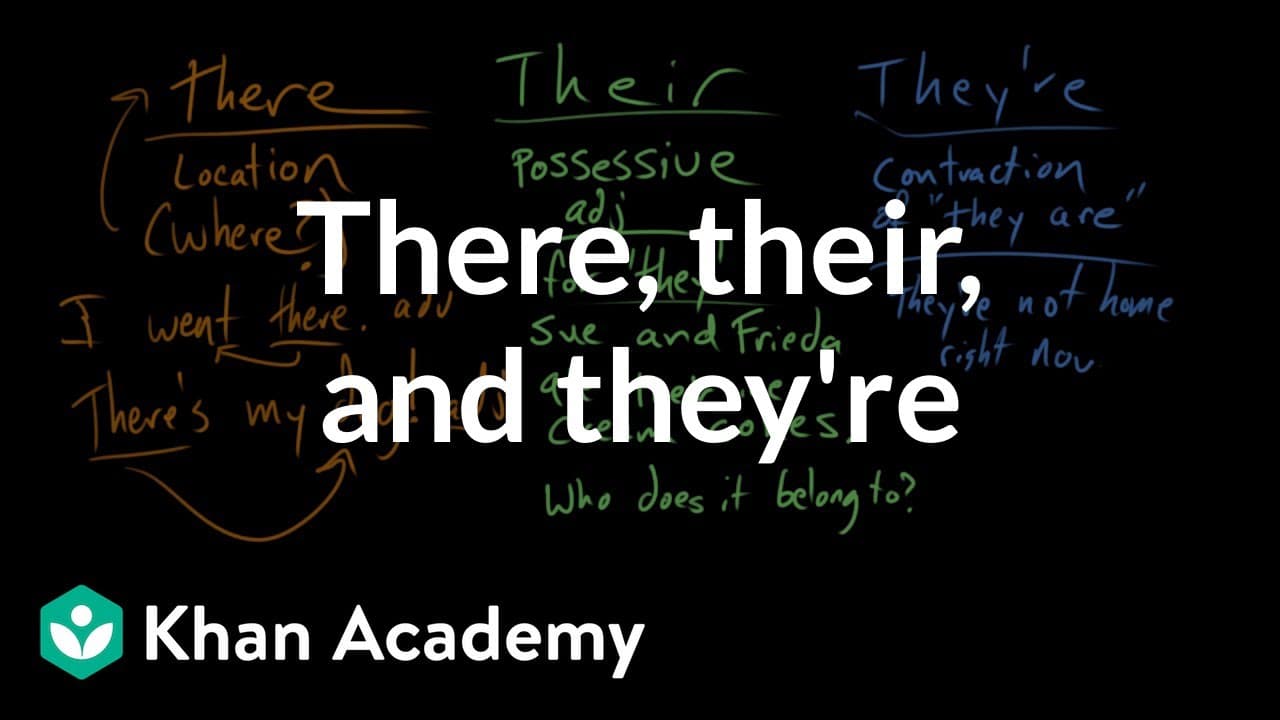
Mastering the Difference Between There, Their, and They're

Mastering the Difference Between There, Their, and They're

This video provides a clear and practical guide to mastering one of the most common confusion points in the English language: the difference between the homophones "there," "their," and "they're." Using a digital whiteboard format, the narrator visually breaks down each word's specific grammatical function—location, possession, and contraction—assigning a distinct color to each to aid memory retention. The lesson explores distinct strategies for identifying the correct word choice. For "there," the narrator demonstrates a "T to W" replacement trick to connect it to the question "Where?". For "their," the focus is placed on ownership and the question "Who does it belong to?". Finally, "they're" is explained through the mechanics of contractions, showing how it simply replaces "they are." Practical sentence examples are diagrammed on screen to reinforce these rules in context. This resource is highly valuable for English Language Arts classrooms ranging from upper elementary to middle school. It addresses a persistent writing error that affects students of all ages. Teachers can use this video as a hook for a grammar unit, a remediation tool for students struggling with mechanics, or a quick refresher before a writing assignment to encourage self-editing skills.
Khan AcademyKhan Academy

3mins 21s

How to Read and Write Contractions

How to Read and Write Contractions

This engaging animated video introduces students to the concept of contractions in the English language, explaining how two words can be combined into one using an apostrophe. Through clear visual demonstrations, it defines what contractions are and shows how specific letters are removed and replaced by an apostrophe to shorten words without changing their meaning. The video systematically guides viewers through identifying contractions in reading and forming them in writing. It breaks down common examples like "didn't" (did not), "she's" (she is), "couldn't" (could not), "I'm" (I am), and "I'll" (I will). The content emphasizes looking for clues in the remaining letters to decode the original words, helping students understand the author's message. Ideal for elementary language arts instruction, this resource serves as both an introduction and a practice tool. It uses relatable scenarios—like pirates searching for treasure or writing a letter to a friend—to contextualize grammar. Teachers can use this video to model how to mechanically construct contractions and to facilitate discussions about why we use them in everyday speech and writing.

GrammarSongs by MelissaGrammarSongs by Melissa

5mins 40s

Mastering Contractions in Reading and Writing

Mastering Contractions in Reading and Writing

This educational video provides a comprehensive introduction to contractions, explaining what they are, how they are formed, and how to use them correctly in both reading and writing. Using a clear whiteboard animation style, the narrator demonstrates how two words can be combined into one by removing specific letters and replacing them with an apostrophe. The video uses a recurring "monster" character to visualize the concept of the apostrophe "eating" the missing letters, making the abstract grammatical rule concrete and memorable for young learners. The content covers key grammatical themes including the function of the apostrophe, the preservation of meaning when using contractions, and the distinction between formal writing (without contractions) and informal writing (with contractions). It systematically breaks down common examples like "she is" to "she's," "did not" to "didn't," and "I am" to "I'm." A significant portion of the video focuses on a practical application where a character named Sasha writes a letter inviting a friend to a slumber party, allowing viewers to see how editing a text to include contractions can make writing sound more natural. For educators, this video serves as an excellent instructional tool for 2nd and 3rd-grade language arts curriculums. The visual metaphor of the "hungry apostrophe" provides a sticky learning hook for students struggling with punctuation placement. The step-by-step editing process shown in the letter-writing segment offers a perfect model for classroom editing activities, helping students move from simply identifying contractions to actively using them to improve sentence flow in their own writing.

GrammarSongs by MelissaGrammarSongs by Melissa

4mins 53s

Mastering the Three Uses of the Apostrophe

Mastering the Three Uses of the Apostrophe

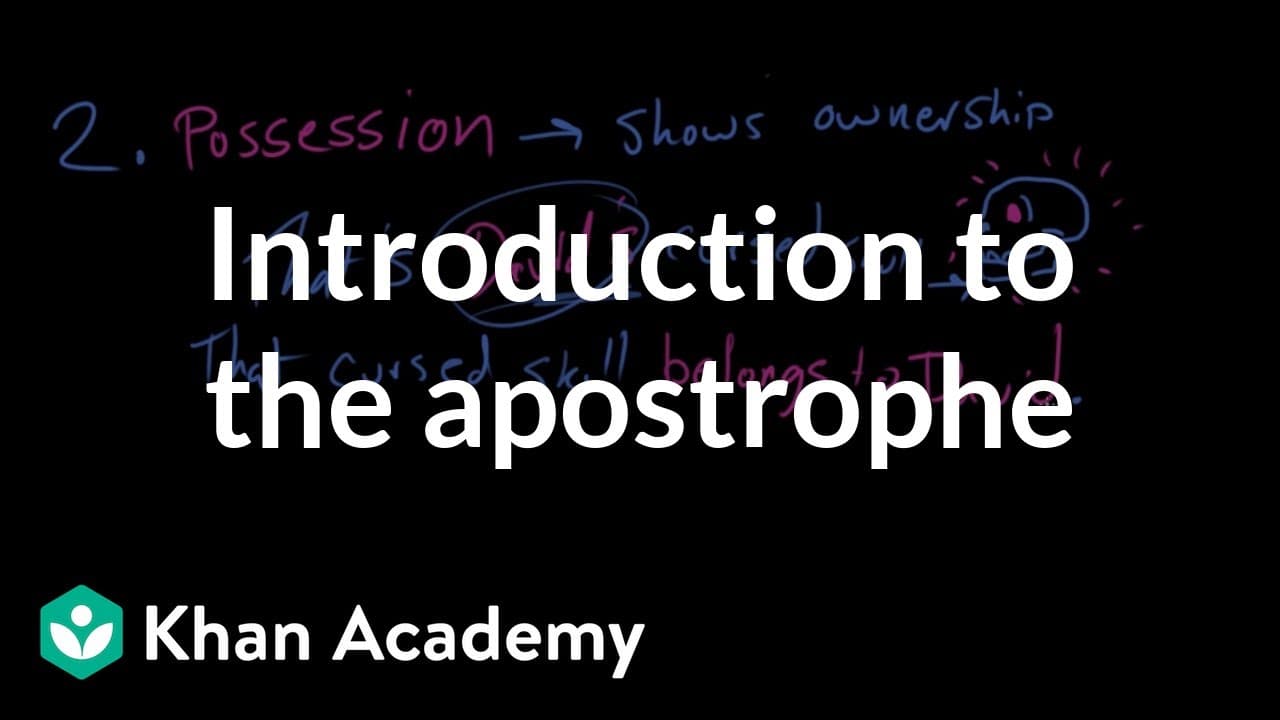
This engaging grammar tutorial features narrators David and Paige exploring the three distinct functions of the apostrophe in English. Using a digital whiteboard format, they visually demonstrate how this "floating comma" operates to change the meaning of words. The lesson covers the two most common uses—contractions and possession—before carefully explaining a highly specific and rare exception regarding the pluralization of lowercase letters. The video focuses on core mechanics of standard English conventions, specifically punctuation rules that often trip up students. A significant portion of the video is dedicated to distinguishing between possessive nouns (which need apostrophes) and simple plural nouns (which do not), directly addressing a frequent student error. The narrators use memorable, slightly humorous examples like "David's cursed skull" to illustrate concepts. For educators, this resource provides a clear, concise method for teaching punctuation mechanics. It effectively targets the misconception that apostrophes are used to make words plural, offering a visual "non-example" to reinforce the rule. The conversational banter and step-by-step breakdown make abstract grammatical rules concrete and accessible, making it an excellent tool for introducing the concept or reviewing it with upper elementary and middle school students.

Khan AcademyKhan Academy

4mins 50s

How to Choose Between It's and Its

How to Choose Between It's and Its

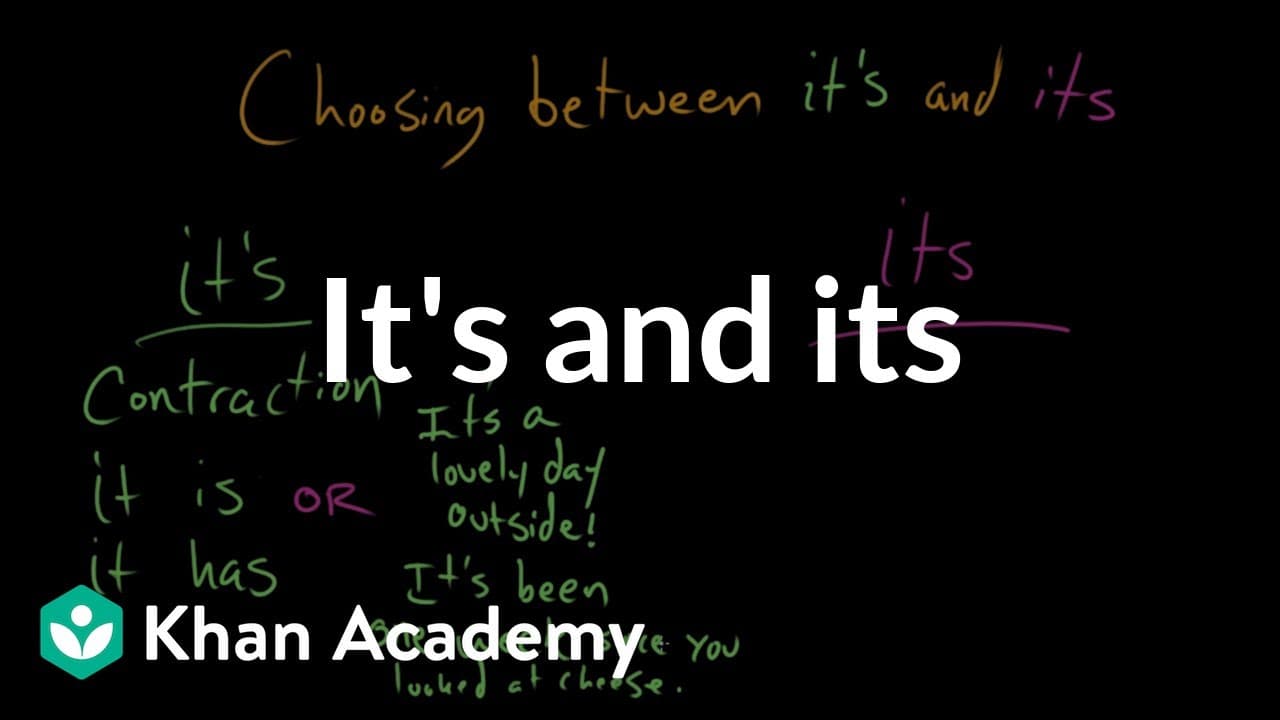
This concise grammar tutorial clarifies the difference between the commonly confused homophones "it's" and "its." Using a digital whiteboard, hosts David and Paige visually separate the two terms, defining "it's" (with an apostrophe) strictly as a contraction for "it is" or "it has," and "its" (without an apostrophe) as a possessive pronoun. The video utilizes humor, such as referencing popular song lyrics and drawing quirky illustrations, to make the definitions stick. The content explores key grammatical themes including the function of apostrophes in contractions versus their absence in possessive pronouns. It addresses the common misconception that all possessive words require apostrophes, explaining that pronouns like "his," "hers," and "its" are exceptions to the general rule used for nouns. A practical "substitution test" is introduced to help learners verify their word choice. For the classroom, this video serves as an engaging hook or review tool for writing and editing units. It provides students with a concrete strategy—replacing "its" with "his" or "her" to check for ownership—that they can immediately apply to their own writing. The conversational style and clear visual distinction between the two forms make it accessible for students struggling with these specific mechanics.

Khan AcademyKhan Academy

2mins 31s

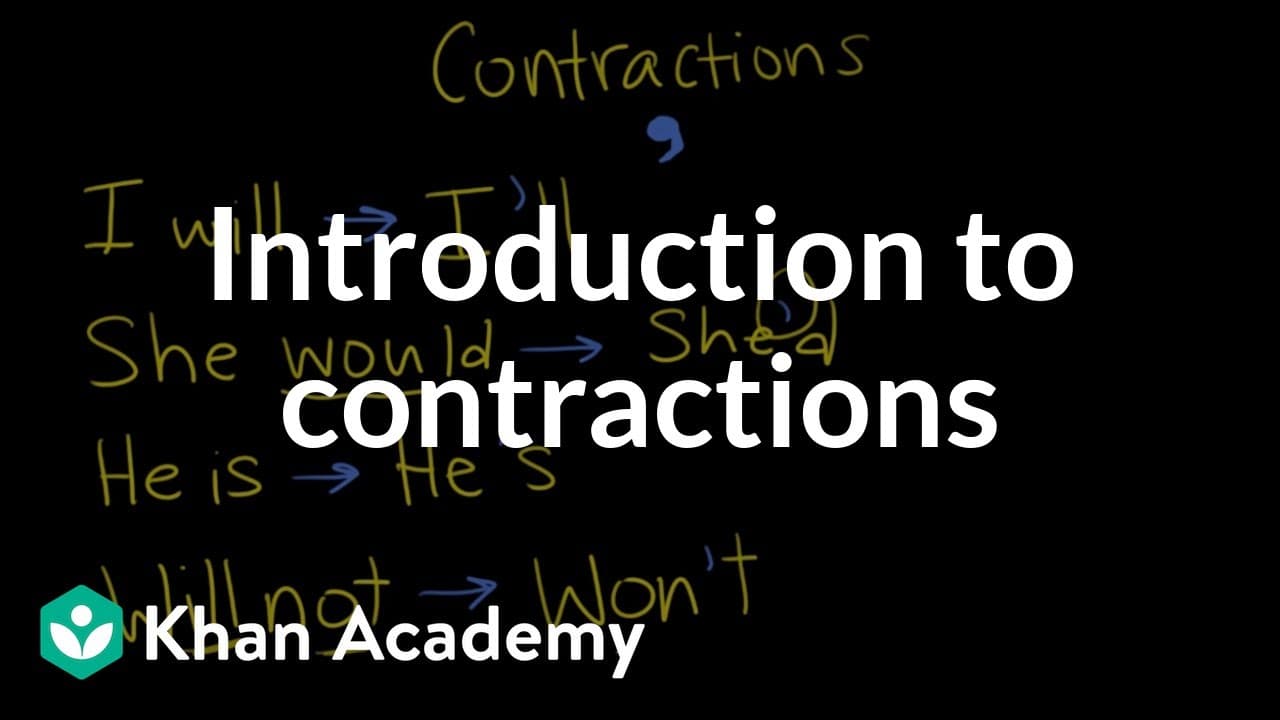
The Apostrophe and the Principle of Least Effort

The Apostrophe and the Principle of Least Effort

This educational video provides a clear and engaging introduction to contractions in English grammar, focusing on the role of the apostrophe. Two narrators, David and Paige, explore the linguistic concept known as the "principle of least effort," explaining that humans naturally shorten language to be more efficient—or "lazy"—when speaking. Through this lens, they demonstrate how two words combine into one, with the apostrophe acting as a placeholder for the missing letters. The video visually demonstrates several common contraction patterns using modal verbs and pronouns, such as "I will" becoming "I'll" and "he is" becoming "he's." It also addresses irregular contractions that don't follow standard rules, specifically highlighting the transformation of "will not" into "won't." The narrators use humor and visual aids to make the abstract rules of punctuation concrete and memorable. For educators, this resource serves as an excellent conceptual anchor for lessons on punctuation and writing flow. It moves beyond simple memorization by providing a "why" for contractions—efficiency in communication. This helps students understand that contractions are not just random rules but tools for natural-sounding speech and writing. It is particularly useful for visual learners who benefit from seeing letters literally disappear and be replaced by apostrophes on screen.

Khan AcademyKhan Academy

3mins 36s

Materials

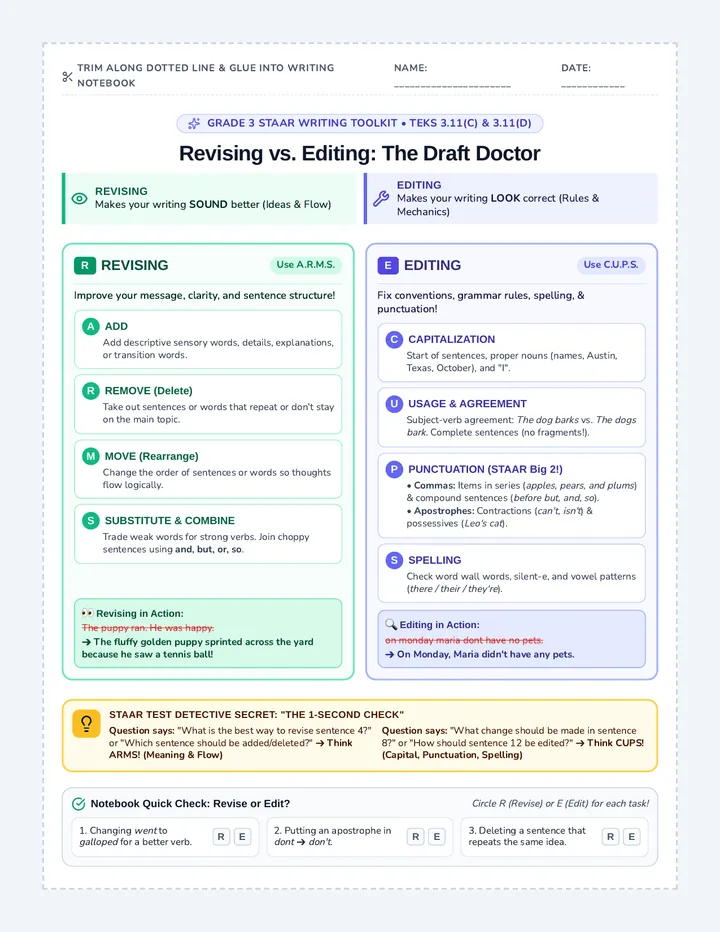
Draft Doctor Notes

Draft Doctor Notes

A 3rd-grade STAAR writing reference sheet designed to be pasted into a student notebook. It breaks down the critical differences between revising (ARMS) and editing (CUPS) with concrete examples, TEKS-aligned convention reminders, and a quick practice check.

HR

Hannah Rodriguez

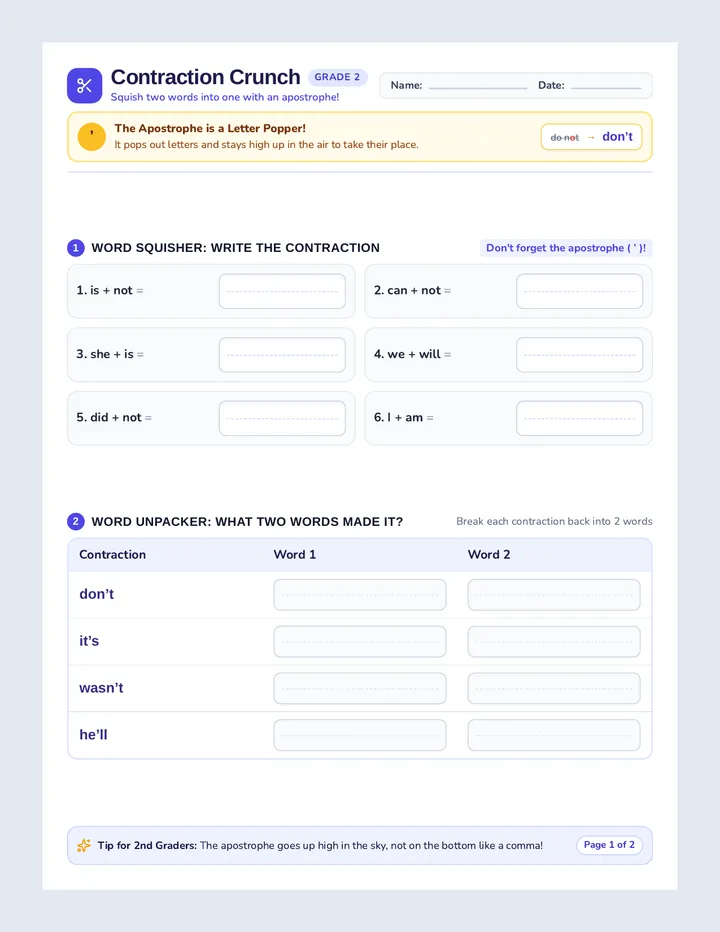
Contraction Crunch Worksheet

Contraction Crunch Worksheet

A 2nd-grade practice worksheet where students combine words, break contractions into two words, spot contractions in decodable sentences, and write original sentences using contractions.

A

andrea.keller

Sequences

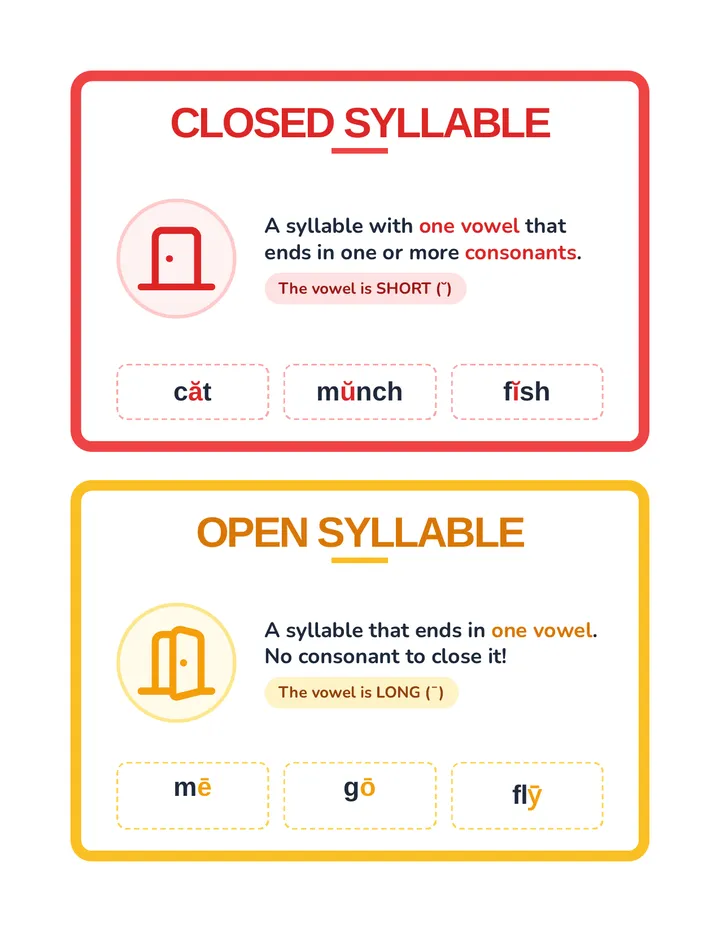
Syllable Type Anchor Charts

Foundational Skills Unit

A foundational skills unit covering literacy progress tracking and early numeracy strategies for decomposition and missing addends.

NT

Nicole Thomson

31
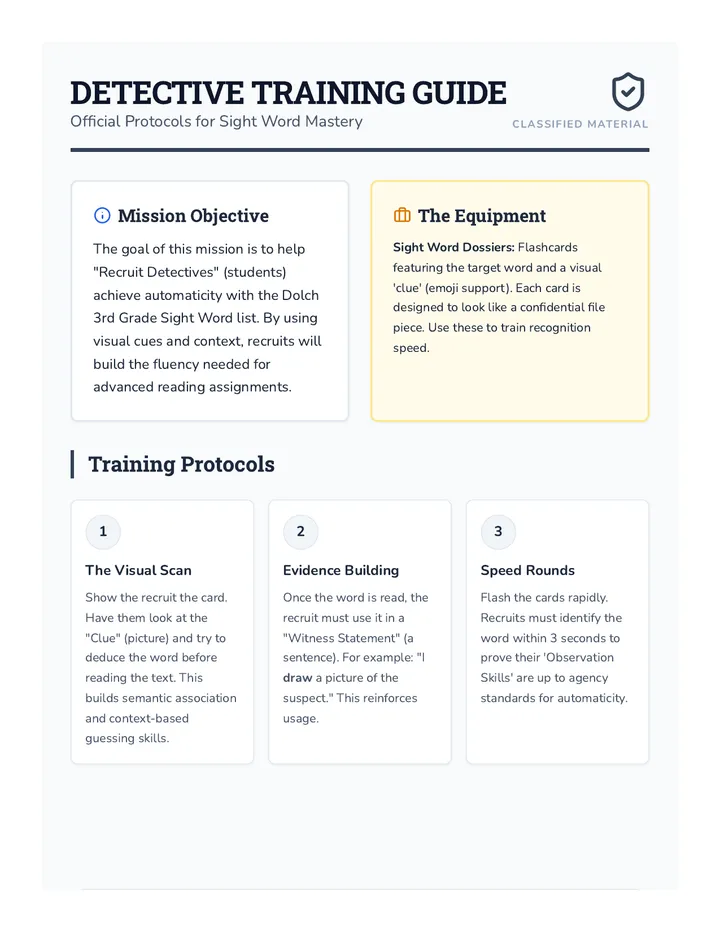
Detective Training Guide Teacher Resource

Literacy Detective Agency

A comprehensive 3rd-grade literacy unit themed around a secret detective agency. Students build foundational skills like sight word recognition and transition into high-stakes state test preparation through engaging, investigative missions.

MW

MacKenzie Wright

11
U9 L3 Do Now Slides

Do Now Mastery Series

A series of five "Do Now" slide decks for Grade 4 RLA, focusing on revising and editing skills aligned with TEKS 4.11. Each deck provides quick, timed practice sessions with original passages and multiple-choice questions.

DF

Denisse Flores

16
Daily Drops Practice Packet

Language Drops Routine

A high-impact, daily ELA review routine for 4th-grade students, aligned with TEKS Editing and Mechanics. Consistently revisits spelling, grammar, punctuation, and sentence editing across multiple weeks to build mastery.

EO

Emily Ondreas

18
Contraction Clues Worksheet

Contraction Adventures

An immersive grammar sequence where third-grade students practice identifying, forming, and writing sentences with contractions through engaging themes like detective investigations and animal safaris.

AM

Amanda McMahon

4
Zorbs Earth Mission Booklet

Word Explorers

A collection of primary grammar lessons designed to build key language skills through engaging stories and games. Lessons cover common contractions and essential parts of speech like nouns, verbs, and adjectives.

JA

Jamie Asack

6

Lessons

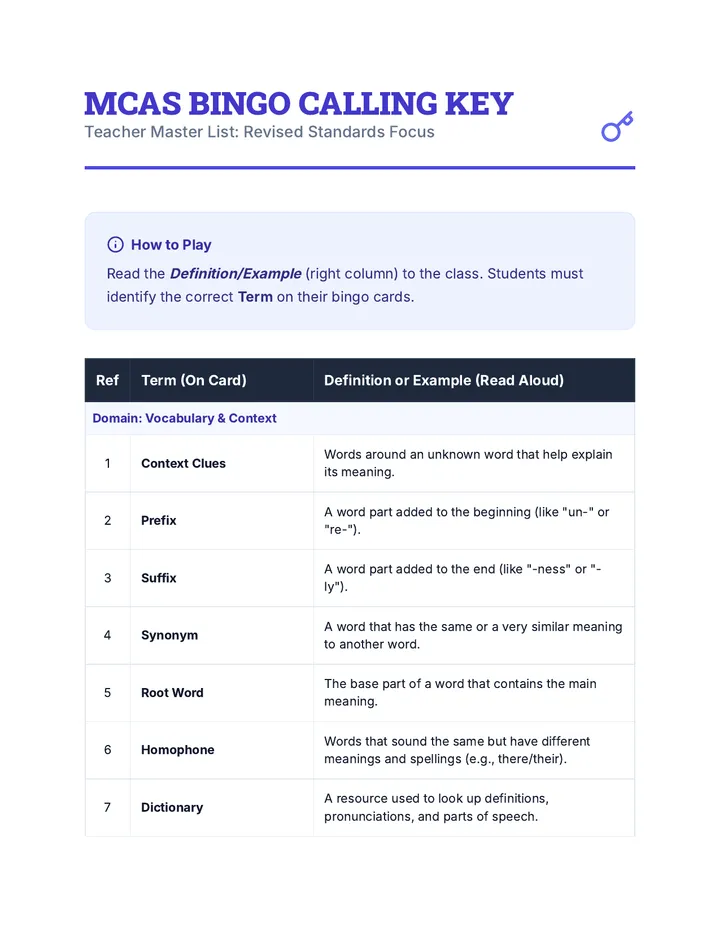
Master Calling Teacher Key

MCAS Bingo Bonanza

A comprehensive ELA review game designed to help students master MCAS standards through a competitive and engaging bingo format. The lesson covers vocabulary, literary elements, text structures, and grammar.

C

cfassel

3
Gymnastics Glow Slides

Vaulting Victory

A phonics-focused lesson for second graders centered on gymnastics, targeting short vowels, CVCe patterns, r-controlled vowels, and common contractions.

LC

Lenore Chieffo

6
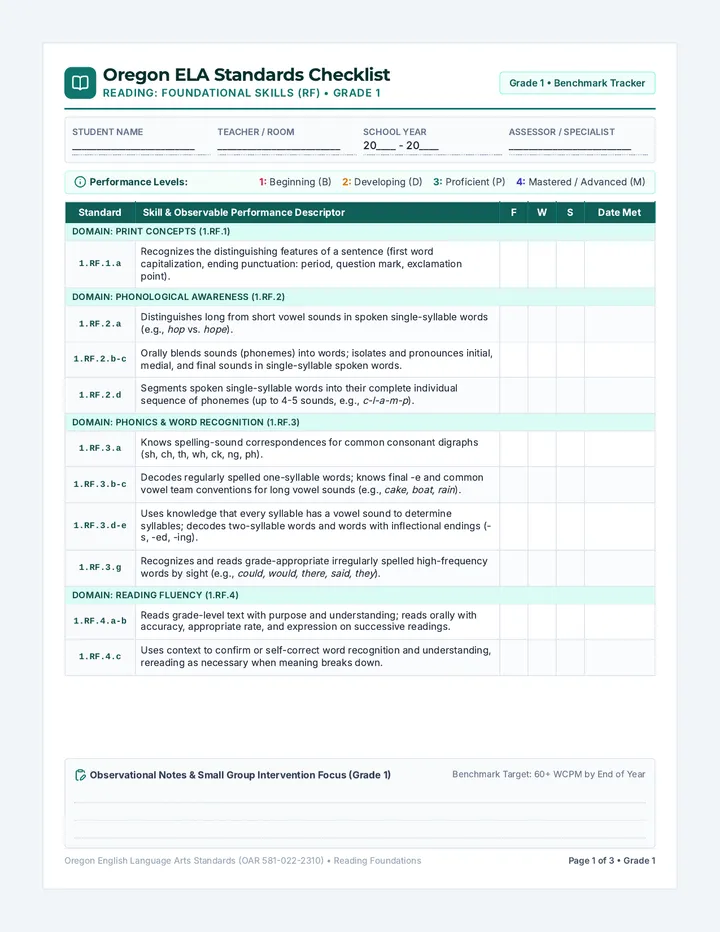
Reading Standards Checklist

Oregon Standards Trackers

A collection of standards-aligned diagnostic and progress-monitoring checklists for educators tracking Oregon English Language Arts benchmarks across Grades 1, 2, and 3. The suite covers reading foundational skills, text comprehension in literature and informational texts, and multi-genre writing competencies.

C

Carla

3
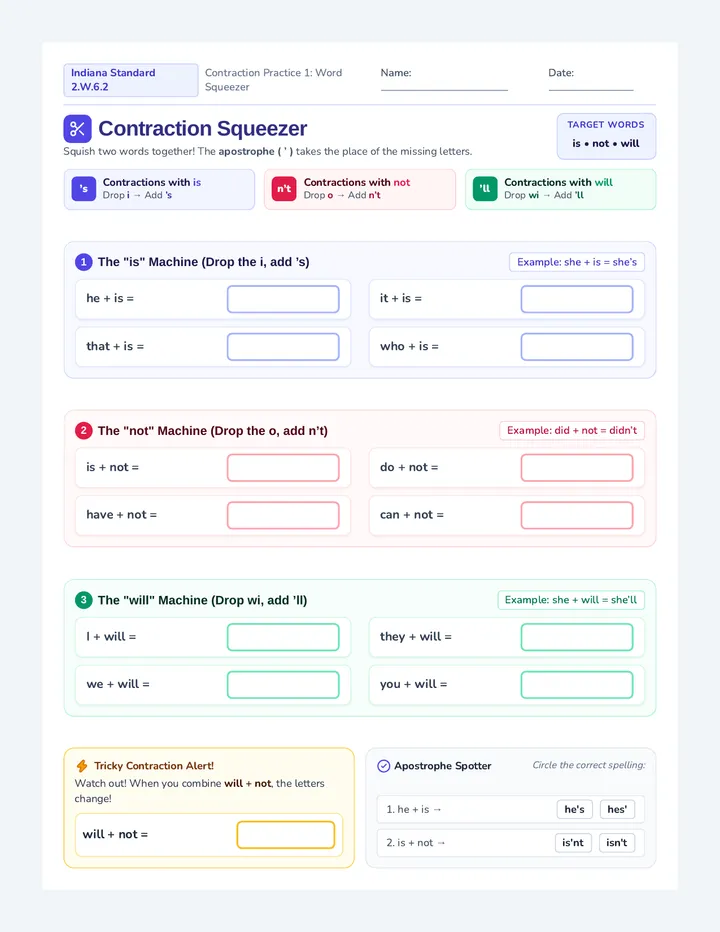
Contraction Squeezer Worksheet

Contraction Crunchers

A second-grade English Language Arts lesson aligned with Indiana Academic Standards (2.W.6.2) on mastering contractions with is, not, and will. Includes dedicated independent worksheets covering forming contractions, sentence substitutions, unpacking words, and application in original writing.

S

SHERI.BURNS

4
Pit Stop Tutor Guide

Dirt Track Derby

A high-octane, 60-minute tutoring lesson designed for an incoming 5th grader. It features an engaging dirt bike reading passage, targeted grammar, homophone, and contraction activities, and concludes with a competitive paper-and-pencil track racing game.

GE

Genevieve Eubanks

5
Grammar Sparks Worksheet

Grammar Sparks

A highly structured grammar lesson focusing on the distinction between 'its' and 'it's', customized with visual icon supports, step-by-step rule scaffolding, and self-monitoring checklists for students who benefit from predictable layouts.

SO

Saiko Otake

2