Lenny.com
Explore
Create
ActivitiesNewMathEnglish Language ArtsScience & EngineeringSocial StudiesGlobal LanguagesHealth & Physical EducationSpecial EducationCounseling & Life SkillsArts & CreativityESL
Lenny.com
Lenny.com
Explore
Create
ActivitiesNewMathEnglish Language ArtsScience & EngineeringSocial StudiesGlobal LanguagesHealth & Physical EducationSpecial EducationCounseling & Life SkillsArts & CreativityESL
Lenny.com
Lenny.com

Solutions

Lenny for EducatorsLenny for SchoolsLenny for Districts

Product

ExploreSign inCreateSupportAbout

Resources

Getting startedMTSS Acceleration Program

© 2026 Lenny Learning Inc.

TermsPrivacyAccessibility
LinkedInInstagramX
Lenny

Analyzing Literature

Textual evidence, thematic development, and narrative techniques across various genres. Builds skills in identifying irony, symbolism, and authorial intent.

English Language ArtsPhonics & Reading FoundationsLetter IdentificationLearn Letters A-ZLowercase and Uppercase LettersConsonants and VowelsLetter-Sound AssociationsLetter-Sound Associations: LowercaseLetter-Sound Associations: UppercaseBeginning and Ending SoundsRhymingBlending And SegmentingShort VowelsShort Vowel SoundsConsonant BlendsConsonant DigraphsBlends, Digraphs, and TrigraphsDigraphs, Blends, and Silent LettersLong Vowel SoundsLong Vowel PatternsShort and Long VowelsShort and Long Vowel PatternsSilent EVowel SoundsVowel TeamsR-Controlled VowelsDiphthongs: Oi, Oy, Ou, OwVariant VowelsVariant, Diphthong, And R Vowel PatternsSoft G And CSight WordsIrregular WordsWord RecognitionSyllablesSyllable TypesTwo-Syllable WordsMultisyllabic WordsPhoneme ManipulationDecodable TextsVocabularyAction WordsQuestion WordsNouns and AdjectivesClassify WordsCompound WordsSynonyms and AntonymsHomophonesHomophones and HomonymsShades of MeaningContext CluesPrefixes and SuffixesGreek and Latin RootsAnalogiesIdioms and AdagesForeign Words and ExpressionsWord Choice and UsageReference SkillsReading ComprehensionRead-Along Literary TextsRead-Along Informational TextsReality vs. FictionStory ElementsCharacterSequenceMain IdeaCause And EffectCompare And ContrastReading StrategiesText StructureAuthor's PurposeAuthor's Purpose And ToneAuthor's PerspectivePoint Of ViewThemeInference And ThemeInference And AnalysisPoetry ElementsLiterary DevicesAnalyzing LiteratureAnalyzing Informational TextsComparing TextsAudience, Purpose, And ToneBusiness DocumentsNovel StudyNonfiction Book StudyGrammar & MechanicsSentencesNounsVerbsAdjectivesPronounsCapitalizationPunctuationContractionsConjunctionsPrepositionsArticlesAdjectives And AdverbsVerb TypesVerb TensePronouns And AntecedentsPronoun TypesSubject-Verb AgreementDirect And Indirect ObjectsSentences, Fragments, And Run-OnsPhrases And ClausesCommasSemicolons, Colons, And CommasDashes, Hyphens, And EllipsesSpellingAbbreviationsFormattingVerb Tense And MoodMisplaced ModifiersWritingDescriptive DetailsCreative WritingOpinion WritingTopic SentencesOrganizing WritingLinking WordsSentence VarietyIntroductions And ConclusionsPersuasive And Opinion WritingExpository WritingPersuasive StrategiesDeveloping And Supporting ArgumentsTopic Sentences And Thesis StatementsSummarizingResearch SkillsEditing And RevisingActive And Passive Voice=Writing Clearly And ConciselyDebate & Public SpeakingPublic Speaking BasicsPersuasive TechniquesClaims and EvidenceTypes of ArgumentsReasoning TypesLogical FallaciesTopic ResearchOrganizing EvidenceDebate Speech OrganizationAttacking and Defending ArgumentsClash and EngagementImpact CalculusQuestioning and Cross-ExaminationCritical ThinkingInformal LogicFormal LogicInductive Reasoning

Videos

How to Read a Poem: Structure and Meaning

How to Read a Poem: Structure and Meaning

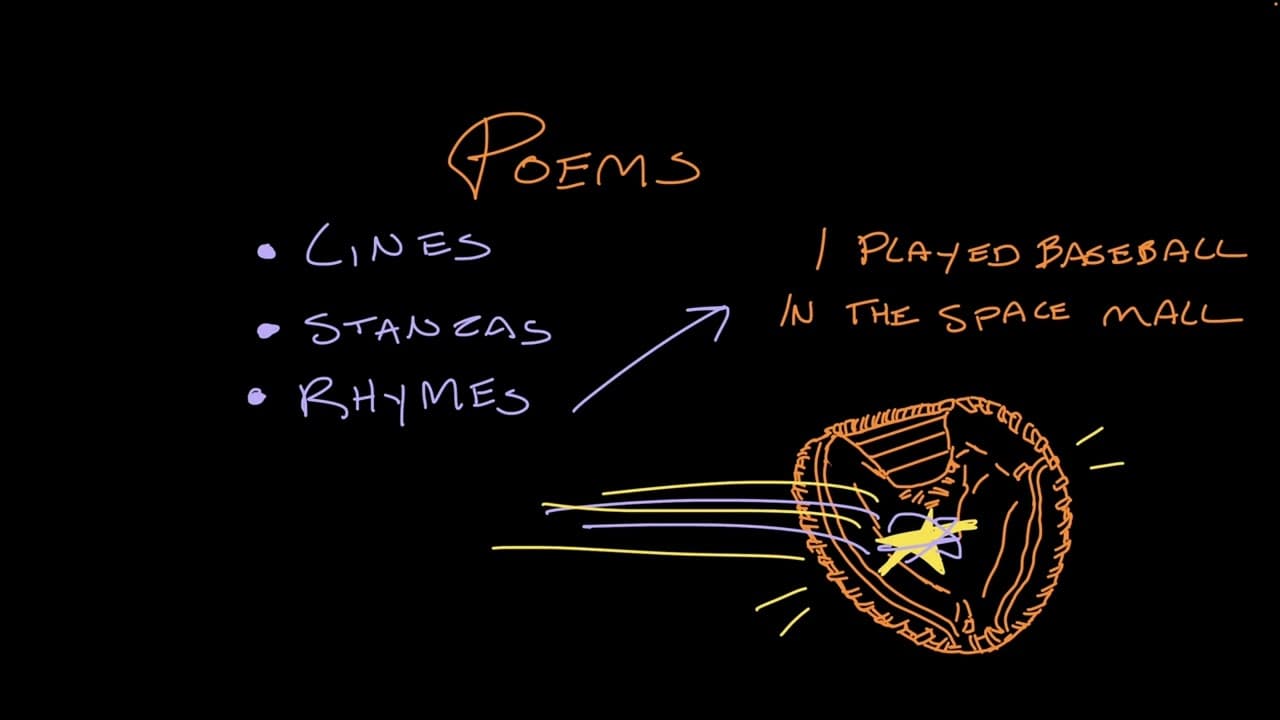
This educational video serves as an engaging introduction to poetry analysis, specifically focusing on how structure contributes to meaning. The narrator, David, welcomes viewers to "The Poem Zone" and breaks down the fundamental building blocks of poetry: lines, line breaks, stanzas, and rhyme. He defines poetry simply as "art made out of words" and explains that while poems play with sound and rhythm, they don't always have to rhyme. The visual style uses a blackboard aesthetic with handwritten text that appears in real-time to illustrate concepts. The core of the video features an original piece titled "Egg Poem," which the narrator reads and then dissects stanza by stanza. Through this close reading, the video demonstrates how a poem's structure can organize ideas and build an emotional arc. The narrator highlights how the poem uses a repeating structure ("Morning is...") to anchor each stanza while progressing from a calm morning to a chaotic one. For educators, this video is a powerful tool for bridging the gap between simply reading poetry and analyzing it. It explicitly teaches students to ask how lines and stanzas build meaning, rather than just identifying them as structural elements. The video introduces the concept of extended metaphor in a highly accessible way by connecting the cooking terms "easy," "medium," and "hard" to both the state of an egg and the speaker's emotional state, providing a clear model for students to use in their own literary analysis.

Khan AcademyKhan Academy

4mins 6s

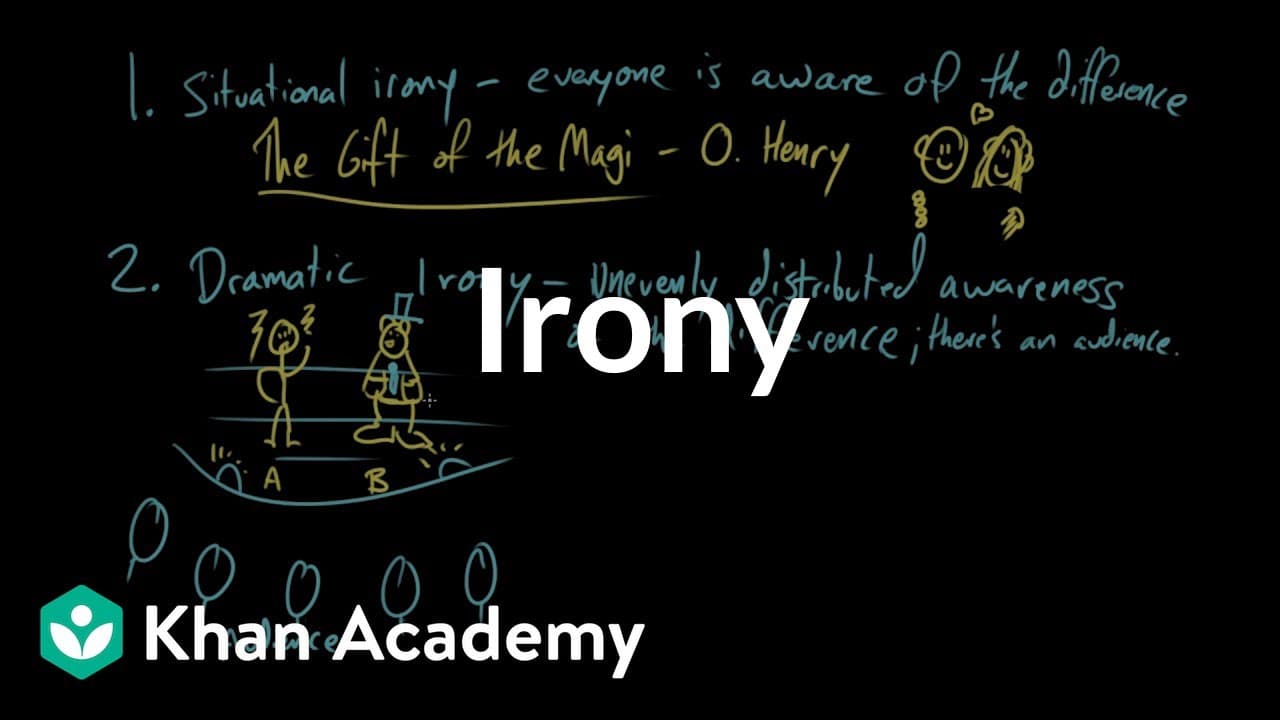
Understanding Situational, Dramatic, and Verbal Irony

Understanding Situational, Dramatic, and Verbal Irony

This educational video provides a comprehensive breakdown of the concept of irony, a literary device often misunderstood as simply meaning "coincidence" or "bad luck." The narrator defines irony fundamentally as "the difference between expectation and result" and proceeds to categorize it into three distinct types: situational irony, dramatic irony, and verbal irony. Each type is explained with clear definitions and illustrated through simple, hand-drawn animations that make abstract concepts concrete and accessible for learners. The video uses classic literature, such as O. Henry's "The Gift of the Magi," alongside humorous, invented scenarios involving bears in disguises, falling anvils, and lions hiding in Murphy beds to exemplify each type. The narrator carefully distinguishes between sarcasm and puns as subsets of verbal irony, helping students navigate the nuances of tone and context. The lesson culminates in a complex "mega example" that synthesizes all three types of irony into a single narrative scenario. For educators, this resource is an invaluable tool for clarifying a notoriously difficult concept in English Language Arts. It moves beyond simple definitions to provide a framework for analysis that students can apply to literature, film, and creative writing. The visual nature of the explanation supports diverse learners, while the humor keeps engagement high. It is particularly useful for introducing literary analysis units or clarifying misconceptions before tackling complex texts like Shakespeare or satirical works.

Khan AcademyKhan Academy

7mins 58s

Exploring Similes, Metaphors, and Idioms

Exploring Similes, Metaphors, and Idioms

This engaging animated video introduces students to the concept of figurative language, specifically focusing on three primary types: similes, metaphors, and idioms. The narrator explains that figurative language is like "art with words," allowing us to communicate in creative and fun ways rather than just literally. Through a series of clear examples and visual demonstrations, viewers learn how to identify and distinguish between these common literary devices. The video is structured into three distinct sections. First, it covers similes, defining them as comparisons using "like" or "as" (e.g., "quiet as mice"). Next, it introduces metaphors, explaining how they compare two things without using "like" or "as" (e.g., "the snow was a white blanket"). Finally, it explores idioms, describing them as phrases with special meanings different from their literal words (e.g., "raining cats and dogs"), and includes a fun fact about the sheer number of idioms in English. This resource is highly valuable for elementary Language Arts classrooms. It uses repetition, text highlighting, and relatable visuals (like animals and weather) to make abstract linguistic concepts concrete for young learners. Teachers can use this video to introduce a unit on creative writing, to support reading comprehension by helping students decode non-literal text, or as a review tool before a poetry or narrative writing assignment.
Homeschool PopHomeschool Pop

15mins 4s

When to Quote vs. When to Paraphrase in Essays

When to Quote vs. When to Paraphrase in Essays

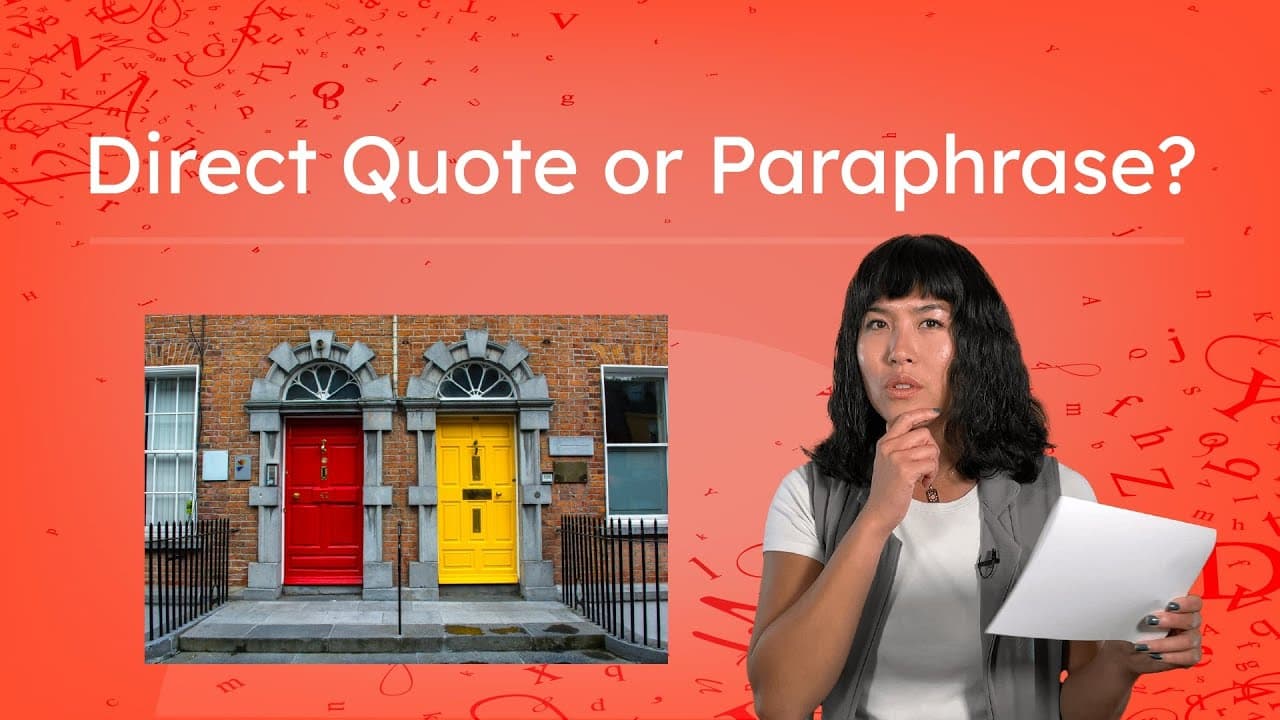
This instructional video guides high school students through the critical writing decision of when to use a direct quote versus a paraphrase in analytical essays. Using Toni Morrison's novel 'Beloved' as a case study, the presenter demonstrates how to integrate evidence effectively to support a thesis statement about literary motifs and character memory. The video distinguishes between analyzing specific language (which requires quotes) and summarizing events (which uses paraphrasing). The content covers key writing concepts including thesis statements, full direct quotes, partial quotes, paraphrasing, explanation sentences, and analysis sentences. It provides visual examples of how to structure a body paragraph, showing text on screen that integrates evidence with the student's own voice. The lesson emphasizes that the choice of evidence format depends entirely on the writer's purpose and what they intend to analyze. For educators, this video serves as an excellent model for teaching evidence integration and literary analysis. It moves beyond simple definitions to show the *why* and *how* of writing. Teachers can use this to help students move away from "quote bombing" (dropping quotes without context) and towards sophisticated embedding of partial quotes and meaningful analysis of diction and syntax.

Miacademy & MiaPrep Learning ChannelMiacademy & MiaPrep Learning Channel

10mins 30s

Unlocking Character Traits with the STEAL Method

Unlocking Character Traits with the STEAL Method

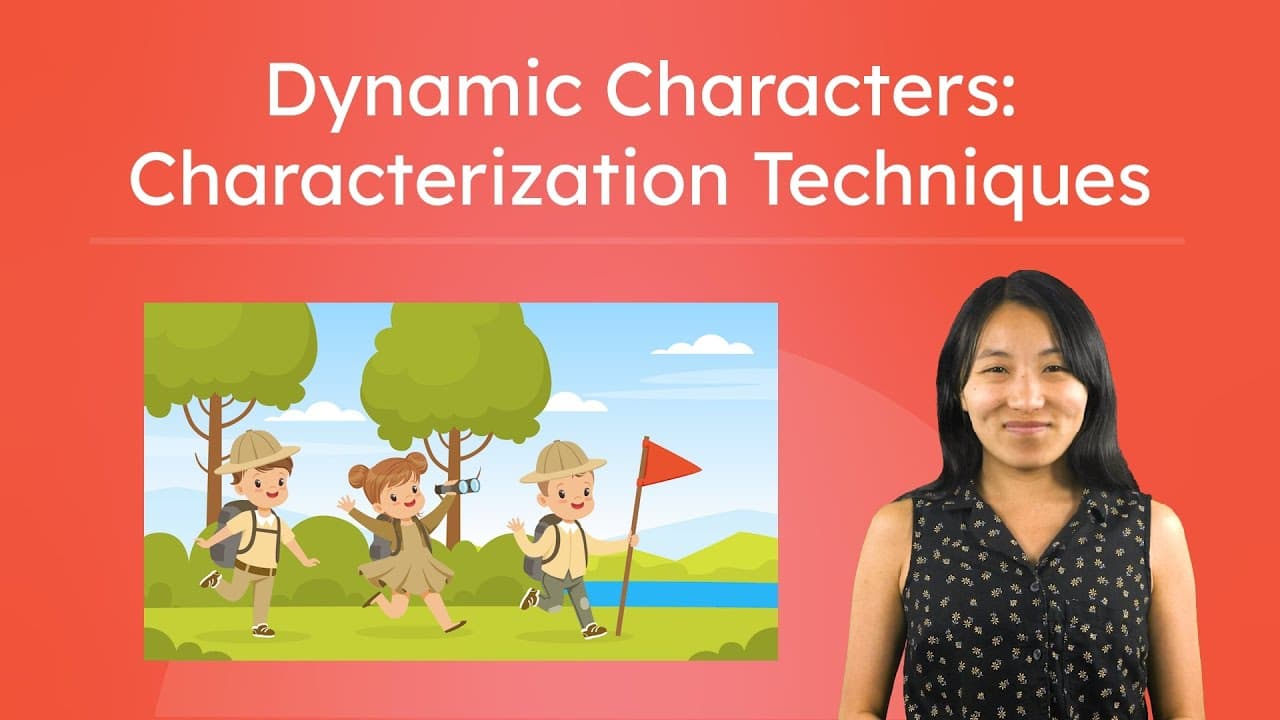
This educational video introduces students to the literary concepts of direct and indirect characterization through a narrative set in "Character Grove." Hosted by Caroline, the lesson features a talking tree character named Timotree who helps illustrate how authors reveal personality traits. The video contrasts direct descriptions with the more subtle "show, don't tell" method of indirect characterization, using specific examples to make the abstract concepts concrete. The core of the lesson focuses on the STEAL acronym (Speech, Thoughts, Effect on others, Actions, Looks) as a tool for analyzing indirect characterization. Viewers are guided through a text excerpt about a "young man" to identify evidence for each category of the STEAL method. The video then moves from identification to interpretation, demonstrating how to infer specific character traits like "caring," "trustworthy," and "practical" based on the text evidence gathered. This resource is highly valuable for Language Arts classrooms as it breaks down a complex analytical skill into manageable steps. It encourages critical thinking by asking students not just to find details, but to interpret what those details imply about a character's internal nature. The use of visual aids, on-screen text, and a memorable acronym makes it an excellent tool for introducing character analysis or supporting students who struggle with making inferences.

Miacademy & MiaPrep Learning ChannelMiacademy & MiaPrep Learning Channel

10mins 16s

How to Find the Theme of a Story

How to Find the Theme of a Story

This educational video provides a clear and engaging guide to understanding literary themes, distinguishing them from plots, summaries, and main ideas. The narrator explains that a theme is a universal message or lesson woven throughout a story that connects the text's action to big ideas about the world. To illustrate this abstract concept, the video uses relatable analogies, such as a humorous anecdote about food poisoning, to differentiate between what happens (plot) and what is learned (theme). The core of the video features a detailed retelling of the West African folktale of Anansi the Spider. In this story, the trickster Anansi attempts to hoard all the world's wisdom in a clay pot, only to be outsmarted by his young son. The narrative serves as a practical case study for the viewer, demonstrating how to apply specific analytical questions—such as "How did the characters grow?" and "What stays with you?"—to uncover the deeper meaning of a text. For educators, this resource is an excellent tool for scaffolding literary analysis skills in upper elementary and middle school classrooms. It offers a concrete framework of "Big Questions" that students can apply to any text to identify themes. The video addresses common confusion between themes and morals, provides a culturally responsive text example, and models the critical thinking process required to move from surface-level comprehension to deeper interpretation.

Khan AcademyKhan Academy

6mins 18s

Materials

Bad Seed Comprehension Worksheet

Bad Seed Comprehension Worksheet

A clean, black-and-white printer-friendly two-page reading comprehension worksheet for *The Bad Seed* by Jory John, featuring expanded multi-line writing spaces for all questions and story elements so students can write in complete sentences.

FT

Faith Timberman

Opinion Web Graphic Organizer

Opinion Web Graphic Organizer

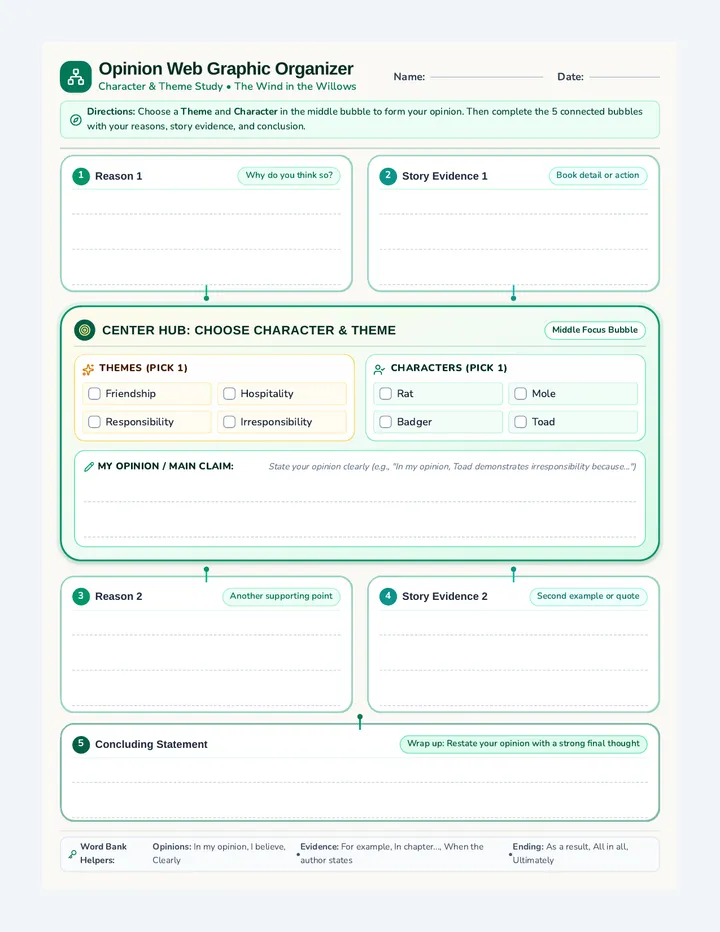
A simplified opinion writing web graphic organizer adapted for ESL and SPED learners. Features a central character and theme web hub directly attached via directional web arrows to four blank writing bubbles, supported by an expanded vocabulary and sentence starter word bank.

M

mkrapazzo

First Day Feelings Reading Worksheet

First Day Feelings Reading Worksheet

An adapted reading passage of Patty Hansen's 'The First Day of Middle School' with enlarged, readable text scaled to fit each page, complete with chunked passage text, comprehension check, and emoji reflection organizer.

PL

Patrick l

Mulan Legend Worksheet

Mulan Legend Worksheet

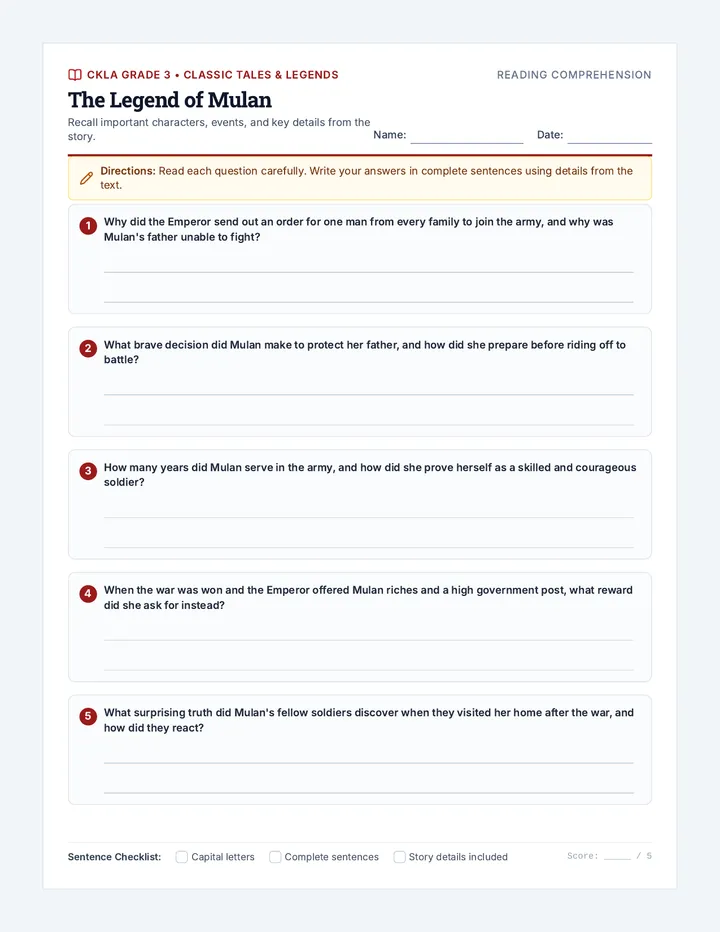
A Grade 3 CKLA reading comprehension worksheet featuring five recall questions on the story of Mulan. Students demonstrate understanding of key plot events, character motivations, and central details with dedicated handwriting lines.

T

tywest

Literary Lens Editing Checklist

Literary Lens Editing Checklist

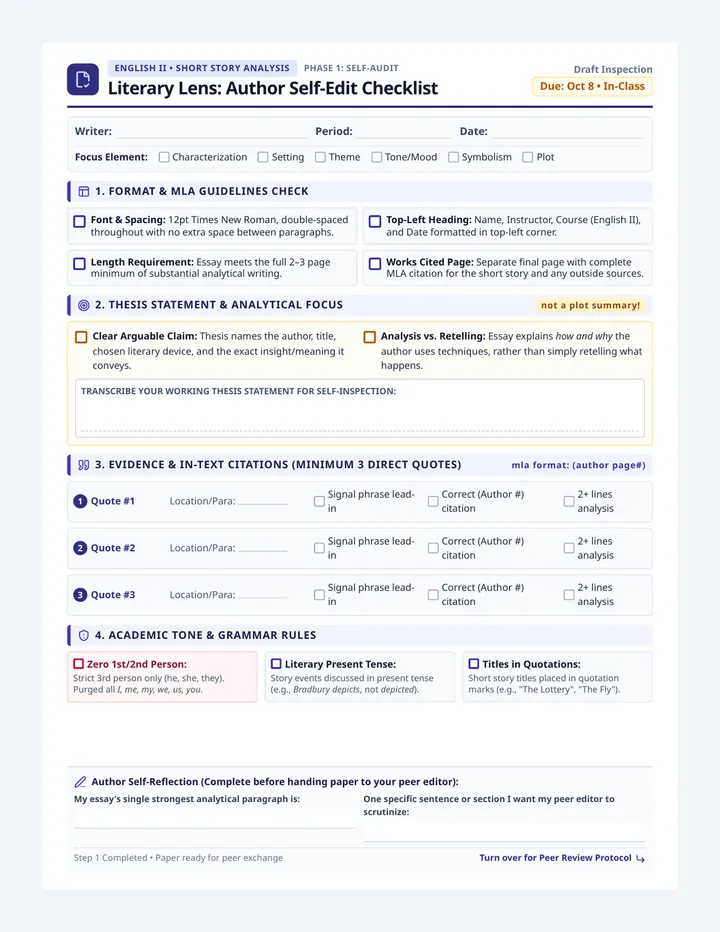
A comprehensive two-stage self-edit and peer-edit checklist designed for English II students assessing their short story literary analysis essays against assignment requirements, MLA guidelines, and analytical depth.

J

jmitchell

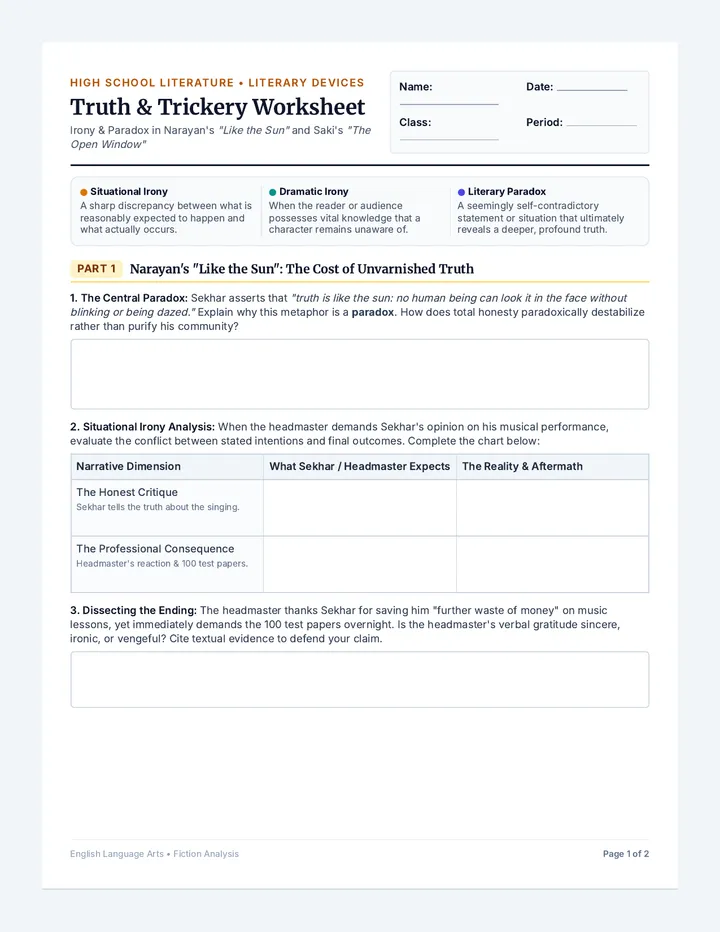
Truth and Trickery Worksheet

Truth and Trickery Worksheet

A rigorous two-page printable literary analysis worksheet exploring irony (situational, dramatic, verbal) and paradox through R.K. Narayan's 'Like the Sun' and Saki's 'The Open Window'. Includes textual analysis, comparative organizers, and synthesis response spaces for high school English students.

PR

Paula Rein

Sequences

Invention Quest Slides

Frindle Frenzy Novel Study

A 9-day novel study for 'Frindle' by Andrew Clements, aligned to 3rd Grade ELAR TEKS, focusing on character development, vocabulary, and plot analysis.

LH

Lucy Hellerman

56
Lesson Plan 1 Introduction

Literary Device Detectives

A comprehensive multi-unit sequence for 3rd and 4th grade students covering key literary devices: Introduction to Figurative Language, Onomatopoeia, Similes, Metaphors, Personification, and Idioms. Each unit provides 5 lesson plans, interactive notebook resources, and a wide variety of activities and stories designed to improve descriptive writing and reading comprehension.

JS

Janette Sullivan

105
Value Vault Teacher Guide

Metamorphosis Mastery

An 8-week deep dive into Kafka's Metamorphosis for special education students, focusing on abstract thinking, social value, and the human condition through high-engagement activities and visual organizers.

C

Ceeasia.walker

58
Prophecy and Power Slides

Shadows and Crowns

A series of lessons exploring Shakespeare's Macbeth, specifically designed for 10th-grade emergent bilingual students to master complex characterization and thematic elements.

DC

Dylan Clark

30
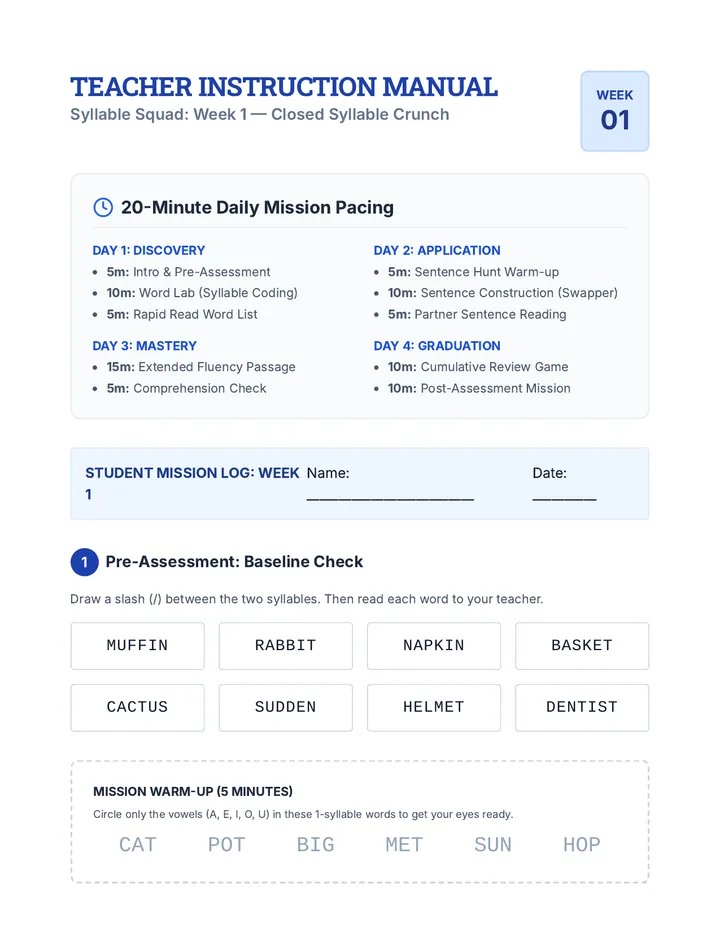
Week 1 Closed Syllable Manual

Syllable Squad Decoding Mission

A comprehensive 5-week phonics intervention focused on decoding two-syllable words across five major syllable types. Each week includes a pre-assessment, daily lessons with specific targets, student practice sheets, and a post-assessment.

KJ

Kelsey Jacobs

29
Question Anatomy Slides

Insight Investigators

A 6-week reading intervention unit for 5th graders focused on making inferences, analyzing questions, and using text evidence. Themes include mysteries, sports (baseball and basketball), and dragons to engage high-interest readers.

MK

Meg Keene

48