Lenny.com
Explore
Create
ActivitiesNewMathEnglish Language ArtsScience & EngineeringSocial StudiesGlobal LanguagesHealth & Physical EducationSpecial EducationCounseling & Life SkillsArts & CreativityESL
Lenny.com
Lenny.com
Explore
Create
ActivitiesNewMathEnglish Language ArtsScience & EngineeringSocial StudiesGlobal LanguagesHealth & Physical EducationSpecial EducationCounseling & Life SkillsArts & CreativityESL
Lenny.com
Lenny.com

Solutions

Lenny for EducatorsLenny for SchoolsLenny for Districts

Product

ExploreSign inCreateSupportAbout

Resources

Getting startedMTSS Acceleration Program

© 2026 Lenny Learning Inc.

TermsPrivacyAccessibility
LinkedInInstagramX
Lenny

Linking Words

Connective phrases for sequencing, contrasting, and adding information. Builds cohesive writing skills by illustrating logical relationships between clauses and paragraphs.

English Language ArtsPhonics & Reading FoundationsLetter IdentificationLearn Letters A-ZLowercase and Uppercase LettersConsonants and VowelsLetter-Sound AssociationsLetter-Sound Associations: LowercaseLetter-Sound Associations: UppercaseBeginning and Ending SoundsRhymingBlending And SegmentingShort VowelsShort Vowel SoundsConsonant BlendsConsonant DigraphsBlends, Digraphs, and TrigraphsDigraphs, Blends, and Silent LettersLong Vowel SoundsLong Vowel PatternsShort and Long VowelsShort and Long Vowel PatternsSilent EVowel SoundsVowel TeamsR-Controlled VowelsDiphthongs: Oi, Oy, Ou, OwVariant VowelsVariant, Diphthong, And R Vowel PatternsSoft G And CSight WordsIrregular WordsWord RecognitionSyllablesSyllable TypesTwo-Syllable WordsMultisyllabic WordsPhoneme ManipulationDecodable TextsVocabularyAction WordsQuestion WordsNouns and AdjectivesClassify WordsCompound WordsSynonyms and AntonymsHomophonesHomophones and HomonymsShades of MeaningContext CluesPrefixes and SuffixesGreek and Latin RootsAnalogiesIdioms and AdagesForeign Words and ExpressionsWord Choice and UsageReference SkillsReading ComprehensionRead-Along Literary TextsRead-Along Informational TextsReality vs. FictionStory ElementsCharacterSequenceMain IdeaCause And EffectCompare And ContrastReading StrategiesText StructureAuthor's PurposeAuthor's Purpose And ToneAuthor's PerspectivePoint Of ViewThemeInference And ThemeInference And AnalysisPoetry ElementsLiterary DevicesAnalyzing LiteratureAnalyzing Informational TextsComparing TextsAudience, Purpose, And ToneBusiness DocumentsNovel StudyNonfiction Book StudyGrammar & MechanicsSentencesNounsVerbsAdjectivesPronounsCapitalizationPunctuationContractionsConjunctionsPrepositionsArticlesAdjectives And AdverbsVerb TypesVerb TensePronouns And AntecedentsPronoun TypesSubject-Verb AgreementDirect And Indirect ObjectsSentences, Fragments, And Run-OnsPhrases And ClausesCommasSemicolons, Colons, And CommasDashes, Hyphens, And EllipsesSpellingAbbreviationsFormattingVerb Tense And MoodMisplaced ModifiersWritingDescriptive DetailsCreative WritingOpinion WritingTopic SentencesOrganizing WritingLinking WordsSentence VarietyIntroductions And ConclusionsPersuasive And Opinion WritingExpository WritingPersuasive StrategiesDeveloping And Supporting ArgumentsTopic Sentences And Thesis StatementsSummarizingResearch SkillsEditing And RevisingActive And Passive Voice=Writing Clearly And ConciselyDebate & Public SpeakingPublic Speaking BasicsPersuasive TechniquesClaims and EvidenceTypes of ArgumentsReasoning TypesLogical FallaciesTopic ResearchOrganizing EvidenceDebate Speech OrganizationAttacking and Defending ArgumentsClash and EngagementImpact CalculusQuestioning and Cross-ExaminationCritical ThinkingInformal LogicFormal LogicInductive Reasoning

Videos

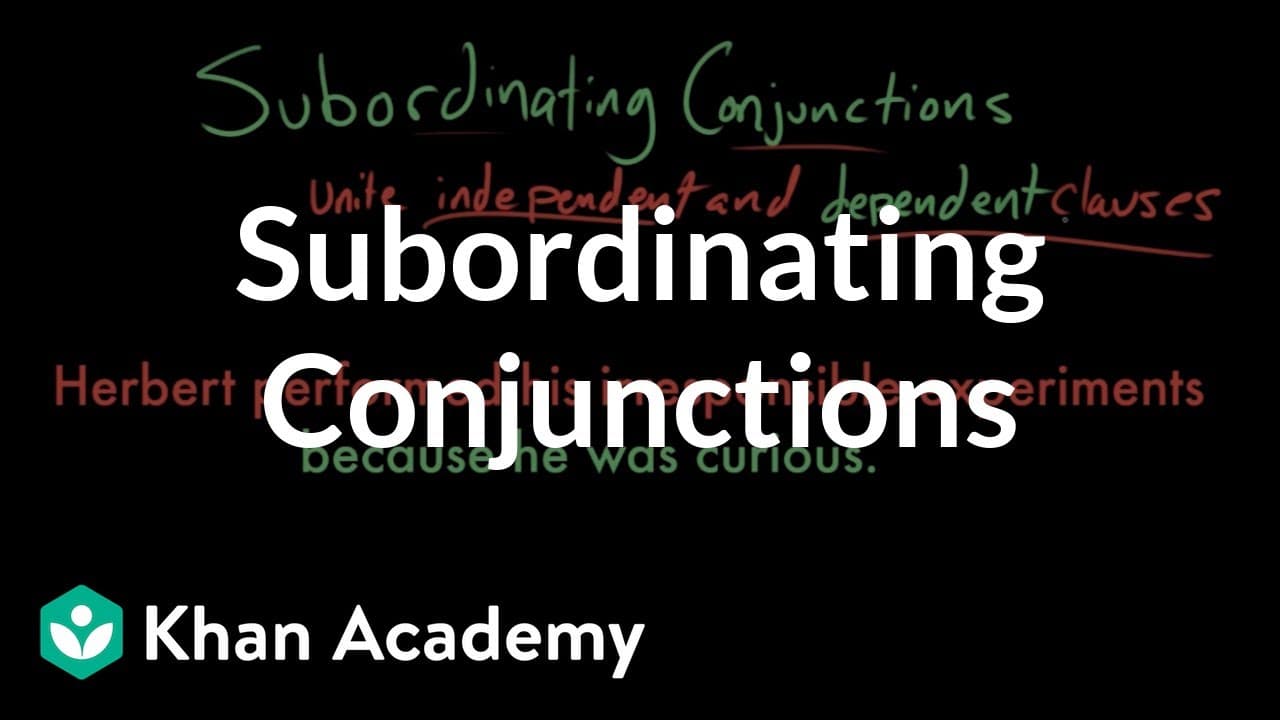
How Subordinating Conjunctions Connect Independent and Dependent Clauses

How Subordinating Conjunctions Connect Independent and Dependent Clauses

This educational video provides a clear and comprehensive introduction to subordinating conjunctions and their role in sentence structure. The narrator breaks down the fundamental difference between independent and dependent clauses, explaining that while all sentences are clauses, not all clauses are sentences. Using the helpful analogy of a tree (independent clause) and a ladder (dependent clause), the video demonstrates how subordinating conjunctions function to connect these two types of clauses to add context and detail to writing. The content covers key grammatical concepts including the definition of a clause (subject plus verb), the identifying features of sentence fragments, and the distinction between coordinating conjunctions (FANBOYS) and subordinating conjunctions. Through humorous example sentences involving characters like Herbert and Sir Reginald, viewers learn practical tests—such as the "Yeah? So what?" test—to identify dependent clauses and determine if a sentence is grammatically complete. For educators, this video is an excellent resource for teaching complex sentence structure and helping students avoid sentence fragments. It simplifies abstract grammatical terms into tangible concepts using visual aids and memorable analogies. The video concludes with a comprehensive list of common subordinating conjunctions, making it a useful reference tool for students looking to add variety and sophistication to their writing.

Khan AcademyKhan Academy

5mins 27s

Exploring Informative Text Types: Descriptive, Comparative, and Procedural

Exploring Informative Text Types: Descriptive, Comparative, and Procedural

In this engaging Language Arts lesson set in the fictional village of "Informatown," students learn how to analyze and categorize different types of informative non-fiction texts. The video begins by reviewing the general characteristics of informative writing—logical structure, objective central ideas, and precise language—before diving into three specific text structures: Descriptive, Comparative, and Procedural. Through the narrative of organizing a messy library, the host guides viewers in examining three distinct sample texts about Nigerian culture, the Dominican Republic, and Lakota Dreamcatchers. Students learn to identify specific structural clues and transition words that distinguish one text type from another, such as looking for sensory details in descriptive texts, contrasting words in comparative texts, and chronological steps in procedural texts. This video is highly valuable for upper elementary and middle school classrooms as it moves beyond simple reading comprehension to structural analysis. It provides concrete strategies for recognizing how authors organize information to achieve specific purposes. Teachers can use this video to introduce a unit on non-fiction text structures, support lessons on transition words, or as a model for students' own informative writing projects.

Miacademy & MiaPrep Learning ChannelMiacademy & MiaPrep Learning Channel

8mins 48s

Mastering Correlative Conjunctions and Matched Word Pairs

Mastering Correlative Conjunctions and Matched Word Pairs

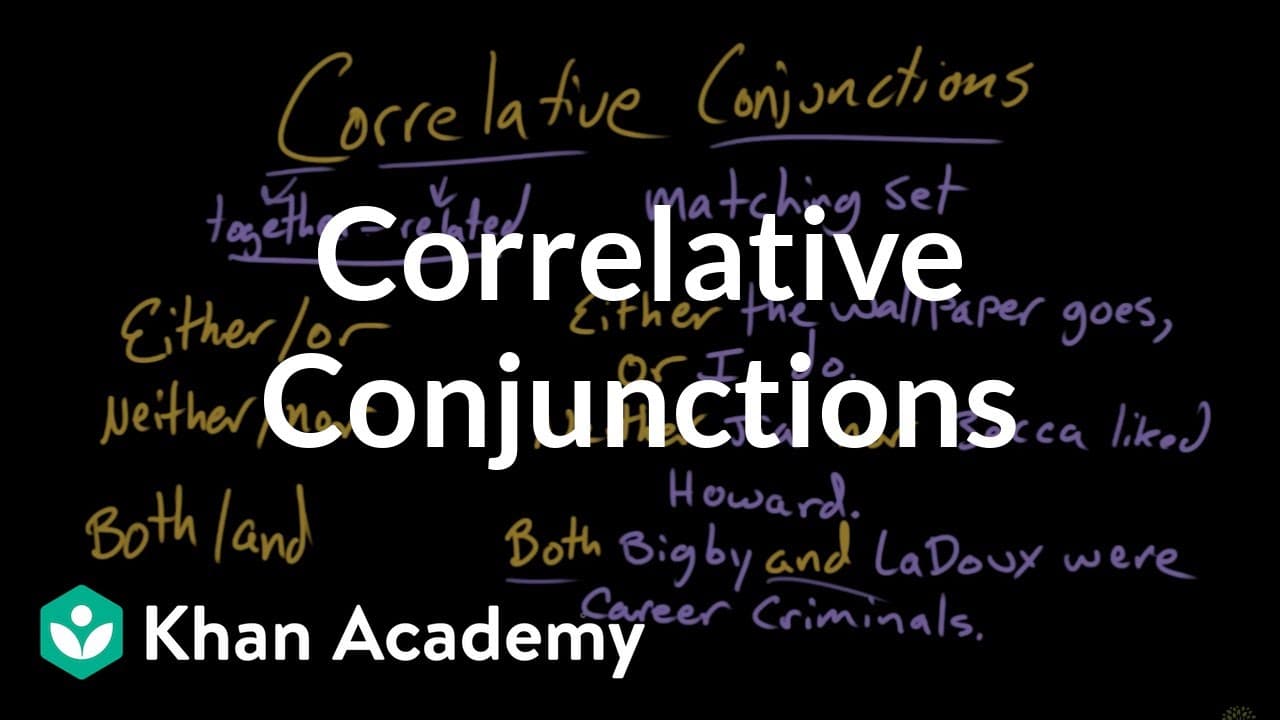
This educational video provides a clear and engaging introduction to correlative conjunctions, breaking down the intimidating terminology into simple, manageable concepts. The narrator, David, uses etymology to explain that "correlative" simply means "related together," defining these conjunctions as matching sets used to connect sentence parts. Through five distinct examples—either/or, neither/nor, both/and, as/so, and whether/or—the video demonstrates how these pairs function within sentences to create balance and establish relationships between ideas. The video explores key grammatical themes such as sentence structure, parallel construction, and the specific nuances of different conjunction pairs. It covers the difference between positive choices (either/or), negative rejection (neither/nor), inclusion (both/and), formal consequence (as/so), and possibilities (whether/or). The lesson also briefly touches upon pronunciation variations (e.g., ee-ther vs. eye-ther) and uses memorable, sometimes humorous examples involving famous quotes and fictional characters to illustrate usage. For educators, this video serves as an excellent tool for teaching intermediate grammar and writing skills. It transforms abstract grammatical rules into concrete patterns that students can recognize and apply. The breakdown of etymology promotes critical thinking about vocabulary, while the distinct examples provide a template for students to model their own writing. It is particularly useful for lessons on sentence variety, improving writing flow, and understanding the logic behind connecting clauses.
Khan AcademyKhan Academy

3mins 12s

How to Outline and Write a Comparative Essay

How to Outline and Write a Comparative Essay

This educational video guides students through the process of writing an informative comparative essay, using the specific example of comparing traditional Korean music (Gugak) with modern K-pop. The lesson takes place in the fictional setting of "Informatown," where the host explains how to take raw information—in this case, a fact sheet about South Korean music—and transform it into a structured, cohesive text. The video emphasizes the importance of planning before writing, using analogies like drawing outlines to explain the concept. The content covers the complete writing lifecycle: selecting the appropriate text type based on the data (comparative), grouping information logically to form body paragraphs, creating a structured outline with Roman numerals, and drafting the essay with attention to topic sentences, transitions, and hooks. It specifically breaks down the structure of an essay into an introduction (hook, background, central idea), body paragraphs (grouped by theme rather than just listing facts), and a conclusion. The video models each step, providing clear examples of how to turn bullet points into flowing prose. For educators, this video serves as an excellent model for a writing workshop. It scaffolds the writing process by breaking it down into manageable chunks, making the often-daunting task of essay writing approachable. By using a culturally relevant and engaging topic (K-pop), it captures student interest while teaching fundamental literacy skills such as synthesizing information, organizing ideas hierarchically, and using transitional phrases to improve flow. The video includes built-in pause points for student practice, making it ready-to-use for direct instruction.

Miacademy & MiaPrep Learning ChannelMiacademy & MiaPrep Learning Channel

11mins 27s

Building Bridges: How to Use Transition Words

Building Bridges: How to Use Transition Words

Join an engaging adventure to the 'Desert of Description' where students learn to build 'Transitional Bridges' to connect their ideas. This video uses a narrative quest format featuring a presenter and a robot companion named Mia to explain the purpose and function of transition words in writing. It breaks down transition words into four key categories: Emphasis, Addition, Compare and Contrast, and Order. The video provides clear definitions and modeled examples for each category, using an ongoing story about a character named Finn stranded on a barren island. Through this story, students see exactly how transition words improve flow, clarify meaning, and add sophistication to a narrative. The content moves from identifying existing transition words to selecting the best words to fill in blanks, providing scaffolded practice within the video itself. This resource is an excellent tool for Language Arts classrooms focusing on narrative writing, sentence fluency, or revision strategies. It actively involves students by asking them to pause, think, and complete tasks, making it more than just a passive viewing experience. It addresses the common struggle of 'choppy' writing by visually demonstrating how these words act as bridges between isolated islands of thought.

Miacademy & MiaPrep Learning ChannelMiacademy & MiaPrep Learning Channel

10mins 51s

Baking an Argument: How to Synthesize Sources in Writing

Baking an Argument: How to Synthesize Sources in Writing

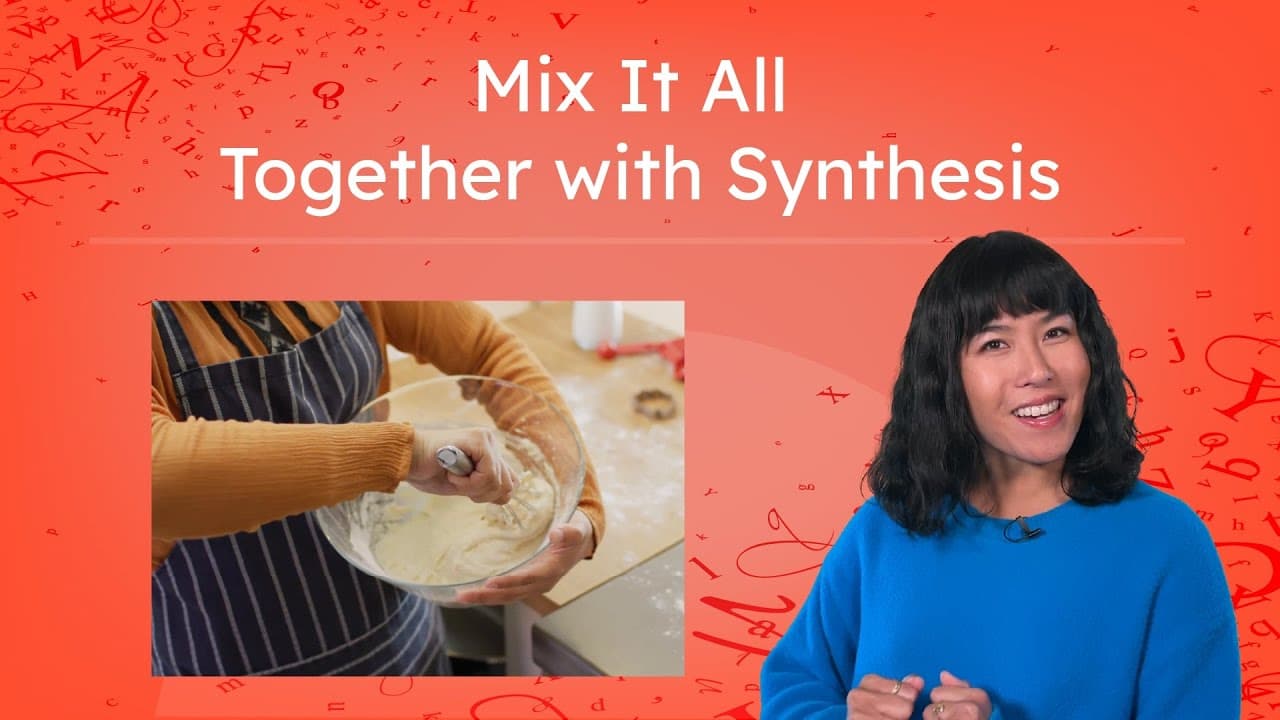
This engaging instructional video uses an extended metaphor of baking a cake to teach students the complex writing skill of synthesizing sources. The host explains that just as baking requires gathering ingredients (evidence), mixing them (combining sources), and decorating (adding original insight), effective writing involves integrating multiple information sources to create something new. The video clarifies the critical difference between merely summarizing information and truly synthesizing it to reach a broader conclusion.

Miacademy & MiaPrep Learning ChannelMiacademy & MiaPrep Learning Channel

12mins 16s

Materials

Sentence Editing Practice Worksheet

Sentence Editing Practice Worksheet

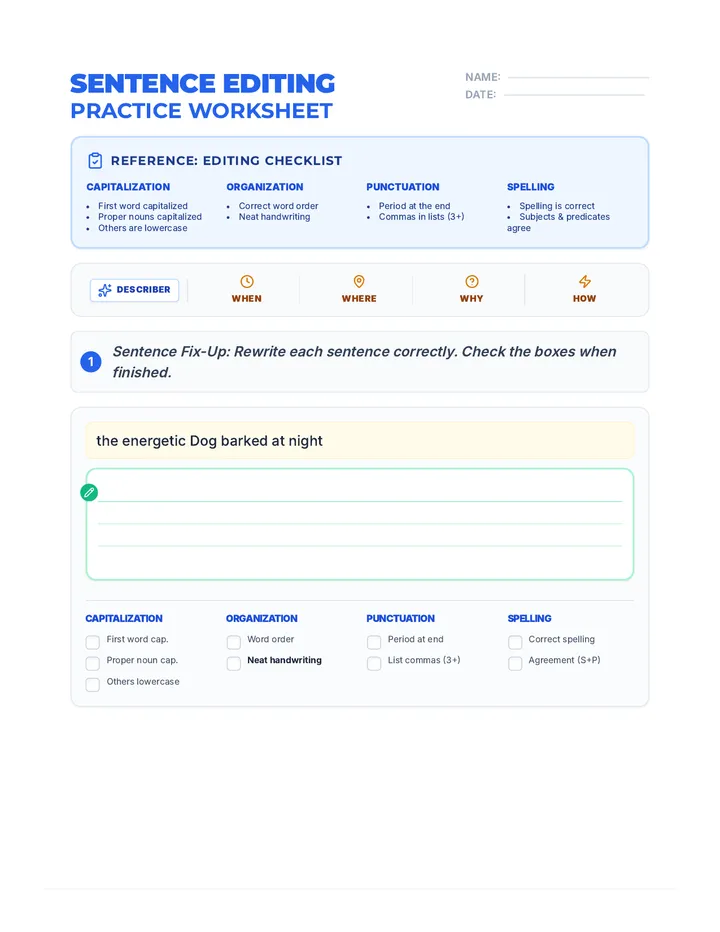
An extensive 6-page worksheet for sentence building and correction. Features an editing checklist for review at the top of Page 1, followed by four 'Sentence Fix-Up' items and six complex frames. All tasks include 4 handwriting lines and a standardized checklist with increased font sizes for better legibility. Subtitle removed and font sizes polished for classroom use.

EV

Erin Venuti

Space Writers Feedback Form

Space Writers Feedback Form

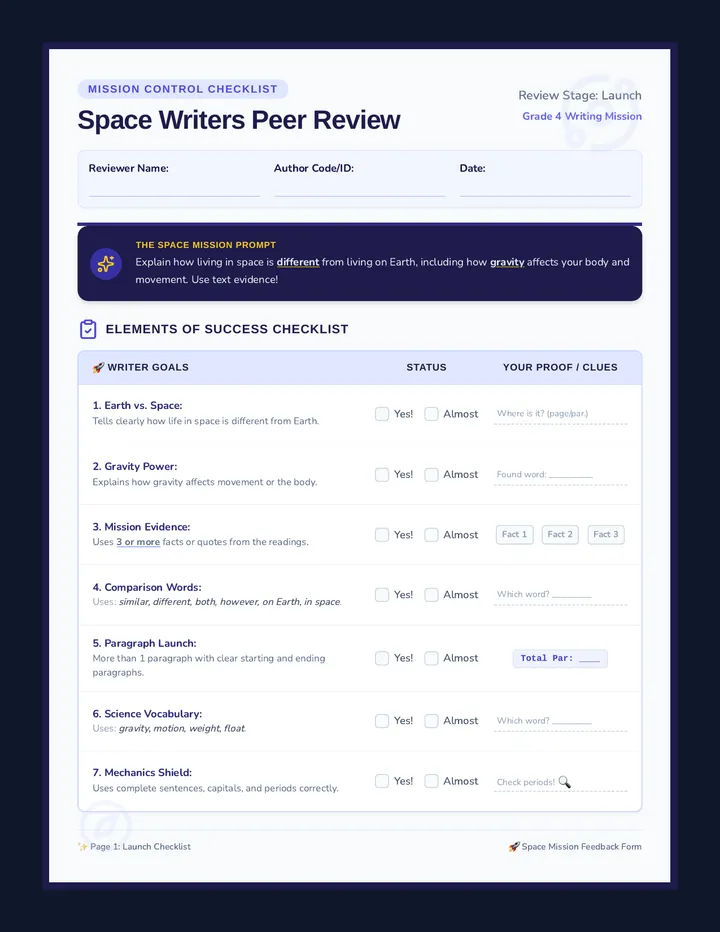
A two-page student peer feedback form styled with an astronaut/space theme. Page 1 contains a spacious visual success checklist for evaluating a writing piece. Page 2 provides expanded writing spaces with generous handwriting lines and color-coded boxes for comprehensive positive and constructive feedback ('Stellar Glows' and 'Cosmic Grows'), accompanied by sentence frames designed for Multilingual Language Learners.

J

jamacleod

Polished Prose Anchor Chart Split Page

Polished Prose Anchor Chart Split Page

An expanded anchor chart featuring a second page focused on academic articulation. It provides curated lists of formal sentence starters for stating arguments, introducing evidence, and performing deep text analysis, maintaining a professional editorial aesthetic.

JB

John Beebe

Bridge Builders List Final Compact

Bridge Builders List Final Compact

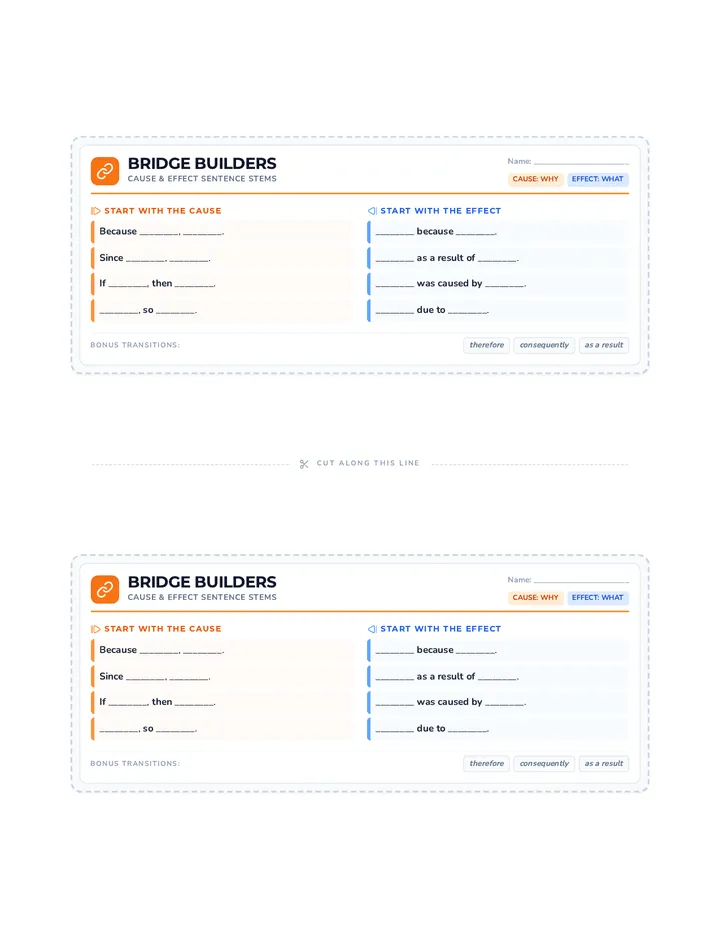
A condensed, printable half-page reference list containing common cause and effect sentence stems for 3rd grade students, strictly constrained to a single page with a center cutting guide.

SP

Sarah Purgason

Multi Paragraph Writing Packet

Multi Paragraph Writing Packet

A 5-page IEP goal work packet for 7th grade students focusing on multi-paragraph essay mastery with cellphone-themed informative and argumentative prompts, source briefs, step-by-step graphic organizers, ruled drafting pages, and self-monitoring rubrics.

Z

Zimmer

Clincher Champions Ring Cards

Clincher Champions Ring Cards

Printable ring and lanyard cards for 4th grade students featuring formula and pattern prompts for writing conclusion sentences in 2-point constructed responses. Includes cut lines, hole-punch markers, color-coded sentence formulas, mentor examples, and a self-check rubric card.

L

lgangi

Sequences

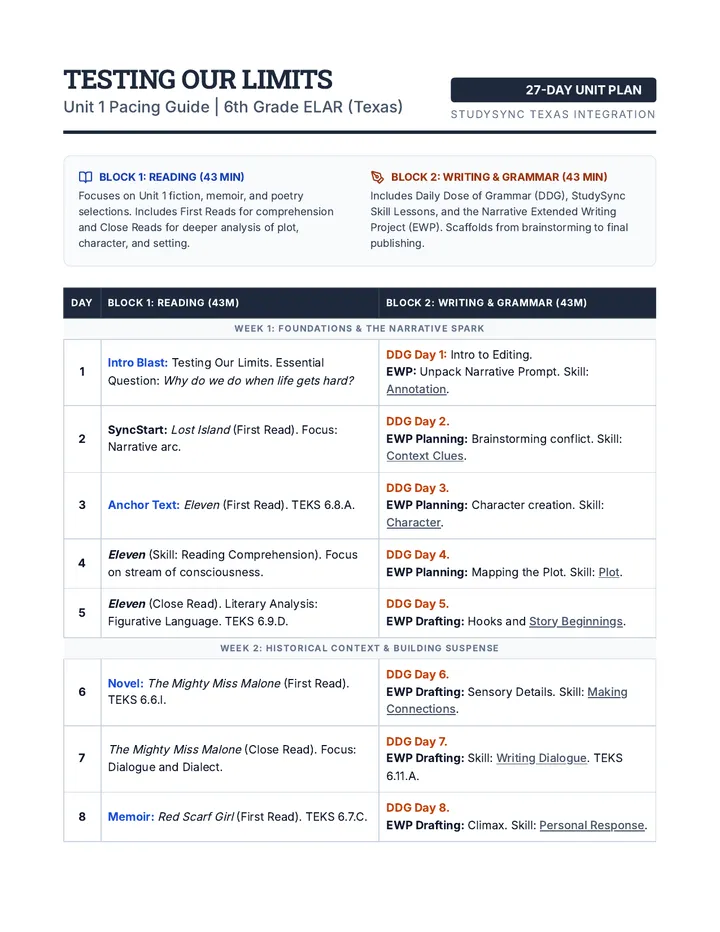
Unit 1 Pacing Guide Document

Testing Our Limits Unit Sequence

A 27-day instructional sequence for 6th Grade ELAR Unit 1: Testing Our Limits, featuring dual blocks for Reading and Writing with daily grammar and skill scaffolding.

DM

Dawn Mustian

81
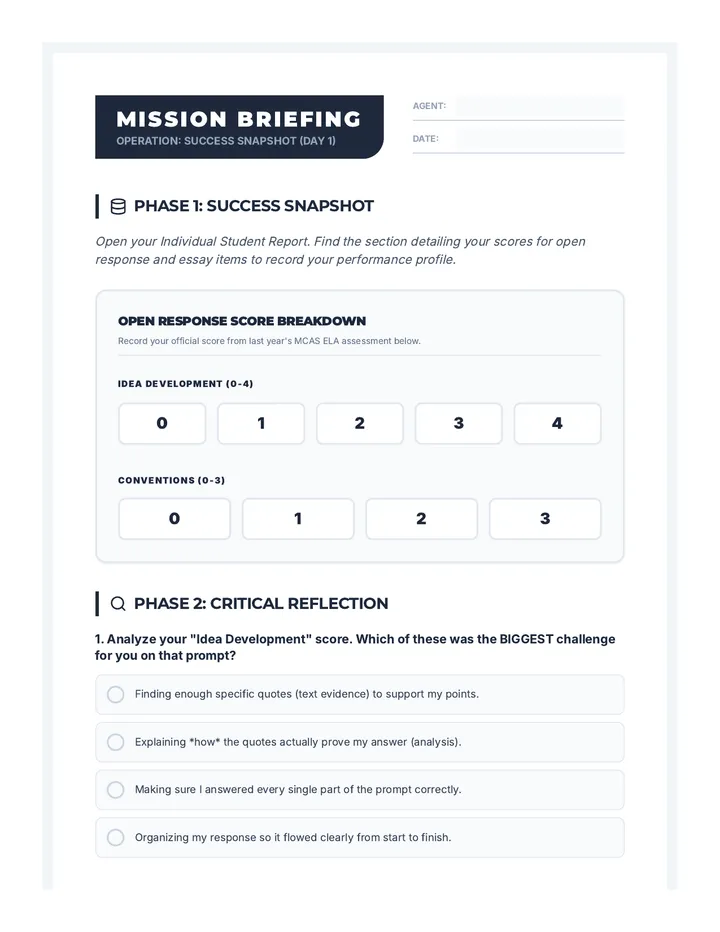
Mission Briefing Worksheet

Mastery Mission

A project-based learning unit designed to help middle school students analyze their past MCAS ELA performance, deconstruct scoring rubrics, and create a personalized strategy playbook for upcoming assessments. Students move from 'investigating' their scores to 'rebooting' their responses and 'finalizing' their test-taking toolkit.

M

mhbutterworth

18
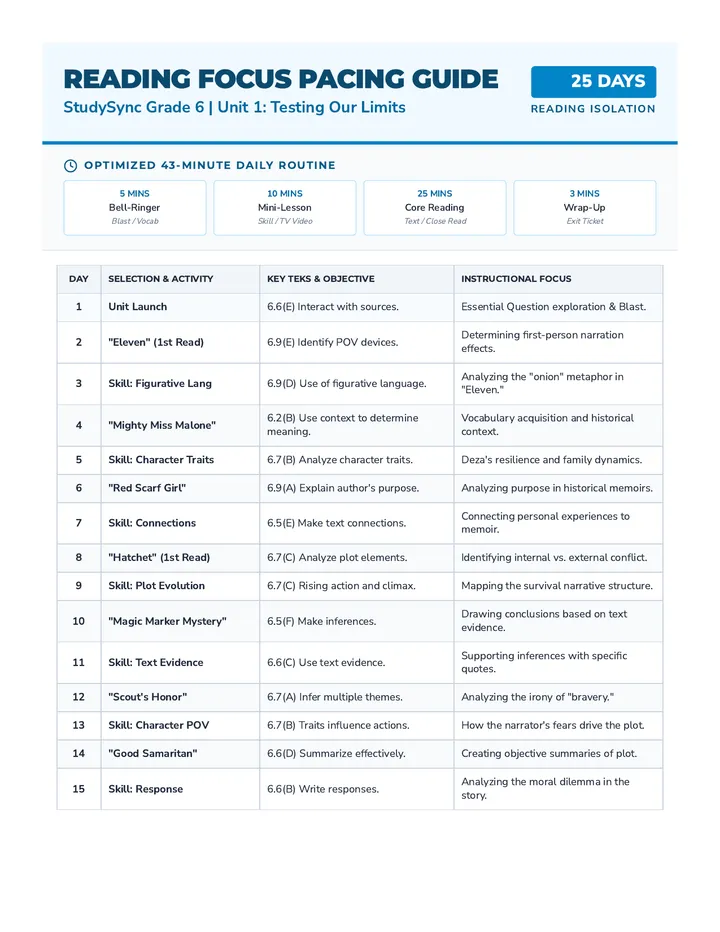
Reading Focus Pacing Guide

Testing Our Limits Unit

A 25-day comprehensive unit for StudySync Grade 6 that explores the theme of courage and resilience through isolated reading and writing tracks, aligned to ELA TEKS.

DM

Dawn Mustian

79
Burger Builder Slides

Paragraph Foundations

A foundational paragraph writing unit designed for early writers and SpEd students to master core paragraph structures through narrative, opinion, and informational writing with heavy visual scaffolding.

E

ecreamer

23
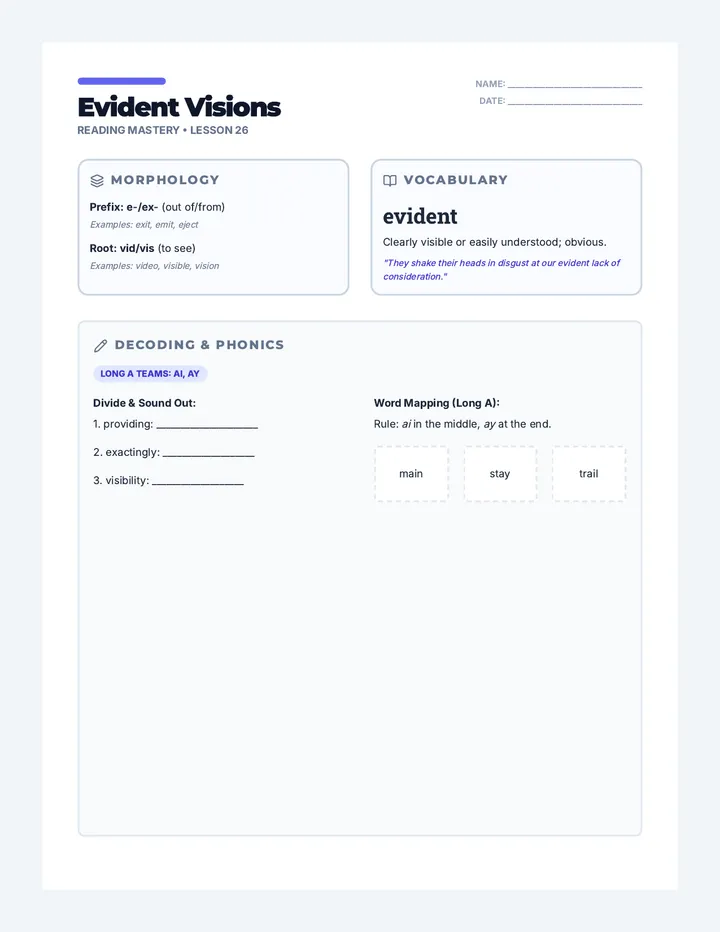
Integrated Mastery Handouts 26-40

Reading Power Pack

A comprehensive literacy intervention sequence for high school TESOL students (Lessons 16-25) focused on morphology, academic vocabulary, systematic decoding, and vowel mastery.

AP

Alexis Paolini

30
Crime Scene Slides

Detective Diaries

A comprehensive English Language Arts unit that uses a mystery-investigation theme to develop reading, writing, listening, and speaking skills. Students act as detectives to analyze evidence, interview witnesses, and present their final case.

AP

AMANDA PAULA ALEXIUS KPM-Guru

11