Lenny.com
Explore
Create
ActivitiesNewMathEnglish Language ArtsScience & EngineeringSocial StudiesGlobal LanguagesHealth & Physical EducationSpecial EducationCounseling & Life SkillsArts & CreativityESL
Lenny.com
Lenny.com
Explore
Create
ActivitiesNewMathEnglish Language ArtsScience & EngineeringSocial StudiesGlobal LanguagesHealth & Physical EducationSpecial EducationCounseling & Life SkillsArts & CreativityESL
Lenny.com
Lenny.com

Solutions

Lenny for EducatorsLenny for SchoolsLenny for Districts

Product

ExploreSign inCreateSupportAbout

Resources

Getting startedMTSS Acceleration Program

© 2026 Lenny Learning Inc.

TermsPrivacyAccessibility
LinkedInInstagramX
Lenny

Idioms and Adages

Distinguishes between literal and figurative language through the study of common cultural expressions and traditional proverbs. Strengthens reading comprehension by analyzing the deeper meanings behind metaphorical phrases.

English Language ArtsPhonics & Reading FoundationsLetter IdentificationLearn Letters A-ZLowercase and Uppercase LettersConsonants and VowelsLetter-Sound AssociationsLetter-Sound Associations: LowercaseLetter-Sound Associations: UppercaseBeginning and Ending SoundsRhymingBlending And SegmentingShort VowelsShort Vowel SoundsConsonant BlendsConsonant DigraphsBlends, Digraphs, and TrigraphsDigraphs, Blends, and Silent LettersLong Vowel SoundsLong Vowel PatternsShort and Long VowelsShort and Long Vowel PatternsSilent EVowel SoundsVowel TeamsR-Controlled VowelsDiphthongs: Oi, Oy, Ou, OwVariant VowelsVariant, Diphthong, And R Vowel PatternsSoft G And CSight WordsIrregular WordsWord RecognitionSyllablesSyllable TypesTwo-Syllable WordsMultisyllabic WordsPhoneme ManipulationDecodable TextsVocabularyAction WordsQuestion WordsNouns and AdjectivesClassify WordsCompound WordsSynonyms and AntonymsHomophonesHomophones and HomonymsShades of MeaningContext CluesPrefixes and SuffixesGreek and Latin RootsAnalogiesIdioms and AdagesForeign Words and ExpressionsWord Choice and UsageReference SkillsReading ComprehensionRead-Along Literary TextsRead-Along Informational TextsReality vs. FictionStory ElementsCharacterSequenceMain IdeaCause And EffectCompare And ContrastReading StrategiesText StructureAuthor's PurposeAuthor's Purpose And ToneAuthor's PerspectivePoint Of ViewThemeInference And ThemeInference And AnalysisPoetry ElementsLiterary DevicesAnalyzing LiteratureAnalyzing Informational TextsComparing TextsAudience, Purpose, And ToneBusiness DocumentsNovel StudyNonfiction Book StudyGrammar & MechanicsSentencesNounsVerbsAdjectivesPronounsCapitalizationPunctuationContractionsConjunctionsPrepositionsArticlesAdjectives And AdverbsVerb TypesVerb TensePronouns And AntecedentsPronoun TypesSubject-Verb AgreementDirect And Indirect ObjectsSentences, Fragments, And Run-OnsPhrases And ClausesCommasSemicolons, Colons, And CommasDashes, Hyphens, And EllipsesSpellingAbbreviationsFormattingVerb Tense And MoodMisplaced ModifiersWritingDescriptive DetailsCreative WritingOpinion WritingTopic SentencesOrganizing WritingLinking WordsSentence VarietyIntroductions And ConclusionsPersuasive And Opinion WritingExpository WritingPersuasive StrategiesDeveloping And Supporting ArgumentsTopic Sentences And Thesis StatementsSummarizingResearch SkillsEditing And RevisingActive And Passive Voice=Writing Clearly And ConciselyDebate & Public SpeakingPublic Speaking BasicsPersuasive TechniquesClaims and EvidenceTypes of ArgumentsReasoning TypesLogical FallaciesTopic ResearchOrganizing EvidenceDebate Speech OrganizationAttacking and Defending ArgumentsClash and EngagementImpact CalculusQuestioning and Cross-ExaminationCritical ThinkingInformal LogicFormal LogicInductive Reasoning

Videos

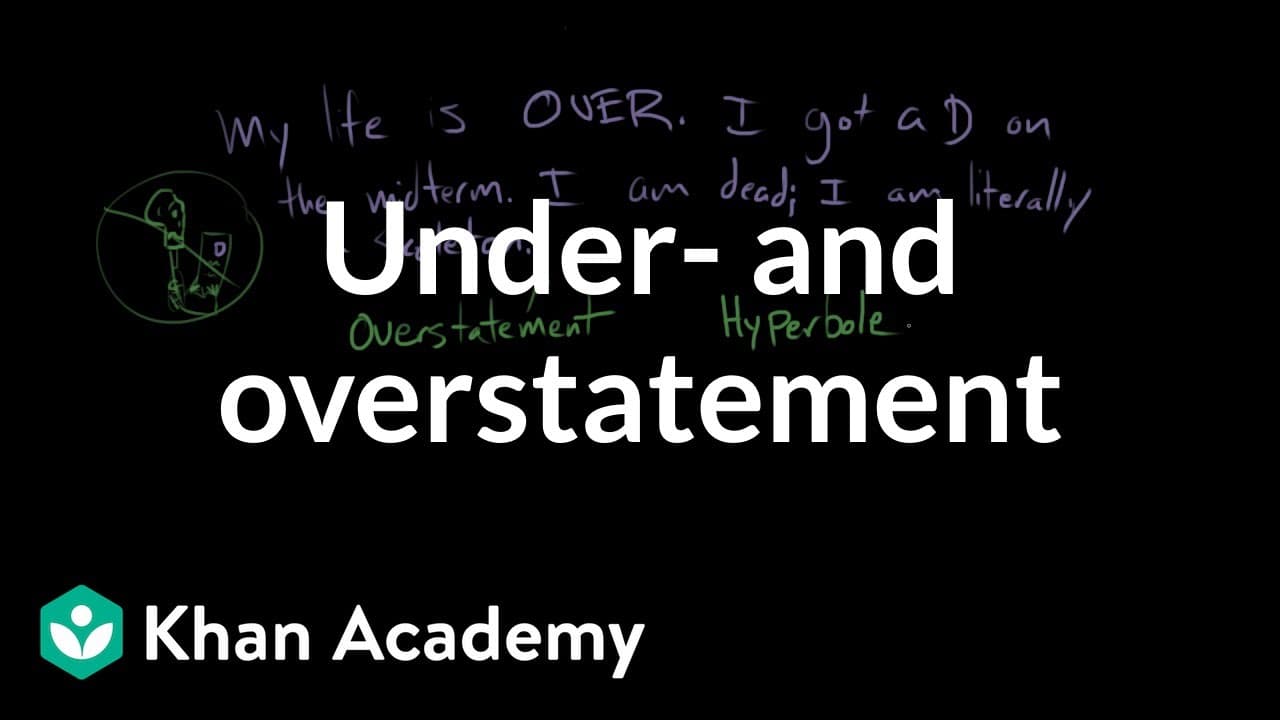
Exploring Understatement and Overstatement in Language

Exploring Understatement and Overstatement in Language

This engaging video features grammar experts David and Rosie exploring the rhetorical concepts of understatement and overstatement. Through humorous, handwritten examples on a digital whiteboard, they demonstrate how writers and speakers often say less or more than they literally mean to convey stronger emotions. The hosts act out scenarios—such as reacting to a kidnapped dog or a bad test grade—to show how these literary devices function in everyday communication. The video covers key literary themes including hyperbole, irony, and subtext. It specifically defines understatement as deliberately minimizing a serious event to highlight its gravity, and overstatement (or hyperbole) as using extreme exaggeration to express intense emotion. The discussion concludes with an insightful look at cultural nuances in American English, explaining how social norms often encourage the repression of strong emotions through understated language. For educators, this resource provides an excellent entry point for teaching figurative language and tone. It moves beyond simple definitions to show how these devices affect the reader or listener emotionally. Teachers can use this video to help students analyze dialogue in literature, write more expressive creative pieces, and understand the complex relationship between a speaker's actual words (text) and their intended meaning (subtext).

Khan AcademyKhan Academy

5mins 43s

Stretching the Truth: How to Identify and Use Hyperbole

Stretching the Truth: How to Identify and Use Hyperbole

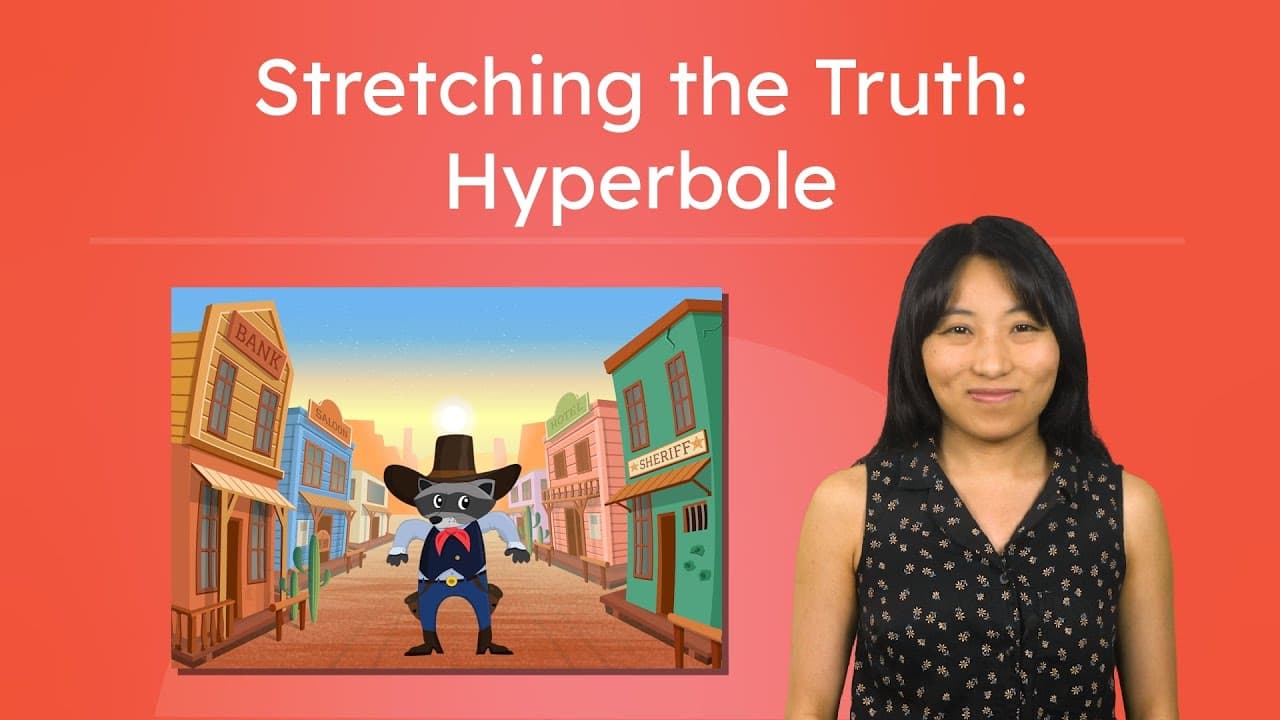
This engaging educational video introduces students to the concept of hyperbole—a figure of speech involving extreme exaggeration. Set against a playful Wild West backdrop, the narrator and a robot companion, Mia, guide viewers through a "ghost town" where they must identify hyperbolic statements to wake the sleeping "Guardian of Hyperbole." The video alternates between clear definitions and practical examples, distinguishing between realistic descriptions and hyperbolic ones found on town signs and in poetry.

Miacademy & MiaPrep Learning ChannelMiacademy & MiaPrep Learning Channel

10mins

Exploring Similes, Metaphors, and Idioms

Exploring Similes, Metaphors, and Idioms

This engaging animated video introduces students to the concept of figurative language, specifically focusing on three primary types: similes, metaphors, and idioms. The narrator explains that figurative language is like "art with words," allowing us to communicate in creative and fun ways rather than just literally. Through a series of clear examples and visual demonstrations, viewers learn how to identify and distinguish between these common literary devices. The video is structured into three distinct sections. First, it covers similes, defining them as comparisons using "like" or "as" (e.g., "quiet as mice"). Next, it introduces metaphors, explaining how they compare two things without using "like" or "as" (e.g., "the snow was a white blanket"). Finally, it explores idioms, describing them as phrases with special meanings different from their literal words (e.g., "raining cats and dogs"), and includes a fun fact about the sheer number of idioms in English. This resource is highly valuable for elementary Language Arts classrooms. It uses repetition, text highlighting, and relatable visuals (like animals and weather) to make abstract linguistic concepts concrete for young learners. Teachers can use this video to introduce a unit on creative writing, to support reading comprehension by helping students decode non-literal text, or as a review tool before a poetry or narrative writing assignment.
Homeschool PopHomeschool Pop

15mins 4s

What Are Idioms? Learning Common English Expressions

What Are Idioms? Learning Common English Expressions

This engaging animated video introduces students to the concept of idioms—phrases that hold a figurative meaning different from their literal words. Using humor and clear visual examples, the narrator breaks down common English expressions like "raining cats and dogs," "break a leg," and "butterflies in your stomach." The video effectively contrasts the hilarious literal interpretations of these phrases with their actual meanings to help students grasp the difference between literal and figurative language. Key themes include vocabulary development, figurative language, and reading comprehension. The video defines an idiom explicitly and provides a memorable "surprising fact" about the sheer volume of idioms in the English language (around 25,000). It systematically moves through five specific examples, explaining the meaning of each while reinforcing the core definition of what an idiom is. This resource is highly valuable for English Language Arts classrooms, particularly for introducing figurative language units or supporting English Language Learners (ELLs). The clear visual metaphors make abstract linguistic concepts concrete, helping students visualize why we use these strange phrases. Teachers can use this video to spark creative writing assignments, idiom illustration projects, or discussions about how language evolves to express feelings and situations in colorful ways.

Homeschool PopHomeschool Pop

6mins 1s

Materials

Reading Evidence Exit Ticket

Reading Evidence Exit Ticket

A 2-page 3rd grade reading comprehension exit ticket assessing Arizona standards 3.RL.1 (explicit text evidence) and 3.RL.4 (literal and nonliteral language). Includes an engaging realistic fiction passage with numbered paragraphs, 3 text-dependent evidence questions, and 3 vocabulary/figurative language questions featuring standardized multiple-choice and two-part items.

TD

Taylor Doucet

Figurative Language Anchor Charts

Figurative Language Anchor Charts

A 4-page print-optimized, ink-friendly 8th-grade ELA figurative language anchor chart set aligned to NYS Next Gen Standard 8R4, designed with crisp high-contrast typography, color-coded device families, mentor text breakdowns, and evidence-based analytical sentence stems.

MV

Maryanne Von Bevern

Spark of Rebellion Rubric

Spark of Rebellion Rubric

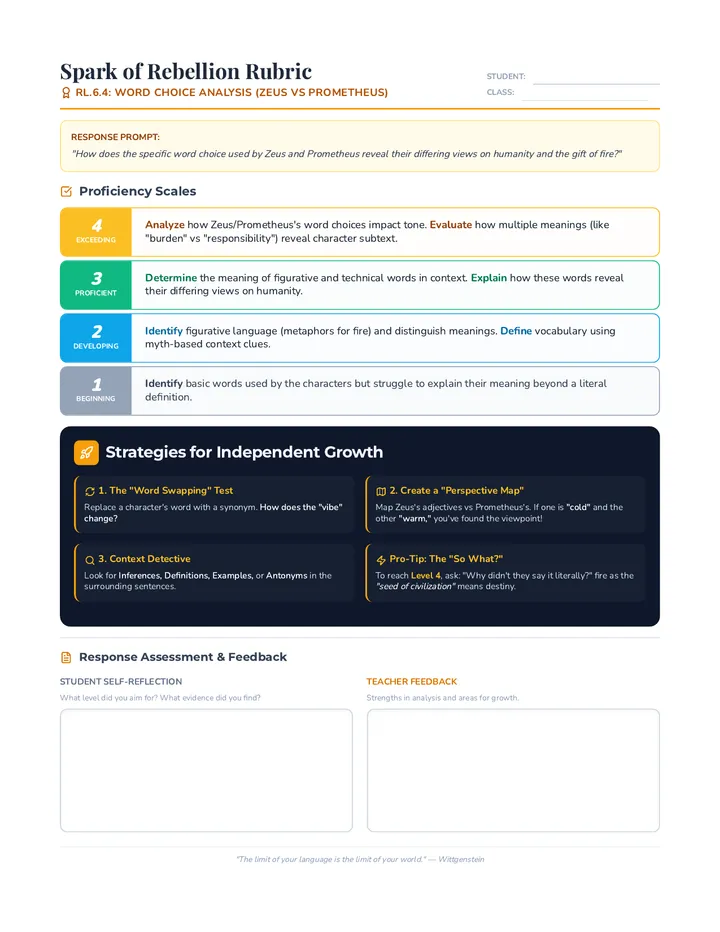
A tailored mastery rubric for the 'Spark of Rebellion' assignment, specifically assessing RL.6.4 by analyzing the word choices of Zeus and Prometheus. Includes a 4-level proficiency scale, targeted growth strategies, and reflection areas for assessment.

CG

Candace Ghelfi

Rainy Day Language Anchor Chart

Rainy Day Language Anchor Chart

A high-contrast visual anchor chart comparing literal and figurative language. Features dual-panel illustrations of raining cats and dogs literally versus heavily, with traceable definitions and sentence frames for student completion.

MR

Melissa Ramirez

Idiom Investigators Reference

Idiom Investigators Reference

A comprehensive idiom cheat sheet for fourth graders, organized by categories like Animals, Body, Food, and Nature. It includes literal and figurative meanings to help students create comparative mini-posters.

L

leramo

Sequences

Lesson Plan 1 Introduction

Literary Device Detectives

A comprehensive multi-unit sequence for 3rd and 4th grade students covering key literary devices: Introduction to Figurative Language, Onomatopoeia, Similes, Metaphors, Personification, and Idioms. Each unit provides 5 lesson plans, interactive notebook resources, and a wide variety of activities and stories designed to improve descriptive writing and reading comprehension.

JS

Janette Sullivan

105
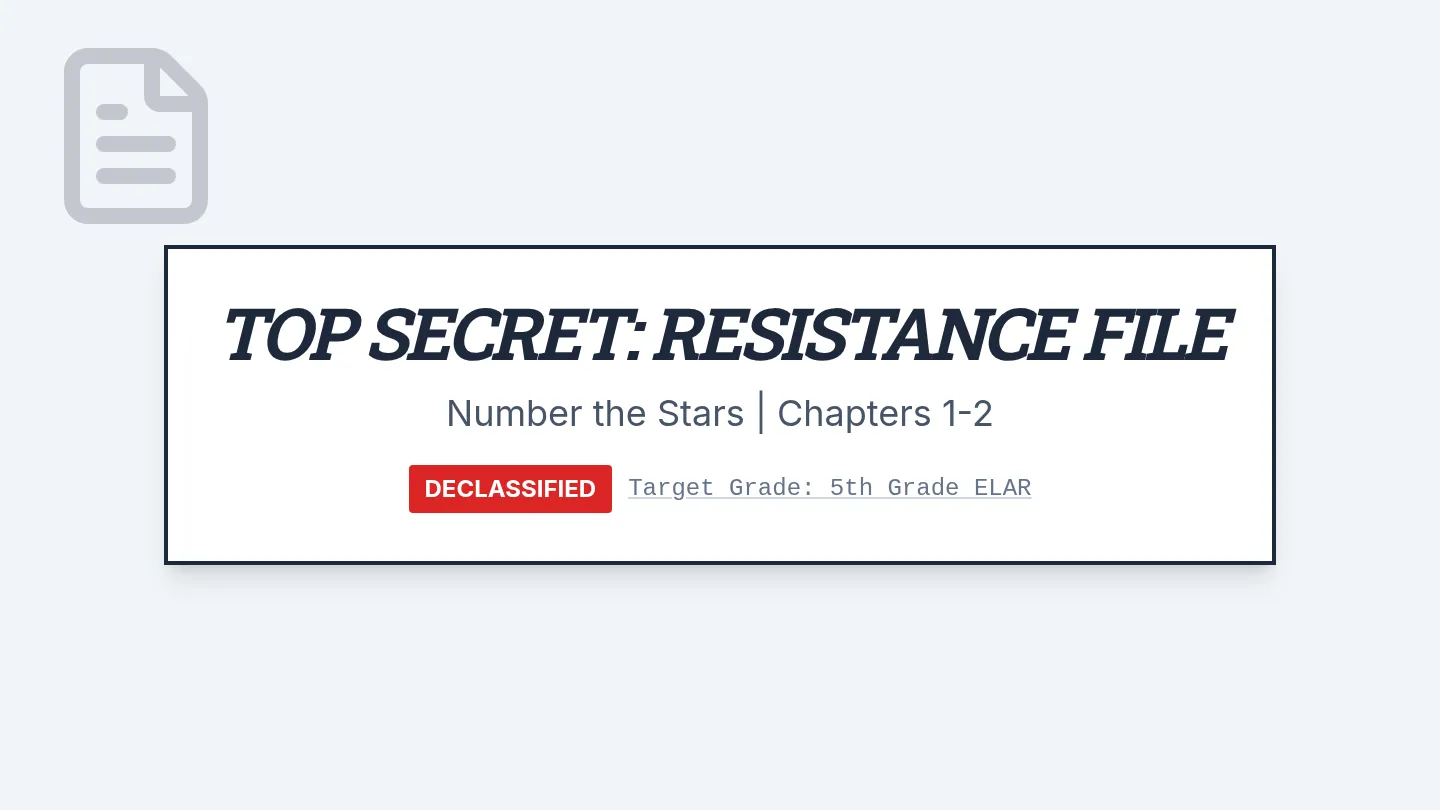
Copenhagen Clues Slides

Resistance Chronicles

A 9-day novel study for Number the Stars centered on 5th Grade ELAR TEKS, focusing on character development, plot analysis, and historical context through the lens of a Resistance Secret File.

LH

Lucy Hellerman

79
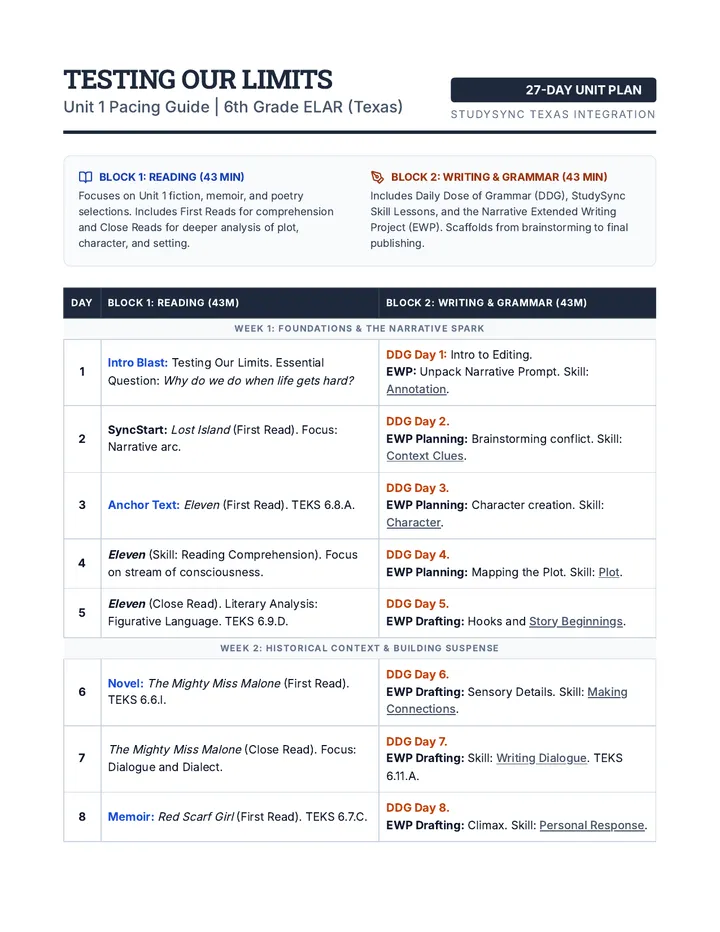
Unit 1 Pacing Guide Document

Testing Our Limits Unit Sequence

A 27-day instructional sequence for 6th Grade ELAR Unit 1: Testing Our Limits, featuring dual blocks for Reading and Writing with daily grammar and skill scaffolding.

DM

Dawn Mustian

81
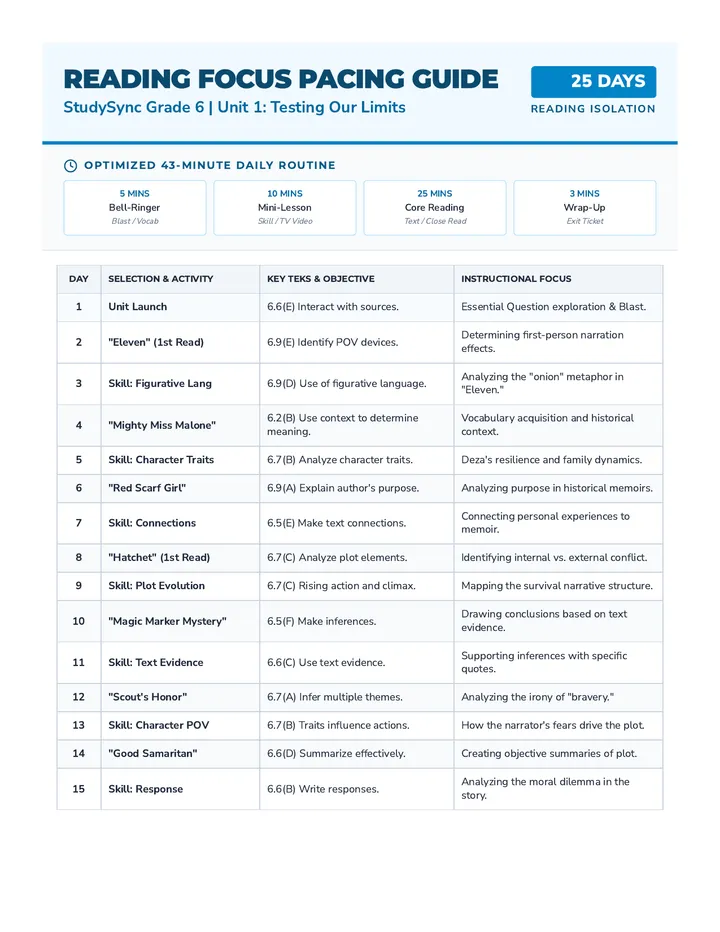
Reading Focus Pacing Guide

Testing Our Limits Unit

A 25-day comprehensive unit for StudySync Grade 6 that explores the theme of courage and resilience through isolated reading and writing tracks, aligned to ELA TEKS.

DM

Dawn Mustian

79
Lab Safety Brief Do Now

Lexicon Labs

A comprehensive unit focusing on vocabulary acquisition and word relationships (L.4 and L.5). Students act as 'Lexicon Engineers' to decode meanings, analyze affixes, and master figurative language through a high-tech laboratory lens.

MW

Mr Whitfield

17
Expedition Slides Presentation

EOG Review Missions

A dual-mission EOG review unit for 3rd grade, covering comprehensive math and ELA standards through immersive, game-based learning experiences.

KT

Kelly Toponce

12

Lessons

Narrative Navigator Slides

Journal Journey Cultural Bridge

An advanced 8th-grade ELA lesson exploring the intersection of Filipino and American identities through personal narrative. Students analyze the immigrant experience, master advanced vocabulary via a 'Quiz Bee,' and draft narratives that bridge their cultural heritage with their current journey.

V

vivianbelarmino

13
Precision Prose Teacher Guide

Precision Prose

A 60-minute ELA lesson focused on analyzing author's diction and drawing logical inferences using excerpts from the Grade 7 Interim Assessment. Students will explore how specific word choices shape meaning and tone through guided and independent practice.

RC

Rachel Cohen

9
Rivers and Roads Answer Key

Rivers and Roads

A comprehensive ELA lesson for 8th grade exploring themes of displacement, identity, and resilience through the analysis of Andrew Jackson's Indian Removal Speech, a Trail of Tears diary entry, and the poems 'Maps' and 'The Negro Speaks of Rivers'. Students engage with Tier 2 and advanced vocabulary, comparative analysis, and a creative choice board.

V

vivianbelarmino

10
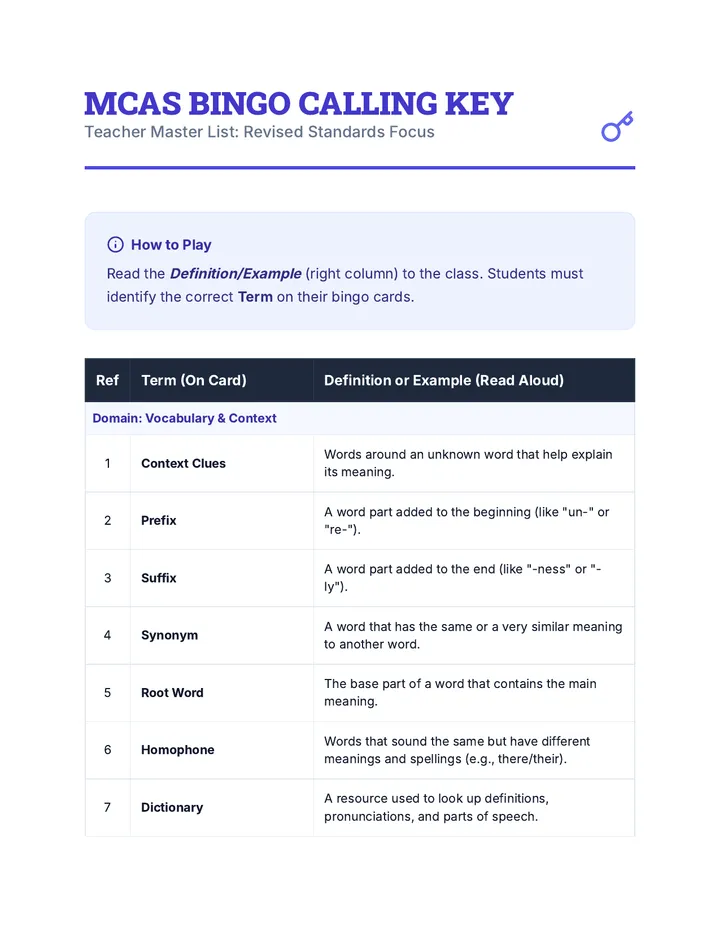
Master Calling Teacher Key

MCAS Bingo Bonanza

A comprehensive ELA review game designed to help students master MCAS standards through a competitive and engaging bingo format. The lesson covers vocabulary, literary elements, text structures, and grammar.

C

cfassel

3
Silver Screen Symbols Teacher Guide

Silver Screen Symbols

A lesson analyzing figurative language and visual symbolism in the song 'The Other Side' by SZA and Justin Timberlake. Students will explore central metaphors and how visual elements in media reinforce lyrical themes.

CQ

carolyn quintanilla

6
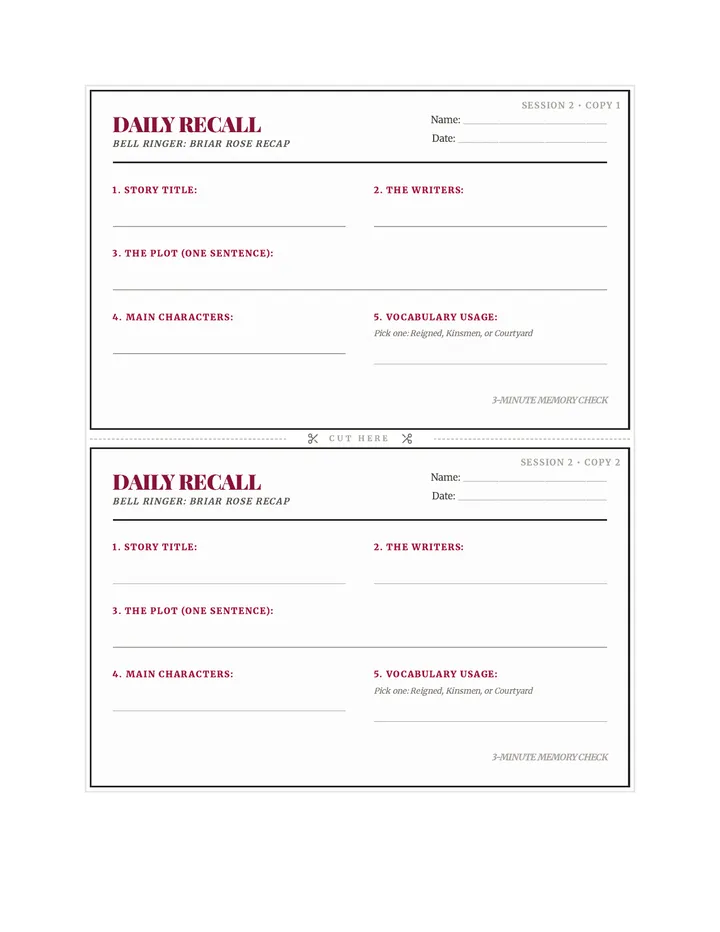
Briar Thorns Session 2 Recall Handout Final

Briar Thorns

A quick exploration of theme and moral within the classic Brothers Grimm tale 'Briar Rose', featuring a focused bell ringer and exit ticket.

V

vivianbelarmino

45