Lenny.com
Explore
Create
ActivitiesNewMathEnglish Language ArtsScience & EngineeringSocial StudiesGlobal LanguagesHealth & Physical EducationSpecial EducationCounseling & Life SkillsArts & CreativityESL
Lenny.com
Lenny.com
Explore
Create
ActivitiesNewMathEnglish Language ArtsScience & EngineeringSocial StudiesGlobal LanguagesHealth & Physical EducationSpecial EducationCounseling & Life SkillsArts & CreativityESL
Lenny.com
Lenny.com

Solutions

Lenny for EducatorsLenny for SchoolsLenny for Districts

Product

ExploreSign inCreateSupportAbout

Resources

Getting startedMTSS Acceleration Program

© 2026 Lenny Learning Inc.

TermsPrivacyAccessibility
LinkedInInstagramX
Lenny

Poetry Elements

Stanza structure, rhyme schemes, and meter across various poetic forms. Examines figurative language like metaphors and similes alongside sound devices such as alliteration and onomatopoeia.

English Language ArtsPhonics & Reading FoundationsLetter IdentificationLearn Letters A-ZLowercase and Uppercase LettersConsonants and VowelsLetter-Sound AssociationsLetter-Sound Associations: LowercaseLetter-Sound Associations: UppercaseBeginning and Ending SoundsRhymingBlending And SegmentingShort VowelsShort Vowel SoundsConsonant BlendsConsonant DigraphsBlends, Digraphs, and TrigraphsDigraphs, Blends, and Silent LettersLong Vowel SoundsLong Vowel PatternsShort and Long VowelsShort and Long Vowel PatternsSilent EVowel SoundsVowel TeamsR-Controlled VowelsDiphthongs: Oi, Oy, Ou, OwVariant VowelsVariant, Diphthong, And R Vowel PatternsSoft G And CSight WordsIrregular WordsWord RecognitionSyllablesSyllable TypesTwo-Syllable WordsMultisyllabic WordsPhoneme ManipulationDecodable TextsVocabularyAction WordsQuestion WordsNouns and AdjectivesClassify WordsCompound WordsSynonyms and AntonymsHomophonesHomophones and HomonymsShades of MeaningContext CluesPrefixes and SuffixesGreek and Latin RootsAnalogiesIdioms and AdagesForeign Words and ExpressionsWord Choice and UsageReference SkillsReading ComprehensionRead-Along Literary TextsRead-Along Informational TextsReality vs. FictionStory ElementsCharacterSequenceMain IdeaCause And EffectCompare And ContrastReading StrategiesText StructureAuthor's PurposeAuthor's Purpose And ToneAuthor's PerspectivePoint Of ViewThemeInference And ThemeInference And AnalysisPoetry ElementsLiterary DevicesAnalyzing LiteratureAnalyzing Informational TextsComparing TextsAudience, Purpose, And ToneBusiness DocumentsNovel StudyNonfiction Book StudyGrammar & MechanicsSentencesNounsVerbsAdjectivesPronounsCapitalizationPunctuationContractionsConjunctionsPrepositionsArticlesAdjectives And AdverbsVerb TypesVerb TensePronouns And AntecedentsPronoun TypesSubject-Verb AgreementDirect And Indirect ObjectsSentences, Fragments, And Run-OnsPhrases And ClausesCommasSemicolons, Colons, And CommasDashes, Hyphens, And EllipsesSpellingAbbreviationsFormattingVerb Tense And MoodMisplaced ModifiersWritingDescriptive DetailsCreative WritingOpinion WritingTopic SentencesOrganizing WritingLinking WordsSentence VarietyIntroductions And ConclusionsPersuasive And Opinion WritingExpository WritingPersuasive StrategiesDeveloping And Supporting ArgumentsTopic Sentences And Thesis StatementsSummarizingResearch SkillsEditing And RevisingActive And Passive Voice=Writing Clearly And ConciselyDebate & Public SpeakingPublic Speaking BasicsPersuasive TechniquesClaims and EvidenceTypes of ArgumentsReasoning TypesLogical FallaciesTopic ResearchOrganizing EvidenceDebate Speech OrganizationAttacking and Defending ArgumentsClash and EngagementImpact CalculusQuestioning and Cross-ExaminationCritical ThinkingInformal LogicFormal LogicInductive Reasoning

Videos

How to Read a Poem: Structure and Meaning

How to Read a Poem: Structure and Meaning

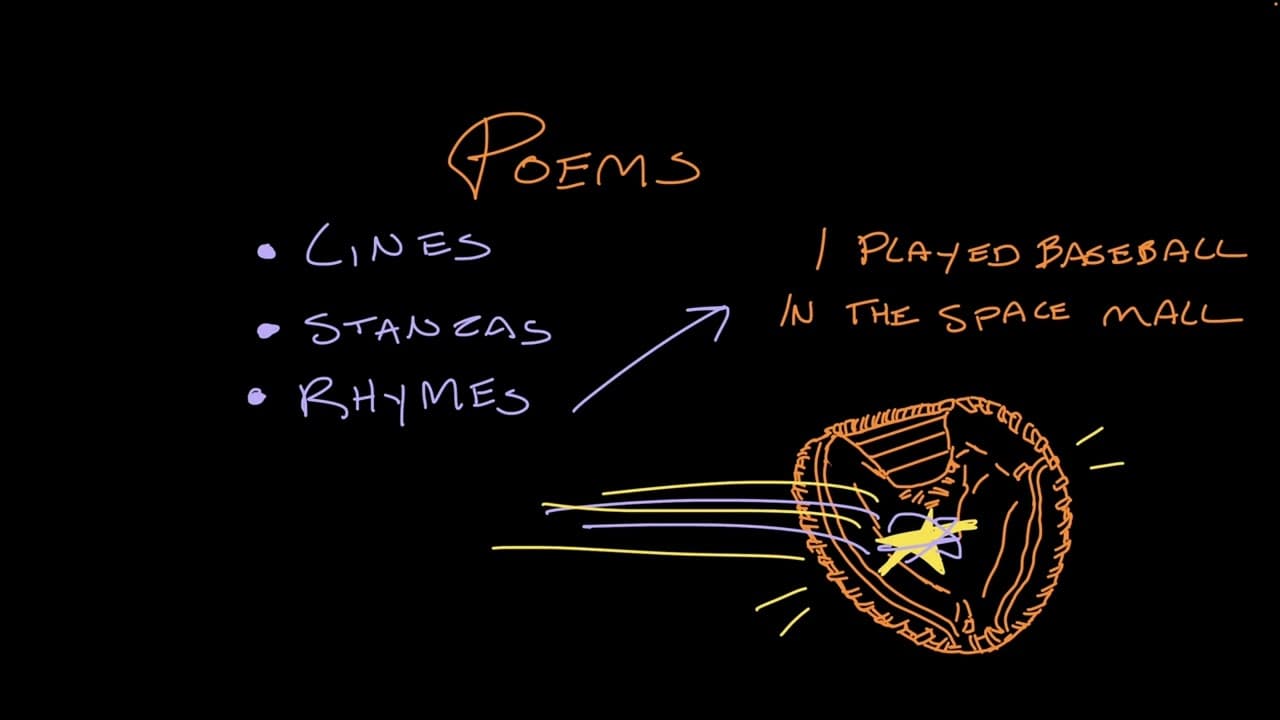
This educational video serves as an engaging introduction to poetry analysis, specifically focusing on how structure contributes to meaning. The narrator, David, welcomes viewers to "The Poem Zone" and breaks down the fundamental building blocks of poetry: lines, line breaks, stanzas, and rhyme. He defines poetry simply as "art made out of words" and explains that while poems play with sound and rhythm, they don't always have to rhyme. The visual style uses a blackboard aesthetic with handwritten text that appears in real-time to illustrate concepts. The core of the video features an original piece titled "Egg Poem," which the narrator reads and then dissects stanza by stanza. Through this close reading, the video demonstrates how a poem's structure can organize ideas and build an emotional arc. The narrator highlights how the poem uses a repeating structure ("Morning is...") to anchor each stanza while progressing from a calm morning to a chaotic one. For educators, this video is a powerful tool for bridging the gap between simply reading poetry and analyzing it. It explicitly teaches students to ask how lines and stanzas build meaning, rather than just identifying them as structural elements. The video introduces the concept of extended metaphor in a highly accessible way by connecting the cooking terms "easy," "medium," and "hard" to both the state of an egg and the speaker's emotional state, providing a clear model for students to use in their own literary analysis.

Khan AcademyKhan Academy

4mins 6s

Mastering the Shakespearean Sonnet: Structure and Strategy

Mastering the Shakespearean Sonnet: Structure and Strategy

In this engaging instructional video, the narrator, Justin, accepts a "StanzaGram" challenge to write a vivid description using the strict constraints of a Shakespearean sonnet. The video breaks down the technical requirements of this poetic form, including the specific rhyme scheme, stanza structure (quatrains and couplets), and the rhythmic pattern of iambic pentameter. It demystifies these complex literary concepts by treating them as a creative puzzle rather than a rigid chore. Key themes include the relationship between structure and creativity, the mechanics of poetry, and the writing process. The video explores how limitations can actually spur innovation, forcing writers to find more precise and musical language. It covers essential terminology such as iambic pentameter, volta, quatrain, and couplet, while using Shakespeare's Sonnet 18 as a primary text for analysis. For educators, this video serves as both an introduction to Shakespearean poetry and a practical writing workshop. It moves beyond passive analysis by modeling the active struggle of writing—demonstrating strategies like working out of order, using inverted syntax, and brainstorming rhymes. It is an excellent resource for English Language Arts classrooms to bridge the gap between reading classic poetry and writing original verse.

Miacademy & MiaPrep Learning ChannelMiacademy & MiaPrep Learning Channel

11mins 14s

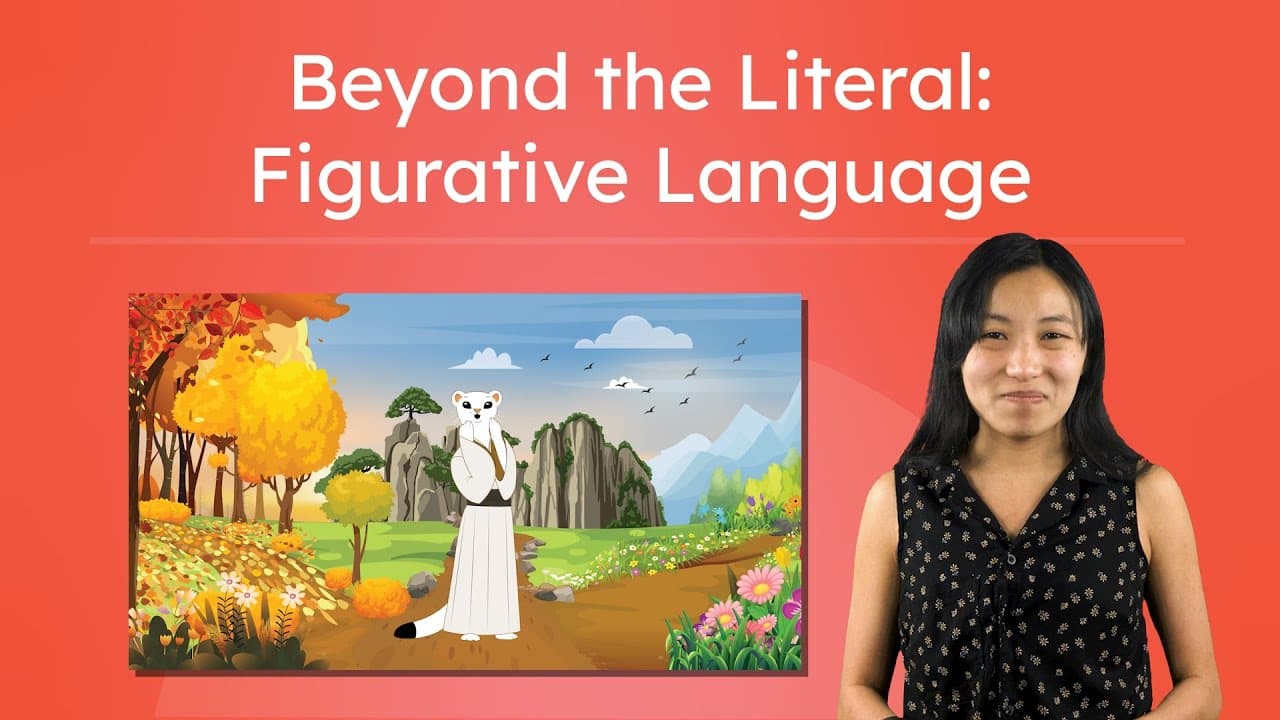
Stretching the Truth: How to Identify and Use Hyperbole

Stretching the Truth: How to Identify and Use Hyperbole

This engaging educational video introduces students to the concept of hyperbole—a figure of speech involving extreme exaggeration. Set against a playful Wild West backdrop, the narrator and a robot companion, Mia, guide viewers through a "ghost town" where they must identify hyperbolic statements to wake the sleeping "Guardian of Hyperbole." The video alternates between clear definitions and practical examples, distinguishing between realistic descriptions and hyperbolic ones found on town signs and in poetry.

Miacademy & MiaPrep Learning ChannelMiacademy & MiaPrep Learning Channel

10mins

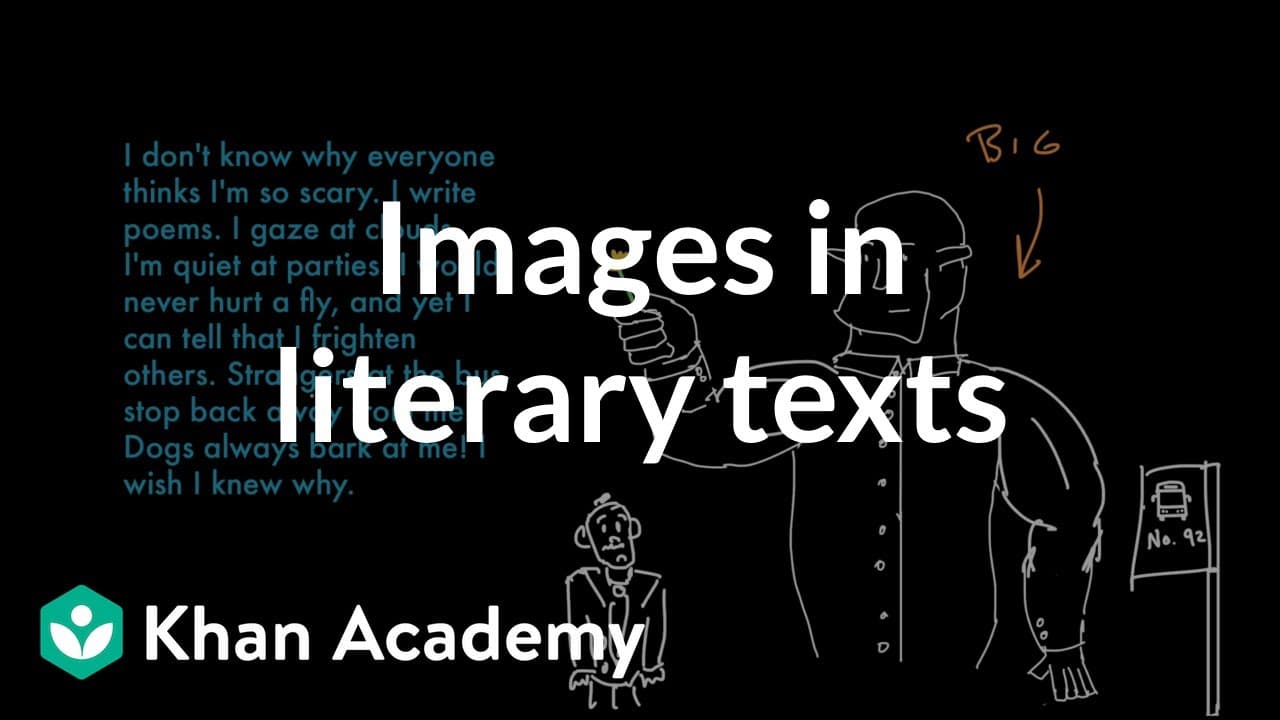
How Images Change the Meaning of Text

How Images Change the Meaning of Text

This engaging educational video explores the critical relationship between text and illustrations in reading comprehension. Using a lively narration and simple line drawings, the video introduces a two-step strategy for analyzing images: asking what new information the image provides that the text does not, and determining how that information changes the reader's understanding. The narrator uses a "cherries and chocolate" analogy to describe the powerful combination of words and pictures. The video centers on a poem about a character who is gentle but feared by others. The narrator reads the poem first without visuals, then reveals a drawing of a giant man holding a flower, demonstrating how the image solves the mystery of why people are scared. To further illustrate the point, the narrator swaps in alternative drawings—a man with antlers and a man with "stink lines"—to show how changing the visual context completely alters the narrative even when the words remain exactly the same. This resource is highly valuable for elementary ELA classrooms focusing on visual literacy and inference. It moves students beyond passively looking at pictures to actively interrogating them for meaning. The clear, explicit questions provided give students a repeatable framework they can apply to picture books, graphic novels, and textbooks to deepen their comprehension.

Khan AcademyKhan Academy

3mins 17s

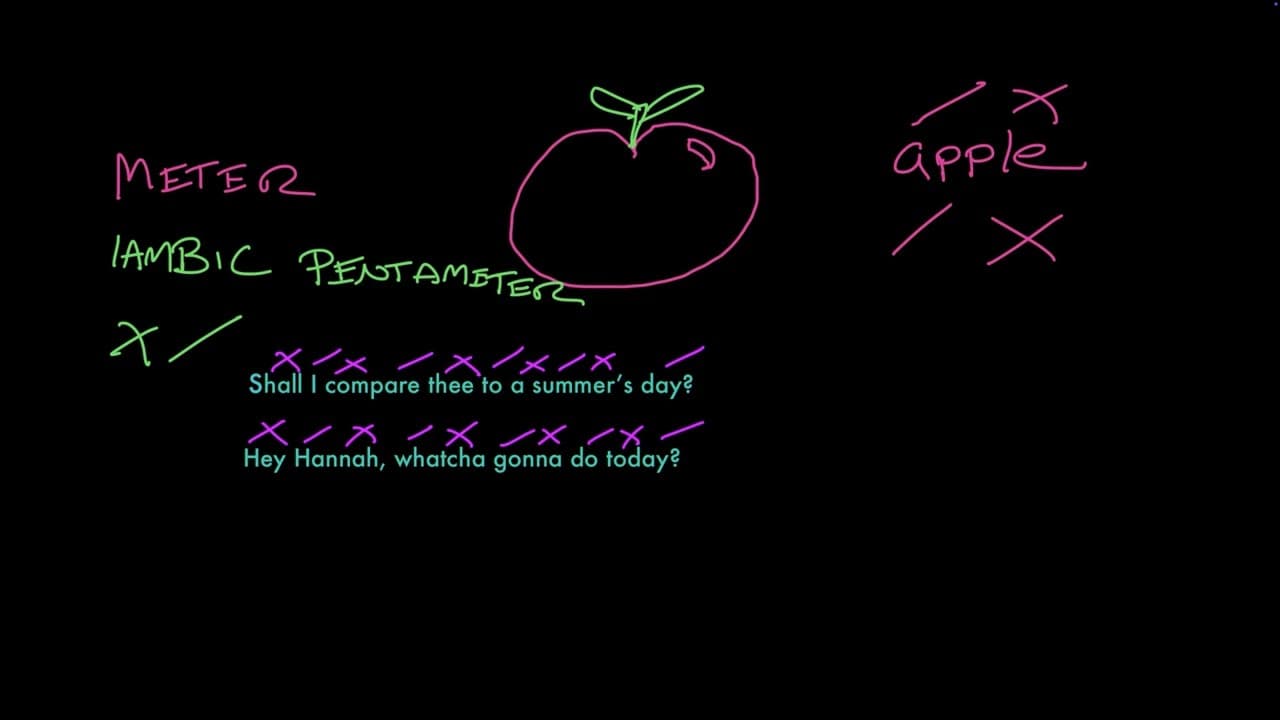
Understanding the Shape and Sound of Poetry

Understanding the Shape and Sound of Poetry

This engaging animated video demystifies poetry by breaking down its fundamental structural elements. Hosts Hannah and David explore the question "How does a poem work?" by contrasting poetry with prose, explaining that while prose relies on sentences and paragraphs, poetry utilizes lines and stanzas to shape the reader's experience. The video emphasizes that poetry is "language art" that plays with sound and shape, making it an accessible medium for expressing feelings about everyday life rather than an elite or overly complex form of writing. The content covers essential poetic devices including rhyme, rhythm, meter, and structure. Specific concepts explained include the difference between lines and sentences, the definition of a stanza, the mechanics of stress and unstress in words (using the word "apple" as a demonstration), and a clear breakdown of iambic pentameter using Shakespeare's Sonnet 18. It also touches on Haiku, challenging the rigid 5-7-5 syllable rule in favor of capturing a specific moment or "vibe," using examples from William Carlos Williams and Yosa Buson. For educators, this video is an excellent primer for a poetry unit. It provides clear, visual definitions of terminology that often confuses students, such as meter and line breaks. Teachers can use the video to introduce scansion, prompt creative writing exercises modeled after the "Post-it note" style of William Carlos Williams, or initiate discussions about when and why writers might choose to break established rules to better serve their artistic intent.

Khan AcademyKhan Academy

5mins

Painting With Words: How to Use Imagery in Poetry

Painting With Words: How to Use Imagery in Poetry

This engaging educational video introduces students to the concept of imagery in poetry through a narrative adventure in "Verse Valley." The host, exploring a dark cave with an animated robot companion named Mia, seeks to wake up the sleeping "Guardian of Imagery"—a lizard in a top hat—by using descriptive language. The video defines imagery as descriptive or figurative language that engages the five senses (sight, sound, smell, touch, taste) and imagination, moving beyond simple adjectives to create vivid mental pictures. The content breaks down how to identify and create imagery using concrete examples. It contrasts weak descriptions (e.g., "The cave is scary") with rich, sensory-laden poetry (e.g., "Stalactites dripping down the back of your neck"). The video explicitly teaches three strategies for writing effective imagery: being specific with details, using diverse parts of speech (not just adjectives), and being creative by making unusual connections. It also provides a side-by-side analysis of a poem about clouds to demonstrate how imagery changes the reader's mental visualization. For educators, this video serves as an excellent introduction or review of figurative language units. It is highly interactive, featuring multiple "pause and resume" moments that prompt students to analyze text, brainstorm sensory words, and write their own short poems. The clear structure—definition, analysis, strategy, and application—makes it a ready-made lesson component that scaffolds creative writing skills and helps students understand the "show, don't tell" principle in writing.
Miacademy & MiaPrep Learning ChannelMiacademy & MiaPrep Learning Channel

12mins 21s

Materials

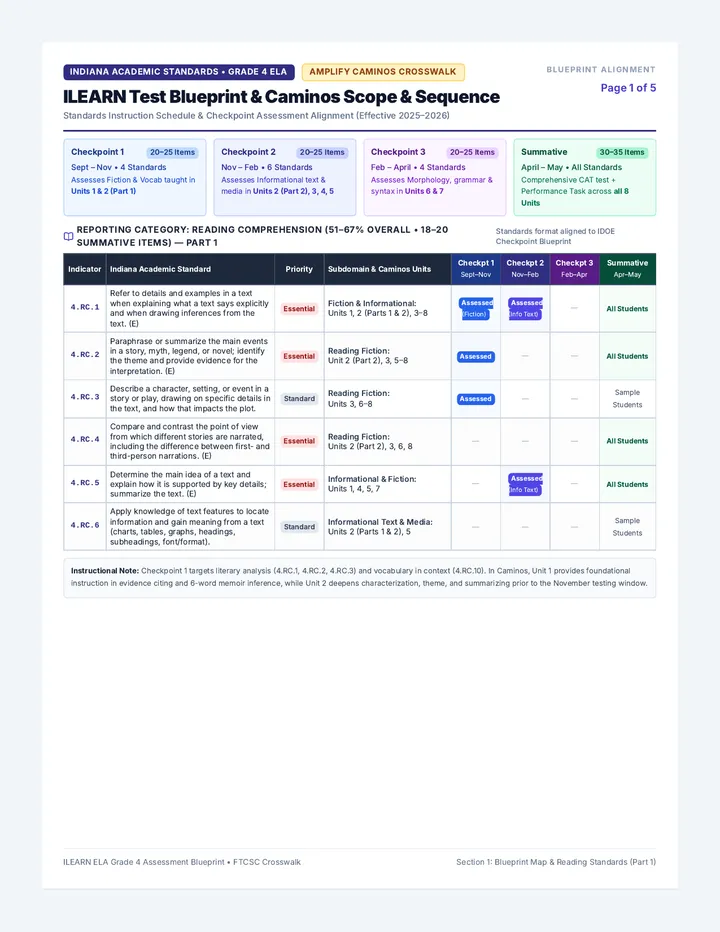
ILEARN Caminos Blueprint Guide

ILEARN Caminos Blueprint Guide

Comprehensive Grade 4 ILEARN Test Blueprint and Amplify Caminos Scope & Sequence crosswalk. Formatted to match the state ILEARN checkpoint blueprint, showing exactly when Indiana Academic Standards (Reading, Vocabulary, Writing, Grammar, and Communication) are taught across Units 1–8 and assessed in Checkpoints 1, 2, 3, and the Summative Assessment.

A

Amy.Hacker

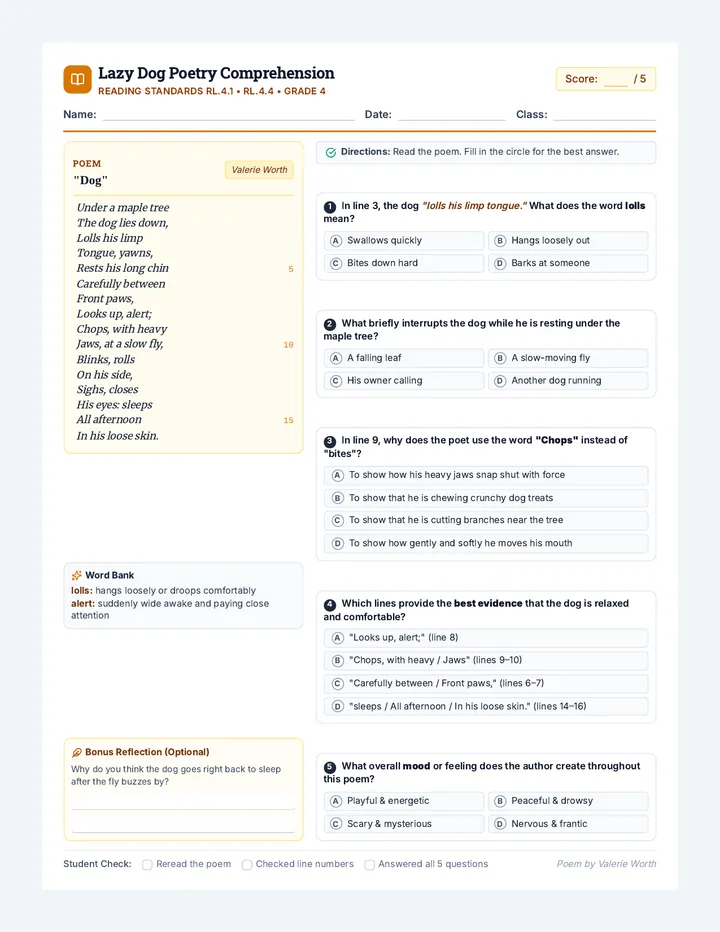
Lazy Dog Picture Comprehension Worksheet

Lazy Dog Picture Comprehension Worksheet

A visual 4th-grade comprehension worksheet for Valerie Worth's poem featuring 5 two-option picture-based questions with randomized correct answers (A and B mixed up), an illustrated word bank, and the full poem with line numbers.

M

mattiea

Text Explorer Vocabulary Notebook

Text Explorer Vocabulary Notebook

A comprehensive 6-page student vocabulary notebook covering all 4th Grade ELA Literature and Informational standards (RL.4.1–RL.4.9 and RI.4.1–RI.4.9). Features student-friendly definitions, authentic mentor text examples, standards alignment tags, handwriting application spaces, conceptual comparison matrices, and an independent reading word collector.

DG

Debra Golden

Poetry Garden Worksheet

Poetry Garden Worksheet

A 2nd-grade reading worksheet featuring an engaging original poem with comprehension questions and poetry practice on rhyme, rhythm, and sensory imagery.

CM

Cheraynne Martin

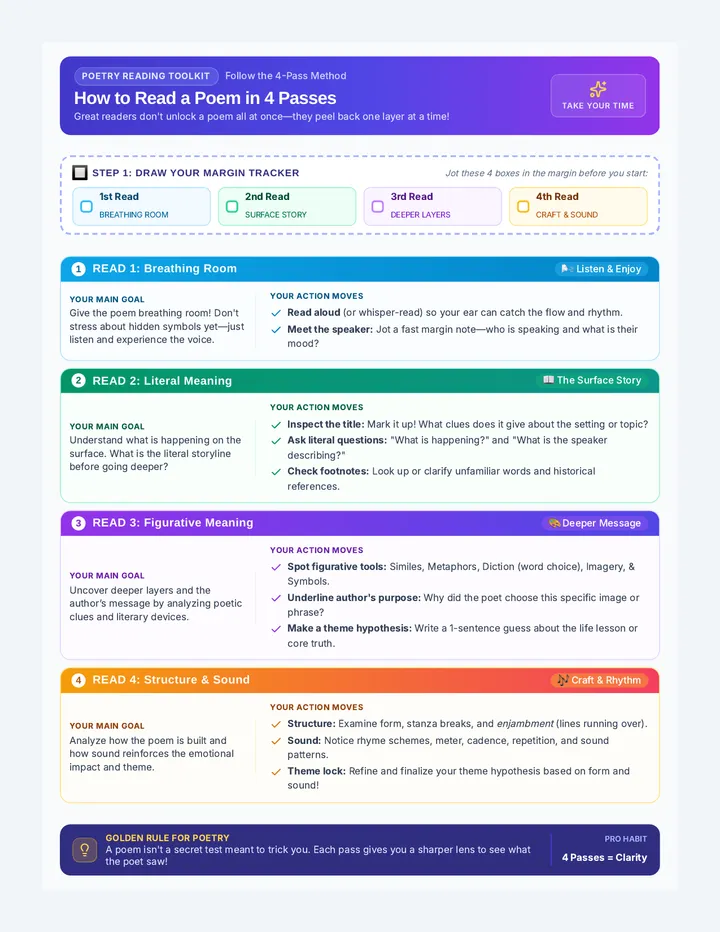
Poetry Deep Dive Anchor Chart

Poetry Deep Dive Anchor Chart

A student-friendly anchor chart breaking down a 4-step poetry reading protocol with actionable goals, visual icons, and margin tracking checkboxes.

K

kyle.hill

Power Words Display Cards

Power Words Display Cards

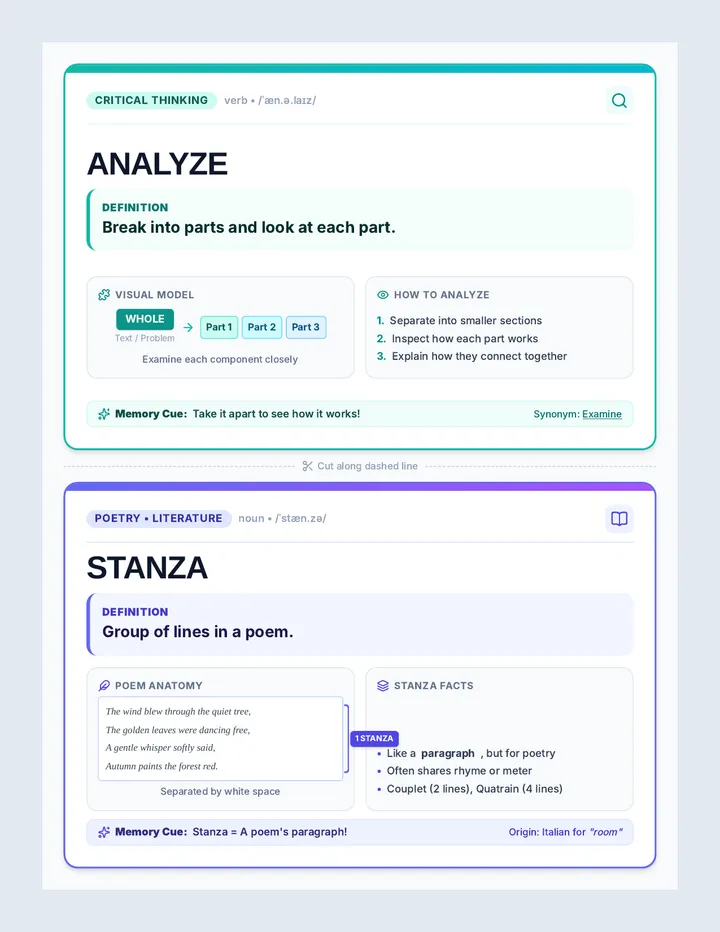
Printable, large-format classroom word wall display cards for key academic vocabulary terms: Analyze, Stanza, Annotate, and Evaluate. Each card features prominent lettering, clear student-friendly definitions, visual anchor models, phonetics, and memory cues designed for bulletin board visibility.

CW

Crystal Wade

Sequences

Lesson Plan 1 Introduction

Literary Device Detectives

A comprehensive multi-unit sequence for 3rd and 4th grade students covering key literary devices: Introduction to Figurative Language, Onomatopoeia, Similes, Metaphors, Personification, and Idioms. Each unit provides 5 lesson plans, interactive notebook resources, and a wide variety of activities and stories designed to improve descriptive writing and reading comprehension.

JS

Janette Sullivan

105
Verse and Veracity Teacher Guide

Media Center Year Curriculum

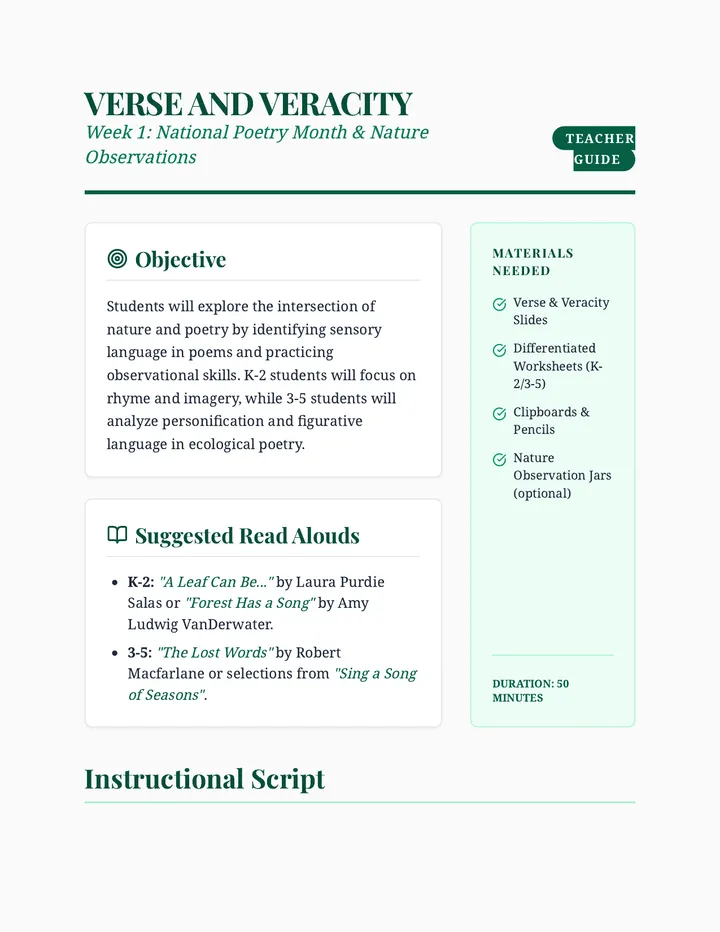
A comprehensive K-5 Media Center curriculum spanning August to May. Each month features a thematic unit integrating library skills (Dewey Decimal System, research, digital citizenship), literacy (poetry, biographies, informational texts), and STEM/Maker Space challenges. Resources are differentiated for K-2 and 3-5.

B

bethany.nied

50
Unit 1 Pacing Guide Document

Testing Our Limits Unit Sequence

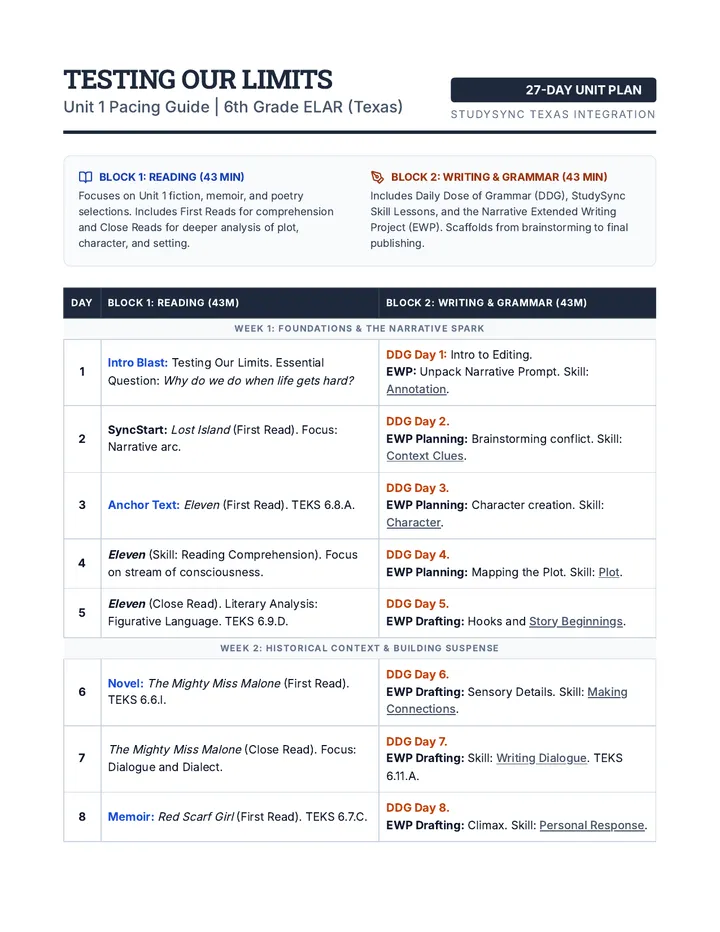
A 27-day instructional sequence for 6th Grade ELAR Unit 1: Testing Our Limits, featuring dual blocks for Reading and Writing with daily grammar and skill scaffolding.

DM

Dawn Mustian

81
Reading Focus Pacing Guide

Testing Our Limits Unit

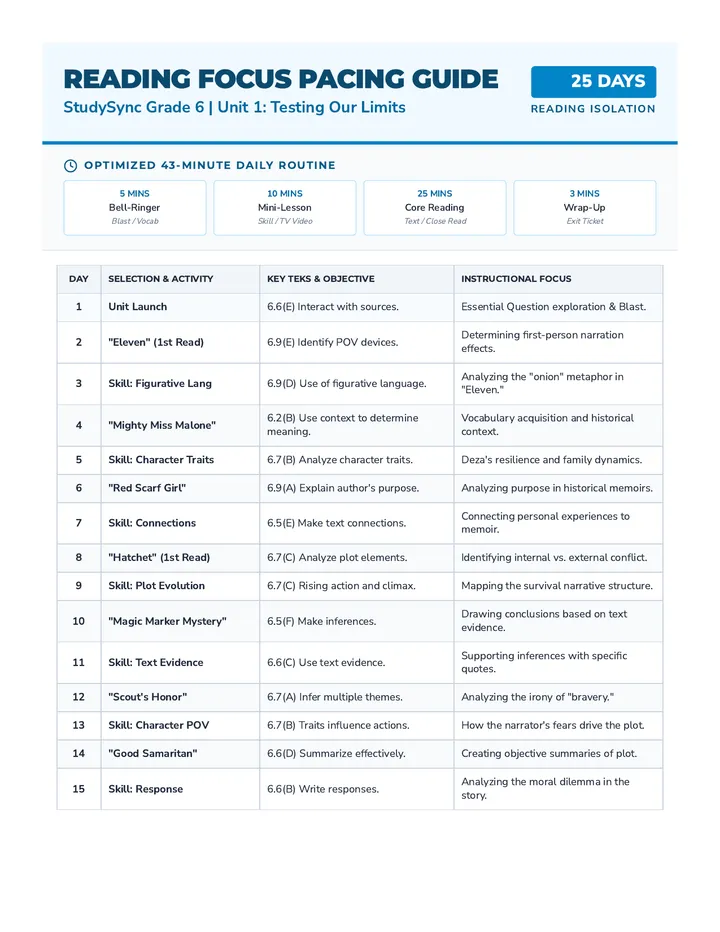
A 25-day comprehensive unit for StudySync Grade 6 that explores the theme of courage and resilience through isolated reading and writing tracks, aligned to ELA TEKS.

DM

Dawn Mustian

79
Landlady Reading Passage

Evidence Files

A four-day investigative unit focused on citing textual evidence and making inferences across various genres, including short stories, non-fiction, and poetry. Students act as 'Evidence Detectives' to solve literary and factual mysteries while engaging in collaborative discussions.

BR

Brandon Ruffin

26
Literary Dossier Packet

The STAAR Files Web Quest Extended Mission

A comprehensive 380-minute digital web quest for STAAR English 2 preparation, divided into 9 high-intensity missions of 45 minutes or less, covering the top five most tested TEKS.

LF

Lindsey Foulks

13