Text Explorer Vocabulary Notebook
Text Explorer Vocabulary Notebook
4th Grade ELA Reading Literature & Informational Standards Master Guide
Grade 4 ELA
Student Name:
Date Started:
Teacher / Class:
Your Standards Word Expedition
Strong readers do not just memorize definitions—they spot these vocabulary concepts inside real stories and articles. This notebook equips you with the exact literary and informational terminology required by 4th grade state standards.
Notebook Structure
-
1
Unit 1: Literature Ideas & Elements
Inference, Evidence, Theme, Summary, Traits (RL.4.1–3)
-
2
Unit 2: Craft, Structure & POV
Figurative Language, Poetry, Drama, Narrator (RL.4.4–9)
-
3
Unit 3: Informational Key Ideas
Main Idea, Details, Explanations, Domain Words (RI.4.1–4)
-
4
Unit 4: Text Structures & Arguments
Patterns, Accounts, Reasons & Multiple Texts (RI.4.5–9)
How to Use Each Word Card
Step 1: Study the Definition
Read the student-friendly explanation and examine the state standard badge in the corner.
Step 2: Analyze Mentor Model
See how authors use this concept in literature and nonfiction passages.
Step 3: Write Your Action Evidence
Complete the prompt in the handwriting lines using your own independent reading book.
Standards Mastery Tracker (Check off when practiced) Literature (RL) & Informational (RI)
RL.4.1
RL.4.2
RL.4.3
RL.4.4
RL.4.5
RL.4.6
RL.4.7
RL.4.9
RI.4.1
RI.4.2
RI.4.3
RI.4.4
RI.4.5
RI.4.6
RI.4.7
RI.4.8/9
Grade 4 Reading Standards Vocabulary Notebook Page 1 • Reference & Guide
Unit 1
Literature • Key Ideas & Characters
Standards: RL.4.1, RL.4.2, RL.4.3 Fiction & Story Craft
Inference
RL.4.1
Definition: A logical conclusion a reader makes by combining explicit text clues with their own background knowledge (schema).
Mentor Model: "Leo zipped his thick parka, pulled mittens over his trembling hands, and watched his breath plume like smoke." → Inference: It is freezing outside.
My Text Clue + Schema = Inference:
Text Evidence
RL.4.1
Definition: Exact words, sentences, or details directly from the story used to prove or support an answer or claim.
Mentor Model: Question: Was Maya determined? Evidence: In paragraph 4, the author writes, "Despite scraped knees, Maya climbed back onto the saddle three more times."
Direct Quote or Sentence from My Book:
Theme
RL.4.2
Definition: The underlying message, life lesson, or big moral about human nature that the author wants readers to learn.
Mentor Model: In The Boy Who Cried Wolf, the topic is lying, but the theme is: "People will not believe a liar, even when they finally tell the truth."
Life Lesson / Theme from My Story:
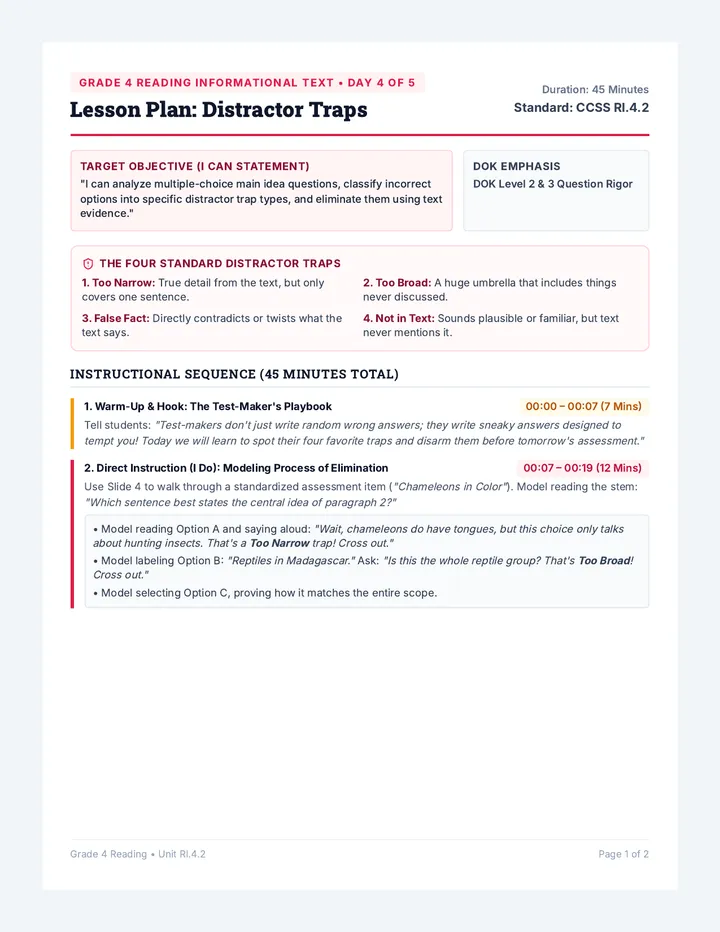
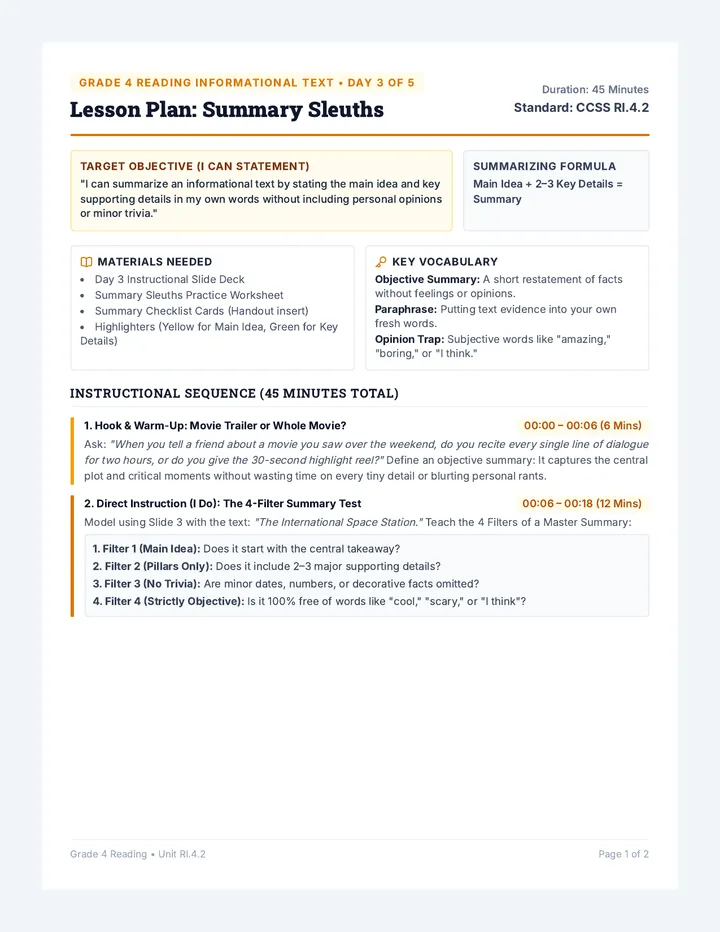
Objective Summary
RL.4.2
Definition: A brief retelling of the main story events (Somebody, Wanted, But, So, Then) containing only facts—no personal opinions.
Mentor Model: Cinderella wanted to attend the royal ball, but her stepmother forbade her. Her fairy godmother helped her go, and she married the prince. (No opinions).
1-Sentence Plot Summary (SWBST):
Character Trait
RL.4.3
Definition: A character's lasting personality quality revealed through thoughts, words, and actions (not a temporary feeling).
Mentor Model: Feeling: Jordan felt nervous for ten minutes before the speech. Trait: Jordan is courageous because he always stands up for classmates.
Character + Trait + Action Proof:
Motivation & Conflict
RL.4.3
Definition: Motivation is the reason why a character behaves a certain way. Conflict is the central obstacle or struggle they must solve.
Mentor Model: Mateo's motivation was to save his family farm. His conflict was an intense three-month drought that withered all crops.
What My Character Wants & The Problem:
Unit 1: Literature Standards RL.4.1–RL.4.3 Page 2 • Key Ideas & Characters
Unit 2
Literature • Craft, Structure & POV
Standards: RL.4.4, RL.4.5, RL.4.6, RL.4.7 Forms & Perspectives
Figurative Language
RL.4.4
Definition: Words used beyond their literal dictionary meaning to create vivid imagery. Includes similes (using like/as) and metaphors (direct comparisons).
Mentor Model: Simile: "Her laughter was as warm as summer sunshine." Metaphor: "The classroom was a bustling beehive before the bell."
Simile or Metaphor I Found / Created:
Idiom & Imagery
RL.4.4
Definition: An idiom is a common cultural expression whose meaning differs completely from the words. Imagery appeals to the 5 senses.
Mentor Model: "Don't throw in the towel" = Don't quit. "Crisp, butter-toasted crust crackled between his teeth" (taste, sound, touch).
Idiom Meaning OR 5-Sense Description:
Prose vs. Drama
RL.4.5
Definition: Prose uses ordinary sentences and paragraphs. Drama is a script meant for actors, formatted with scenes, dialogue tags, and stage directions.
Mentor Model: Drama element: NARRATOR: (whispering) Look closer! [STAGE DIRECTION: Lights dim; sound of distant thunder.]
Key Difference I Noticed in Text Format:
Poetry: Stanza & Meter
RL.4.5
Definition: Verse refers to a single line of poetry. A stanza is a grouped set of lines (like a poem paragraph). Meter is the rhythmic beat of syllables.
Mentor Model: "The wind tapped softly on the pane, / And sang a song of silver rain." (2 lines in a rhyming couplet stanza with a bouncy meter).
Rhyme Scheme or Stanza Note from Poem:
Point of View (POV)
RL.4.6
Definition: The lens through which the story is told. 1st Person: narrator is a character (I, me, we). 3rd Person: outside narrator tells the story (he, she, they).
Mentor Model: 1st: "I gripped my compass." vs. 3rd: "Kiran gripped his compass while Elena checked their battery power."
Story Narrator POV & Clue Words (I / He / She):
Visual Connections
RL.4.7
Definition: How illustrations, drawings, or graphic novel panels add meaning, build mood, or clarify character emotions that words alone don't reveal.
Mentor Model: The text simply states, "The cavern was dark," but the illustration shows glowing crystal runes on the rocky walls, hinting at ancient magic.
What the Picture Showed that the Words Didn't:
Unit 2: Literature Standards RL.4.4–RL.4.7 Page 3 • Craft, Structure & POV
Unit 3
Informational • Key Ideas & Academic Vocabulary
Standards: RI.4.1, RI.4.2, RI.4.3, RI.4.4 Nonfiction & Facts
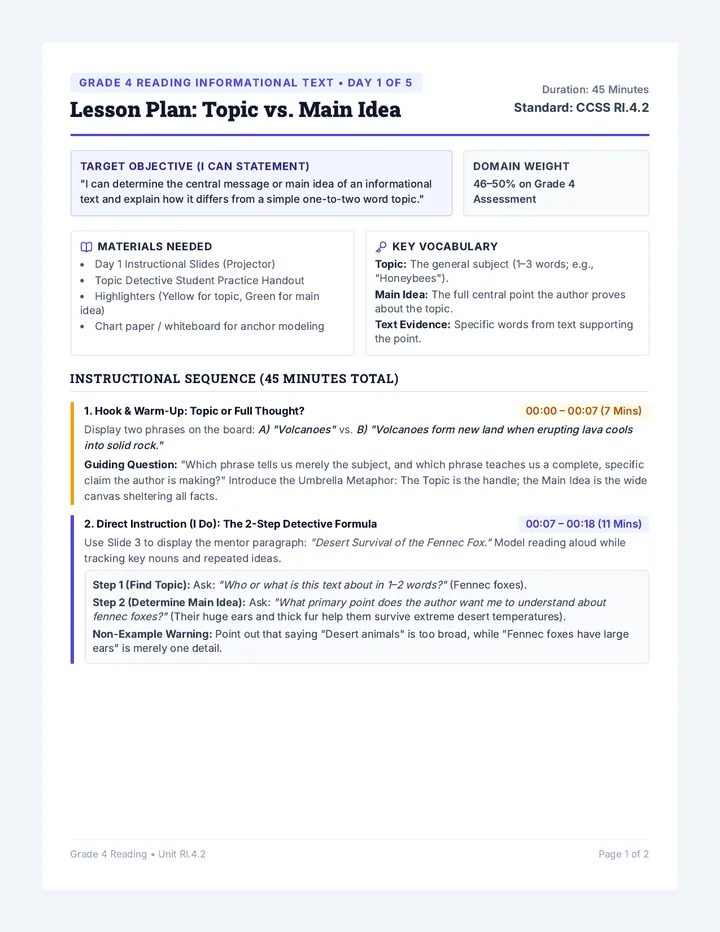
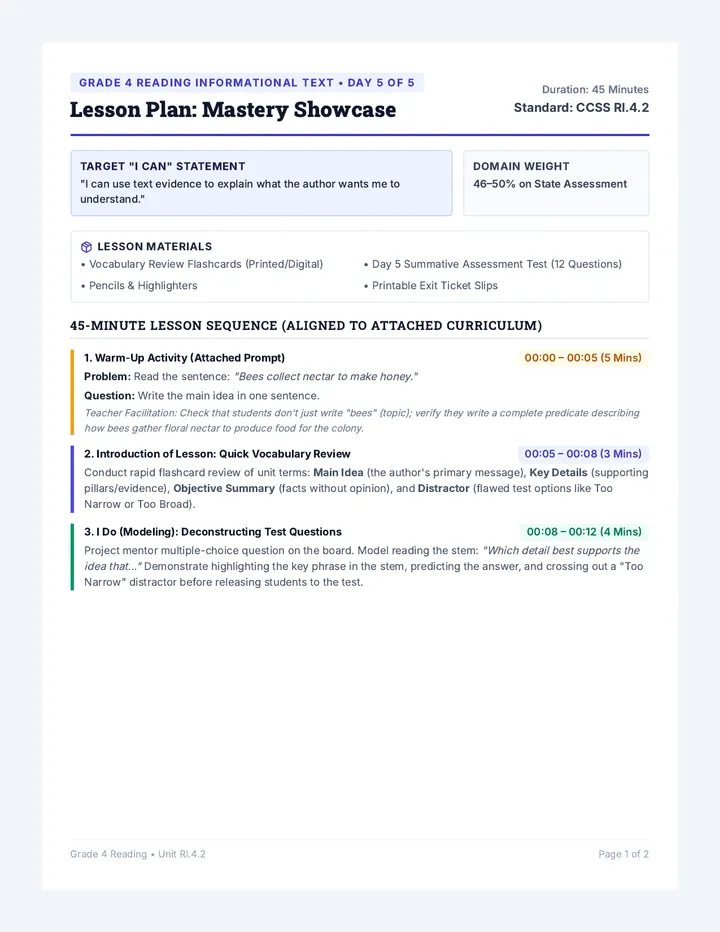
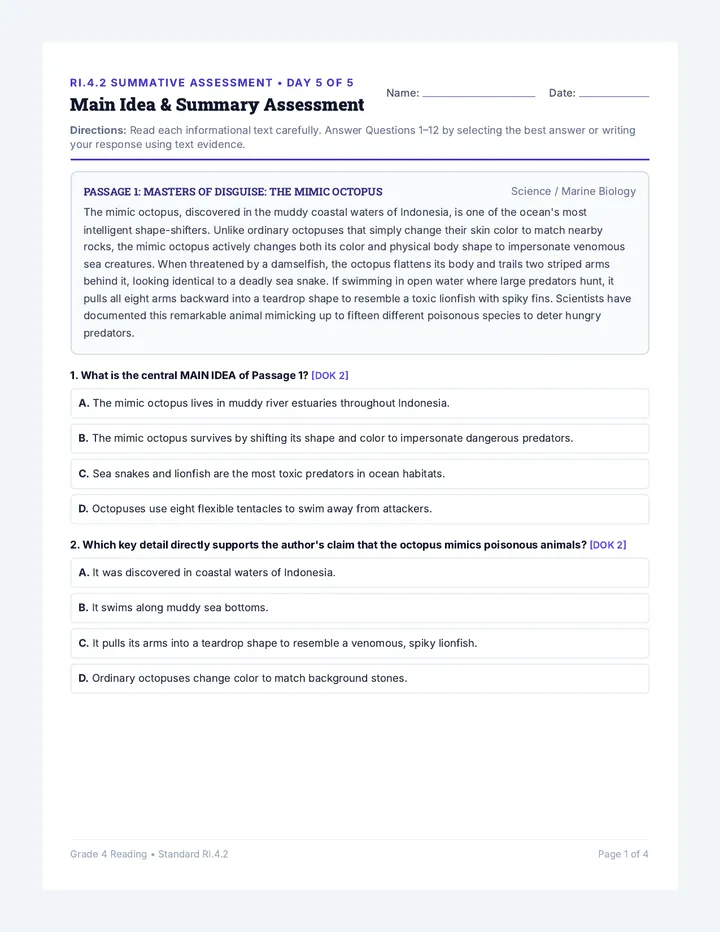
Main Idea
RI.4.2
Definition: The most important overarching point the author makes about the topic in an informational text or paragraph.
Mentor Model: Topic: Honeybees. Main Idea: "Honeybees are essential pollinators whose survival directly impacts human food supplies across the globe."
Topic + Main Idea Statement:
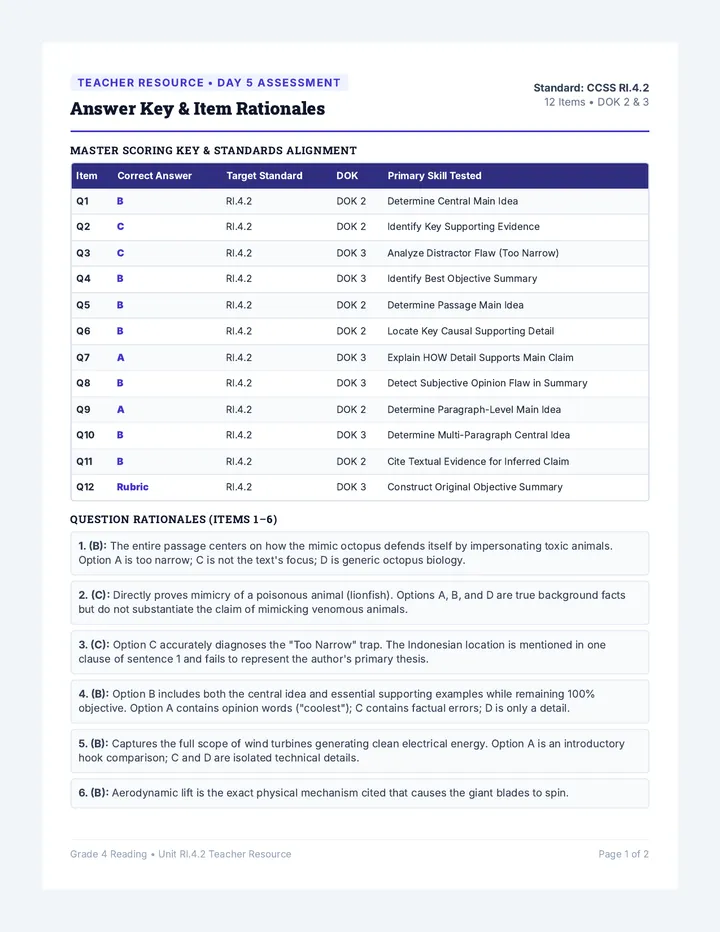
Key Details
RI.4.2
Definition: Specific facts, statistics, research findings, and examples that explain, prove, or build up the main idea.
Mentor Model: Key Detail: "According to the USDA, one out of every three bites of food Americans eat depends on honeybee pollination."
Two Supporting Facts from Article:
Quote vs. Paraphrase
RI.4.1
Definition: A direct quote copies word-for-word in quotation marks (" "). A paraphrase restates the author's facts in your own unique words.
Mentor Model: Quote: Dr. Bell wrote, "Mars loses water into space." Paraphrase: Dr. Bell explains that Mars's water vapor continuously escapes into the atmosphere.
Paraphrase a Sentence in Your Own Words:
Scientific & Historical Events
RI.4.3
Definition: Explaining what happened, how a process unfolds, or why something occurred based on specific information in a nonfiction text.
Mentor Model: "When tectonic plates slip suddenly under ocean basins, energy pushes tons of water upward, triggering powerful tsunami waves."
Cause & Effect Explanation of Event/Concept:
Domain-Specific Words
RI.4.4
Definition: Specialized words and technical terms that belong specifically to a particular field of study (e.g., science, history, geography).
Mentor Model: Science: photosynthesis, precipitation, magma. Social Studies: legislature, tributary, expedition.
Domain Word + Subject Field + Meaning:
Context Clues
RI.4.4
Definition: Hints found in surrounding sentences (definitions, synonyms, antonyms, examples) that help decipher unfamiliar vocabulary.
Mentor Model: "The cave was so cavernous—unlike our cramped, tiny shelter—that an airplane could have fit inside." → cavernous means vast and huge.
Mystery Word + Clue Found in Sentence:
Unit 3: Informational Standards RI.4.1–RI.4.4 Page 4 • Key Ideas & Academic Vocabulary
Unit 4
Informational • Text Structures & Arguments
Standards: RI.4.5, RI.4.6, RI.4.7, RI.4.8, RI.4.9 Analysis & Evaluation
Chronological & Sequence
RI.4.5
Definition: Organizing text by the time order in which events happened, or step-by-step instructions. Uses words like first, next, then, in 1969, finally.
Mentor Model: "In 1903, the Wright Brothers flew at Kitty Hawk. Twelve years later, military aircraft were mass-produced. By 1969, astronauts landed on the moon."
Timeline Steps / Time Transition Words:
Problem & Solution
RI.4.5
Definition: An organizational pattern where an author presents a difficult challenge, dilemma, or conflict and explains one or more ways to resolve it.
Mentor Model: Problem: Plastic waste clogs marine habitats. Solution: Engineers designed floating barriers that collect trash powered by ocean currents.
Article's Problem and Proposed Solution:
Firsthand vs. Secondhand
RI.4.6
Definition: A firsthand account is written by someone who personally experienced the event (diaries, letters). A secondhand account is written by a researcher (textbooks, biographies).
Mentor Model: Firsthand: Anne Frank's personal diary. Secondhand: A 2024 history textbook chapter summarizing World War II.
Account Type & Why (Did Author Live It?):
Graphic Features
RI.4.7
Definition: Visual displays of information like charts, tables, diagrams, timelines, and maps that clarify and expand upon the body text.
Mentor Model: A cross-section diagram of a volcano showing the magma chamber and vent allows the reader to visualize what is hidden deep beneath Earth's crust.
Feature Type (Chart/Map/Diagram) & What It Taught Me:
Claim & Reasons
RI.4.8
Definition: A claim is the author's stance or opinion on an issue. Reasons and evidence are the logical arguments and proofs that back up that claim.
Mentor Model: Claim: Schools should extend recess. Reason: Pediatric studies demonstrate that physical play improves afternoon math concentration.
Author's Claim + Best Supporting Reason:
Integrate Information
RI.4.9
Definition: Combining key knowledge and details from two different texts on the same topic to speak, write, or present like an expert.
Mentor Model: Reading an article on Mars rovers + looking at a NASA altitude chart = writing a complete essay on rover landing mechanics.
How Text A + Text B Fit Together:
Unit 4: Informational Standards RI.4.5–RI.4.9 Page 5 • Text Structures & Arguments
Cross-Standards Master Matrix & Word Collector
Review & Synthesis
Part A: Literature vs. Informational Counterparts (Don't Confuse These!)
Theme vs. Main Idea RL.2 vs RI.2
Theme: Universal moral/lesson about life in stories (e.g., honesty, resilience).
Main Idea: Specific central point of a nonfiction passage (e.g., how bats navigate using sonar).
Point of View vs. Account RL.6 vs RI.6
Point of View: Story narrator perspective (1st Person "I" vs. 3rd Person "He/She").
Firsthand Account: Written by an eyewitness who was physically present at the real event.
Conflict vs. Problem RL.3 vs RI.5
Story Conflict: Emotional, physical, or social struggle facing a fictional character.
Nonfiction Problem: Real-world issue (pollution, disease) paired with tested solutions.
Part B: Standards Detective in Action Read passage & identify standards terms
"The ancient redwoods rose like towering emerald cathedrals into the Pacific mist. Park ranger David Chen inspected the charred outer bark of a thousand-year-old giant. 'Fire looks destructive,' Chen noted in his field journal, 'yet redwood cones need intense heat to open their seeds.' Because wildfires clear overgrown brush, young saplings receive vital sunlight to germinate."
1. Figurative Language: What simile is used to describe the redwoods?
2. Text Structure (RI.4.5): Is this Cause & Effect, Chronology, or Compare?
3. Account Type (RI.4.6): Is Ranger Chen's quote Firsthand or Secondhand?
Part C: My Personal Standards Word Collector Record 3 challenging words from your reading books
| New Word / Standard | Book Title & Sentence Found | Meaning (Using Context Clues) | Mastered? |
|---|
| | | |
| | | |
|
|
|
|
|
|
|
|
|
|
|
|
|
Synthesis & Independent Application Matrix Page 6 • Matrix & Collector