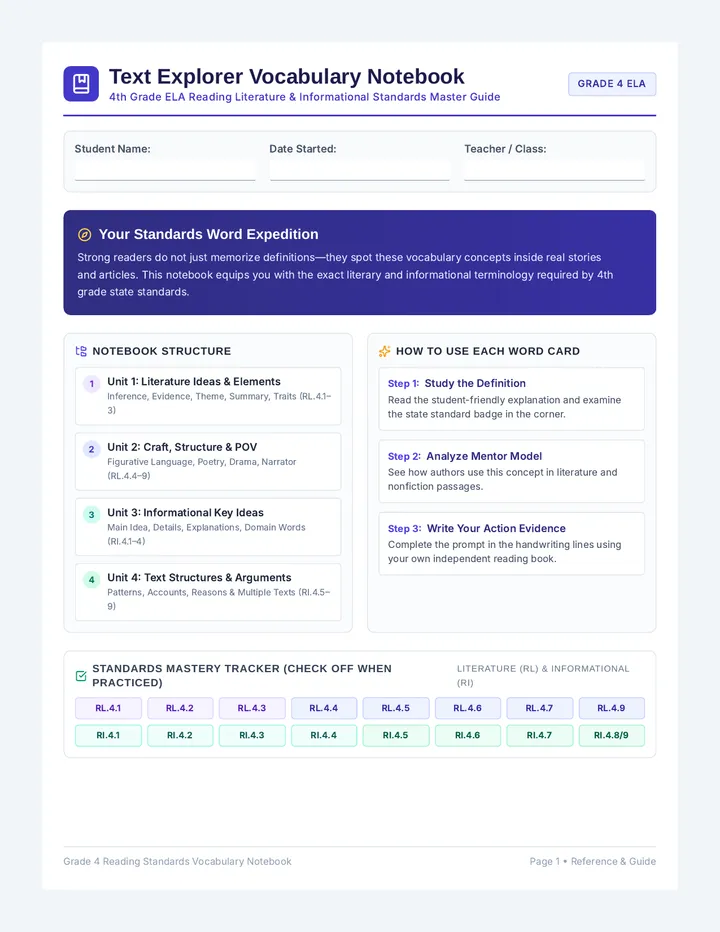
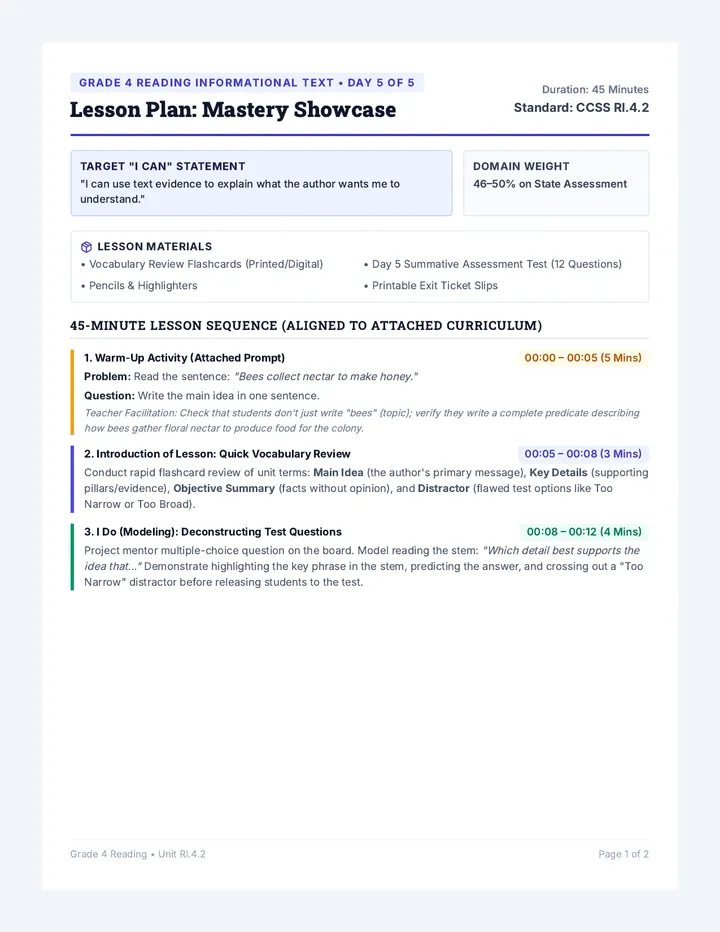
A five-day fourth-grade reading unit aligned to CCSS RI.4.2 focusing on determining main ideas, analyzing supporting key details, crafting summaries, mastering multiple-choice test strategies, and demonstrating mastery.
Look for the noun or noun phrase repeated across the passage.
2
Underline the Main Idea in Green
Ask: "What big truth is the author proving about that topic?"
3
Test Your Umbrella
Check if all supporting sentences fit comfortably underneath your sentence.
Open your Topic Detective Worksheet and let's crack the first case together!
A. Peregrine falcons have clear third eyelids to protect their eyes from high winds.
B. The peregrine falcon possesses remarkable physical adaptations that enable extreme diving speeds.
C. Birds that live across North America use their wings to hunt food.
D. High altitudes cause air pressure issues for animals in flight.
6. Detective Analysis: Why are the other choices incorrect?
Match each wrong answer option from Question 5 with the reason it is flawed:
Option A is flawed because: It is only ONE supporting detail (Too Narrow)
Option C is flawed because: It is an overly general statement (Too Broad)
Option D is flawed because: It is not the focus of this passage
7. Detective Tip: In 1–2 sentences, explain the difference between a detail and a main idea:
Core Idea Quest • RI.4.2 Page 2 of 2
"Venus Flytrap: The Carnivorous Marvel"
Have students locate the stated main idea: "The Venus flytrap has specialized snap traps to capture insects in nutrient-poor soil."
Partners evaluate three sentences and label them: [PILLAR] or [TRIVIA].
Conduct a choral response or thumbs up/down check to verify reasoning.
4. Independent Practice (You Do): Pillar Blueprint Organizer
00:28 – 00:40 (12 Mins)
Students complete Passage 2 ("The Roman Aqueduct System"). They independently identify the main idea and extract exactly three key supporting details, writing a brief justification for each detail explaining how it proves the central claim.
5. Closure & Quick Whip-Around
00:40 – 00:45 (5 Mins)
Sentence Stem Wrap-up: "A key detail is different from a fun fact because ________." Have 3–4 students share their response aloud before collecting worksheets.
Targeted Differentiation Strategies
Support / ELL
Color-code the text ahead of time with numbered lines so students can point to specific lines when citing evidence.
On-Level Focus
Require students to paraphrase key details rather than copying whole sentences word-for-word from the passage.
Extension / Advanced
Ask students to write one additional hypothetical key detail that would make the author's argument even stronger.
Common Student Misconceptions to Address
Students often mistake an emotionally exciting sentence or shocking number for the main key detail. Remind them: "Just because a fact is surprising does not mean it is the author's primary building block. Always check if it connects back to the tabletop!"
Grade 4 Reading • Unit RI.4.2 Page 2 of 2
2
Highlight the 3 Strongest Pillars
Look for the concrete evidence, facts, and steps that prove the author's claim.
3
Screen Out the Extras
Don't get tricked by cool trivia that doesn't actually hold up the tabletop!
Grab your Supporting Pillars Handout and construct your evidence blueprint!
Tabletop: Identify the Passage Main Idea (Complete Sentence)
▼ Supported by 3 Key Pillars (Evidence from Text) ▼
Pillar 1: Gravity & Slope
Quote or paraphrase detail:
How it supports main idea:
Pillar 2: Arched Bridges
Quote or paraphrase detail:
How it supports main idea:
Pillar 3: Filtration & Pipes
Quote or paraphrase detail:
How it supports main idea:
Core Idea Quest • RI.4.2 Page 2 of 2
Attempt A: Contains personal opinion ("Reefs are the prettiest place in the world..."). Have students strike through the opinion words.
Attempt B: Only lists tiny details without stating the main idea.
Attempt C: Balanced, concise, objective summary.
4. Independent Practice (You Do): Crafting an Objective Summary
00:28 – 00:40 (12 Mins)
Students read Passage 2 ("The Ant and the Acacia Tree: A Mutual Partnership"). They use the 3-step scaffold to write an objective 3–4 sentence summary and complete the self-check rubric.
5. Closure & Quick Cold Call
00:40 – 00:45 (5 Mins)
Ask: "If a summary has a sentence like 'I think this animal is super cool,' what rule did it break?" (Violated objectivity rule). Preview Day 4: Tackling tricky multiple-choice questions on tests!
Targeted Differentiation Strategies
Support / ELL
Provide sentence starters: "This text explains that [Main Idea]. First, [Detail 1]. Next, [Detail 2]."
On-Level Focus
Have students limit their summary strictly to 35–50 words to enforce brevity and precision.
Extension / Advanced
Challenge students to write a "micro-summary" of exactly 20 words that captures both main idea and core proof.
Standard Mastery Benchmark (RI.4.2)
Students demonstrate mastery when their summary integrates the text's central idea with 2 supporting details, avoids verbatim plagiarism, and strictly excludes personal feelings or irrelevant trivia.
Grade 4 Reading • Unit RI.4.2 Page 2 of 2
Checklist for Success
1
State the Main Idea First
Write a clean sentence that tells the author's primary takeaway.
2
Include 2 Key Pillars
Add only the most essential facts that prove the main idea.
3
Delete Trivia & Opinions
Check: Are there any feelings or minor trivia? If yes, edit them out!
Open your Summary Sleuths Worksheet and craft your master summary!
Step 2: Two Essential Details
Final Objective Summary (3 to 4 Complete Sentences):
Write in your own words. Do not include personal feelings or opinions.
Summary Sleuth Self-Check Checklist
Includes the text's central main idea Contains 2 essential supporting details Free of personal opinions or feelings Written in complete, original sentences
Core Idea Quest • RI.4.2 Page 2 of 2
Debrief aloud: Why is "Too Narrow" the most tempting distractor for fourth graders? (Because it actually appeared in the passage word-for-word!).
4. Independent Practice (You Do): Test Detective Mission
00:29 – 00:40 (11 Mins)
Students complete Questions 2, 3, and 4 independently under simulated test conditions. They must show their work by crossing out at least two eliminated options and writing a 1-sentence evidence justification for their chosen answer.
5. Closure & Tomorrow's Test Preview
00:40 – 00:45 (5 Mins)
Reiterate: "Tomorrow on our Day 5 Assessment, every question will test your ability to determine main ideas, cite supporting details, and select or write summaries. Trust your detective toolkit!"
Targeted Differentiation Strategies
Support / ELL
Allow students to use a physical "Trap Detective" bookmark with definitions and visual symbols of each trap type.
On-Level Focus
Emphasize re-reading the question stem carefully to see if it asks for the main idea of a single paragraph or the whole passage.
Extension / Advanced
Have advanced students write their own "Too Narrow" and "Too Broad" distractor options for a short paragraph.
Assessment Preparation Alignment
Today's practice directly primes students for the 30-minute summative test tomorrow (Day 5), ensuring high test-taking stamina and familiarity with DOK 2 and 3 phrasing.
Grade 4 Reading • Unit RI.4.2 Page 2 of 2
2
Label the Traps
Mark TN (Too Narrow), TB (Too Broad), FF (False Fact), or NT (Not in Text).
3
Prove the Winner
Make sure your chosen answer acts as an umbrella for every single detail!
Open your Distractor Traps Worksheet and conquer multiple-choice tests!
A. Elephants have sensitive foot pads that detect tremors in the dirt. Trap: [ ]
B. Elephants utilize low-frequency infrasound rumbles to communicate warnings and coordinate herd movements over great distances. [ Winner ]
C. Wild animals in Africa face dangerous predators every day. Trap: [ ]
D. Elephants prefer living alone rather than traveling in family groups. Trap: [ ]
4. Which detail from Passage 2 directly supports the idea that elephants can perceive sounds that humans cannot hear?
A. "These ultra-low sound waves register below the limit of human hearing..."
B. "When a herd leader detects a rumbling alarm..."
C. "...march toward safety."
D. "...family members across vast savannah landscapes..."
5. Test-Taker's Pledge: Write your personal strategy for tomorrow's 12-question assessment:
Core Idea Quest • RI.4.2 Page 2 of 2
5. Closure: Strategy Reflection (Attached Prompt)
00:40 – 00:43 (3 Mins)
Class Discussion: Students share aloud the specific strategies that helped them find main ideas and summarize during the assessment (e.g., umbrella model, looking for repeated nouns, crossing out too narrow details).
6. Exit Ticket (Attached Prompt)
00:43 – 00:45 (2 Mins)
Prompt:"Write one tip for finding the main idea in nonfiction." Collect slips at the classroom door as a final summative reflection.
Testing Accommodations & Differentiation
IEP / 504 / ELL
Provide text-to-speech or read-aloud of question stems. Offer chunked testing intervals or extended time (+15 mins) as specified in plans.
Standard Administration
Encourage students to re-read the first and last sentences of each paragraph to check for topic shifts.
Early Finishers
Students write a 3-sentence summary of their favorite nonfiction library book on the back of their assessment.
Mastery Scoring Scale (12 Items)
10–12 Correct (83–100%): Exceeds / Meets Standard
8–9 Correct (67–75%): Approaching Standard
0–7 Correct (<67%): Needs Targeted Tier 2 Reteach
Grade 4 Reading • Unit RI.4.2 Page 2 of 2
4. Which option represents the best OBJECTIVE SUMMARY of Passage 1? [DOK 3]
A. The mimic octopus is the coolest animal ever because it scares damselfish with snake arms.
B. The mimic octopus defends itself against predators by altering its body shape and color patterns to impersonate several poisonous sea creatures, including sea snakes and lionfish.
C. Marine biologists went on an expedition to Indonesia where they discovered sixteen new animals.
D. Lionfish have venomous spines, whereas sea snakes have striped bodies that swim near reefs.
Passage 2: Harnessing the Wind: Modern Turbines
Physical Science & Technology
Modern wind turbines have evolved into powerful machines that generate massive amounts of clean, renewable electricity. Standing taller than the Statue of Liberty, these towering structures capture the kinetic energy of passing wind currents. When wind hits the aerodynamic curved blades, it creates lift—the exact same physical force that lifts airplane wings—forcing the giant blades to spin around a central rotor hub. This spinning motion turns an internal shaft connected to a gearbox, which accelerates the rotation speed up to 1,800 revolutions per minute. Finally, a magnetic generator converts this mechanical movement into usable electrical currents, sending clean power through underground cables to light thousands of surrounding homes and schools without releasing harmful greenhouse gases.
5. What is the author's primary MAIN IDEA in Passage 2? [DOK 2]
A. The Statue of Liberty is shorter than most industrial wind turbines.
B. Wind turbines convert the natural energy of wind into clean electrical power using aerodynamic blades and generators.
C. Gearboxes inside turbines spin at eighteen hundred revolutions per minute.
D. Underground power cables carry electricity to modern schools.
6. Which key detail explains HOW wind turbines generate the force needed to turn the rotor? [DOK 2]
A. Underground cables deliver electricity directly to homes.
B. Curved aerodynamic blades create aerodynamic lift as wind currents pass across them.
C. Turbines prevent the release of dangerous greenhouse gases.
D. Steel towers are painted white to stand out against hillsides.
7. How does the detail about greenhouse gases support the main idea? [DOK 3]
A. It proves why wind energy is considered an environmentally clean power source.
B. It explains why airplane wings create lift in high winds.
C. It shows how fast gearboxes spin under heavy friction.
D. It describes how tall engineers construct modern turbine towers.
8. Read the four summaries below. Which one contains a personal OPINION that disqualifies it as an objective summary? [DOK 3]
A. Wind turbines use aerodynamic lift to turn rotors and generate clean electricity without pollution.
B. Wind turbines are the most beautiful and wonderful technology ever invented to save our planet.
C. Towering turbines convert kinetic wind currents into usable electricity via gearboxes and generators.
D. Modern wind power systems capture wind energy with spinning blades to light thousands of community homes.
Passage 3: The Silk Road: Bridge Between Continents
World History
Paragraph 1: The ancient Silk Road was an extensive 4,000-mile network of overland caravan routes linking China, Central Asia, the Middle East, and the Mediterranean Sea. Merchants traveled in camel caravans across deserts and freezing mountain passes to exchange commodities. Chinese traders carried silk, porcelain, and teas westward, returning with Mediterranean glassware, tapestries, and horses.
Paragraph 2: Far more significant than the trade of physical luxury goods was the rich exchange of knowledge along the routes. Travelers shared revolutionary breakthroughs, including Chinese papermaking, compass navigation, and medicinal discoveries. Furthermore, languages, musical instruments, and major world religions traveled freely along with merchant caravans, permanently transforming civilization.
Grade 4 Reading • Standard RI.4.2 Page 3 of 4
Section 3 (Continued)
Final Assessment Questions
Questions 9–12
9. What is the central MAIN IDEA of Paragraph 2? [DOK 2]
A. The Silk Road enabled the vital exchange of ideas, technologies, and culture across civilizations.
B. Chinese craftsmen invented paper using mulberry bark and water.
C. Merchants rode camels across rugged mountain passes for four thousand miles.
D. Musical instruments were traded for Mediterranean glassware.
10. Which statement expresses the MAIN IDEA of the ENTIRE passage (Passage 3)? [DOK 3]
A. Camel caravans carried silk fabric through desert oases.
B. The Silk Road served as an essential trade and cultural bridge that exchanged both valuable goods and groundbreaking ideas.
C. Ancient travel was too dangerous for ordinary citizens to undertake.
D. Arabian horses were the most prized commodity along Mediterranean coastlines.
11. Which detail from Paragraph 1 supports the claim that the Silk Road was a challenging journey? [DOK 2]
A. "...exchanging precious commodities."
B. "...traveled in large camel caravans across blazing deserts and freezing mountain passes..."
C. "...returning with Mediterranean glassware..."
D. "...linking China, Central Asia, the Middle East, and the Mediterranean Sea."
Write an objective summary of Passage 3 in 2 to 3 complete sentences. State the main idea and at least two key supporting details. Remember: Do not include personal opinions!
Finished early? Review your work to ensure all questions are answered. ★ End of Assessment ★
Grade 4 Reading • Standard RI.4.2 Page 4 of 4
4. (B): Option B includes both the central idea and essential supporting examples while remaining 100% objective. Option A contains opinion words ("coolest"); C contains factual errors; D is only a detail.
5. (B): Captures the full scope of wind turbines generating clean electrical energy. Option A is an introductory hook comparison; C and D are isolated technical details.
6. (B): Aerodynamic lift is the exact physical mechanism cited that causes the giant blades to spin.
Grade 4 Reading • Unit RI.4.2 Teacher Resource Page 1 of 2
Rationales & Constructed Rubric
Scoring Guide & Exemplars
Day 5 Teacher Key
Question Rationales (Items 7–11)
7. (A): Emitting zero greenhouse gases directly validates why wind energy fulfills the definition of "clean, renewable electricity."
8. (B): Option B uses emotionally charged, subjective opinion language ("most beautiful and wonderful technology ever invented to save our planet"), which invalidates it as an objective summary.
9. (A): Paragraph 2 shifts focus from trade commodities to the intellectual, religious, and scientific exchange between civilizations.
10. (B): Synthesizes both Paragraph 1 (commercial goods trade) and Paragraph 2 (cultural and technological exchange) into a single cohesive central idea.
11. (B): Directly cites the physical hardships of the route: "blazing deserts and freezing mountain passes."
States accurate main idea of the entire text (both physical goods & cultural exchange), includes 2+ key supporting details in own words, and is 100% free of personal opinions.
3 Points (Proficient)
States accurate main idea, includes at least 1 key supporting detail with objective tone, minor phrasing flaws or slight over-reliance on text wording.
2 Points (Basic)
Main idea is incomplete (only mentions silk or camels), lacks key details, or includes subjective opinion statements ("it was amazing").
1 Point (Below)
Inaccurate or off-topic, copies an isolated phrase without demonstrating comprehension of the text.
Exemplar 4-Point Student Response:
"The Silk Road was an ancient network of trade routes connecting Asia and Europe that allowed merchants to exchange precious goods like Chinese silk and Mediterranean glassware. In addition to physical products, travelers also shared critical technologies such as papermaking and navigation, permanently shaping human history without bias."
Grade 4 Reading • Unit RI.4.2 Teacher Resource Page 2 of 2