Deductive reasoning structures, symbolic notation, and truth tables to evaluate argument validity. Identifies formal fallacies and constructs sound logical proofs.
A foundational language and logic lesson for first graders to master the concept of negation ('not') through playful categorization activities.
Capstone simulation. Students apply all 11 strategies to solve a complex text-based 'Maze' and earn their Thought Tracker Mastery.
Metacognitive choice. Students practice deciding which 'Mind Tool' (Inference, Visualization, Questioning) is best for specific text challenges.
Masters the 'Click or Clunk' monitoring technique. Students learn to identify when meaning breaks down and which tool to use for a 'fix-up'.
Identifies text structures (Cause/Effect, Sequence) as 'Brain Blueprints' that help organize incoming data.
Uses Arthur Evans' deductive reasoning techniques. Students solve logic puzzles by eliminating impossibilities within a text.
Directly inspired by the Reading Detective series. Students learn to cite page, line, and word clues to prove their reasoning.
Focuses on Synthesis. Students track how their 'Thought Map' changes from the first page to the final sentence.
Introduces the 'Curiosity Compass' to generate Thick and Thin questions, moving from literal facts to deep inquiry.
Teaches visualization as a sensory experience. Students learn to 'film' the story in their heads using five-sense descriptions.
Masters the 'Clue + Vault = Discovery' equation. Students learn to justify their inferences using specific text evidence and background knowledge.
Focuses on Schema as the 'Knowledge Vault.' Students learn to retrieve and organize prior knowledge before entering a text.
An ultra-simplified, single-page negation worksheet for preschoolers focusing on identifying 'not cake' items. Features no text under the pictures, giant centered 3D-like emojis inside soft colorful bubbles, and a clean header without the level badge. Item 7 has been updated from a pancake to a delicious chocolate cake slice.
Facilitator script for Lesson 6 of the Thinking Readers Program. Aligned with Bloom's Taxonomy (Remember, Analyze, Evaluate, Create). Focuses on Synthesis (Thinking Evolution). Includes character shift modeling and explicit Bloom's checks. Revised for branding and layout.
Facilitator script for Lesson 5 of the Thinking Readers Program. Aligned with Bloom's Taxonomy (Understand, Analyze, Evaluate). Teaches the Curiosity Compass strategy for generated questioning. Revised for branding and layout.
Facilitator script for Lesson 4 of the Thinking Readers Program. Aligned with Bloom's Taxonomy (Remember, Apply, Create). Focuses on Visualization (The Sensory Cinema). Includes explicit strategy modeling for 4D sensory reading.
Facilitator script for Lesson 3 of the Thinking Readers Program. Aligned with Bloom's Taxonomy (Understand, Apply, Analyze, Evaluate). Teaches the 'Clue Equation' strategy for inferencing. Includes explicit Bloom's check for evaluation.
Facilitator script for Lesson 2 of the Thinking Readers Program. Aligned with Bloom's Taxonomy (Remember, Understand, Analyze, Create). Focuses on activating background knowledge (The Knowledge Vault). Revised for branding and taxonomy labels.
Facilitator script for Lesson 1 of the Thinking Readers Program. Explicitly aligned with Bloom's Taxonomy (Remember, Apply, Analyze, Evaluate). Includes the specific 'Brain Choice' prompt and modeling for metacognition.
Student workbook page for Lesson 6 of the Thinking Readers Program. Features a 'Thinking Evolution Log' to track shifts at 0%, 50%, and 100%. Revised for page fit, high-contrast writing areas, and larger response boxes. Added evolution clues for better guidance. Aligned with Bloom's Taxonomy.
Student workbook page for Lesson 5 of the Thinking Readers Program. Features a 'Quest Map' for Thick and Thin questions. Includes Strategy Clues for vocabulary help and a high-contrast integrated Brain Choice section. Revised for contrast and page fit. Added specific quest clues for distinguishing question types.
Student workbook page for Lesson 4 of the Thinking Readers Program. Features a storyboard frame for multi-sensory visualization. Includes Strategy Clues for vocabulary help and a print-friendly high-contrast layout. Revised for page fit and larger writing areas. Added specific director clues.
Student workbook page for Lesson 3 of the Thinking Readers Program. Centers on the 'Clue Equation' (Inference). Features Strategy Clues for vocabulary support and a print-friendly high-contrast Brain Choice section. Revised for alignment, writing space, and contrast. Added specific equation clues.
Student workbook page for Lesson 2 of the Thinking Readers Program. Focuses on Schema activation (The Knowledge Vault). Includes optimized writing areas for item sorting and a print-friendly Deductive Dilemma section. Revised for contrast, vocabulary support, and answer choice uniformity.
A 12-lesson comprehension mastery program focused on metacognition, reasoning, and evidence-based thinking. Students progress from basic thinking awareness to complex deductive reasoning and synthesis. Inspired by Reading Detective and Comprehension Connections.
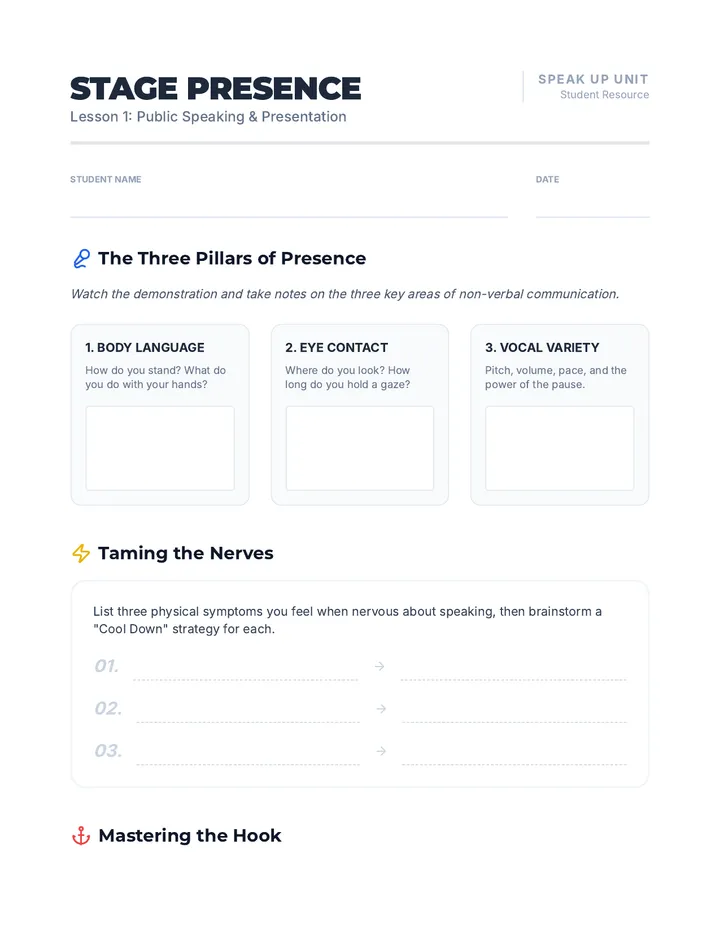
A comprehensive 5-day introductory unit on speech and debate, covering public speaking, argumentation, logic, research, and competitive formats.
A graduate-level sequence focused on integrating deductive, inductive, and analogical reasoning into a cohesive defensive strategy for academic and professional contexts.
A high-intensity vocabulary sequence for 10th graders focusing on the logic of analogies. Students progress from basic pattern recognition to designing their own complex logic puzzles, treating language as a series of solvable equations.
A 12th-grade ELA unit focused on the logical sequencing of ideas within dense informational texts and complex arguments. Students analyze how the ordering of premises and evidence determines the validity and rhetorical impact of a text.
A high-level bridging of English Language Arts and formal logic, focusing on the structural patterns of reasoning through analogies. Students move from basic symbolic notation to complex deductive puzzles, treating language with mathematical precision.
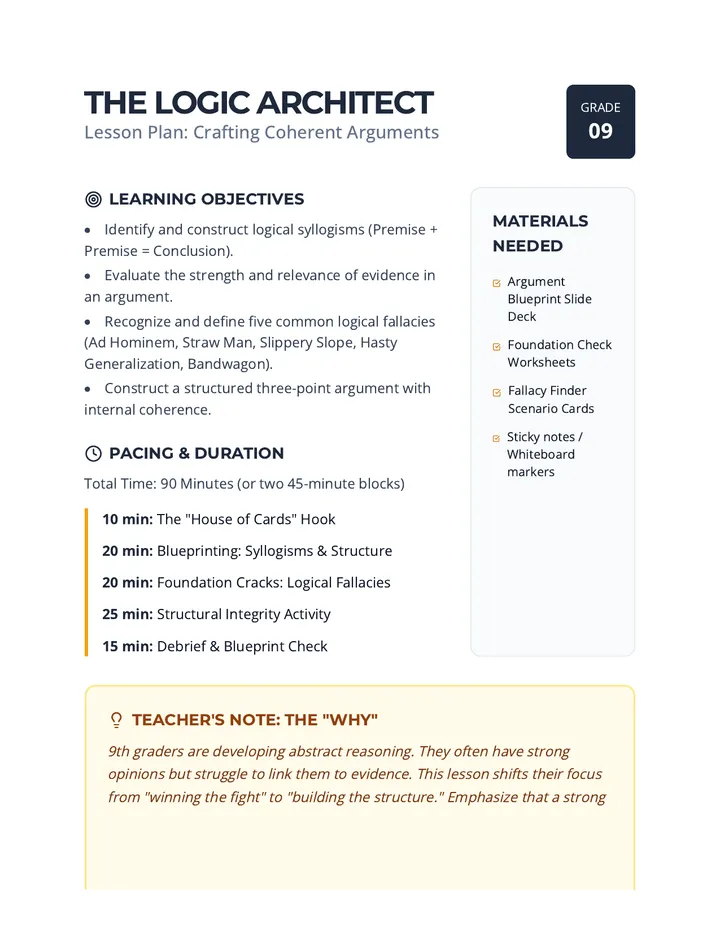
A 9th-grade English Language Arts sequence that bridges formal logic with argumentative writing. Students learn to use valid argument forms like Modus Ponens, Modus Tollens, and Hypothetical Syllogisms as structural blueprints for high-quality, undeniable writing.
A foundational sequence for 9th-grade students on the structures of deductive reasoning, focusing on categorical syllogisms, validity, and soundness to enhance critical thinking and analytical writing.
A high-level ELA unit for 11th graders that bridges formal logic and argumentative writing. Students move from identifying hidden premises (enthymemes) to constructing complex essays built on valid deductive frameworks like Modus Ponens and Modus Tollens.
A comprehensive 11th Grade ELA sequence on formal logic, focusing on identifying structural fallacies (Affirming the Consequent, Denying the Antecedent, Undistributed Middle) and repairing invalid arguments. Students act as 'logic doctors' to diagnose and fix flawed reasoning in various rhetorical contexts.
A high-school ELA sequence that treats argumentative writing like geometric proofs, focusing on formal logic structures like axioms, modus ponens, and proofs by contradiction to build unassailable positions.