Logic Architect Teacher Guide The Logic Architect
Lesson Plan: Crafting Coherent Arguments
Grade 09
Learning Objectives
Identify and construct logical syllogisms (Premise + Premise = Conclusion).
Evaluate the strength and relevance of evidence in an argument.
Recognize and define five common logical fallacies (Ad Hominem, Straw Man, Slippery Slope, Hasty Generalization, Bandwagon).
Construct a structured three-point argument with internal coherence.
Pacing & Duration
Total Time: 90 Minutes (or two 45-minute blocks)
10 min: The "House of Cards" Hook
20 min: Blueprinting: Syllogisms & Structure
20 min: Foundation Cracks: Logical Fallacies
25 min: Structural Integrity Activity
15 min: Debrief & Blueprint Check
Materials Needed
Argument Blueprint Slide Deck
Foundation Check Worksheets
Fallacy Finder Scenario Cards
Sticky notes / Whiteboard markers
Teacher's Note: The "Why"
9th graders are developing abstract reasoning. They often have strong opinions but struggle to link them to evidence. This lesson shifts their focus from "winning the fight" to "building the structure." Emphasize that a strong argument is like a skyscraper: it needs a deep foundation (logic) and high-quality materials (evidence).
Step-by-Step Procedure
1
The "House of Cards" Hook (10 min)
Display a controversial (but light) claim on the board (e.g., "Cereal is soup"). Ask students to agree or disagree. Then, ask: "If I take away one reason why you believe that, does your whole argument fall apart?" Introduce the metaphor of the Logic Architect —someone who builds arguments that can't be knocked down.
2
Blueprinting: Syllogisms (20 min)
Use the Argument Blueprint Slides . Define Premise and Conclusion .Foundation Check Worksheet .
3
Foundation Cracks: Logical Fallacies (20 min)
Introduce fallacies as "cracks in the foundation." Focus on the "Big Five":
Straw Man: Misrepresenting an argument to make it easier to attack.Ad Hominem: Attacking the person, not the argument.Slippery Slope: Claiming one small step leads to a disaster.Hasty Generalization: Jumping to a conclusion with too little evidence.
4
Structural Integrity Activity (25 min)
Distribute the Fallacy Finder Scenario Cards . In small groups, students must identify which fallacy is present and "repair" the argument by writing a sound alternative on a sticky note.
Assessment & Differentiation
Formative Assessment
Exit Ticket: Students write one original syllogism about a topic of their choice and identify one fallacy they often hear in real life.
Support/Extension
Support: Provide "Syllogism Starters" (sentence stems). Extension: Analyze a real political speech or advertisement for complex fallacies.
Argument Blueprint Slides The Logic Architect
Argument Blueprint
Building Arguments That Won't Fall Down
The Core Objective
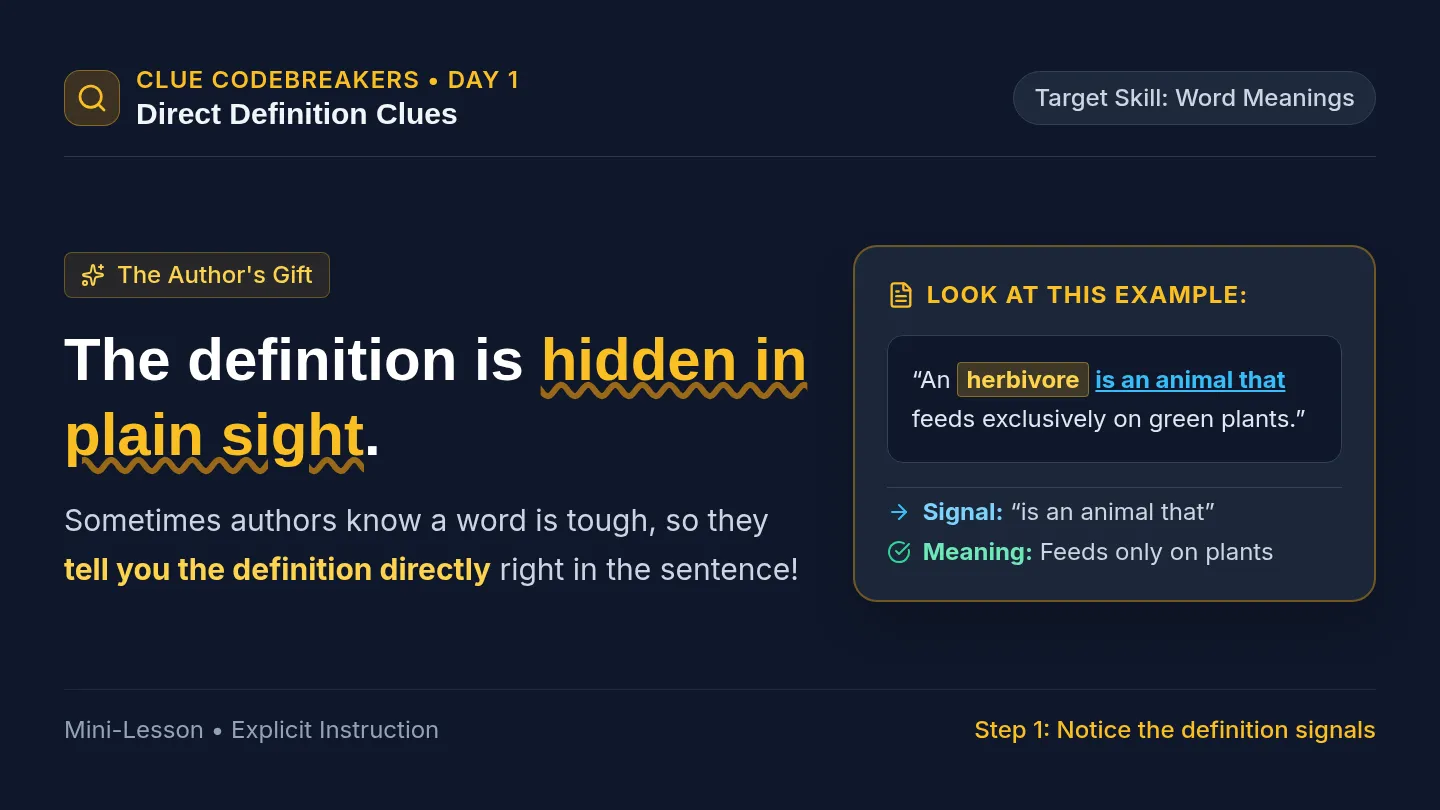
An argument isn't just a fight. An argument is a structure.
Our Goal Today:
Identify the building blocks
Spot cracks in the foundation
Construct sound reasoning
Anatomy of an Argument
Premise 1
A general fact or rule that most people agree on.
The Ground
Premise 2
A specific observation or case that fits the rule.
The Pillar
Conclusion
The final claim that MUST be true if both premises are true.
The Roof
The Syllogism Check
1
All humans are mortal.
2
Socrates is a human.
Therefore, Socrates is mortal.
Foundation Cracks
Logical Fallacies: Errors in Reasoning
Ad Hominem
"To the Person"
Attacking an opponent's character or personal traits instead of their actual argument.
Example:
"My doctor told me to stop eating sugar, but she's overweight herself, so why should I listen?"
The Truth:
The doctor's health doesn't change the scientific fact that sugar is harmful.
Misrepresenting the point
Straw Man
Oversimplifying or misrepresenting someone's argument to make it easier to attack.
A: "We should spend more on public libraries."
B: "So you hate private businesses and want to tax everyone into poverty?"
Quick Blueprint Audit
"Every student who studies at least 5 hours a week gets an A. Taylor studies for 6 hours a week. Therefore, Taylor will get an A."
SOUND
The logic follows perfectly. If the premises are true, the conclusion MUST be true.
FLAWED
There is a logical gap or fallacy present.
Now build it.
Grab your worksheet. It's time to test your foundation.
Foundation Check Worksheet Foundation Check
Argument Construction Worksheet
Name:
Date:
PART 1
The Syllogism Blueprint
Recall: Premise A + Premise B = Conclusion. If the premises are true and the logic is valid, the conclusion is unavoidable.
Example A: Fill in the missing piece.
Premise 1:
All mammals breathe air.
Premise 2:
____________________________________________________
Conclusion:
Therefore, a whale breathes air.
Example B: Identify the Conclusion.
Premise 1:
No professional athlete uses broken equipment.
Premise 2:
Alex is a professional athlete.
Conclusion:
Example C: Design your own.
Topic: Any school-related rule (e.g., dress code, phone policy, homework).
Premise 1:
Premise 2:
Conclusion:
PART 2
The Fallacy Repair Shop
Identify the fallacy in each claim and explain why the logic is "cracked."
"If we let students use their phones in the hallway, pretty soon they'll be using them during exams, and eventually, no one will learn anything and the whole school system will collapse."
Fallacy Name
Why it's flawed
"You shouldn't listen to anything Mr. Henderson says about the environment; he drives an old SUV that gets terrible gas mileage."
Fallacy Name
Why it's flawed
"I saw three teenagers wearing hoodies in the park today and they were all being loud. Teenagers in this town are completely out of control."
Fallacy Name
Why it's flawed
Fallacy Finder Activity Fallacy Finder
Scenario Cards & Activity Guide
Teacher Instructions:
Cut: Separate the scenario cards on the following pages.Group: Divide students into groups of 3 or 4.Identify: Give each group a set of cards. They must categorize each card by the fallacy it contains.Repair: For each card, students must rewrite the argument on a separate piece of paper (or sticky note) to make it logically sound.Present: Groups swap cards and "repair" notes to see if they agree with the logic.
Key Fallacies in this Set:
Ad Hominem
Straw Man
Slippery Slope
Hasty Generalization
Bandwagon
Scenario #01
"The school should not adopt the new cafeteria menu. The person who designed it is a former politician, and we all know you can't trust anything a politician says."
Faulty Logic Detected:
Scenario #02
"Everyone at the party was using that new messaging app, so it's clearly the best and safest way to communicate with your friends."
Faulty Logic Detected:
Scenario #03
"Senator Jenkins wants to cut the defense budget by 1%. It's obvious he wants to leave our country completely defenseless and let our enemies invade us tomorrow."
Faulty Logic Detected:
Scenario #04
"I tried that new spicy taco place and got a stomach ache. Clearly, that restaurant is serving bad food to everyone who goes there."
Faulty Logic Detected:
Scenario #05
"If you don't clean your room today, you'll start being lazy with your schoolwork. Then you'll fail your classes, drop out of high school, and never get a job."
Faulty Logic Detected:
Scenario #06
"Why would you vote for that candidate? He wears those weird bow ties. Anyone with such bad fashion sense shouldn't be making laws for us."
Faulty Logic Detected:
Structural Integrity Discussion Guide Structural Integrity
Discussion & Debate Guide
"The goal of a debate is not to win, but to reach a closer understanding of the truth through sound reasoning." — This guide provides prompts and protocols to ensure student discussions remain logical rather than emotional.
Rules of Engagement
01
Attack the argument, not the person. Avoid Ad Hominem attacks at all costs.
02
Steel-Man the opposition. Before you disagree, can you restate the other person's point so well they agree with your summary?
03
Cite your foundation. Every claim needs a premise. If you can't state your premise, you aren't ready to speak.
04
Acknowledge the "Gray." Logic often reveals that neither side is 100% correct. Look for the nuance.
Discussion Stems
"Your premise seems to be __________, but I disagree because..."
"I think that argument is a Slippery Slope because..."
"If we follow your logic to its conclusion, it would mean..."
"Can you provide evidence that this isn't a Hasty Generalization?"
Logic Lab: Debate Scenarios
Topic: Technology
Should social media platforms be legally required to verify the age of users with government IDs?
Challenge: Construct an argument for either side that avoids using a Slippery Slope fallacy.
Topic: Education
Should the school week be shortened to 4 days, with longer hours each day?
Challenge: Identify the core premise of your opponent's argument and attempt to refute it using a syllogism.
Topic: Environment
Is it the individual's or the corporation's responsibility to solve climate change?
Challenge: Avoid "False Dichotomy" (the idea that it MUST be one or the other). Can it be both? Construct a complex argument.
Evaluation Rubric
Logical Flow (40%) • Evidence Strength (30%) • Fallacy Avoidance (30%)