Lenny.com
Explore
Create
ActivitiesNewMathEnglish Language ArtsScience & EngineeringSocial StudiesGlobal LanguagesHealth & Physical EducationSpecial EducationCounseling & Life SkillsArts & CreativityESL
Lenny.com
Lenny.com
Explore
Create
ActivitiesNewMathEnglish Language ArtsScience & EngineeringSocial StudiesGlobal LanguagesHealth & Physical EducationSpecial EducationCounseling & Life SkillsArts & CreativityESL
Lenny.com
Lenny.com

Solutions

Lenny for EducatorsLenny for SchoolsLenny for Districts

Product

ExploreSign inCreateSupportAbout

Resources

Getting startedMTSS Acceleration Program

© 2026 Lenny Learning Inc.

TermsPrivacyAccessibility
LinkedInInstagramX
Lenny

Adjectives

Descriptive word usage to modify nouns and pronouns, including comparative and superlative forms. Addresses proper sequencing and sensory language to enhance precision in writing.

English Language ArtsPhonics & Reading FoundationsLetter IdentificationLearn Letters A-ZLowercase and Uppercase LettersConsonants and VowelsLetter-Sound AssociationsLetter-Sound Associations: LowercaseLetter-Sound Associations: UppercaseBeginning and Ending SoundsRhymingBlending And SegmentingShort VowelsShort Vowel SoundsConsonant BlendsConsonant DigraphsBlends, Digraphs, and TrigraphsDigraphs, Blends, and Silent LettersLong Vowel SoundsLong Vowel PatternsShort and Long VowelsShort and Long Vowel PatternsSilent EVowel SoundsVowel TeamsR-Controlled VowelsDiphthongs: Oi, Oy, Ou, OwVariant VowelsVariant, Diphthong, And R Vowel PatternsSoft G And CSight WordsIrregular WordsWord RecognitionSyllablesSyllable TypesTwo-Syllable WordsMultisyllabic WordsPhoneme ManipulationDecodable TextsVocabularyAction WordsQuestion WordsNouns and AdjectivesClassify WordsCompound WordsSynonyms and AntonymsHomophonesHomophones and HomonymsShades of MeaningContext CluesPrefixes and SuffixesGreek and Latin RootsAnalogiesIdioms and AdagesForeign Words and ExpressionsWord Choice and UsageReference SkillsReading ComprehensionRead-Along Literary TextsRead-Along Informational TextsReality vs. FictionStory ElementsCharacterSequenceMain IdeaCause And EffectCompare And ContrastReading StrategiesText StructureAuthor's PurposeAuthor's Purpose And ToneAuthor's PerspectivePoint Of ViewThemeInference And ThemeInference And AnalysisPoetry ElementsLiterary DevicesAnalyzing LiteratureAnalyzing Informational TextsComparing TextsAudience, Purpose, And ToneBusiness DocumentsNovel StudyNonfiction Book StudyGrammar & MechanicsSentencesNounsVerbsAdjectivesPronounsCapitalizationPunctuationContractionsConjunctionsPrepositionsArticlesAdjectives And AdverbsVerb TypesVerb TensePronouns And AntecedentsPronoun TypesSubject-Verb AgreementDirect And Indirect ObjectsSentences, Fragments, And Run-OnsPhrases And ClausesCommasSemicolons, Colons, And CommasDashes, Hyphens, And EllipsesSpellingAbbreviationsFormattingVerb Tense And MoodMisplaced ModifiersWritingDescriptive DetailsCreative WritingOpinion WritingTopic SentencesOrganizing WritingLinking WordsSentence VarietyIntroductions And ConclusionsPersuasive And Opinion WritingExpository WritingPersuasive StrategiesDeveloping And Supporting ArgumentsTopic Sentences And Thesis StatementsSummarizingResearch SkillsEditing And RevisingActive And Passive Voice=Writing Clearly And ConciselyDebate & Public SpeakingPublic Speaking BasicsPersuasive TechniquesClaims and EvidenceTypes of ArgumentsReasoning TypesLogical FallaciesTopic ResearchOrganizing EvidenceDebate Speech OrganizationAttacking and Defending ArgumentsClash and EngagementImpact CalculusQuestioning and Cross-ExaminationCritical ThinkingInformal LogicFormal LogicInductive Reasoning

Videos

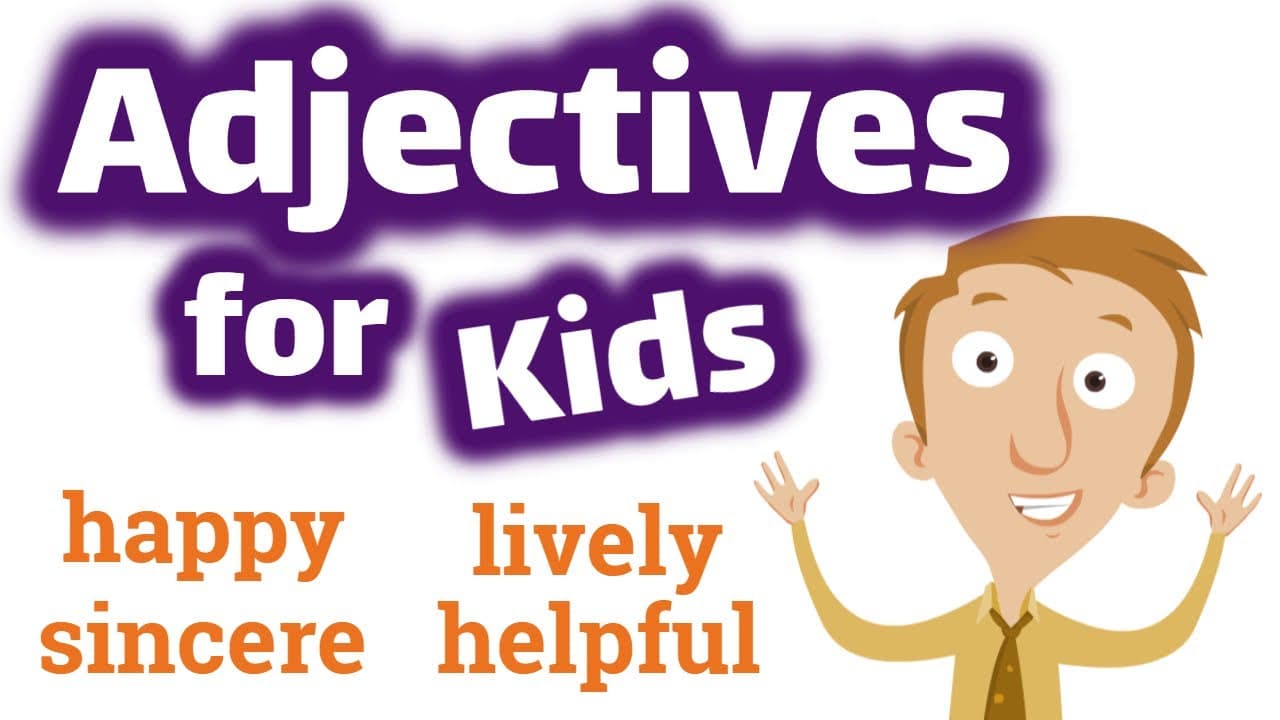
Using Adjectives to Create Vivid Mental Images

Using Adjectives to Create Vivid Mental Images

This educational video provides a clear and engaging introduction to adjectives and their role in grammar and writing. It defines adjectives as words that "modify" or change nouns, explaining this concept through visual demonstrations of how descriptive language alters mental images. The narrator uses a step-by-step approach, starting with a basic sentence ("The dog ran") and showing how adding different adjectives (e.g., "brown," "sneaky," "thirsty") completely transforms the reader's visualization of the event.

GrammarSongs by MelissaGrammarSongs by Melissa

3mins 42s

Mastering Parallel Structure in Writing

Mastering Parallel Structure in Writing

This educational video provides a clear and engaging guide to understanding parallel structure in writing. Hosted by David, Rosie, and Paige, the lesson distinguishes parallel structure as a stylistic choice rather than a strict grammatical rule, emphasizing how it creates harmony and flow in sentences. Through handwritten visual examples on a blackboard, the instructors demonstrate how to align items in a list—whether they are nouns, verbs, or phrases—to ensure they match in form.

Khan AcademyKhan Academy

5mins 5s

How to Form Comparative and Superlative Adjectives

How to Form Comparative and Superlative Adjectives

This video provides a clear, step-by-step guide on how to form comparative and superlative adjectives in English. Using a digital whiteboard, the narrator constructs a reference table that categorizes adjectives based on their spelling and syllable count—such as one-syllable words ending in 'e', words ending in 'y', and longer multi-syllable words. Specific spelling rules, like doubling consonants or changing 'y' to 'i', are explained visually and phonetically. The content covers five distinct categories of adjectives: (1) one syllable ending in 'e' (cute); (2) one syllable with one vowel and one consonant (big); (3) short words with two vowels or ending in two consonants (sweet, short); (4) two-syllable words ending in 'y' (shiny); and (5) long words (magnificent). The video concludes with a humorous application of these rules to a nonsense word, "blarfy," demonstrating how internalizing these patterns allows students to conjugate even unfamiliar vocabulary. This resource is highly valuable for English Language Arts and ESL classrooms. It breaks down complex spelling conventions into manageable rules, making it an excellent tool for introducing or reviewing adjective morphology. Teachers can use the final "blarfy" segment to test students' ability to transfer these rules to new or made-up words, fostering a deeper understanding of English structural patterns rather than just rote memorization.

Khan AcademyKhan Academy

7mins 40s

Mastering the Difference Between There, Their, and They're

Mastering the Difference Between There, Their, and They're

This video provides a clear and practical guide to mastering one of the most common confusion points in the English language: the difference between the homophones "there," "their," and "they're." Using a digital whiteboard format, the narrator visually breaks down each word's specific grammatical function—location, possession, and contraction—assigning a distinct color to each to aid memory retention. The lesson explores distinct strategies for identifying the correct word choice. For "there," the narrator demonstrates a "T to W" replacement trick to connect it to the question "Where?". For "their," the focus is placed on ownership and the question "Who does it belong to?". Finally, "they're" is explained through the mechanics of contractions, showing how it simply replaces "they are." Practical sentence examples are diagrammed on screen to reinforce these rules in context. This resource is highly valuable for English Language Arts classrooms ranging from upper elementary to middle school. It addresses a persistent writing error that affects students of all ages. Teachers can use this video as a hook for a grammar unit, a remediation tool for students struggling with mechanics, or a quick refresher before a writing assignment to encourage self-editing skills.

Khan AcademyKhan Academy

3mins 21s

How Adjectives Modify and Describe Nouns

How Adjectives Modify and Describe Nouns

This video provides a clear and engaging introduction to adjectives, defining them as words that "change stuff" or modify nouns. Through simple illustrations and sentence examples, the narrator explains how adjectives function within the larger category of modifiers to describe specific qualities like color, personality, and size. The content moves from a visual demonstration involving a sketched bear to analyzing specific sentences to identify adjectives. It differentiates between general nouns (like "bear") and specific descriptions (like "friendly bear" or "blue bear"), helping students understand how these words refine meaning. The video also briefly explores the Latin etymology of the word "adjective" to explain its function as something "thrown on top" of a sentence. Teachers can use this video to introduce parts of speech, specifically the role of adjectives in descriptive writing. It is particularly useful for visualizing how modifiers alter the mental image of a noun and for demonstrating that while sentences can function grammatically without adjectives, these words are essential for adding necessary detail and color to language.

Khan AcademyKhan Academy

3mins 32s

Adjectives: The Words That Describe Nouns

Adjectives: The Words That Describe Nouns

This engaging educational video introduces students to the concept of adjectives as part of speech. It begins by reviewing nouns (people, places, and things) to establish a foundation, then defines adjectives as words that describe nouns or tell us more about them. The narrator uses clear, illustrated examples—such as a "tall, smart" doctor and a "clean, tan" desk—to demonstrate how adjectives function in a sentence. The video progresses through a series of practice scenarios using real-world images, challenging viewers to identify descriptive words for colorful faces, angry toys, tall forests, and splashing water. This visual approach helps students connect the abstract grammatical concept to tangible observations they can make about the world around them. Key vocabulary includes descriptive terms related to size, emotion, cleanliness, and color. Finally, the lesson concludes with an interactive "Adjective Game," a multiple-choice style quiz where students identify the adjective in a given sentence. This video is an excellent resource for early elementary classrooms to introduce grammar concepts, support descriptive writing skills, and encourage vocabulary development through interactive participation.
Homeschool PopHomeschool Pop

8mins 33s

Materials

Morpheme Mayhem Game Slides

Morpheme Mayhem Game Slides

A 24-slide teacher-led review game for Unit 3 vocabulary and word parts, featuring four competitive team rounds covering morpheme identification, definitions, real-world scenario applications, and lightning morphology word building.

SR

Savanna Robertson-Boerner

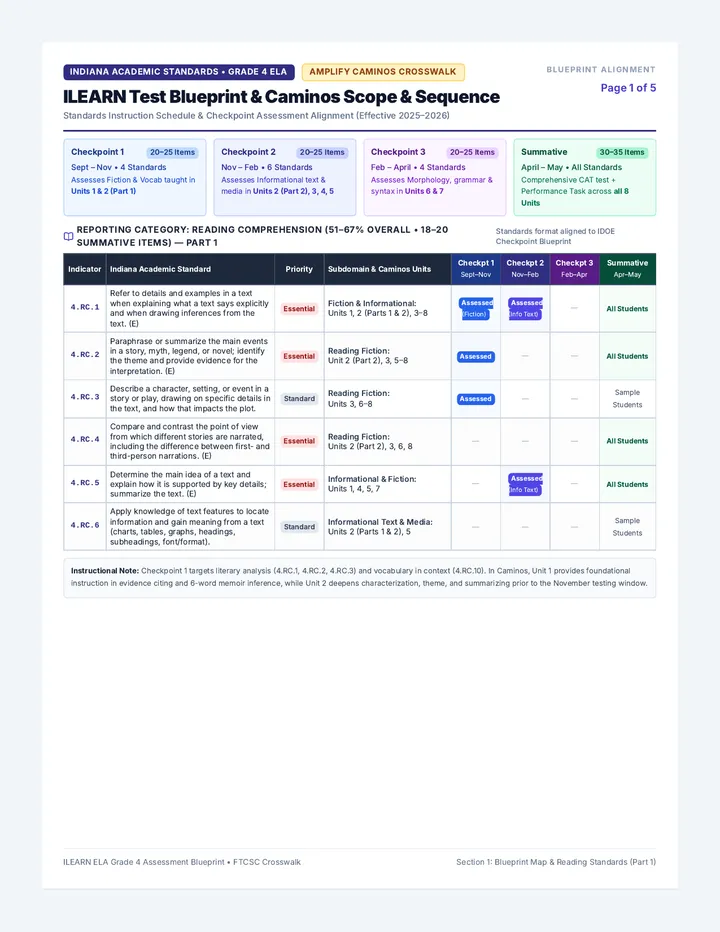
ILEARN Caminos Blueprint Guide

ILEARN Caminos Blueprint Guide

Comprehensive Grade 4 ILEARN Test Blueprint and Amplify Caminos Scope & Sequence crosswalk. Formatted to match the state ILEARN checkpoint blueprint, showing exactly when Indiana Academic Standards (Reading, Vocabulary, Writing, Grammar, and Communication) are taught across Units 1–8 and assessed in Checkpoints 1, 2, 3, and the Summative Assessment.

A

Amy.Hacker

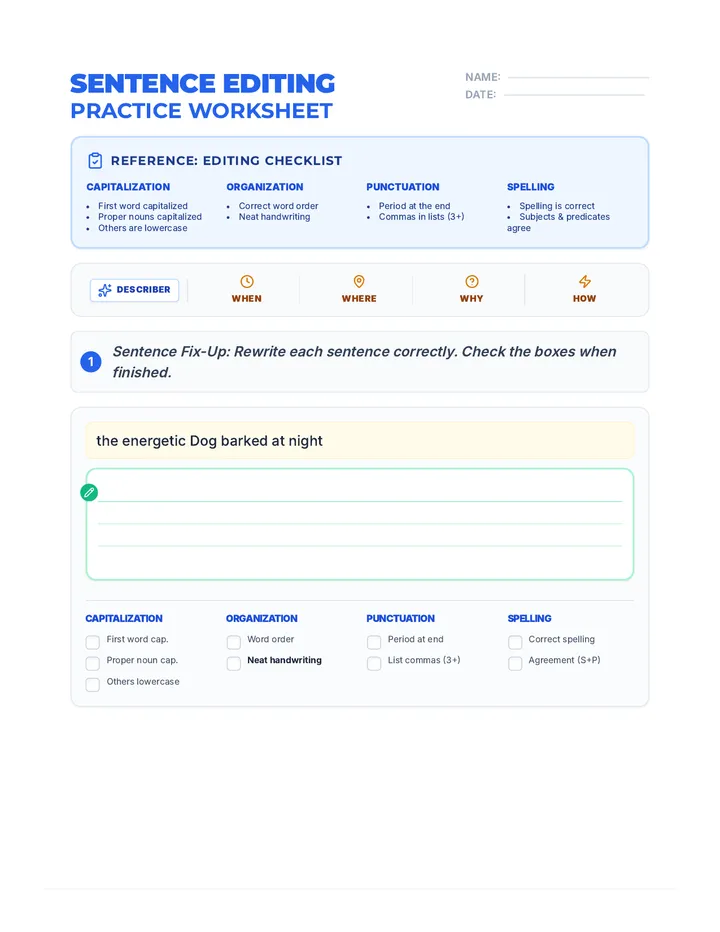
Sentence Editing Practice Worksheet

Sentence Editing Practice Worksheet

An extensive 6-page worksheet for sentence building and correction. Features an editing checklist for review at the top of Page 1, followed by four 'Sentence Fix-Up' items and six complex frames. All tasks include 4 handwriting lines and a standardized checklist with increased font sizes for better legibility. Subtitle removed and font sizes polished for classroom use.

EV

Erin Venuti

Sentence Sparks Bell Ringer

Sentence Sparks Bell Ringer

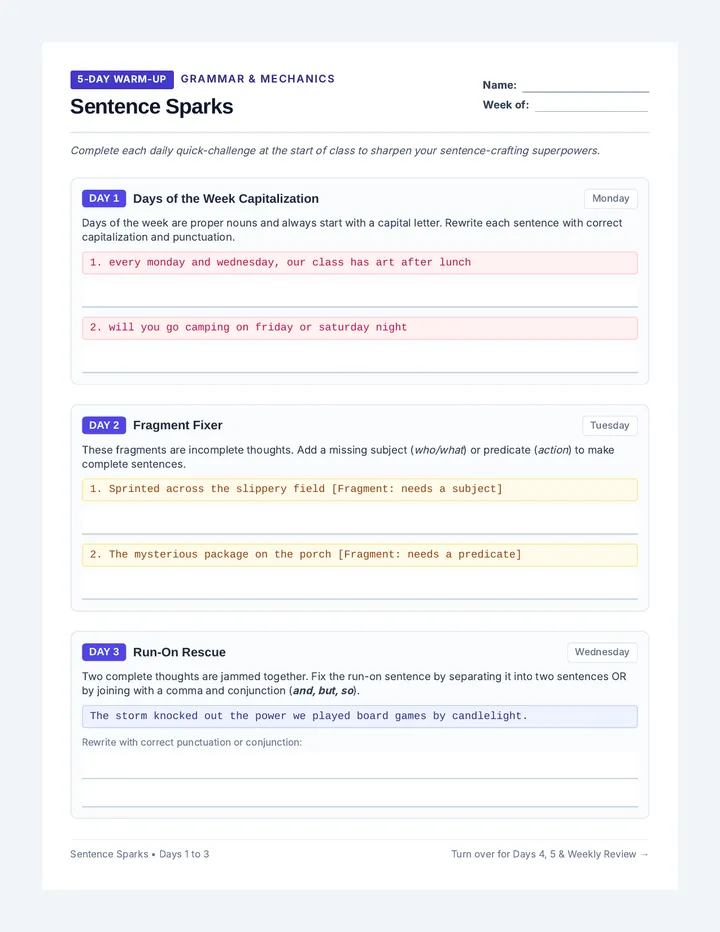
A five-day sentence writing bell ringer worksheet designed to strengthen complete sentence structure, capitalization of days of the week, punctuation, and descriptive grammar. Features daily focused prompts with dedicated handwriting lines and a weekly self-monitoring checklist.

Z

Zimmer

Haunted Vocabulary Reference Sheet

Haunted Vocabulary Reference Sheet

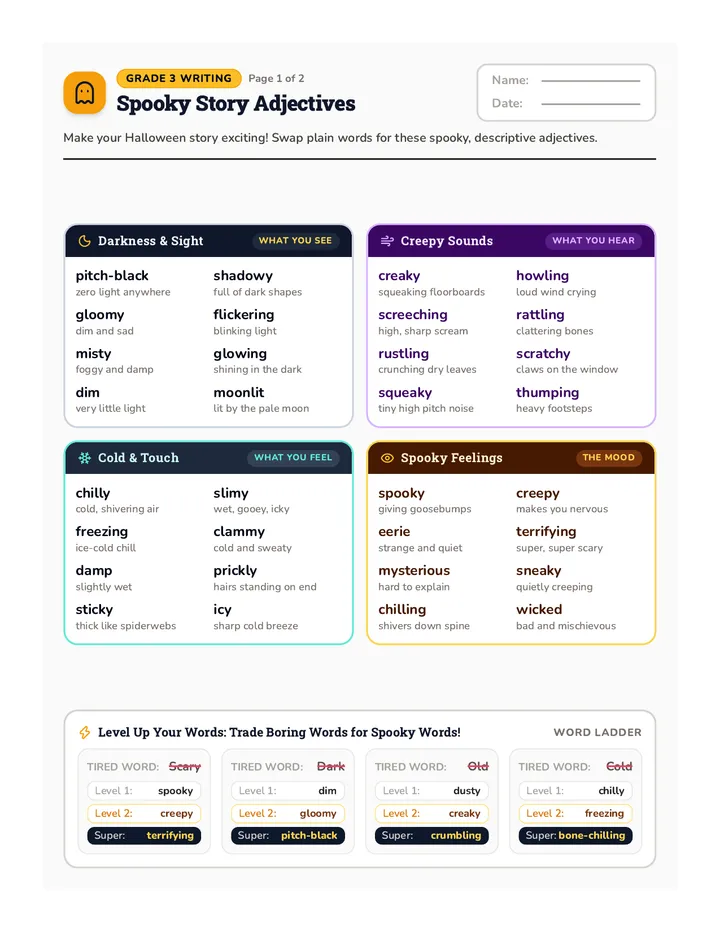
A 2-page large-print Halloween story vocabulary reference sheet tailored for 3rd grade writers. Features accessible spooky adjectives categorized by sight, sound, touch, mood, places, and monsters, complete with word level-up ladders and sentence writing practice.

KK

Katie Keith

Brain Spark Worksheets

Brain Spark Worksheets

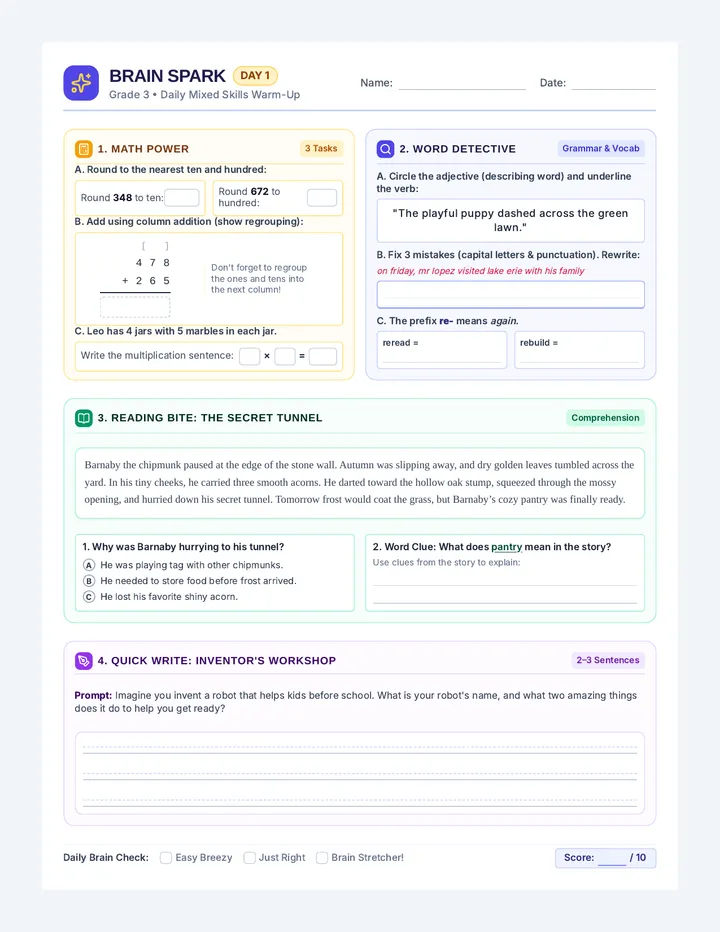
A two-day mixed-skills morning work packet for third grade featuring daily math, word study, reading comprehension, and creative quick writes. Each day is formatted as a single printable page with dedicated workspace and handwriting guides.

SS

Samantha Slentz

Sequences

Invention Quest Slides

Frindle Frenzy Novel Study

A 9-day novel study for 'Frindle' by Andrew Clements, aligned to 3rd Grade ELAR TEKS, focusing on character development, vocabulary, and plot analysis.

LH

Lucy Hellerman

56
Prophecy and Power Slides

Shadows and Crowns

A series of lessons exploring Shakespeare's Macbeth, specifically designed for 10th-grade emergent bilingual students to master complex characterization and thematic elements.

DC

Dylan Clark

30
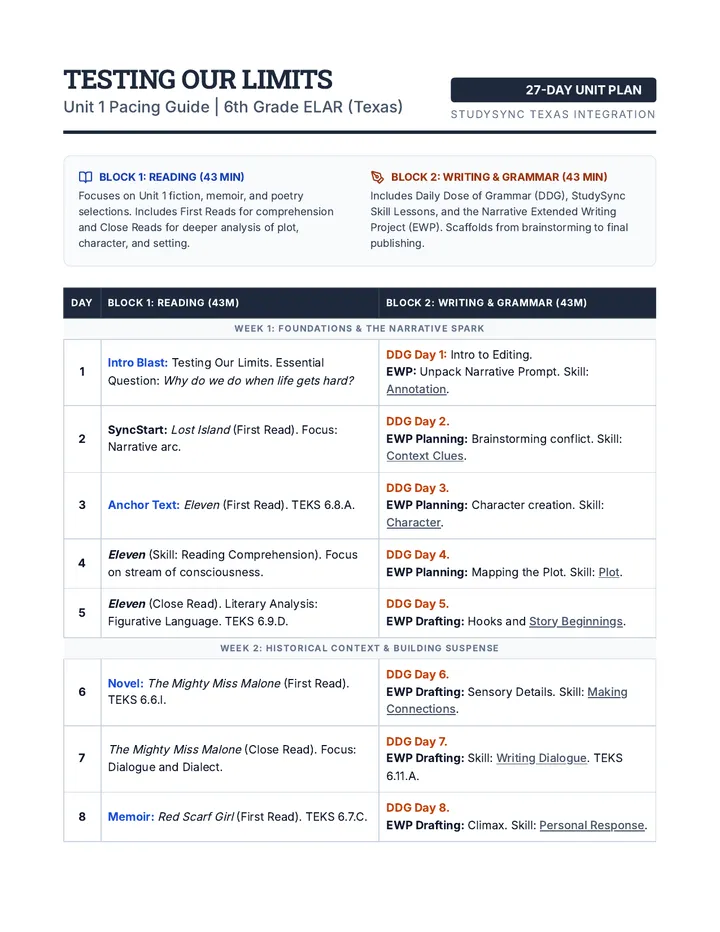
Unit 1 Pacing Guide Document

Testing Our Limits Unit Sequence

A 27-day instructional sequence for 6th Grade ELAR Unit 1: Testing Our Limits, featuring dual blocks for Reading and Writing with daily grammar and skill scaffolding.

DM

Dawn Mustian

81
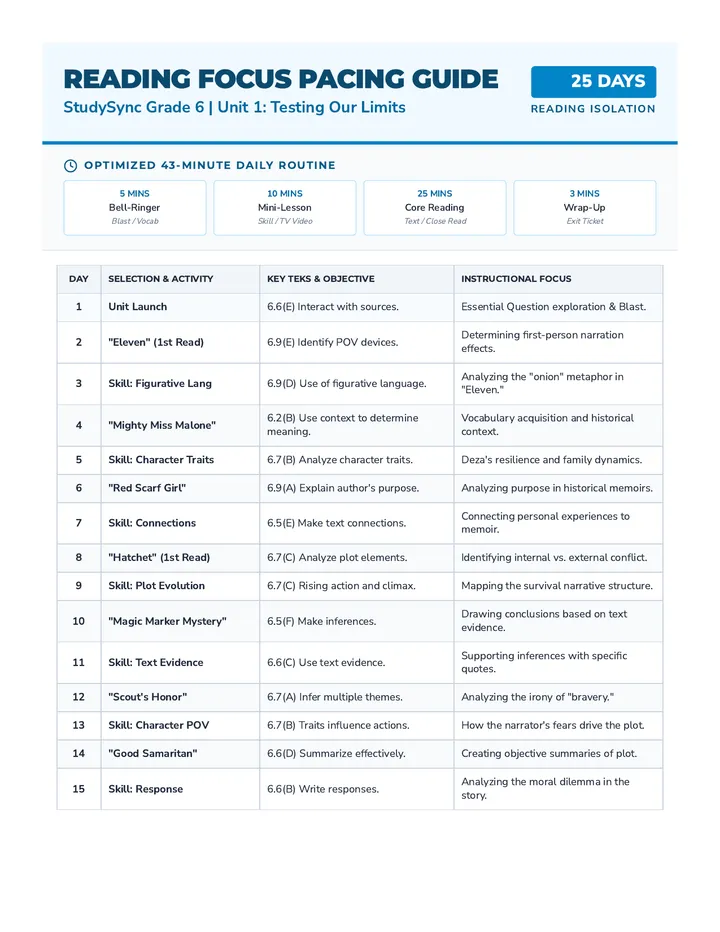
Reading Focus Pacing Guide

Testing Our Limits Unit

A 25-day comprehensive unit for StudySync Grade 6 that explores the theme of courage and resilience through isolated reading and writing tracks, aligned to ELA TEKS.

DM

Dawn Mustian

79
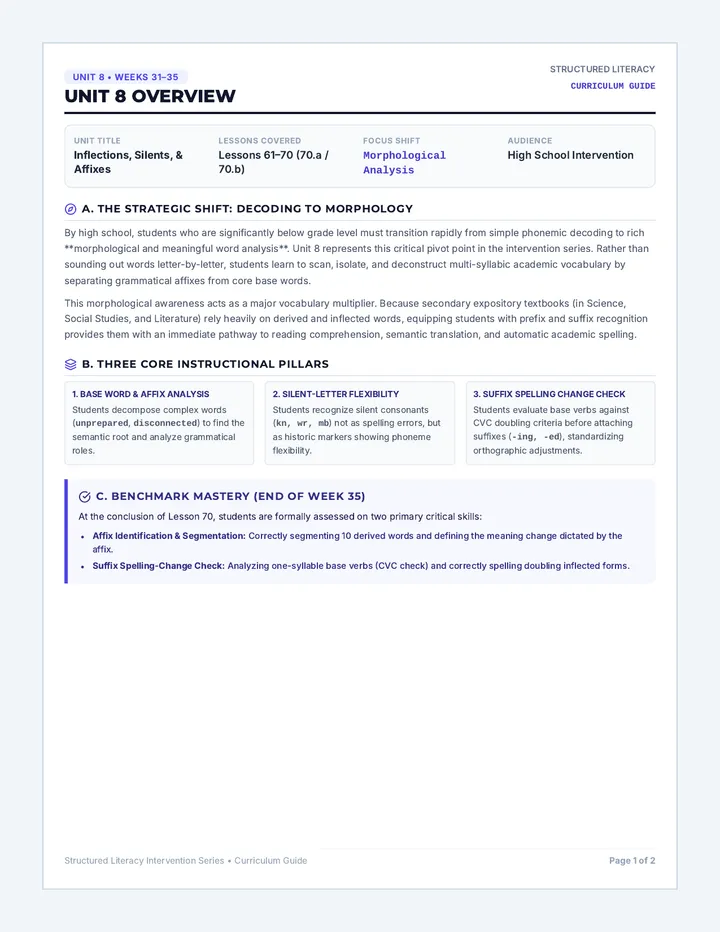
Unit Overview Teacher Guide

Linguistic Signals

A structured high school reading intervention sequence focusing on silent consonants, orthographic markers, pluralization rules, and academic spelling structures.

AP

Alexis Paolini

36
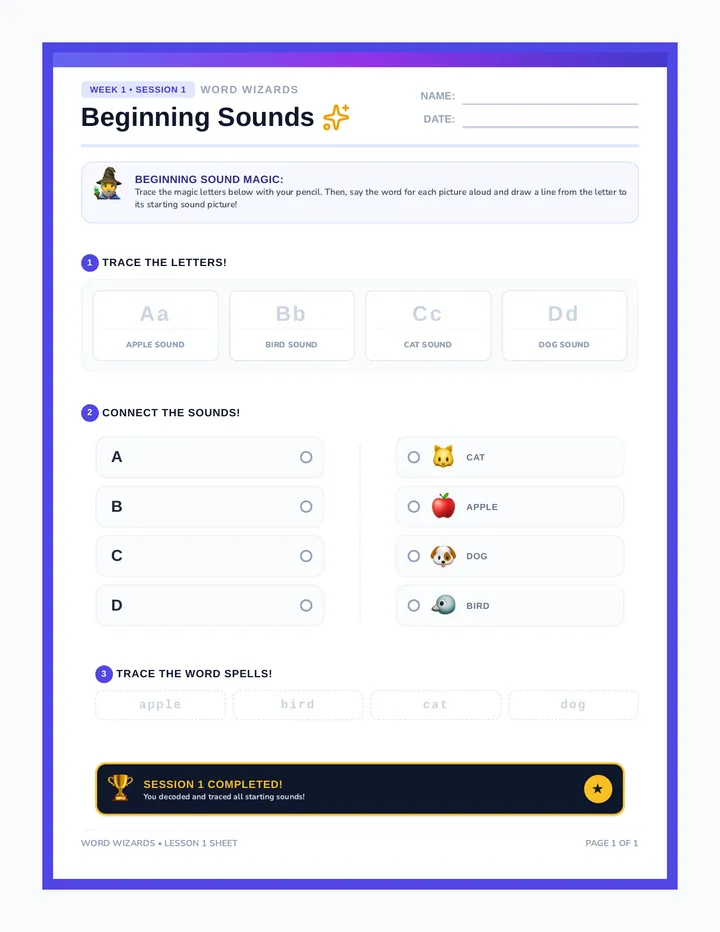
Beginning Sounds Worksheet

Word Wizards

An engaging, high-impact 4-week literacy skills program for young learners. Features highly visual, fun printable worksheets focusing on beginning letter sounds, CVC phonics blending, sight word reading, and short stories.

Z

ziad

18