Lenny.com
Explore
Create
ActivitiesNewMathEnglish Language ArtsScience & EngineeringSocial StudiesGlobal LanguagesHealth & Physical EducationSpecial EducationCounseling & Life SkillsArts & CreativityESL
Lenny.com
Lenny.com
Explore
Create
ActivitiesNewMathEnglish Language ArtsScience & EngineeringSocial StudiesGlobal LanguagesHealth & Physical EducationSpecial EducationCounseling & Life SkillsArts & CreativityESL
Lenny.com

Nouns

Proper and common nouns, singular and plural forms, and possessive structures. Addresses concrete versus abstract categorization and collective noun usage in sentence construction.

Lenny.com

Solutions

Lenny for EducatorsLenny for SchoolsLenny for Districts

Product

ExploreSign inCreateSupportAbout

Resources

Getting startedMTSS Acceleration Program

© 2026 Lenny Learning Inc.

TermsPrivacyAccessibility
LinkedInInstagramX
Lenny
English Language ArtsPhonics & Reading FoundationsLetter IdentificationLearn Letters A-ZLowercase and Uppercase LettersConsonants and VowelsLetter-Sound AssociationsLetter-Sound Associations: LowercaseLetter-Sound Associations: UppercaseBeginning and Ending SoundsRhymingBlending And SegmentingShort VowelsShort Vowel SoundsConsonant BlendsConsonant DigraphsBlends, Digraphs, and TrigraphsDigraphs, Blends, and Silent LettersLong Vowel SoundsLong Vowel PatternsShort and Long VowelsShort and Long Vowel PatternsSilent EVowel SoundsVowel TeamsR-Controlled VowelsDiphthongs: Oi, Oy, Ou, OwVariant VowelsVariant, Diphthong, And R Vowel PatternsSoft G And CSight WordsIrregular WordsWord RecognitionSyllablesSyllable TypesTwo-Syllable WordsMultisyllabic WordsPhoneme ManipulationDecodable TextsVocabularyAction WordsQuestion WordsNouns and AdjectivesClassify WordsCompound WordsSynonyms and AntonymsHomophonesHomophones and HomonymsShades of MeaningContext CluesPrefixes and SuffixesGreek and Latin RootsAnalogiesIdioms and AdagesForeign Words and ExpressionsWord Choice and UsageReference SkillsReading ComprehensionRead-Along Literary TextsRead-Along Informational TextsReality vs. FictionStory ElementsCharacterSequenceMain IdeaCause And EffectCompare And ContrastReading StrategiesText StructureAuthor's PurposeAuthor's Purpose And ToneAuthor's PerspectivePoint Of ViewThemeInference And ThemeInference And AnalysisPoetry ElementsLiterary DevicesAnalyzing LiteratureAnalyzing Informational TextsComparing TextsAudience, Purpose, And ToneBusiness DocumentsNovel StudyNonfiction Book StudyGrammar & MechanicsSentencesNounsVerbsAdjectivesPronounsCapitalizationPunctuationContractionsConjunctionsPrepositionsArticlesAdjectives And AdverbsVerb TypesVerb TensePronouns And AntecedentsPronoun TypesSubject-Verb AgreementDirect And Indirect ObjectsSentences, Fragments, And Run-OnsPhrases And ClausesCommasSemicolons, Colons, And CommasDashes, Hyphens, And EllipsesSpellingAbbreviationsFormattingVerb Tense And MoodMisplaced ModifiersWritingDescriptive DetailsCreative WritingOpinion WritingTopic SentencesOrganizing WritingLinking WordsSentence VarietyIntroductions And ConclusionsPersuasive And Opinion WritingExpository WritingPersuasive StrategiesDeveloping And Supporting ArgumentsTopic Sentences And Thesis StatementsSummarizingResearch SkillsEditing And RevisingActive And Passive Voice=Writing Clearly And ConciselyDebate & Public SpeakingPublic Speaking BasicsPersuasive TechniquesClaims and EvidenceTypes of ArgumentsReasoning TypesLogical FallaciesTopic ResearchOrganizing EvidenceDebate Speech OrganizationAttacking and Defending ArgumentsClash and EngagementImpact CalculusQuestioning and Cross-ExaminationCritical ThinkingInformal LogicFormal LogicInductive Reasoning

Videos

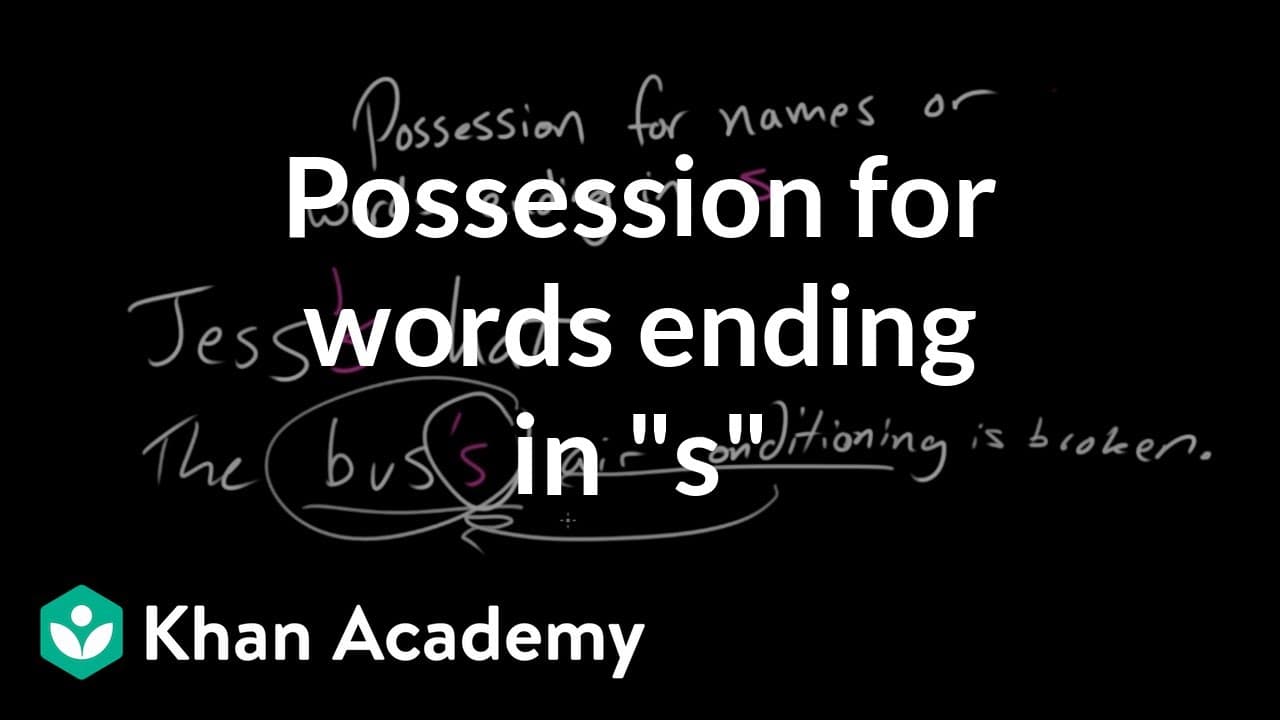
How to Make Words Ending in S Possessive

How to Make Words Ending in S Possessive

This concise grammar tutorial addresses a common point of confusion in English writing: how to form the possessive of singular nouns and names that already end in the letter 's'. The video features two narrators, David and Paige, who use handwritten examples on a blackboard to demonstrate that the standard rule—adding an apostrophe followed by an 's'—still applies to these words, just as it does for any other singular noun. The video explores key examples including proper names like "Jess" and "Texas," as well as common nouns like "bus." It visually breaks down the transformation from a phrase like "the air conditioning on this bus" to the possessive form "the bus's air conditioning." The narrators acknowledge that while the resulting words may look crowded with 's's, the additional letter is crucial for accurately representing how these possessives are pronounced in spoken English. For educators, this video serves as an excellent tool for clarifying a specific punctuation rule that students frequently misapply. It helps dismantle the misconception that an existing 's' at the end of a word precludes adding another one for possession. The clear, step-by-step visual examples make it easy to introduce or review this concept in upper elementary and middle school English Language Arts classrooms, supporting better mechanics in student writing.

Khan AcademyKhan Academy

1min 51s

How to Use Apostrophes for Possession

How to Use Apostrophes for Possession

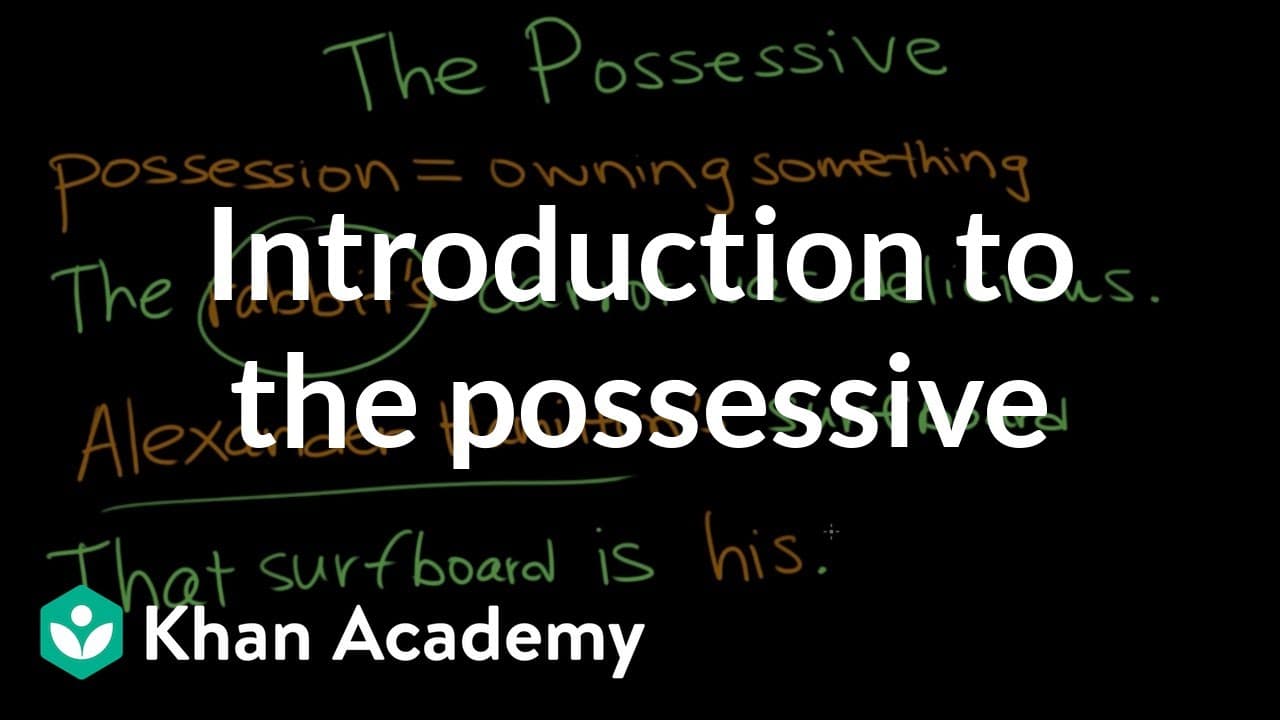
This educational video provides a clear and friendly introduction to the grammatical concept of the possessive. The narrators, David and Paige, define possession simply as "owning something" and demonstrate how the apostrophe-s ('s) is used to condense complex phrases like "the carrot that belonged to the rabbit" into efficient forms like "the rabbit's carrot." They explore how this rule applies to both common nouns and proper nouns, using whimsical examples to keep the content engaging. The video then pivots to a crucial exception that often trips up students: possessive pronouns. The narrators clarify that while nouns rely on apostrophes to show ownership, possessive pronouns (like his, hers, ours, and its) never take an apostrophe. They illustrate this with side-by-side comparisons to reinforce the difference between a noun's possessive form and a pronoun's possessive form. Teachers can use this video to introduce or review the mechanics of possession in writing. It is particularly valuable for addressing the common error of adding apostrophes to possessive pronouns (e.g., writing "her's" instead of "hers"). The video's visual style—simple handwriting on a black background—focuses student attention directly on the spelling and punctuation changes being discussed.

Khan AcademyKhan Academy

3mins 45s

Concrete vs. Abstract Nouns: The Difference Between Objects and Ideas

Concrete vs. Abstract Nouns: The Difference Between Objects and Ideas

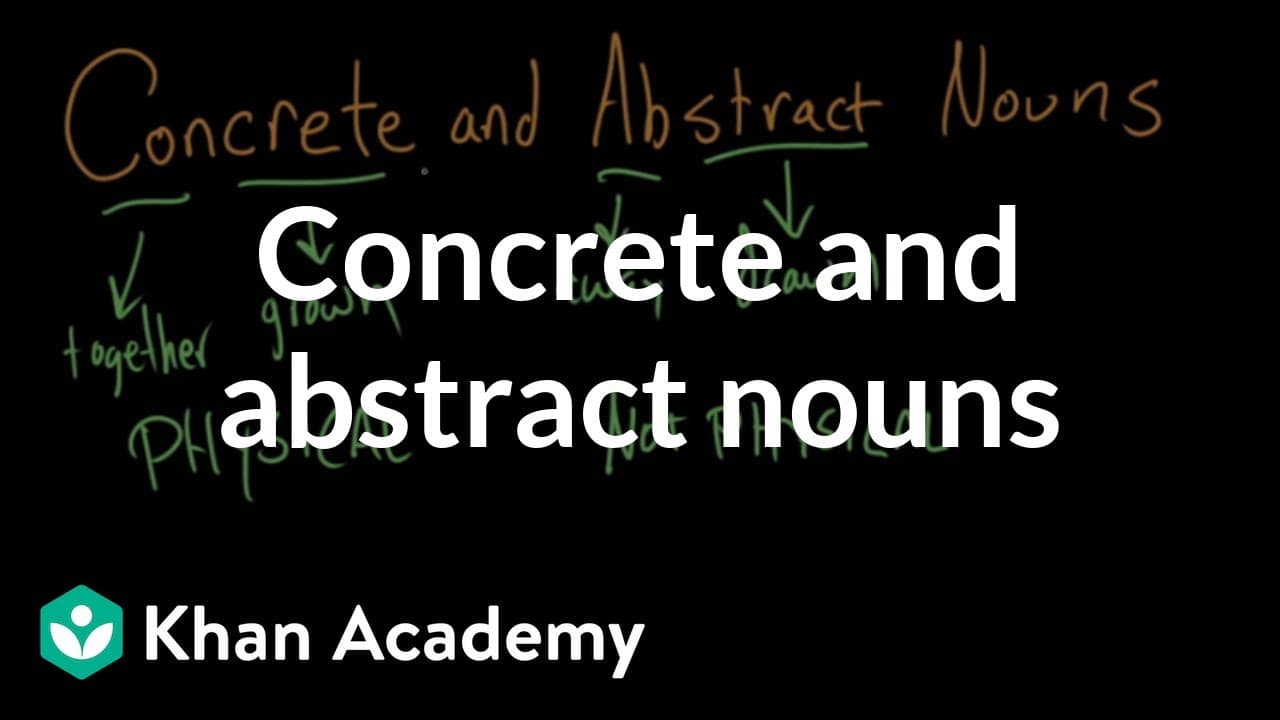
This video provides a clear and engaging explanation of the difference between concrete and abstract nouns, utilizing etymology to deepen student understanding. The narrator breaks down the Latin roots of both terms—"concrete" meaning "grown together" or physical, and "abstract" meaning "drawn away" or conceptual—to help students visualize the distinction. Through a digital whiteboard demonstration, the lesson contrasts tangible objects that can be sensed with intangible ideas, emotions, and states of being. The content focuses on key grammatical concepts including the definition of nouns as not just persons, places, and things, but also *ideas*. It explores how abstract nouns like "sadness," "freedom," and "permission" function grammatically (often using suffixes like "-ness") despite lacking physical form. The video specifically addresses the nuance between an abstract concept and its physical manifestations, using the example of "freedom" versus the "ice cream" one is free to eat. For educators, this resource offers a robust foundation for grammar instruction in upper elementary and middle school. It moves beyond simple memorization by providing a logic-based framework (the "physical vs. not physical" test) that students can apply to new vocabulary. The video is particularly useful for introducing abstract nouns, a concept that often challenges students transitioning from basic concrete noun identification, and can serve as a springboard for lessons on sensory imagery and descriptive writing.

Khan AcademyKhan Academy

3mins 43s

How to Identify Direct Objects in Sentences

How to Identify Direct Objects in Sentences

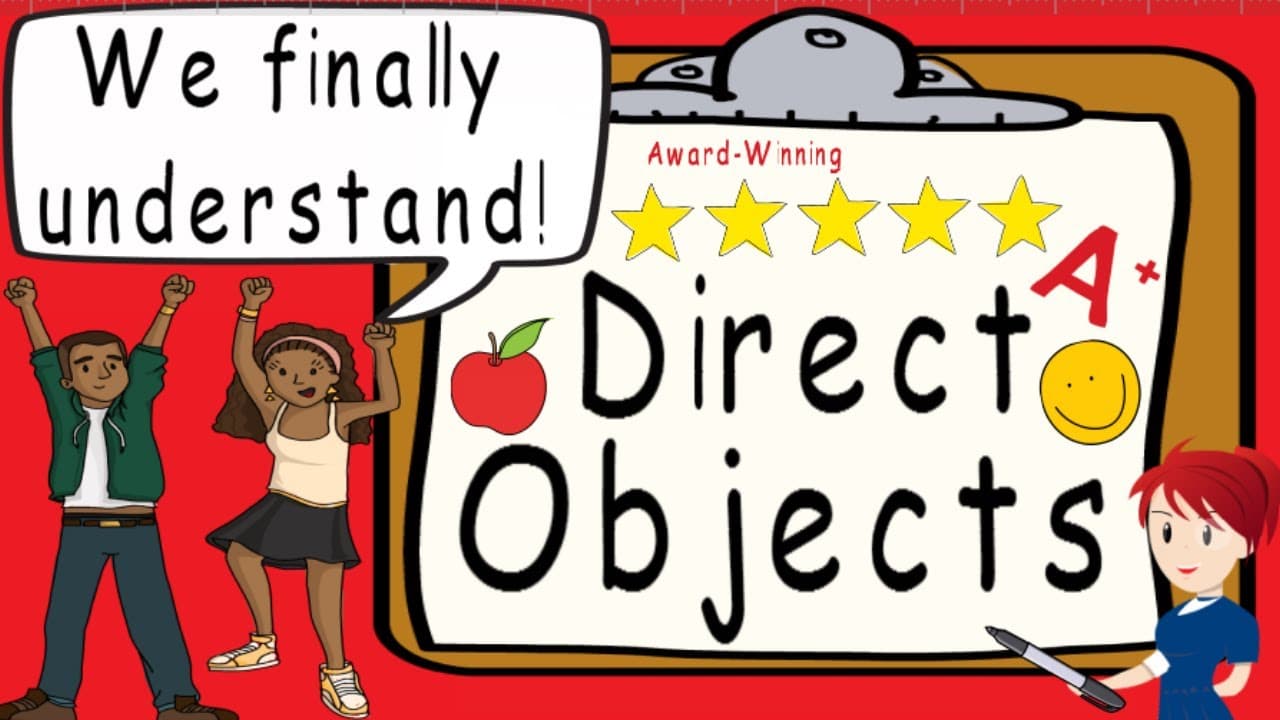
This instructional video provides a clear, step-by-step guide to identifying direct objects within sentences. Through simple animations and relatable examples, the narrator breaks down the relationship between nouns, verbs, and the objects that receive the action. The video uses a consistent scaffolding method—identifying the subject first, then the action verb, and finally asking specific questions to locate the direct object. The content covers key grammatical concepts including the roles of nouns and proper nouns as subjects, the function of action verbs, and the definition of direct objects. It specifically addresses common pitfalls, such as distinguishing between a direct object and other nouns in a sentence (like objects of prepositions) that do not receive the action of the verb. This resource is highly valuable for elementary and middle school language arts classrooms. Its repetitive, logical structure allows students to practice along with the narrator, reinforcing the mental checklist needed to analyze sentence structure. The visual cues, such as circling and labeling parts of speech, make abstract grammatical rules concrete and accessible for learners.

GrammarSongs by MelissaGrammarSongs by Melissa

6mins 3s

Identifying Nouns: People, Places, Things, and Ideas

Identifying Nouns: People, Places, Things, and Ideas

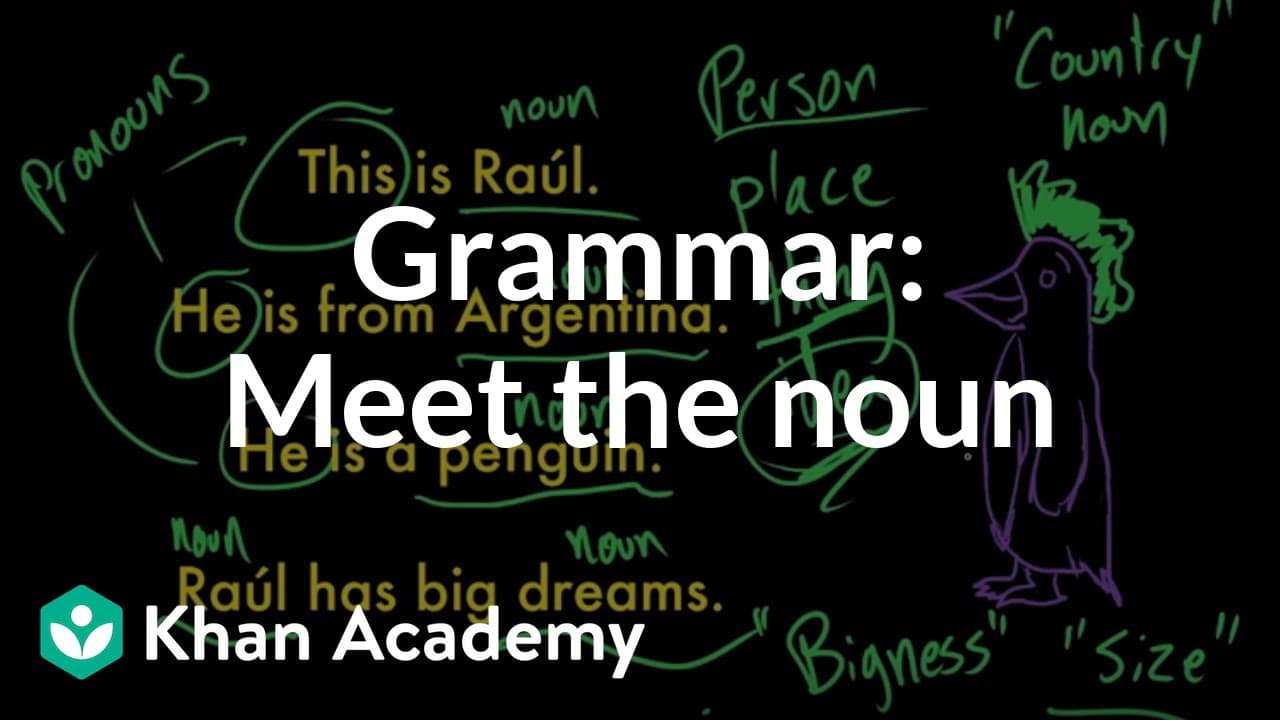
In this engaging grammar lesson, the narrator introduces the concept of the noun, one of the fundamental parts of speech in the English language. Moving beyond the traditional definition of "person, place, or thing," the video expands the definition to include "ideas," a crucial category often overlooked in early grammar instruction. Through the charming example of Raúl, a penguin from Argentina with big dreams, students see exactly how to identify nouns in sentences by asking if a word fits into one of four specific categories.

Khan AcademyKhan Academy

4mins 28s

The Noun Song: Person, Place, and Thing

The Noun Song: Person, Place, and Thing

This catchy, upbeat song introduces students to the concept of nouns as a fundamental part of speech. Through a repetitive and memorable musical structure, the video breaks down the definition of a noun into three primary categories: people, places, and things. It provides concrete examples for each category, helping young learners distinguish between different types of nouns they encounter in their daily lives. The song explores a wide variety of vocabulary, listing specific examples like family members and occupations for 'people,' common locations like schools and stores for 'places,' and everyday objects and animals for 'things.' Notably, it also briefly touches upon abstract nouns by mentioning 'ideas in your mind' such as love and joy, offering a slightly deeper conceptual layer for students ready to move beyond concrete objects. Teachers can use this song as an engaging hook to start a grammar unit, a transition activity, or a tool for memorization. The clear structure—devoting a specific verse to each category—makes it excellent for sorting activities. Because the video features a static image with audio, it works particularly well as a listening exercise where students can move around the classroom or focus on a worksheet without needing to keep their eyes glued to a screen.
Have Fun TeachingHave Fun Teaching

3mins 4s

Materials

Proofreader Press Exit Ticket

Proofreader Press Exit Ticket

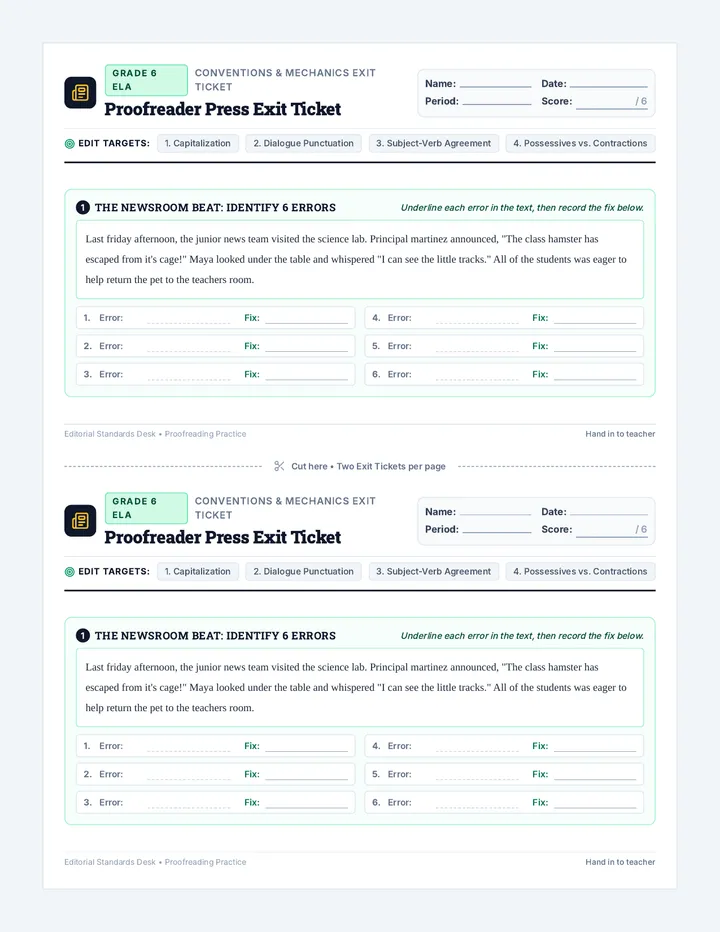
A print-ready 2-up half-sheet exit ticket for Grade 6 containing the newsroom editing passage with 6 targeted errors covering capitalization, dialogue punctuation, subject-verb agreement, and possessives.

TE

Tesa Etchieson

Morpheme Mayhem Game Slides

Morpheme Mayhem Game Slides

A 24-slide teacher-led review game for Unit 3 vocabulary and word parts, featuring four competitive team rounds covering morpheme identification, definitions, real-world scenario applications, and lightning morphology word building.

SR

Savanna Robertson-Boerner

ILEARN Caminos Blueprint Guide

ILEARN Caminos Blueprint Guide

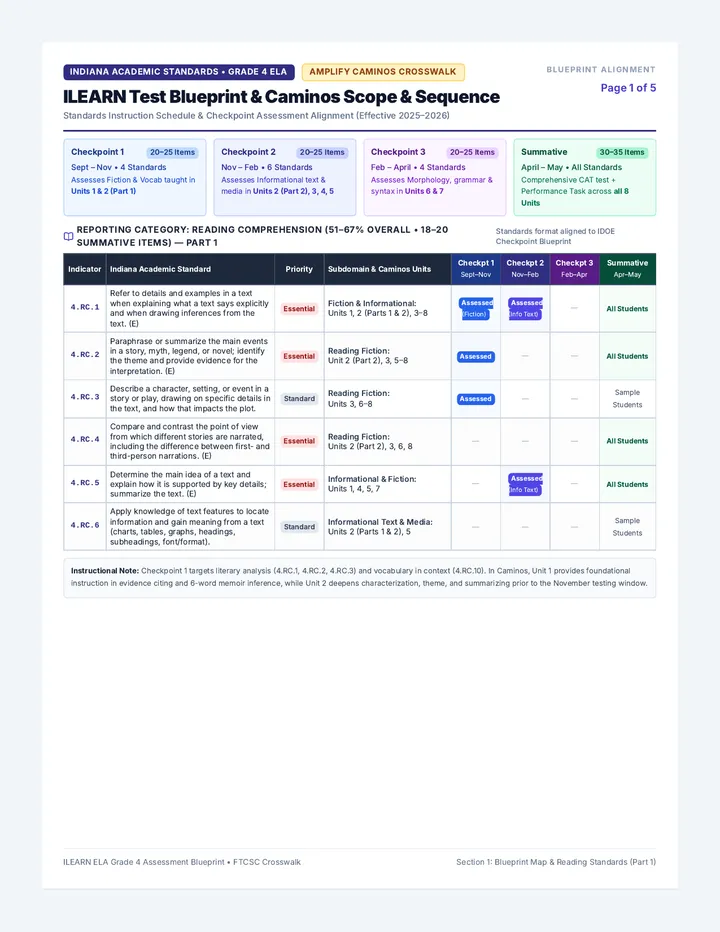
Comprehensive Grade 4 ILEARN Test Blueprint and Amplify Caminos Scope & Sequence crosswalk. Formatted to match the state ILEARN checkpoint blueprint, showing exactly when Indiana Academic Standards (Reading, Vocabulary, Writing, Grammar, and Communication) are taught across Units 1–8 and assessed in Checkpoints 1, 2, 3, and the Summative Assessment.

A

Amy.Hacker

Book Jacket Studio Worksheet

Book Jacket Studio Worksheet

A comprehensive 2-page book jacket and front-matter design worksheet where students craft their own book cover illustration, back cover blurb, endorsements, dedication, table of contents, chapter names, preface, and interior illustration.

MG

MICHELLE GRIMALDI

Verb Voyagers Anchor Chart Revised

Verb Voyagers Anchor Chart Revised

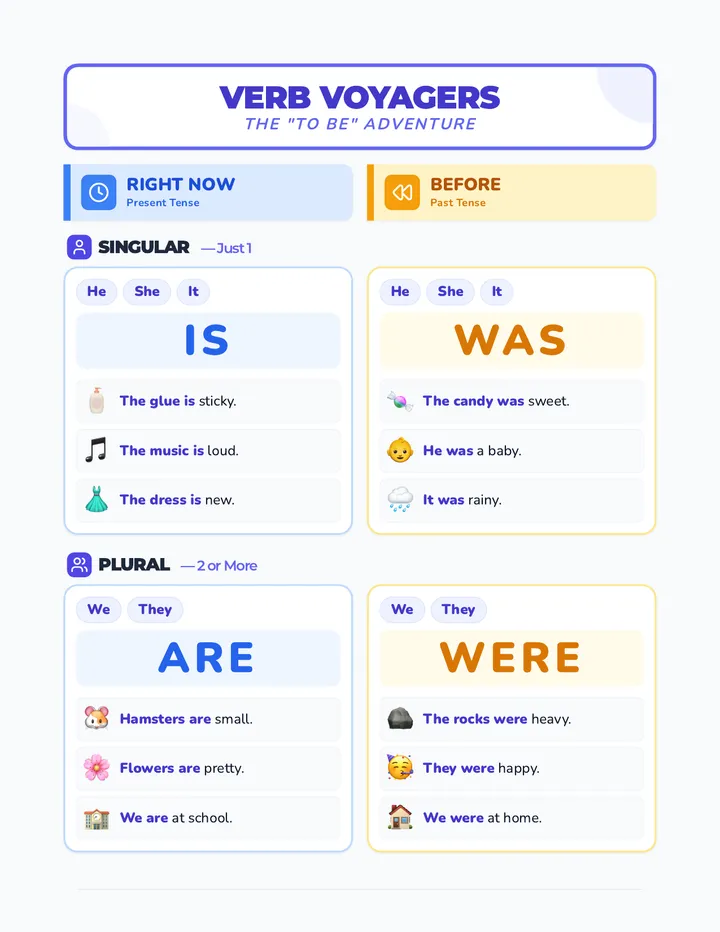
A condensed version of the Verb Voyagers anchor chart, removing student information sections and adjusting spacing and font sizes to ensure it fits perfectly on a single printable page.

T

tdunbar

Literacy Loop Newsletter

Literacy Loop Newsletter

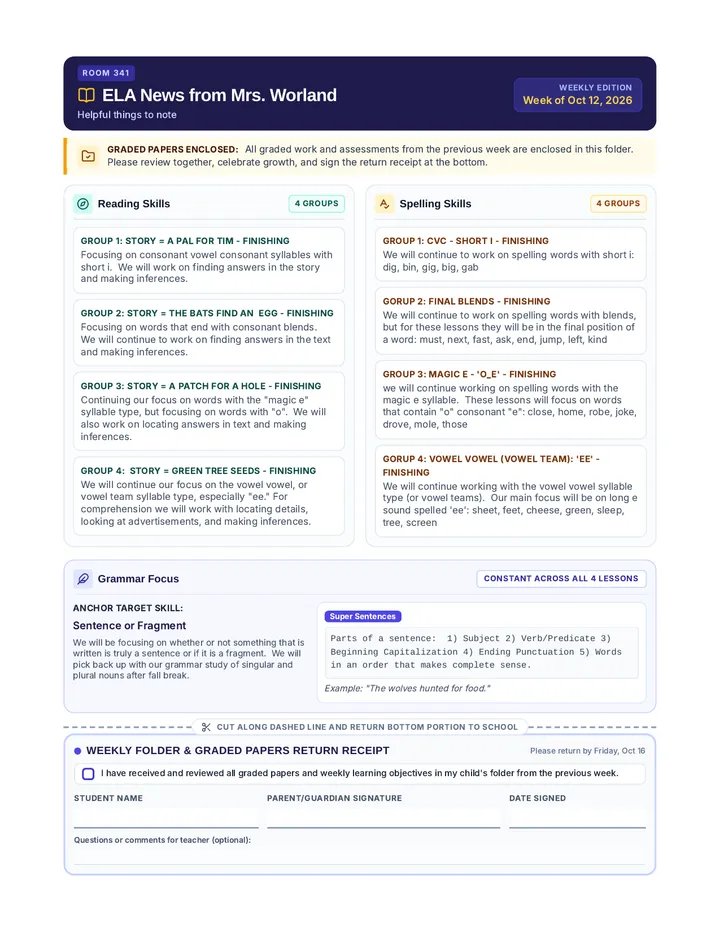
A printable weekly Language Arts newsletter featuring four-lesson skill overviews for reading and spelling, a unified weekly grammar anchor skill, an enclosed graded papers notice, and a tear-off return receipt slip.

CW

Carrie Worland

Sequences

Invention Quest Slides

Frindle Frenzy Novel Study

A 9-day novel study for 'Frindle' by Andrew Clements, aligned to 3rd Grade ELAR TEKS, focusing on character development, vocabulary, and plot analysis.

LH

Lucy Hellerman

56
Monday Sentences Worksheet

OG+ LIFT: Red word K-Concepts: Book 1

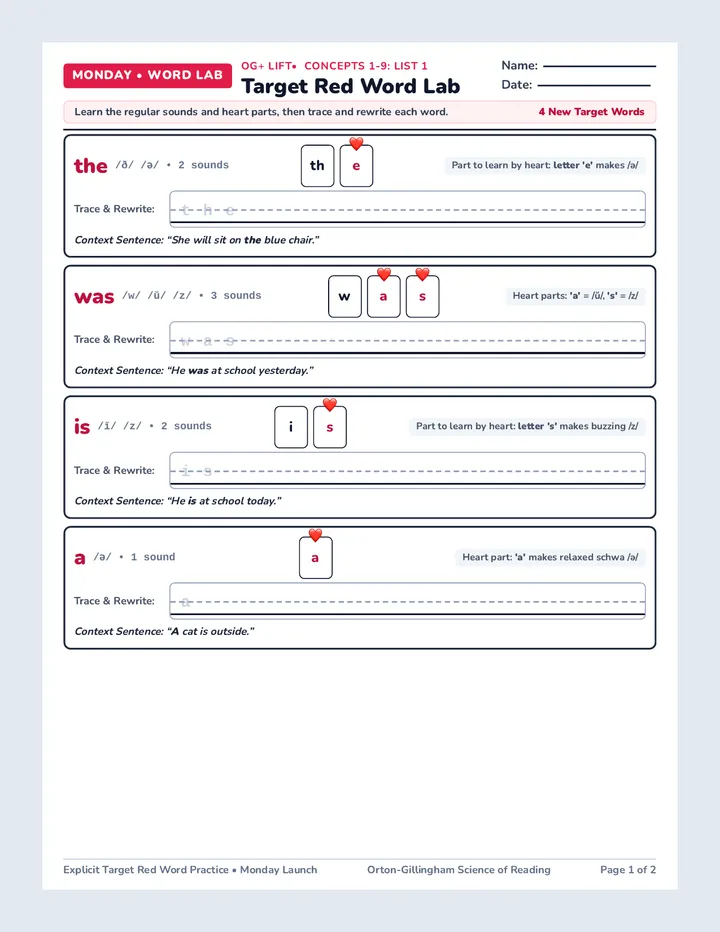
This comprehensive intervention unit features a weekly scope and sequence targeting high-frequency red words, sound-spelling correspondences, and reading comprehension, directly aligned with Orton-Gillingham Kindergarten Book 1 beginning concepts. Designed for self-contained or intervention settings, it pairs decodable readers and comprehension story mapping with explicit daily paraprofessional guides, fluency routines, scaffolded practice, and weekly assessments.

S

Sara

59
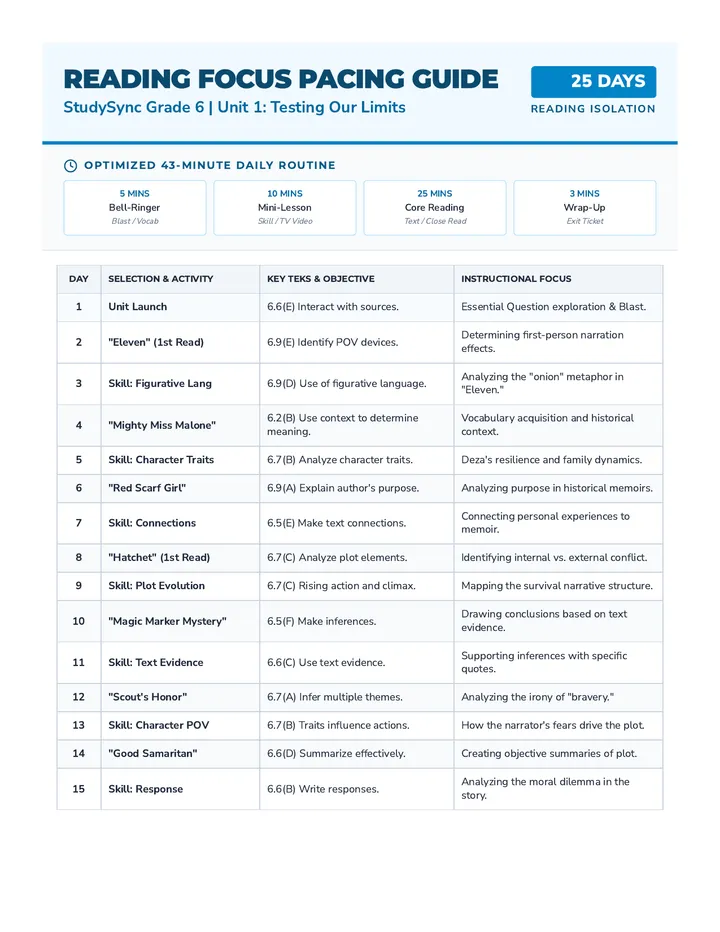
Unit 1 Pacing Guide Document

Testing Our Limits Unit Sequence

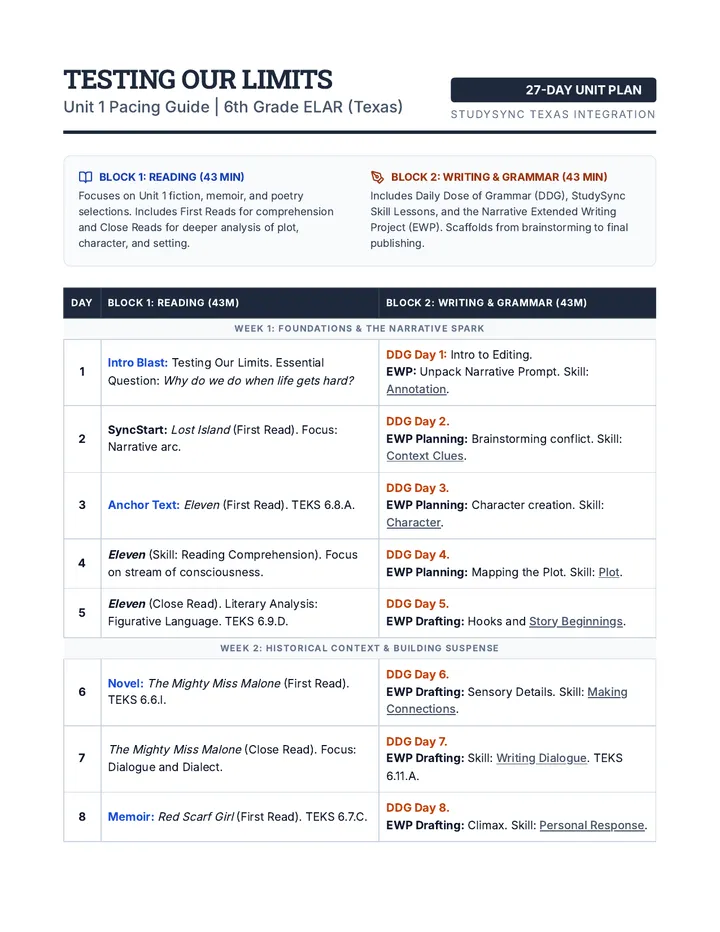
A 27-day instructional sequence for 6th Grade ELAR Unit 1: Testing Our Limits, featuring dual blocks for Reading and Writing with daily grammar and skill scaffolding.

DM

Dawn Mustian

81
Reading Focus Pacing Guide

Testing Our Limits Unit

A 25-day comprehensive unit for StudySync Grade 6 that explores the theme of courage and resilience through isolated reading and writing tracks, aligned to ELA TEKS.

DM

Dawn Mustian

79
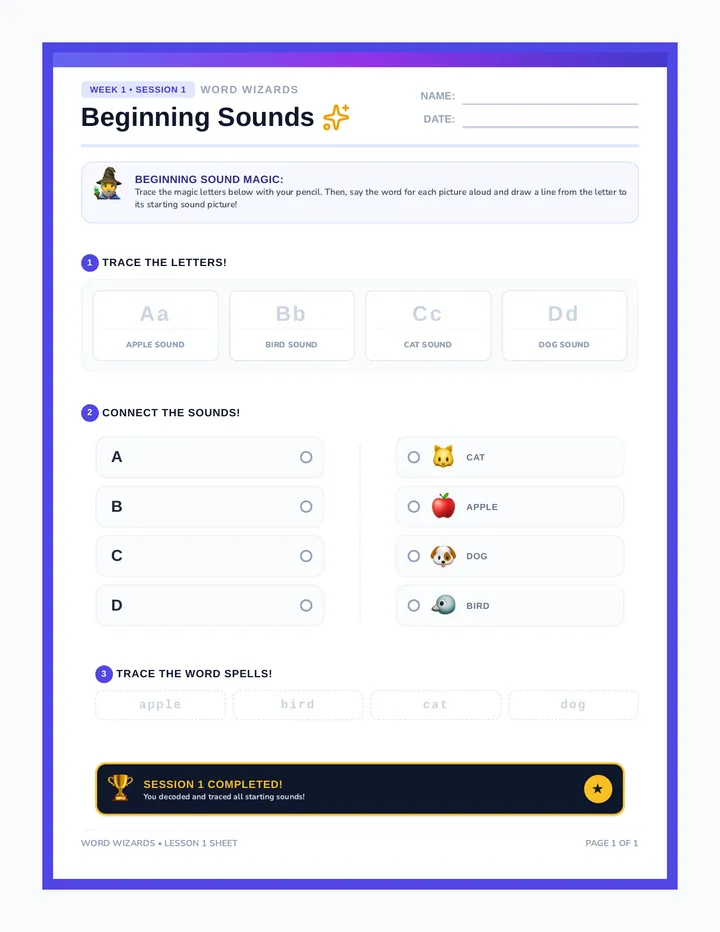
Beginning Sounds Worksheet

Word Wizards

An engaging, high-impact 4-week literacy skills program for young learners. Features highly visual, fun printable worksheets focusing on beginning letter sounds, CVC phonics blending, sight word reading, and short stories.

Z

ziad

18
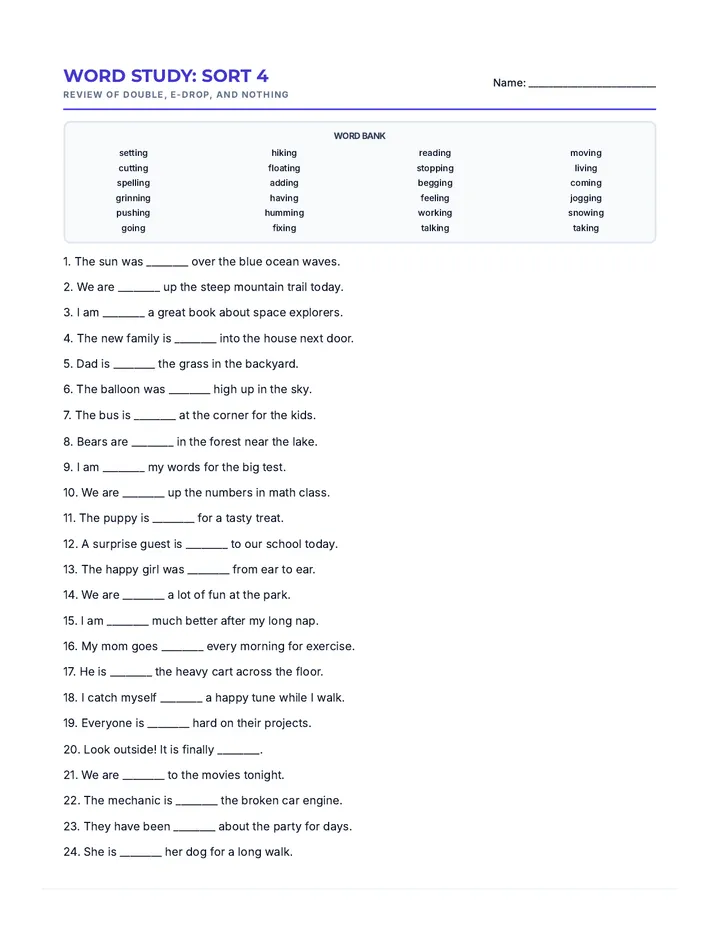
Inflections and Past Tense Worksheets 2 v2

Word Study Master Collection

A comprehensive collection of 56 word study sorts for 4th-grade students, covering everything from basic vowel patterns and inflected endings to advanced syllable junctures, prefixes, and suffixes.

N

nmack

15