Lenny.com
Explore
Create
ActivitiesNewMathEnglish Language ArtsScience & EngineeringSocial StudiesGlobal LanguagesHealth & Physical EducationSpecial EducationCounseling & Life SkillsArts & CreativityESL
Lenny.com
Lenny.com
Explore
Create
ActivitiesNewMathEnglish Language ArtsScience & EngineeringSocial StudiesGlobal LanguagesHealth & Physical EducationSpecial EducationCounseling & Life SkillsArts & CreativityESL
Lenny.com
Lenny.com

Solutions

Lenny for EducatorsLenny for SchoolsLenny for Districts

Product

ExploreSign inCreateSupportAbout

Resources

Getting startedMTSS Acceleration Program

© 2026 Lenny Learning Inc.

TermsPrivacyAccessibility
LinkedInInstagramX
Lenny

Character

Examination of personality traits, motivations, and growth arcs in literary figures. Builds skills in analyzing how character choices drive plot development and thematic depth.

English Language ArtsPhonics & Reading FoundationsLetter IdentificationLearn Letters A-ZLowercase and Uppercase LettersConsonants and VowelsLetter-Sound AssociationsLetter-Sound Associations: LowercaseLetter-Sound Associations: UppercaseBeginning and Ending SoundsRhymingBlending And SegmentingShort VowelsShort Vowel SoundsConsonant BlendsConsonant DigraphsBlends, Digraphs, and TrigraphsDigraphs, Blends, and Silent LettersLong Vowel SoundsLong Vowel PatternsShort and Long VowelsShort and Long Vowel PatternsSilent EVowel SoundsVowel TeamsR-Controlled VowelsDiphthongs: Oi, Oy, Ou, OwVariant VowelsVariant, Diphthong, And R Vowel PatternsSoft G And CSight WordsIrregular WordsWord RecognitionSyllablesSyllable TypesTwo-Syllable WordsMultisyllabic WordsPhoneme ManipulationDecodable TextsVocabularyAction WordsQuestion WordsNouns and AdjectivesClassify WordsCompound WordsSynonyms and AntonymsHomophonesHomophones and HomonymsShades of MeaningContext CluesPrefixes and SuffixesGreek and Latin RootsAnalogiesIdioms and AdagesForeign Words and ExpressionsWord Choice and UsageReference SkillsReading ComprehensionRead-Along Literary TextsRead-Along Informational TextsReality vs. FictionStory ElementsCharacterSequenceMain IdeaCause And EffectCompare And ContrastReading StrategiesText StructureAuthor's PurposeAuthor's Purpose And ToneAuthor's PerspectivePoint Of ViewThemeInference And ThemeInference And AnalysisPoetry ElementsLiterary DevicesAnalyzing LiteratureAnalyzing Informational TextsComparing TextsAudience, Purpose, And ToneBusiness DocumentsNovel StudyNonfiction Book StudyGrammar & MechanicsSentencesNounsVerbsAdjectivesPronounsCapitalizationPunctuationContractionsConjunctionsPrepositionsArticlesAdjectives And AdverbsVerb TypesVerb TensePronouns And AntecedentsPronoun TypesSubject-Verb AgreementDirect And Indirect ObjectsSentences, Fragments, And Run-OnsPhrases And ClausesCommasSemicolons, Colons, And CommasDashes, Hyphens, And EllipsesSpellingAbbreviationsFormattingVerb Tense And MoodMisplaced ModifiersWritingDescriptive DetailsCreative WritingOpinion WritingTopic SentencesOrganizing WritingLinking WordsSentence VarietyIntroductions And ConclusionsPersuasive And Opinion WritingExpository WritingPersuasive StrategiesDeveloping And Supporting ArgumentsTopic Sentences And Thesis StatementsSummarizingResearch SkillsEditing And RevisingActive And Passive Voice=Writing Clearly And ConciselyDebate & Public SpeakingPublic Speaking BasicsPersuasive TechniquesClaims and EvidenceTypes of ArgumentsReasoning TypesLogical FallaciesTopic ResearchOrganizing EvidenceDebate Speech OrganizationAttacking and Defending ArgumentsClash and EngagementImpact CalculusQuestioning and Cross-ExaminationCritical ThinkingInformal LogicFormal LogicInductive Reasoning

Videos

Understanding Point of View and Tone Through Text Messages

Understanding Point of View and Tone Through Text Messages

This video uses a relatable text message conversation between two friends to teach students about literary point of view, tone, and perspective-taking. A narrator guides viewers through an unfolding drama between Liz, who wants to hang out spontaneously, and Kim, who keeps saying no. By analyzing the word choice and brevity of the text messages, the narrator demonstrates how characters' differing situations influence their perspectives and communication styles. The video explores key themes of empathy, miscommunication in digital spaces, and the difference between explicit statements and implied meanings. It highlights how a lack of context can lead to false assumptions, as seen when Liz interprets Kim's refusal as dislike rather than an inability to be spontaneous due to family responsibilities. The resolution teaches students to look beyond surface-level reactions to understand the underlying reality of others. For the classroom, this is an excellent tool for English Language Arts lessons on analyzing character interactions and determining point of view. It also serves as a strong social-emotional learning resource regarding digital citizenship and empathy. Teachers can use the video to spark discussions about how text-based communication strips away tone, leading to conflicts that can only be resolved by understanding another person's "reality" or context.

Miacademy & MiaPrep Learning ChannelMiacademy & MiaPrep Learning Channel

5mins 35s

Making Inferences: The Detective Work of Reading

Making Inferences: The Detective Work of Reading

This educational video introduces the concept of making inferences in reading comprehension through a playful, noir-detective theme. The narrator, adopting a "detective voice" due to a cold, defines an inference as a conclusion drawn from evidence in a text combined with the reader's own background knowledge. He emphasizes that inferring is the "detective work of reading," requiring active engagement to uncover meanings that are implied rather than explicitly stated. The video explores key themes of critical thinking, close reading, and the use of textual evidence. It distinguishes between making a supported inference and simply guessing, highlighting that valid inferences must always be rooted in clues found within the passage. Two distinct examples are analyzed: a simple scenario involving snow forts and hot chocolate to infer the season, and a biographical passage about ballerina Michaela DePrince to infer character traits like talent and perseverance. For educators, this video serves as an engaging introduction to a difficult reading standard. It provides a memorable visual metaphor—the reader as a detective (

Khan AcademyKhan Academy

5mins 8s

Unlocking Character Traits with the STEAL Method

Unlocking Character Traits with the STEAL Method

This educational video introduces students to the literary concepts of direct and indirect characterization through a narrative set in "Character Grove." Hosted by Caroline, the lesson features a talking tree character named Timotree who helps illustrate how authors reveal personality traits. The video contrasts direct descriptions with the more subtle "show, don't tell" method of indirect characterization, using specific examples to make the abstract concepts concrete. The core of the lesson focuses on the STEAL acronym (Speech, Thoughts, Effect on others, Actions, Looks) as a tool for analyzing indirect characterization. Viewers are guided through a text excerpt about a "young man" to identify evidence for each category of the STEAL method. The video then moves from identification to interpretation, demonstrating how to infer specific character traits like "caring," "trustworthy," and "practical" based on the text evidence gathered. This resource is highly valuable for Language Arts classrooms as it breaks down a complex analytical skill into manageable steps. It encourages critical thinking by asking students not just to find details, but to interpret what those details imply about a character's internal nature. The use of visual aids, on-screen text, and a memorable acronym makes it an excellent tool for introducing character analysis or supporting students who struggle with making inferences.

Miacademy & MiaPrep Learning ChannelMiacademy & MiaPrep Learning Channel

10mins 16s

Reading Characters' Minds: Understanding Thoughts and Feelings

Reading Characters' Minds: Understanding Thoughts and Feelings

This engaging video lesson explores the literary concept of 'mind reading,' or how readers gain access to a character's internal world. Through simple animations and clear narration, it demonstrates how authors reveal character thoughts and feelings, distinguishing between first-person narration where a character speaks directly to the reader, and third-person narration where an outside voice reveals internal states. The video delves into complex emotional nuances, explaining that characters can experience conflicting emotions simultaneously or act in ways that contradict their internal feelings. It provides concrete examples, such as a character who climbs a tree despite fearing heights, or a sculptor who smiles politely while feeling frustrated by a friend's criticism. These scenarios illustrate the difference between internal traits (thoughts/feelings) and external traits (actions/dialogue). For educators, this resource is an excellent tool for teaching character analysis, point of view, and inference in English Language Arts. It moves students beyond basic plot comprehension to deeper analytical skills, helping them understand character motivation and the 'evidence' provided by text. The relatable examples serve as perfect anchors for classroom discussions about social-emotional cues and narrative structure.

Khan AcademyKhan Academy

3mins 21s

Comparing Written Text to Audio Performance

Comparing Written Text to Audio Performance

This video serves as an engaging English Language Arts lesson that explores the differences between reading a text silently and experiencing it as an oral performance. The narrator guides students through a comparative analysis using a short story set on a blueberry farm, first asking them to read it to themselves, and then performing it with expressive vocal modulation and sound effects. This side-by-side comparison helps illuminate how a reader's internal experience differs from an external performance. The content focuses on key literary and dramatic concepts such as tone, mood, pacing, and sensory details. It specifically highlights how a performer makes creative choices—such as stretching out words to indicate heat or tightening lips to show disgust—to reflect the narrator's feelings. Additionally, the video introduces the concept of non-textual elements, like sound effects, and how they contribute to atmosphere and storytelling without changing the actual words of the text. For educators, this video is an excellent tool for teaching standards related to comparing and contrasting different versions of a story (text vs. audio). It models critical thinking by using a T-chart to map textual details to performance choices, providing a clear framework for students to analyze media. It can spark lessons on reading fluency, the importance of expression in oral reading, and how multimedia elements influence a viewer's understanding and emotional engagement with a narrative.

Khan AcademyKhan Academy

3mins 56s

Mastering Literary Point of View: First, Second, and Third Person

Mastering Literary Point of View: First, Second, and Third Person

This engaging educational video guides students through the literary concept of "Point of View" (POV) using a fantasy-themed narrative involving a quest to find a "Crystal Quill." The host, accompanied by an animated robot named Mia, explains the three main types of POV: First-Person, Second-Person, and Third-Person. Through clear definitions and visual examples, students learn to identify these perspectives by looking for specific pronouns (I/we, you, he/she/they). The video goes beyond simple identification by analyzing the impact each point of view has on a story and the reader. Using a "three ponds" metaphor, the host presents three versions of the same narrative event—the villain "The Silencer" approaching a pond—told from different perspectives. Students are asked to match "engraved stones" describing specific literary effects (such as emotional connection, reliability, or immersion) to the correct point of view. Designed for upper elementary and middle school students, this resource combines direct instruction with interactive checking for understanding. It effectively demonstrates how authorial choices shape a narrative, helping students become more critical readers and more intentional writers. The gamified elements keep viewers engaged while tackling core English Language Arts standards regarding narrative structure.

Miacademy & MiaPrep Learning ChannelMiacademy & MiaPrep Learning Channel

10mins 36s

Materials

Bad Seed Comprehension Worksheet

Bad Seed Comprehension Worksheet

A clean, black-and-white printer-friendly two-page reading comprehension worksheet for *The Bad Seed* by Jory John, featuring expanded multi-line writing spaces for all questions and story elements so students can write in complete sentences.

FT

Faith Timberman

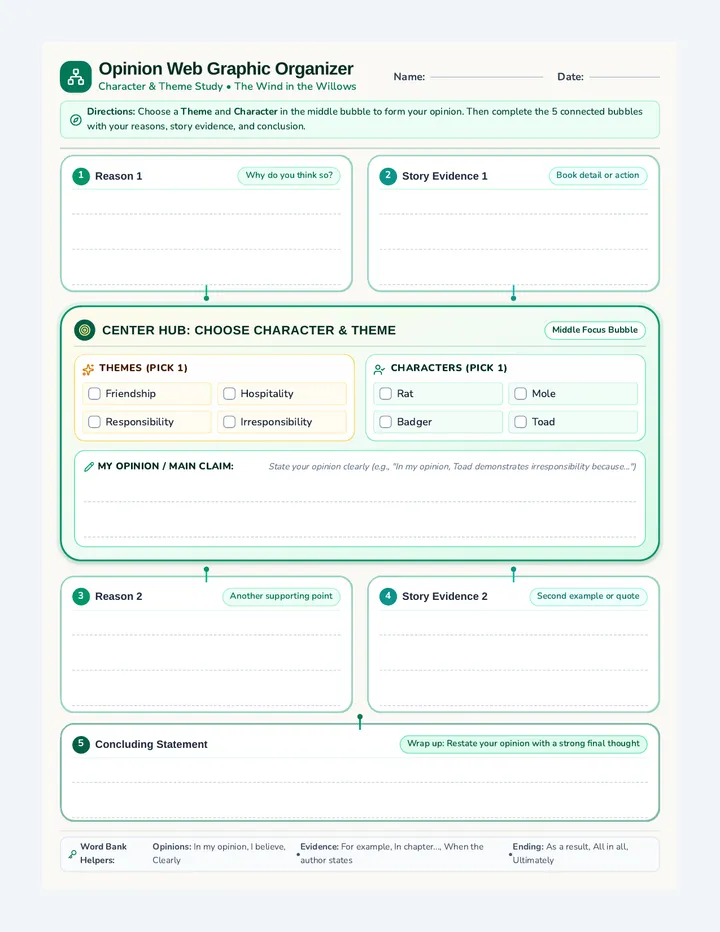
Opinion Web Graphic Organizer

Opinion Web Graphic Organizer

A simplified opinion writing web graphic organizer adapted for ESL and SPED learners. Features a central character and theme web hub directly attached via directional web arrows to four blank writing bubbles, supported by an expanded vocabulary and sentence starter word bank.

M

mkrapazzo

First Day Feelings Reading Worksheet

First Day Feelings Reading Worksheet

An adapted reading passage of Patty Hansen's 'The First Day of Middle School' with enlarged, readable text scaled to fit each page, complete with chunked passage text, comprehension check, and emoji reflection organizer.

PL

Patrick l

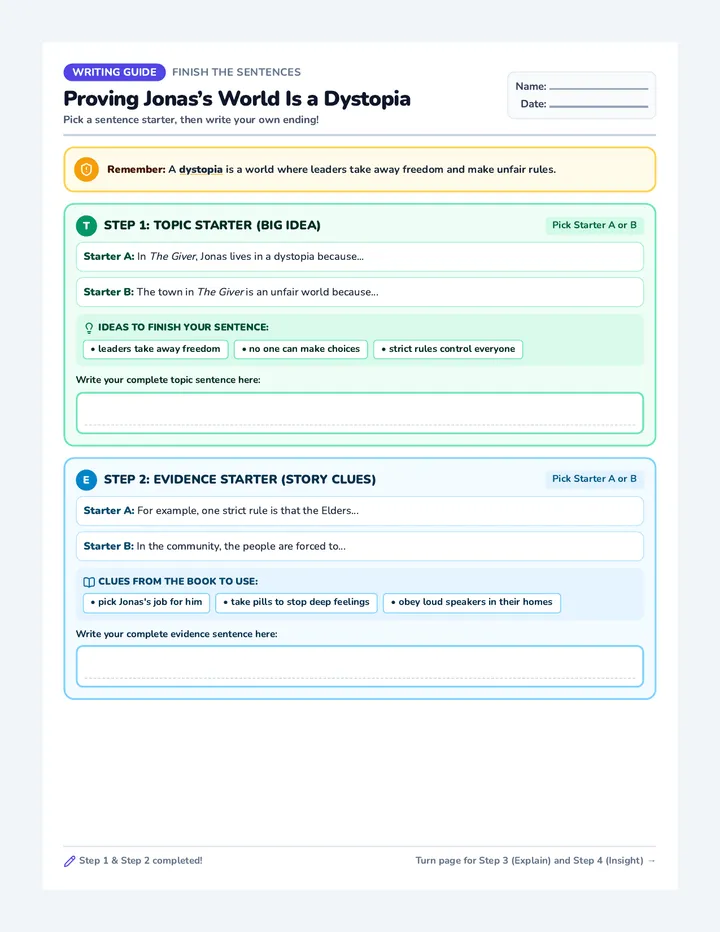
Giver Dystopia Reference Sheet

Giver Dystopia Reference Sheet

A simplified 2-page writing guide for a second-grade reading level. Features structured sentence starters with ending prompt banks and dedicated handwriting lines, allowing students to complete their own analysis to prove The Giver is a dystopian setting.

AM

Ashley McGregor

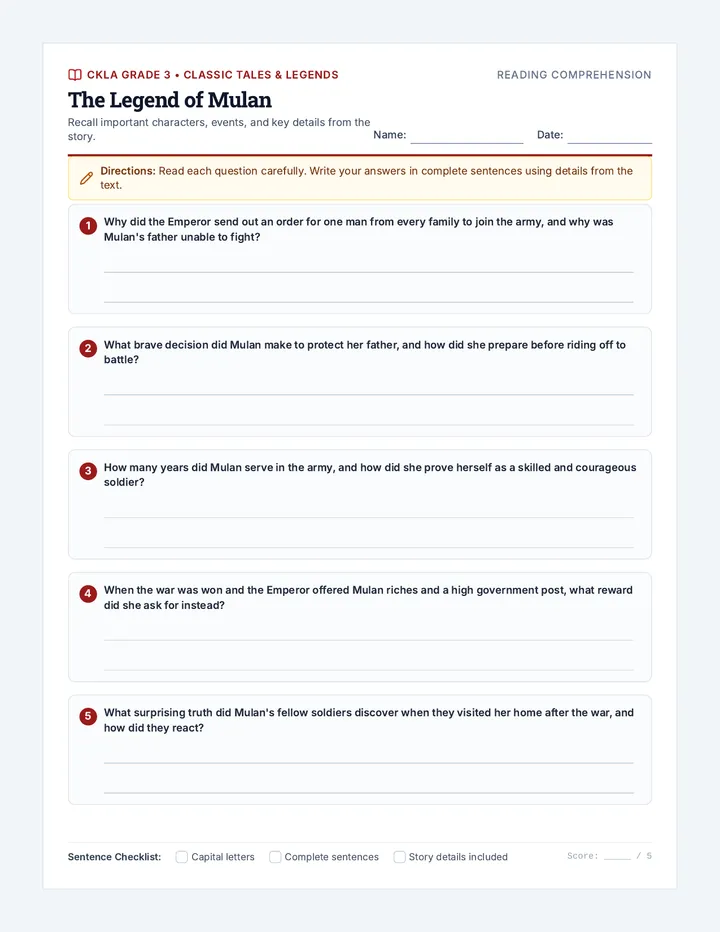
Mulan Legend Worksheet

Mulan Legend Worksheet

A Grade 3 CKLA reading comprehension worksheet featuring five recall questions on the story of Mulan. Students demonstrate understanding of key plot events, character motivations, and central details with dedicated handwriting lines.

T

tywest

Lost Son Story Slides

Lost Son Story Slides

A 10-slide visual teaching deck adapted for deaf kindergarten listeners, enhanced with Google Slides 16:9 widescreen print and export compatibility CSS for seamless PDF import into Google Slides.

SC

Shelley Carman

Sequences

Invention Quest Slides

Frindle Frenzy Novel Study

A 9-day novel study for 'Frindle' by Andrew Clements, aligned to 3rd Grade ELAR TEKS, focusing on character development, vocabulary, and plot analysis.

LH

Lucy Hellerman

56
Lesson Plan 1 Introduction

Literary Device Detectives

A comprehensive multi-unit sequence for 3rd and 4th grade students covering key literary devices: Introduction to Figurative Language, Onomatopoeia, Similes, Metaphors, Personification, and Idioms. Each unit provides 5 lesson plans, interactive notebook resources, and a wide variety of activities and stories designed to improve descriptive writing and reading comprehension.

JS

Janette Sullivan

105
Value Vault Teacher Guide

Metamorphosis Mastery

An 8-week deep dive into Kafka's Metamorphosis for special education students, focusing on abstract thinking, social value, and the human condition through high-engagement activities and visual organizers.

C

Ceeasia.walker

58
Prophecy and Power Slides

Shadows and Crowns

A series of lessons exploring Shakespeare's Macbeth, specifically designed for 10th-grade emergent bilingual students to master complex characterization and thematic elements.

DC

Dylan Clark

30
Week 1 Closed Syllable Manual

Syllable Squad Decoding Mission

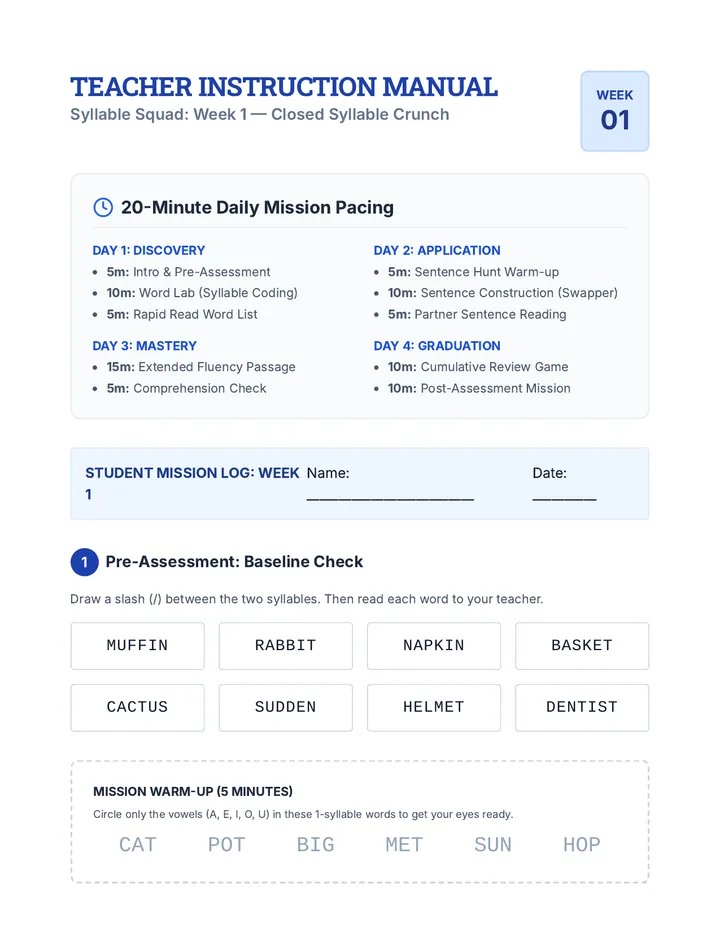
A comprehensive 5-week phonics intervention focused on decoding two-syllable words across five major syllable types. Each week includes a pre-assessment, daily lessons with specific targets, student practice sheets, and a post-assessment.

KJ

Kelsey Jacobs

29
Question Anatomy Slides

Insight Investigators

A 6-week reading intervention unit for 5th graders focused on making inferences, analyzing questions, and using text evidence. Themes include mysteries, sports (baseball and basketball), and dragons to engage high-interest readers.

MK

Meg Keene

48