Lenny.com
Explore
Create
ActivitiesNewMathEnglish Language ArtsScience & EngineeringSocial StudiesGlobal LanguagesHealth & Physical EducationSpecial EducationCounseling & Life SkillsArts & CreativityESL
Lenny.com
Lenny.com
Explore
Create
ActivitiesNewMathEnglish Language ArtsScience & EngineeringSocial StudiesGlobal LanguagesHealth & Physical EducationSpecial EducationCounseling & Life SkillsArts & CreativityESL
Lenny.com
English Language ArtsPhonics & Reading FoundationsLetter IdentificationLearn Letters A-ZLowercase and Uppercase LettersConsonants and VowelsLetter-Sound AssociationsLetter-Sound Associations: LowercaseLetter-Sound Associations: UppercaseBeginning and Ending SoundsRhymingBlending And SegmentingShort VowelsShort Vowel SoundsConsonant BlendsConsonant DigraphsBlends, Digraphs, and TrigraphsDigraphs, Blends, and Silent LettersLong Vowel SoundsLong Vowel PatternsShort and Long VowelsShort and Long Vowel PatternsSilent EVowel SoundsVowel TeamsR-Controlled VowelsDiphthongs: Oi, Oy, Ou, OwVariant VowelsVariant, Diphthong, And R Vowel PatternsSoft G And CSight WordsIrregular WordsWord RecognitionSyllablesSyllable TypesTwo-Syllable WordsMultisyllabic WordsPhoneme ManipulationDecodable TextsVocabularyAction WordsQuestion WordsNouns and AdjectivesClassify WordsCompound WordsSynonyms and AntonymsHomophonesHomophones and HomonymsShades of MeaningContext CluesPrefixes and SuffixesGreek and Latin RootsAnalogiesIdioms and AdagesForeign Words and ExpressionsWord Choice and UsageReference SkillsReading ComprehensionRead-Along Literary TextsRead-Along Informational TextsReality vs. FictionStory ElementsCharacterSequenceMain IdeaCause And EffectCompare And ContrastReading StrategiesText StructureAuthor's PurposeAuthor's Purpose And ToneAuthor's PerspectivePoint Of ViewThemeInference And ThemeInference And AnalysisPoetry ElementsLiterary DevicesAnalyzing LiteratureAnalyzing Informational TextsComparing TextsAudience, Purpose, And ToneBusiness DocumentsNovel StudyNonfiction Book StudyGrammar & MechanicsSentencesNounsVerbsAdjectivesPronounsCapitalizationPunctuationContractionsConjunctionsPrepositionsArticlesAdjectives And AdverbsVerb TypesVerb TensePronouns And AntecedentsPronoun TypesSubject-Verb AgreementDirect And Indirect ObjectsSentences, Fragments, And Run-OnsPhrases And ClausesCommasSemicolons, Colons, And CommasDashes, Hyphens, And EllipsesSpellingAbbreviationsFormattingVerb Tense And MoodMisplaced ModifiersWritingDescriptive DetailsCreative WritingOpinion WritingTopic SentencesOrganizing WritingLinking WordsSentence VarietyIntroductions And ConclusionsPersuasive And Opinion WritingExpository WritingPersuasive StrategiesDeveloping And Supporting ArgumentsTopic Sentences And Thesis StatementsSummarizingResearch SkillsEditing And RevisingActive And Passive Voice=Writing Clearly And ConciselyDebate & Public SpeakingPublic Speaking BasicsPersuasive TechniquesClaims and EvidenceTypes of ArgumentsReasoning TypesLogical FallaciesTopic ResearchOrganizing EvidenceDebate Speech OrganizationAttacking and Defending ArgumentsClash and EngagementImpact CalculusQuestioning and Cross-ExaminationCritical ThinkingInformal LogicFormal LogicInductive Reasoning

Cause And Effect

Logical relationships between events and their resulting outcomes across informational and literary texts. Identifies signal words and strengthens critical thinking through evidence-based reasoning.

Lenny.com

Solutions

Lenny for EducatorsLenny for SchoolsLenny for Districts

Product

ExploreSign inCreateSupportAbout

Resources

Getting startedMTSS Acceleration Program

Newsletters

School Funding Newsletter

© 2026 Lenny Learning Inc.

TermsPrivacyAccessibility
LinkedInInstagramX
Lenny

Videos

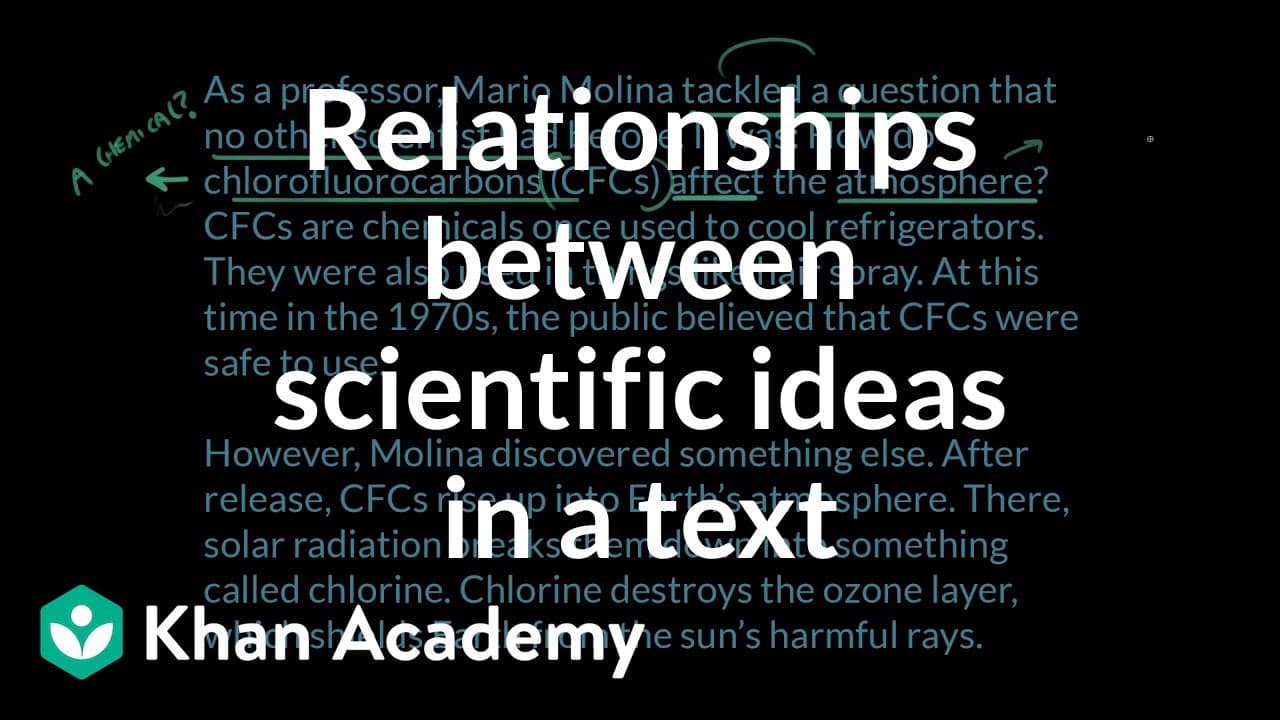
How to Connect Ideas in Scientific Texts

How to Connect Ideas in Scientific Texts

This educational video teaches students how to draw connections within scientific texts, using the real-world example of Nobel Prize winner Dr. Mario Molina's research on the ozone layer. The narrator begins with a simple, relatable analogy involving a bowl of pasta to explain four types of logical connections: why something happened, how it happened, how one event impacts another, and cause-and-effect relationships. This scaffolding helps prepare viewers for the more complex scientific text that follows. The video then transitions to a guided reading of a passage about Dr. Molina's discovery of the link between Chlorofluorocarbons (CFCs) and ozone depletion. The narrator models active reading strategies by highlighting key terms, decoding acronyms like 'CFCs' using context clues (parentheses), and identifying signal words like 'However' that indicate a shift in the argument. The analysis breaks down the complex chemical chain reaction described in the text—from hairspray cans to the stratosphere—demonstrating how to map linear events from a dense paragraph. This resource is highly valuable for both English Language Arts and Science classrooms. It bridges the gap between literacy and scientific understanding, showing students that reading science requires active engagement to construct meaning. Teachers can use this video to introduce annotation strategies, teach text structure, or launch a unit on environmental science. It effectively models how to slow down, ask questions of the text, and visualize processes to comprehend complex informational writing.

Khan AcademyKhan Academy

7mins 41s

How Good Readers Connect Ideas in a Text

How Good Readers Connect Ideas in a Text

This video introduces the critical reading comprehension strategy of making connections between ideas within a text. Using an accessible analogy of a social network where friends are connected in different ways, the narrator explains how sentences and concepts in a passage relate to one another to build a larger meaning. The video transitions from this analogy to a concrete demonstration using a nonfiction passage about the history of shipbuilding. The content focuses on three specific types of text connections: Comparison (identifying similarities and differences), Cause and Effect (understanding how one event leads to another), and Sequence (tracking the order of events). Through a step-by-step close reading of a paragraph about iron versus brass nails in ships, the narrator explicitly models how to identify these structures using textual evidence. For educators, this resource provides a clear, visual model for teaching text structure and close reading. It moves beyond the common "text-to-self" connection strategy to the more rigorous "text-to-text" internal analysis required for higher-level comprehension. It is an excellent tool for introducing informational text structures or for supporting students who struggle to see the "big picture" when reading complex nonfiction.

Khan AcademyKhan Academy

3mins 3s

How to Identify and Compare Text Structures

How to Identify and Compare Text Structures

This educational video provides a clear and practical guide to understanding text structures—how authors organize information within a text. The narrator introduces four common types of text structures: Cause and Effect, Chronology, Problem and Solution, and Comparison. Through visual aids and simple definitions, the video explains that recognizing these structures helps readers identify the main ideas and understand how events or concepts connect.

Khan AcademyKhan Academy

4mins 28s

Analyzing How People, Events, and Ideas Interact

Analyzing How People, Events, and Ideas Interact

This educational video provides a clear, step-by-step strategy for analyzing interactions between individuals, events, and ideas in informational texts. The narrator explains that understanding these interactions—specifically how one element causes or influences another—is crucial for deep reading comprehension. The video breaks this process down into two manageable steps: first identifying the key elements (people, events, ideas), and then determining the relationships between them. The video models this strategy using a short biographical text about Caroline Herschel, an 18th-century astronomer. By creating a three-column chart, the narrator visually organizes the text's content and then uses arrows to map out how Herschel's belief that women could be scientists led to specific actions and eventual historical changes. This concrete example transforms an abstract reading standard into a practical, replicable skill. This resource is highly valuable for ELA classrooms, particularly when tackling Common Core standards regarding text analysis (RI.5.3, RI.6.3, RI.7.3). It offers teachers a specific graphic organizer (the People/Events/Ideas chart) that can be applied to any nonfiction text. It helps students move beyond simple recall to higher-order thinking by asking them to trace cause-and-effect chains and understand the influence of ideas on historical events.
Khan AcademyKhan Academy

3mins 24s

Making Connections: How Goats Help Prevent Wildfires

Making Connections: How Goats Help Prevent Wildfires

In this engaging English Language Arts video, narrators Hannah and David use a humorous personal anecdote and a fascinating real-world article to teach students how to identify connections between ideas in informational texts. The video defines connections as the "web of influence" linking people, events, and ideas, focusing specifically on cause-and-effect relationships. The narrators demonstrate how to trace these connections by analyzing how one event (mowing a lawn) can lead to unexpected outcomes (neighborhood noise complaints). The core of the lesson centers on a reading passage about "The Goat Brigade," a business that rents goats to graze on lawns. Through a guided close reading, the video models how to connect specific details in the text—such as a goat's diet of dry grass—to broader outcomes, like wildfire prevention. The narrators explicitly walk through the logic chain: goats eat dry plants (cause) → less fuel for fires (effect) → fires are easier to contain (outcome). This video is an excellent tool for 3rd through 5th grade classrooms to introduce or reinforce reading comprehension standards related to historical, scientific, or technical texts. It moves beyond simple recall to higher-order thinking, asking students to synthesize information and understand the "why" behind events. The humorous rapport between the narrators keeps students engaged while making abstract concepts concrete and understandable.

Khan AcademyKhan Academy

3mins 49s

Ordering Ideas: Why Structure Matters in Writing

Ordering Ideas: Why Structure Matters in Writing

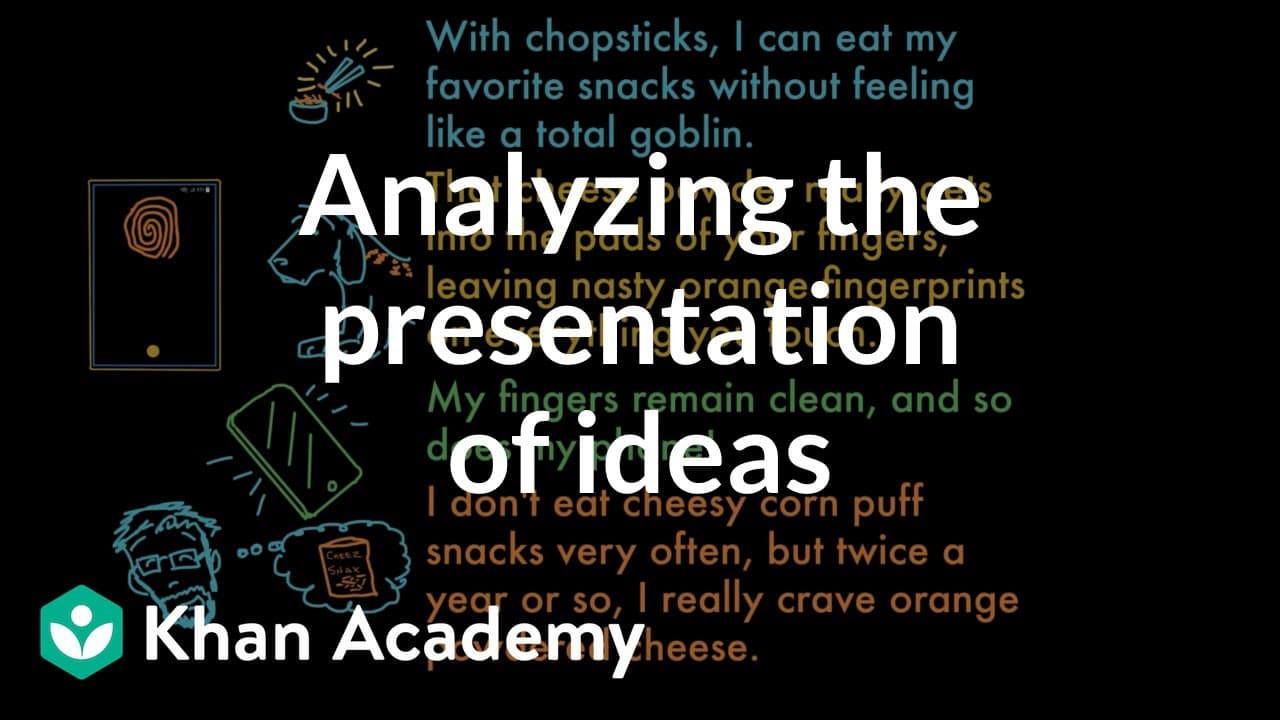
This video uses a humorous and relatable example—eating messy snacks with chopsticks—to demonstrate the importance of logically ordering ideas in writing. The narrator presents a jumbled paragraph that makes little sense, challenges the viewer to unscramble it, and then reveals the correct sequence to show how structure creates clarity and persuasion. The video explores key themes of writing structure, specifically the logical flow from context to problem to solution to evidence. It draws a parallel between reading and writing, explaining that understanding structure helps students become 'stronger readers' who can evaluate authors' choices and 'stronger writers' who can craft clear arguments. For educators, this video serves as an excellent hook for lessons on paragraph structure, editing, or persuasive writing. Its interactive nature (asking viewers to pause and reorder the text) makes it an active learning tool rather than passive consumption. It concretizes the abstract concept of 'flow' using a low-stakes, funny example that is accessible to upper elementary and middle school students.

Khan AcademyKhan Academy

3mins 28s

Materials

Grade 1 ELA Assessment Packet

Grade 1 ELA Assessment Packet

An End-of-Grade-1 ELA Benchmark Assessment Packet featuring late-first-grade sight words, complex initial and final consonant blends, a rich 105-word spring decodable reading passage with open constructed-response comprehension questions, an accommodated visual version, and a teacher running record and scoring rubric aligned to Spring Grade 1 benchmarks.

A

awarner1

ILEARN Caminos Blueprint Guide

ILEARN Caminos Blueprint Guide

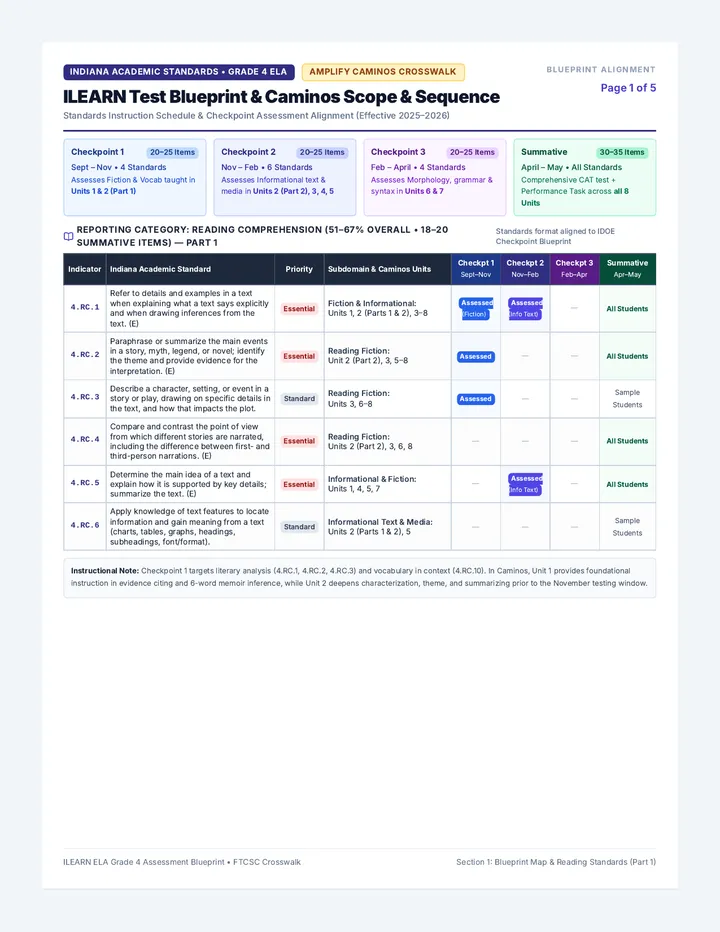
Comprehensive Grade 4 ILEARN Test Blueprint and Amplify Caminos Scope & Sequence crosswalk. Formatted to match the state ILEARN checkpoint blueprint, showing exactly when Indiana Academic Standards (Reading, Vocabulary, Writing, Grammar, and Communication) are taught across Units 1–8 and assessed in Checkpoints 1, 2, 3, and the Summative Assessment.

A

Amy.Hacker

Dino Dig Reading Worksheet

Dino Dig Reading Worksheet

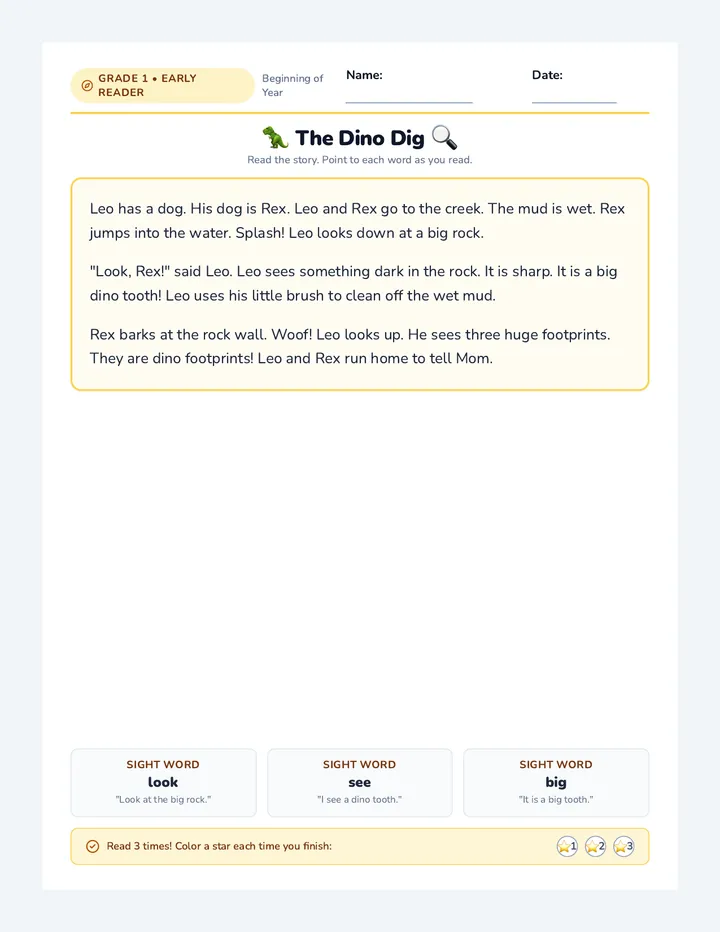
A 2-page printable reading comprehension and writing worksheet calibrated for beginning-of-first-grade readers (Level C/D), featuring a 3-paragraph decodable dinosaur adventure story with high-frequency sight words, early-reader multiple-choice questions, a drawing area, and wide primary handwriting lines.

LB

Lisa Ball

Secret Creek Fossil Hunt Reading Passage

Secret Creek Fossil Hunt Reading Passage

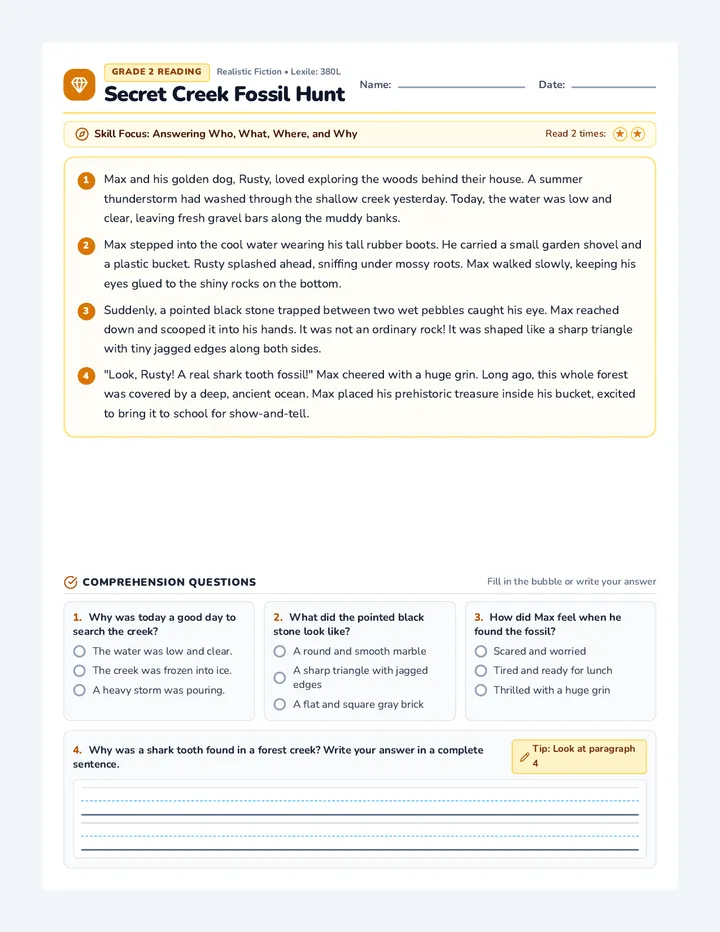
A high-interest beginning 2nd-grade reading comprehension passage about a boy discovering an ancient shark tooth in a creek bed, featuring four paragraphs, three multiple-choice questions, and a written response section with handwriting guide lines.

LB

Lisa Ball

Biomimicry Probe Worksheet

Biomimicry Probe Worksheet

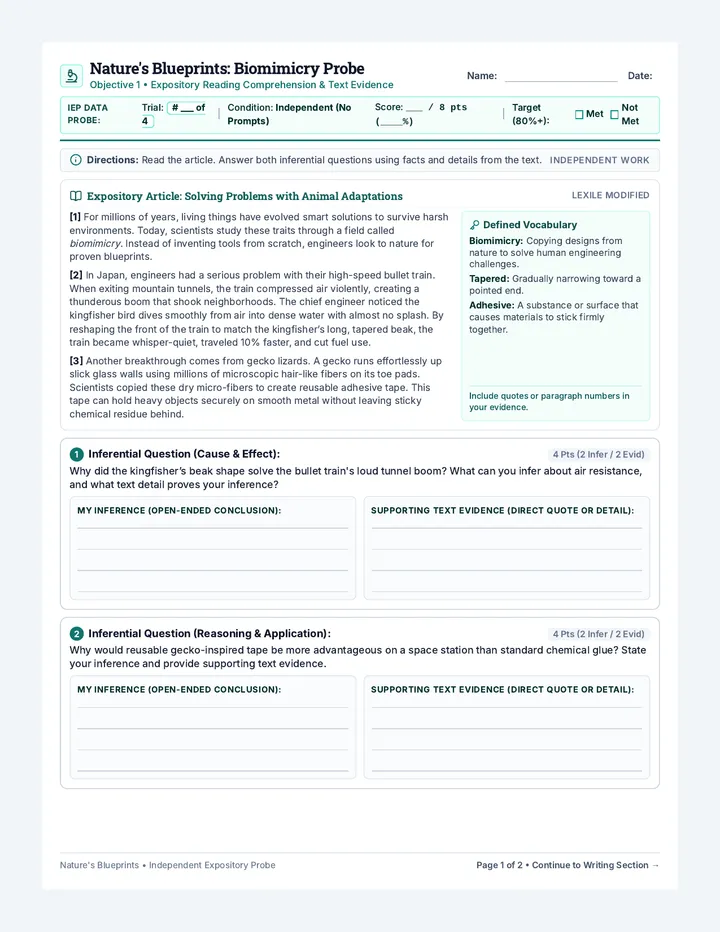
A two-page independent progress monitoring worksheet assessing expository reading inference with supportive text evidence, elaborative paragraph writing with two or more supporting details, and single-skill editing mechanics, featuring expanded student writing space and streamlined header data tracking.

A

amanda_raboin

Lightning Thief Clue Organizer

Lightning Thief Clue Organizer

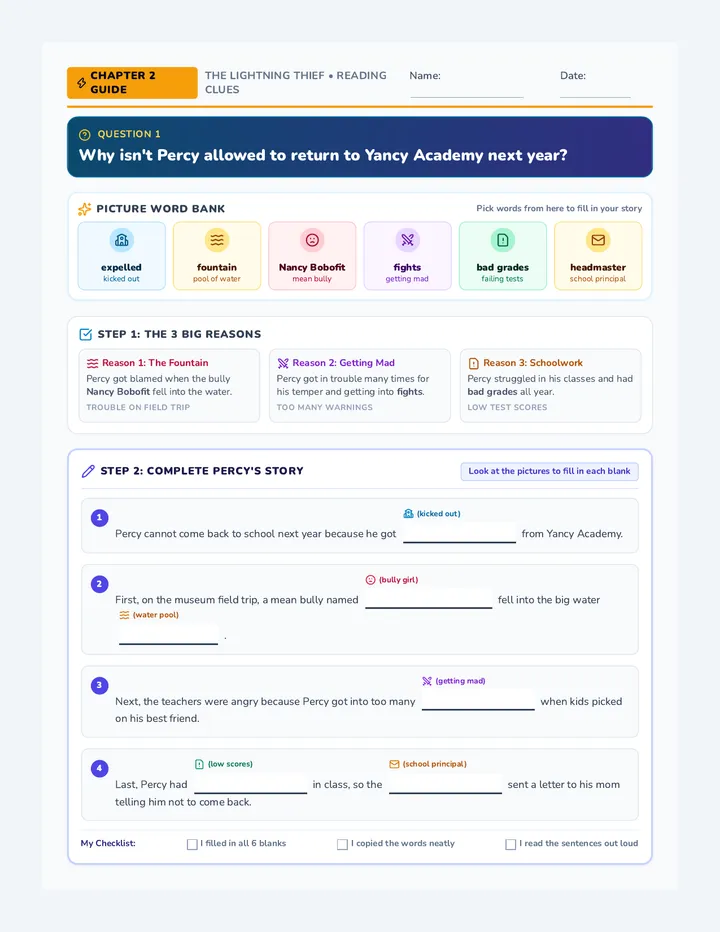
A two-page, picture-supported graphic organizer scaffolding Chapter 2 of Percy Jackson & The Olympians: The Lightning Thief, with simplified Grade 3 vocabulary across the visual word banks, organizers, and fill-in story frames.

C

cedaniels

Sequences

Invention Quest Slides

Frindle Frenzy Novel Study

A 9-day novel study for 'Frindle' by Andrew Clements, aligned to 3rd Grade ELAR TEKS, focusing on character development, vocabulary, and plot analysis.

LH

Lucy Hellerman

56
Prophecy and Power Slides

Shadows and Crowns

A series of lessons exploring Shakespeare's Macbeth, specifically designed for 10th-grade emergent bilingual students to master complex characterization and thematic elements.

DC

Dylan Clark

30
Virtual Harvest Teacher Guide

Digital Dirt

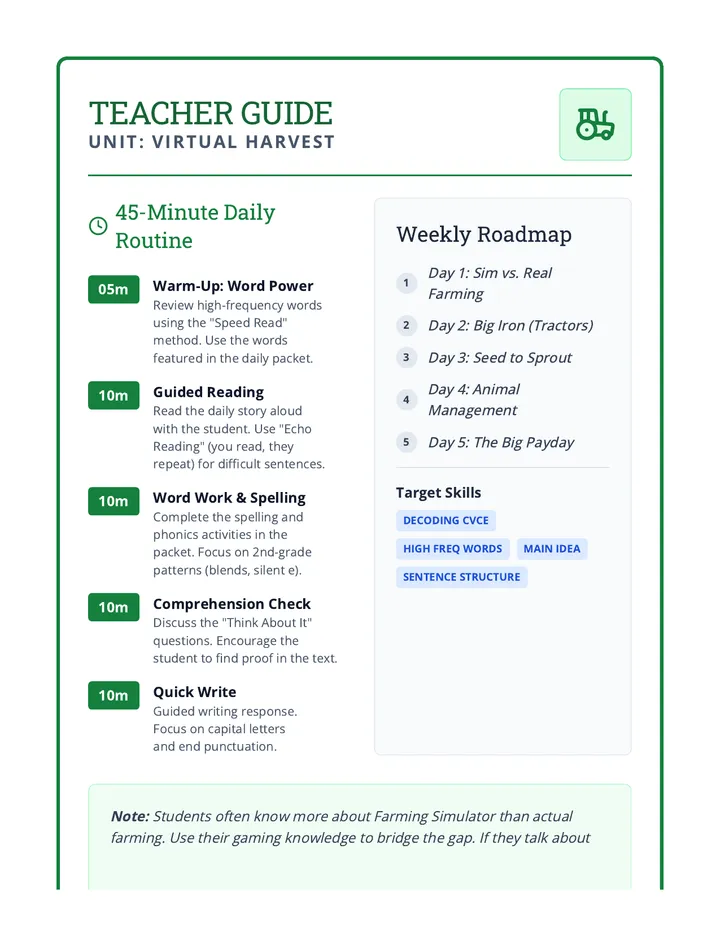
A 5-day reading comprehension and writing unit for struggling readers, blending the world of Farming Simulator with real-world agriculture. Focuses on 2nd-grade level literacy skills within a high-interest 5th-grade context.

CM

carley Martin

30
Question Anatomy Slides

Insight Investigators

A 6-week reading intervention unit for 5th graders focused on making inferences, analyzing questions, and using text evidence. Themes include mysteries, sports (baseball and basketball), and dragons to engage high-interest readers.

MK

Meg Keene

48
Copenhagen Clues Slides

Resistance Chronicles

A 9-day novel study for Number the Stars centered on 5th Grade ELAR TEKS, focusing on character development, plot analysis, and historical context through the lens of a Resistance Secret File.

LH

Lucy Hellerman

79
Detective Nutmeg Story Document

Story Investigators

A series of lessons focused on developing reading comprehension through mystery stories, with tiered assignments for different grade levels.

JJ

Julie Johns

30