Refutation techniques and direct response strategies for competitive debate. Addresses argument weighing, impact analysis, and the systematic breakdown of opposing claims.
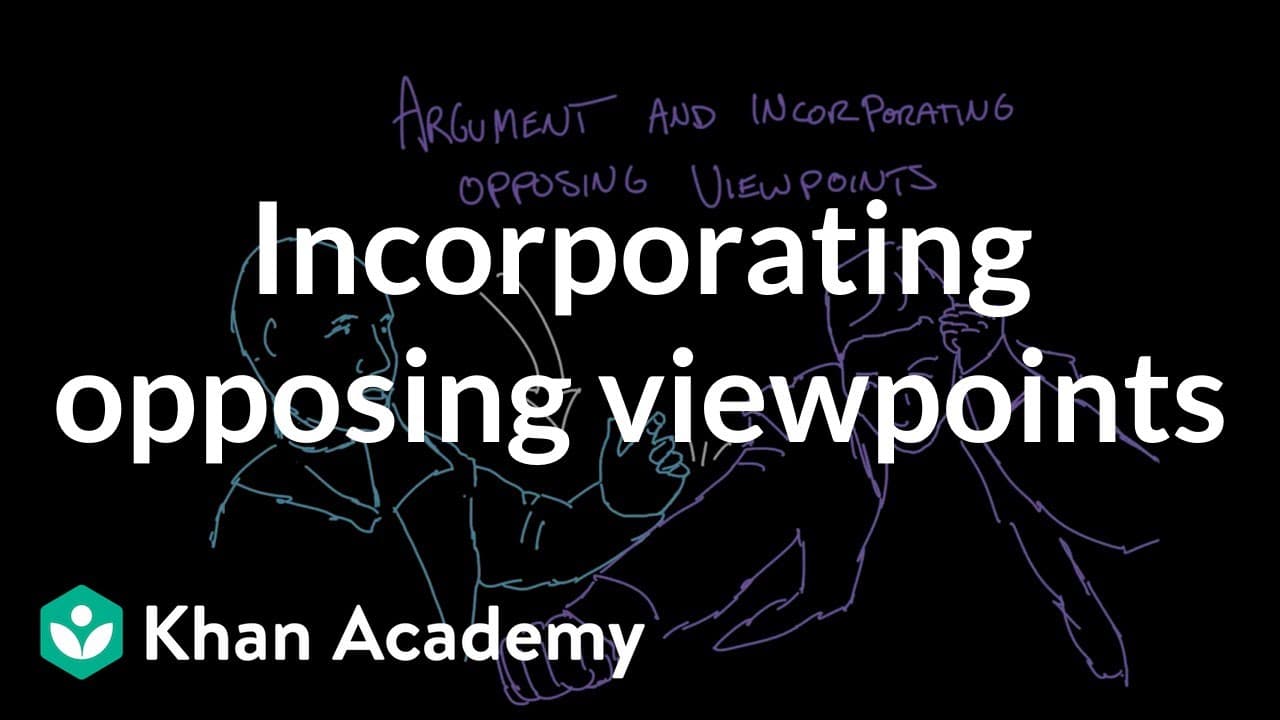
This video explores the rhetorical strategy of acknowledging and incorporating opposing viewpoints to strengthen argumentative writing. Using a martial arts analogy, the narrator explains that effective arguments do not simply "steamroll" opposition but rather engage with it constructively. The video outlines two primary applications for this technique: maintaining neutrality in journalistic reporting and fortifying persuasive arguments by anticipating and dismantling counter-claims. The video uses two distinct examples to illustrate these concepts. First, a humorous dispute over stolen cookies between fictional characters (Ms. Adeyemi and Mr. Dupont) demonstrates how to describe a conflict neutrally without injecting personal bias. Second, the historical mystery of the Lost Colony of Roanoke is used to show how addressing alternative theories (like disease or violence) and refuting them with evidence actually supports the author's main thesis that the colony's fate remains unknown. This resource is highly valuable for English Language Arts classrooms focusing on persuasive writing, debate, and media literacy. It provides a concrete framework (the "Block and Strike" method) for students to understand the function of counter-arguments and rebuttals. It also encourages critical reading by teaching students to be suspicious of authors who ignore opposing viewpoints entirely.
5mins 35s
A 5-day instructional sequence for 7th grade students focusing on the final review, performance, and summative assessment of Unit 1: Conflicts and Clashes. Students synthesize knowledge of author's purpose and conflict resolution through a collaborative debate and Socratic seminar before completing a comprehensive reading and editing assessment.
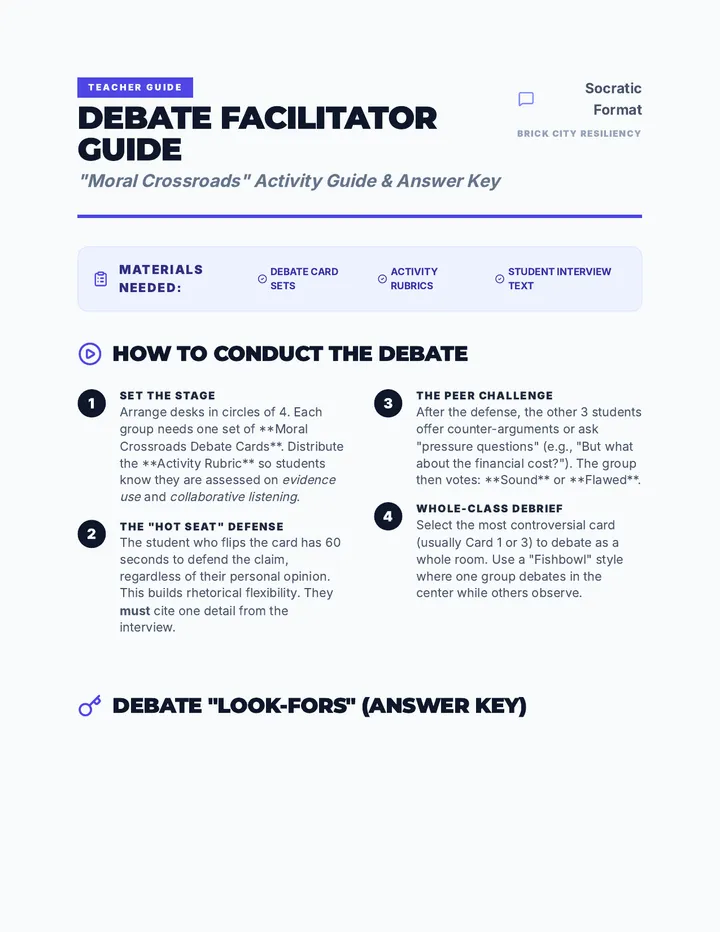
A comprehensive ELA unit focusing on text structure, argument analysis, and the interaction of ideas using the text 'Healing Brick City'. Students explore how personal anecdotes and systemic observations build a compelling case for social change.
A comprehensive unit designed to guide students through the complexities of writing a research-based argumentative paper, from paragraph structure to final revision.
A series of lessons focused on collaborative argumentation, evidence gathering, and literary analysis through interactive movement and peer-to-peer feedback.
Une série de ressources pour organiser et promouvoir une table ronde sur la littérature romance pour adolescents, incluant programme, guide de discussion et supports de communication.
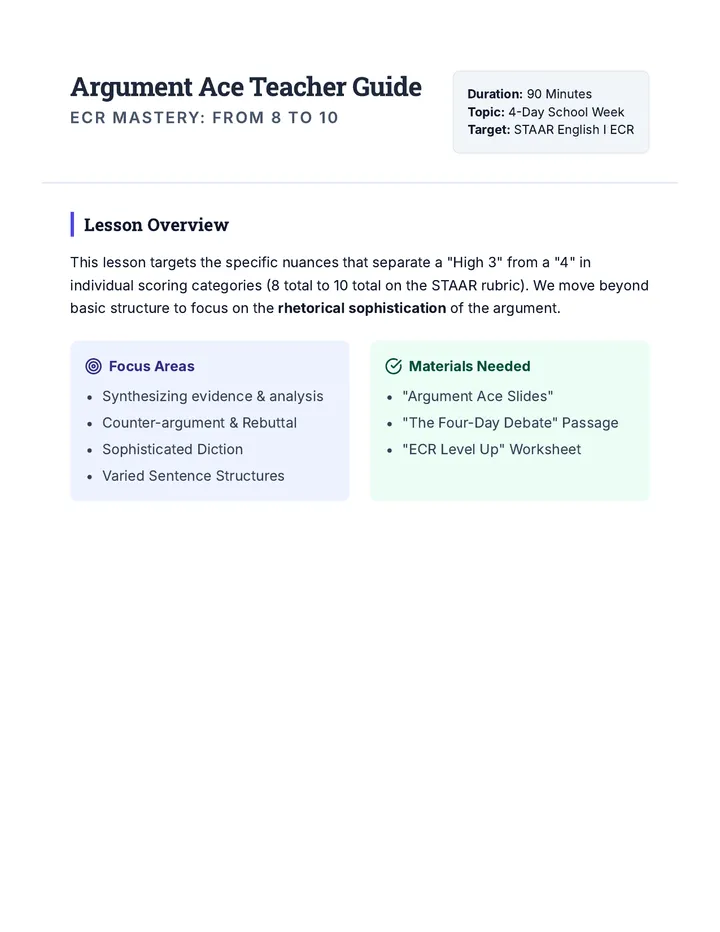
A week-long argumentative writing unit for 7th graders focused on the controversial topic of the 4-day school week. Students act as 'Arguments Attorneys' to research, build claims, and master the art of the rebuttal.
A series of lessons focused on mastering the art of persuasion and argumentative writing, from building claims to defending them against opposition.
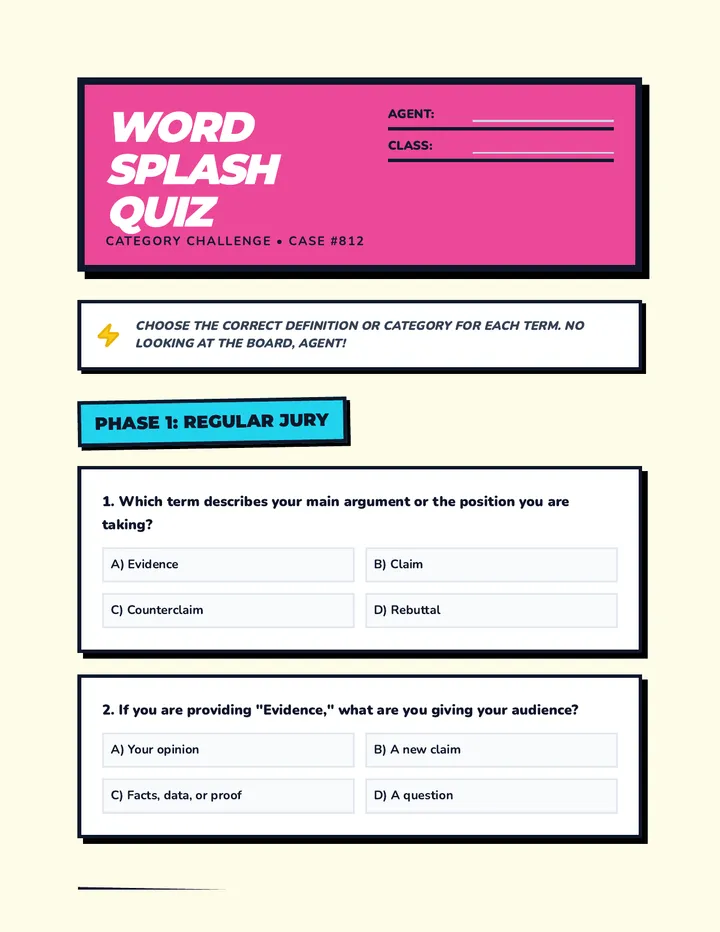
A series of lessons focused on mastering argumentative writing through immersive, game-based activities and role-playing scenarios.
A comprehensive graduate-level workshop series focused on transitioning from research topics to defensible academic contributions. Students will master thesis refinement, literature synthesis, counter-argument strengthening (steelmanning), and the oral defense of evidentiary choices.
An intensive sequence for undergraduate students focused on the structural and rhetorical deconstruction of academic monographs. Students will master the Toulmin model, evaluate evidence types, and analyze how scholarly authority is constructed through language and methodology.
A 10th-grade ELA sequence exploring the intersection of narrative techniques and factual reporting in literary nonfiction. Students analyze how authors use plot, characterization, setting, and dialogue to shape the 'truth' of real-world events.
A high-level rhetoric and logic course for undergraduate students, focusing on the identification and dismantling of logical fallacies during cross-examination. Students move from theoretical understanding to real-time application in legal and political contexts.
An updated student practice worksheet for the Fishbowl and Role-Play Tracker, featuring a clear, structured student guide box at the top, step-by-step directions for each phase of the activity, and optimized writing spaces with light backgrounds and larger font sizes.
A single-page student vocabulary worksheet containing a term matching grid and a fill-in-the-blank contextual application paragraph, updated to Grade 10 History.
A single-page teacher resource containing verbatim instructional scripts, differentiation strategies, and checks for understanding, updated to Grade 10 History.
A single-page teacher sequence document highlighting the instructional step-by-step sequence and pacing breakdown. Updated to align with the new slide deck structure where the dialogue steps precede the scenarios.
A single-page teacher guide containing learning objectives, student prerequisites, materials list, and key vocabulary definitions, updated to Grade 10 History.
A beautifully completed 3-question self-reflection exit ticket designed for students to evaluate their personal communication growth and systemic environmental thinking, with increased font sizes for improved readability.
A complete lesson presentation containing the lesson objective, vocabulary, key concepts, stakeholder instructions, fishbowl protocols, and structured reflection prompts. Reordered so that the active dialogue steps slide precedes the scenarios, with all text increased to a minimum of 24px for compliance and enhanced legibility.
A 2-page student worksheet packet containing 4 creative 'Would You Rather' conversation cards with speech stems on Page 1, and a spacious active-listening peer response log on Page 2.
A comprehensive, 2-page teacher facilitation guide and rubric designed for the 30-minute Opinion Arena lesson. It contains step-by-step scripted prompts, timing guides, standard-aligned assessment rubrics, and a classroom observation tracker.
A multi-page holistic rubric for school-wide collaborative debates, focusing heavily on academic argument quality, empirical validation, constructive civil dialogue, responsive rebuttals, and public delivery. Includes scoring charts, student instructions, and feedback guides.
Final unit reflection and data tracking document for Day 26. Students track their assessment performance and reflect on the unit's essential question. Improved layout density to fit all reflection questions on one page with high-quality styling. Re-reviewed for spacing and distribution.
Complete answer key and high-proficiency written exemplars for the Day 25 Summative Assessment. Includes rationales for multiple-choice items, high-level paragraph responses, and corrected grammar tasks. Re-reviewed for completion and contrast.
A Grade 10 History & SEL lesson focused on active listening and respectful communication during structured stakeholder dialogue about community environmental space use. Features a complete slide deck, a student worksheet, a teacher facilitation guide with scripts, and a self-reflective exit ticket.
A high-energy, 30-minute lesson designed to teach 4th-grade students the mechanics of collaborative dialogue. Using creative 'Would You Rather' prompts, students practice active listening, responding to follow-up questions, and building on peer ideas.
A foundational lesson containing frameworks and evaluative tools to support rigorous, evidence-based collaborative debate. It focuses on elevating academic argument quality, critical thinking, and respectful civil dialogue across different subjects and grade levels.
Analysis of assessment data and personal growth tracking to conclude the unit.
Summative unit assessment covering 7th-grade reading comprehension and editing/revising skills.
Comprehensive review of unit vocabulary, reading skills, and grammar through interactive games and practice assessments.
A student-led Socratic Seminar focused on conflict resolution across unit genres, followed by the drafting of a unit reflection letter and grammar review.
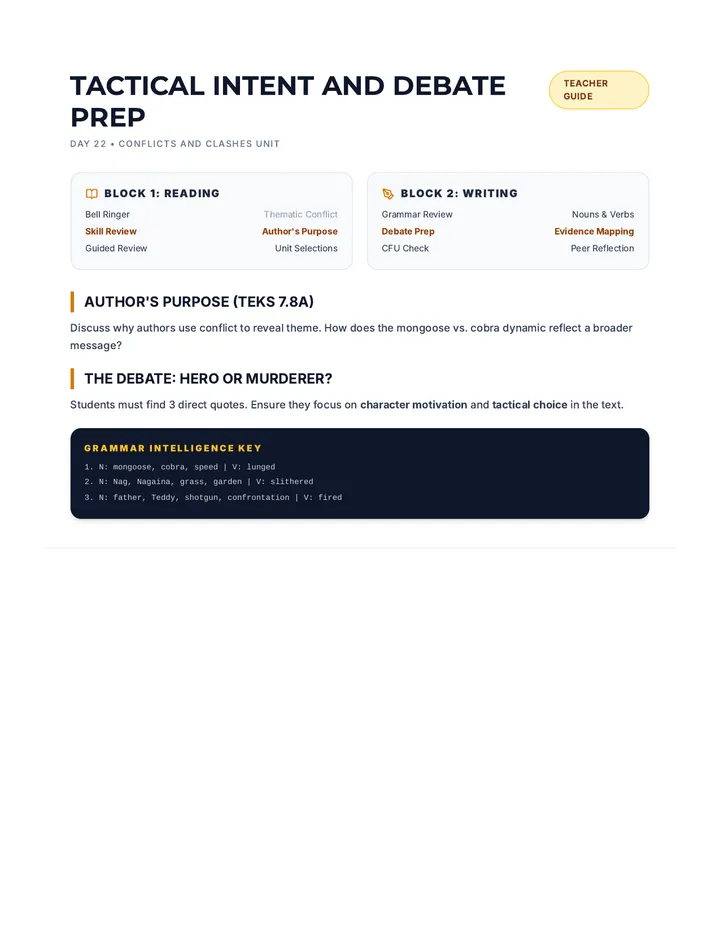
Review of author's purpose and message across unit texts, coupled with collaborative preparation for a debate on Rikki-Tikki-Tavi's actions.
A high-stakes rhetorical challenge where 8th-grade students analyze character motivation and authorial intent by putting a controversial literary figure on trial using textual evidence.
An 8th-grade ELA lesson focused on central ideas and evidence through the CommonLit text 'Keeping Up with the Joneses'. Students analyze the origins, social impacts, and psychological pressures of status-seeking behavior through vocabulary challenges, media analysis, and collaborative activities.
This lesson focuses on Dr. Sampson Davis's journey and his argument for medical reform in Newark. Students will analyze how the interview's structure develops the central idea that education and social responsibility can heal a community.
A wrap-up activity for a Socratic Seminar where students reflect on their contributions, evaluate their peers' ideas, and self-assess their performance using an investigative 'Monster Mystery' theme.