Lenny.com
Explore
Create
ActivitiesNewMathEnglish Language ArtsScience & EngineeringSocial StudiesGlobal LanguagesHealth & Physical EducationSpecial EducationCounseling & Life SkillsArts & CreativityESL
Lenny.com
Lenny.com
Explore
Create
ActivitiesNewMathEnglish Language ArtsScience & EngineeringSocial StudiesGlobal LanguagesHealth & Physical EducationSpecial EducationCounseling & Life SkillsArts & CreativityESL
Lenny.com
Lenny.com

Solutions

Lenny for EducatorsLenny for SchoolsLenny for Districts

Product

ExploreSign inCreateSupportAbout

Resources

Getting startedMTSS Acceleration Program

© 2026 Lenny Learning Inc.

TermsPrivacyAccessibility
LinkedInInstagramX
Lenny

Types of Arguments

Distinguishes between logical, emotional, and ethical appeals used in persuasive communication. Examines deductive and inductive reasoning structures to strengthen case construction and rebuttal strategies.

English Language ArtsPhonics & Reading FoundationsLetter IdentificationLearn Letters A-ZLowercase and Uppercase LettersConsonants and VowelsLetter-Sound AssociationsLetter-Sound Associations: LowercaseLetter-Sound Associations: UppercaseBeginning and Ending SoundsRhymingBlending And SegmentingShort VowelsShort Vowel SoundsConsonant BlendsConsonant DigraphsBlends, Digraphs, and TrigraphsDigraphs, Blends, and Silent LettersLong Vowel SoundsLong Vowel PatternsShort and Long VowelsShort and Long Vowel PatternsSilent EVowel SoundsVowel TeamsR-Controlled VowelsDiphthongs: Oi, Oy, Ou, OwVariant VowelsVariant, Diphthong, And R Vowel PatternsSoft G And CSight WordsIrregular WordsWord RecognitionSyllablesSyllable TypesTwo-Syllable WordsMultisyllabic WordsPhoneme ManipulationDecodable TextsVocabularyAction WordsQuestion WordsNouns and AdjectivesClassify WordsCompound WordsSynonyms and AntonymsHomophonesHomophones and HomonymsShades of MeaningContext CluesPrefixes and SuffixesGreek and Latin RootsAnalogiesIdioms and AdagesForeign Words and ExpressionsWord Choice and UsageReference SkillsReading ComprehensionRead-Along Literary TextsRead-Along Informational TextsReality vs. FictionStory ElementsCharacterSequenceMain IdeaCause And EffectCompare And ContrastReading StrategiesText StructureAuthor's PurposeAuthor's Purpose And ToneAuthor's PerspectivePoint Of ViewThemeInference And ThemeInference And AnalysisPoetry ElementsLiterary DevicesAnalyzing LiteratureAnalyzing Informational TextsComparing TextsAudience, Purpose, And ToneBusiness DocumentsNovel StudyNonfiction Book StudyGrammar & MechanicsSentencesNounsVerbsAdjectivesPronounsCapitalizationPunctuationContractionsConjunctionsPrepositionsArticlesAdjectives And AdverbsVerb TypesVerb TensePronouns And AntecedentsPronoun TypesSubject-Verb AgreementDirect And Indirect ObjectsSentences, Fragments, And Run-OnsPhrases And ClausesCommasSemicolons, Colons, And CommasDashes, Hyphens, And EllipsesSpellingAbbreviationsFormattingVerb Tense And MoodMisplaced ModifiersWritingDescriptive DetailsCreative WritingOpinion WritingTopic SentencesOrganizing WritingLinking WordsSentence VarietyIntroductions And ConclusionsPersuasive And Opinion WritingExpository WritingPersuasive StrategiesDeveloping And Supporting ArgumentsTopic Sentences And Thesis StatementsSummarizingResearch SkillsEditing And RevisingActive And Passive Voice=Writing Clearly And ConciselyDebate & Public SpeakingPublic Speaking BasicsPersuasive TechniquesClaims and EvidenceTypes of ArgumentsReasoning TypesLogical FallaciesTopic ResearchOrganizing EvidenceDebate Speech OrganizationAttacking and Defending ArgumentsClash and EngagementImpact CalculusQuestioning and Cross-ExaminationCritical ThinkingInformal LogicFormal LogicInductive Reasoning

Videos

How to Win Arguments Using Claims and Evidence

How to Win Arguments Using Claims and Evidence

This engaging video lesson breaks down the components of a persuasive argument using a relatable scenario: a teenager negotiating with her mother via text message for a new phone. The narrator analyzes the conversation in real-time, highlighting how the character, Liz, effectively uses rhetorical strategies to make her case. The video transforms a common daily interaction into a clear model for argumentative thinking. The content focuses on three core concepts of argumentation: Claims (stating a position), Evidence (providing specific facts to support the position), and Counterclaims (anticipating and addressing opposing arguments before they are fully raised). It specifically highlights how to evaluate the strength of different types of evidence, demonstrating why connecting the problem to schoolwork is more persuasive to a parent than connecting it to gaming. For educators, this video serves as an excellent hook or modeling tool for units on argumentative writing or speech. It takes abstract terms like 'counterclaim' and 'preemptive argument' and grounds them in a context every student understands. It is particularly useful for visual learners who benefit from seeing the argument structure unfold as a text message thread.

Miacademy & MiaPrep Learning ChannelMiacademy & MiaPrep Learning Channel

4mins 50s

Why the Earthworm Should Be Our Mascot: A Persuasive Speech

Why the Earthworm Should Be Our Mascot: A Persuasive Speech

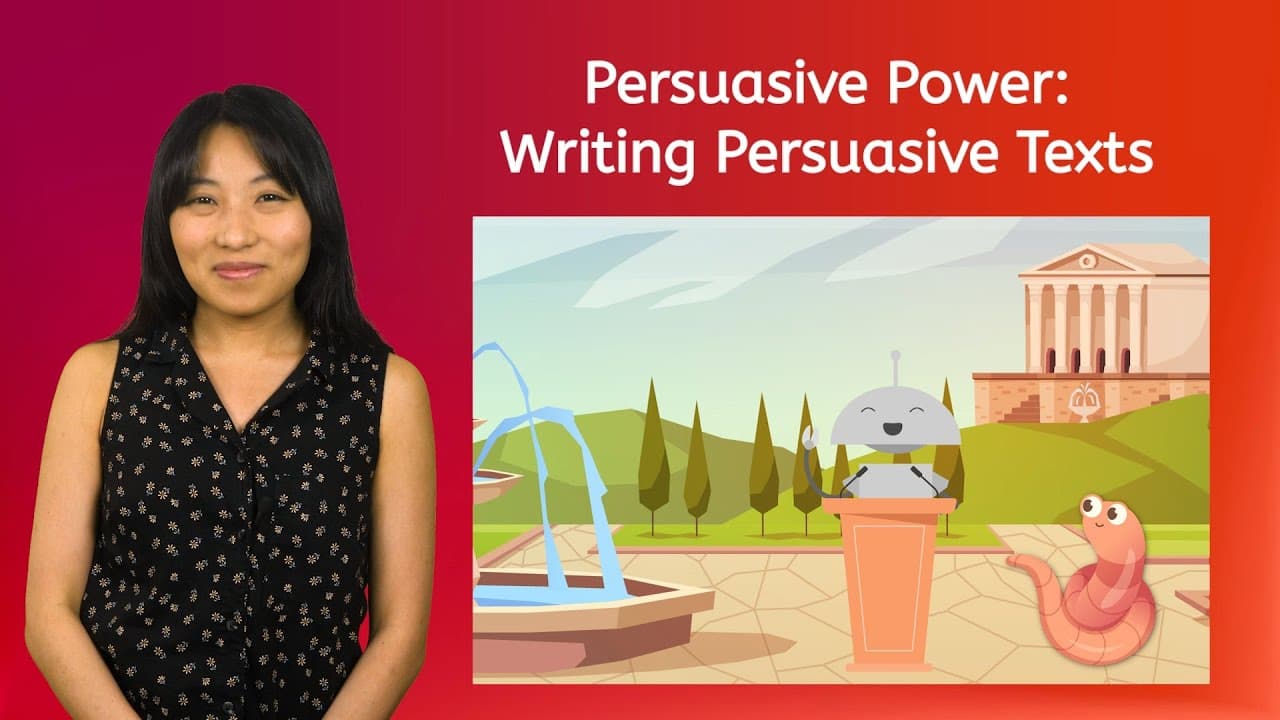
This video features a spirited persuasive speech delivered by a young woman advocating for an earthworm to become the new mascot for the fictional town of 'Persuasia'. The speaker systematically addresses potential skepticism about choosing a humble worm, transforming its perceived weaknesses into strengths such as uniqueness, ecological importance, and resilience. She uses a blend of scientific facts—like soil aeration and regeneration—and emotional appeals to community identity to build a compelling case. The content explores key themes of persuasive rhetoric, including the use of logical arguments (logos), emotional connection (pathos), and credibility (ethos). It highlights how to structure an argument by introducing a thesis, supporting it with distinct points (inclusivity, practicality, scientific wonder, and hard work), and concluding with a strong call to action. Additionally, the video touches upon biological concepts regarding the earthworm's vital role in the ecosystem. For educators, this video serves as an excellent model text for teaching persuasive writing and public speaking. It demonstrates clear organizational structure, effective use of rhetorical questions, and the power of reframing a topic. Teachers can use it to have students analyze argument strength, identify transition words, discuss the speaker's delivery techniques, or launch a cross-curricular unit combining English Language Arts with life science.

Miacademy & MiaPrep Learning ChannelMiacademy & MiaPrep Learning Channel

2mins 28s

Mastering Persuasion: Ethos, Logos, and Pathos

Mastering Persuasion: Ethos, Logos, and Pathos

In this engaging Language Arts lesson, students visit the fictional town of "Persuasia" where a heated debate is unfolding regarding the potential replacement of their beloved warthog mascot, Wartimer. Through this narrative framework, the video introduces the fundamental concepts of persuasive text analysis. Viewers are tasked with helping the host and her robot companion, Mia, sort through mixed-up debate notes to identify which arguments belong to which debater based on their content and style.

Miacademy & MiaPrep Learning ChannelMiacademy & MiaPrep Learning Channel

10mins 55s

Mastering the Art of Persuasion: Rhetoric, Devices, and Appeals

Mastering the Art of Persuasion: Rhetoric, Devices, and Appeals

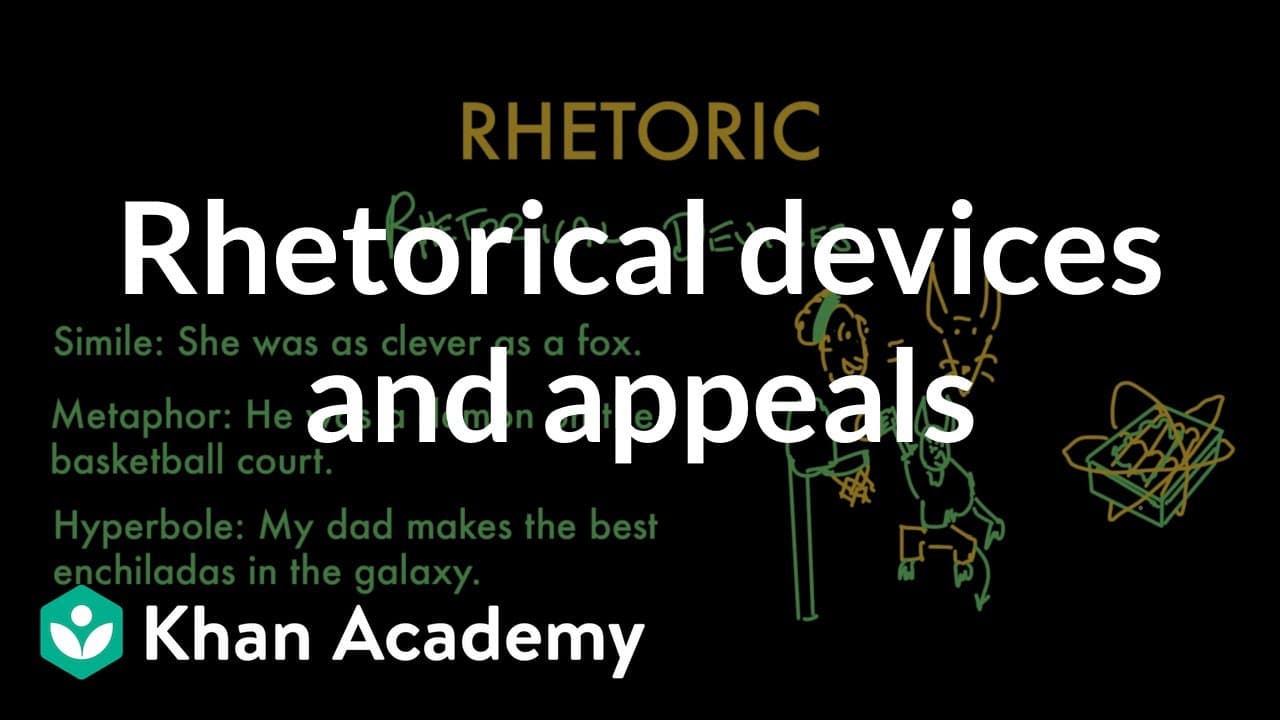
This educational video introduces students to the concept of rhetoric, defined as the art of persuasion. The narrator breaks down the subject into two main categories: rhetorical devices (figures of speech like similes, metaphors, and hyperbole) and rhetorical appeals (strategic modes of persuasion). Through clear narration and simple hand-drawn illustrations, the video explains how these tools are used to construct arguments and influence audiences. The content covers key rhetorical terminology including specific devices and the three classical appeals: Logos (logic/reason), Pathos (emotion), and Ethos (authority/credibility). The narrator uses relatable, humorous examples—such as "galactic enchiladas" for hyperbole and a sad puppy for pathos—to make abstract concepts concrete. It also touches on more complex ideas like apophasis to show the depth of the field. For educators, this video serves as an excellent foundational tool for English Language Arts units on persuasive writing, speech analysis, or media literacy. It empowers students not only to craft more effective arguments themselves but also to critically analyze the messages they encounter in the world. By understanding these mechanisms, students become more discerning consumers of information and more powerful communicators.

Khan AcademyKhan Academy

4mins 3s

Sequences

Master Pacing Guide Teacher Resource

Literacy Mastery Lab

A comprehensive year-long intervention sequence for 8th-grade literacy, focusing on STAR 360 and OSAS benchmark skills. The sequence follows a 3-day weekly instructional cycle (Instruction, Practice, Application) to supplement 2 days of choice reading.

SA

Senta Agnello-Shelton

60
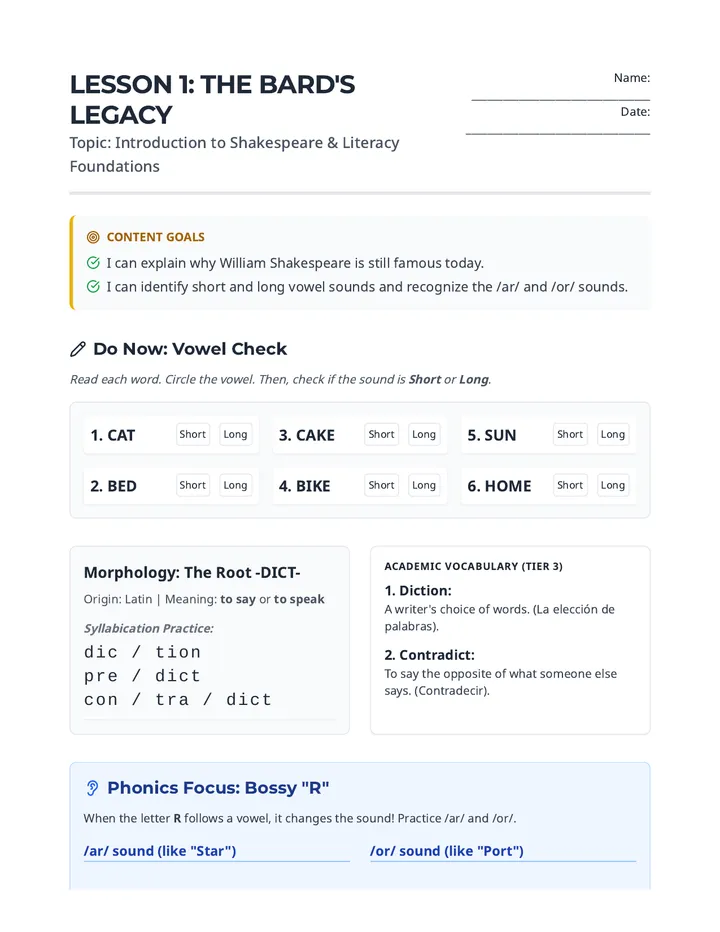
The Bard's Legacy Handout

Ambition and Power Unit

A 10-lesson thematic unit for 9th-grade ESOL students focusing on Shakespeare's Macbeth, integrating systemic language instruction, morphology, and phonics (R-controlled vowels) with high-school level analysis.

AP

Alexis Paolini

108
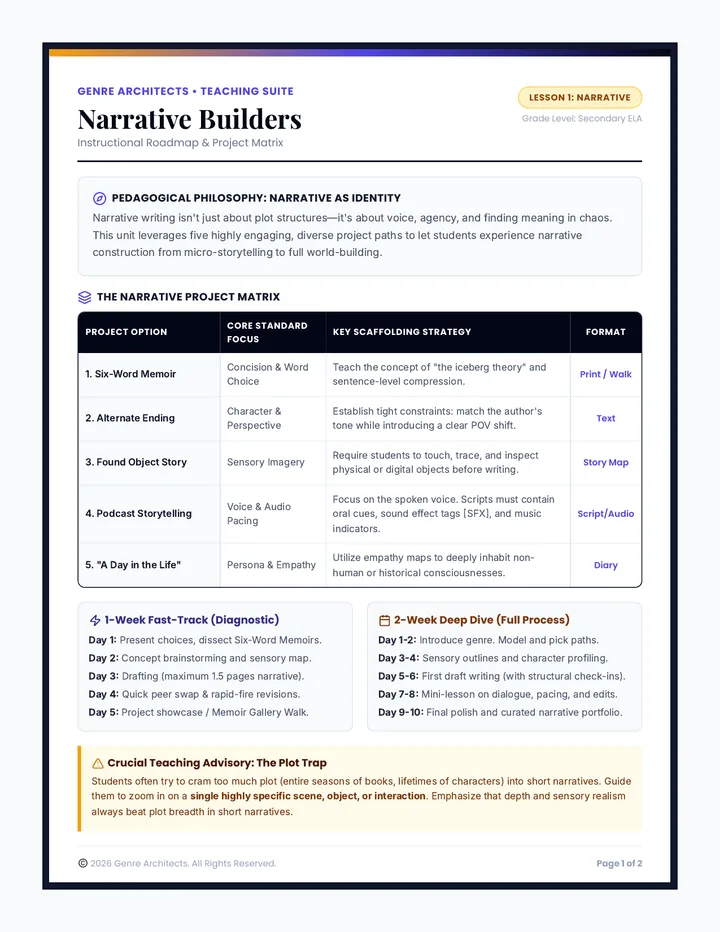
Narrative Builders Teacher Companion

Genre Architects

A comprehensive, multi-genre writing project suite that transforms secondary ELA classrooms. This sequence features 25 creative, high-engagement projects categorized into Narrative, Expository, Argumentative, Persuasive, and Multi-Genre masterpieces, complete with teacher guides, student workbooks, and introductory slide decks.

MC

Makaela Carias

19
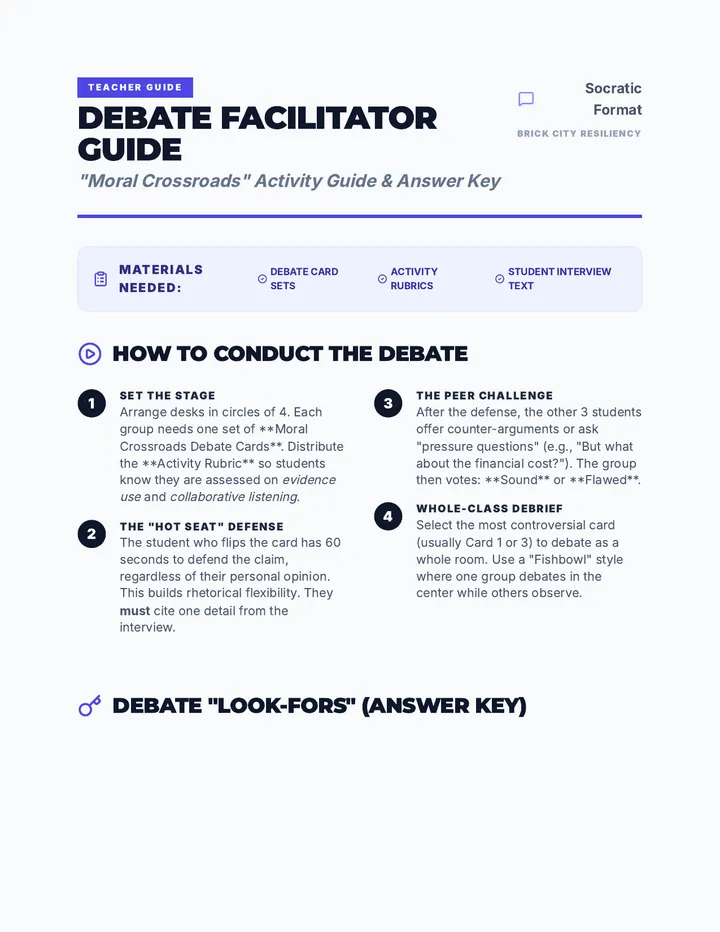
Debate Facilitator Guide

Brick City Resiliency

A comprehensive ELA unit focusing on text structure, argument analysis, and the interaction of ideas using the text 'Healing Brick City'. Students explore how personal anecdotes and systemic observations build a compelling case for social change.

V

vivianbelarmino

12
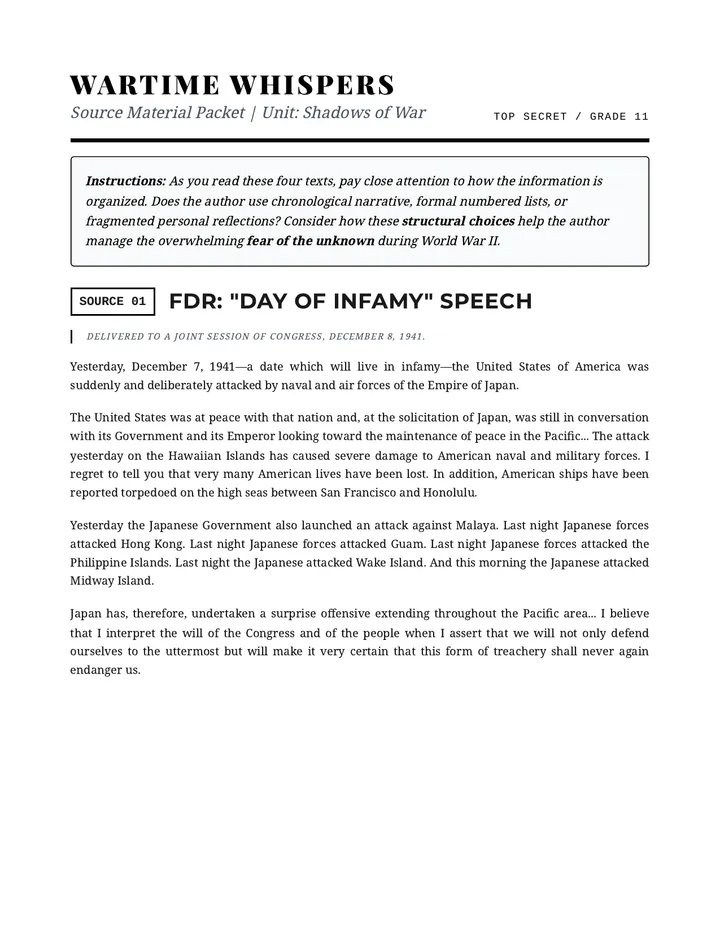
Wartime Whispers Text Packet

Shadows of War

A 4-part unit for 11th-grade English/History analyzing text structure and author's purpose through the lens of fear and the unknown during WWII, examining political rhetoric, legal orders, personal diaries, and wartime superstition.

LF

Lindsey Foulks

18
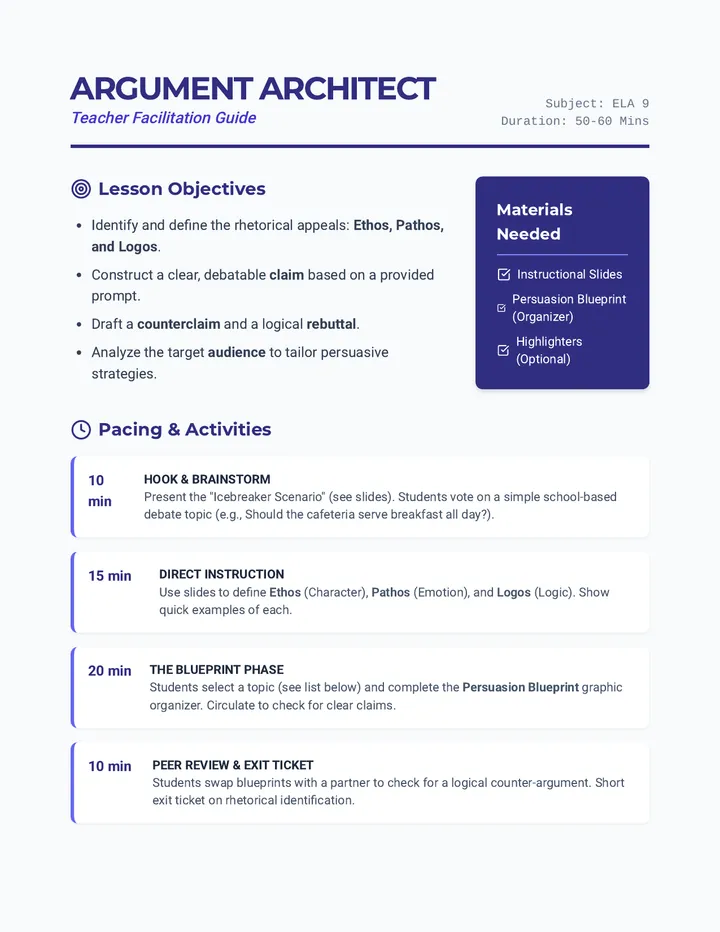
Argument Guide Teacher Resource

Persuasion Mastery Series

A scaffolded progression of persuasive writing mastery, moving from 9th-grade foundations of Ethos, Pathos, and Logos to 11th-grade advanced rhetorical strategies including Kairos and logical fallacy analysis.

LC

Leeah Cavanaugh

15

Lessons

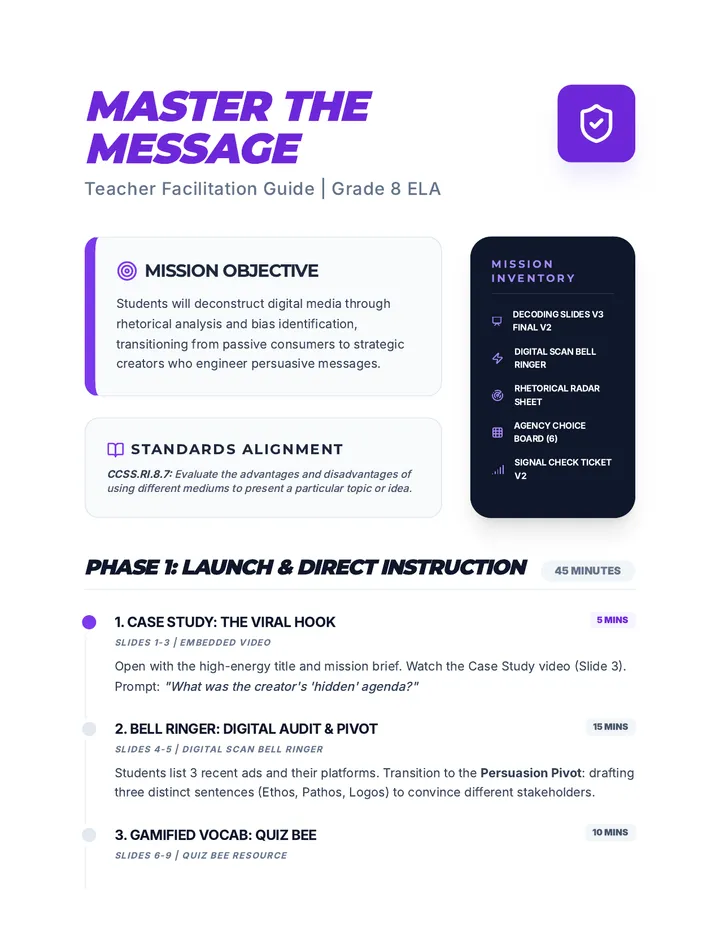
Master the Message Teacher Guide v2

Media Message Mastery

An 8th-grade ELA lesson focused on deconstructing digital media messages through the lens of rhetorical appeals (ethos, pathos, logos) and identifying bias in various online formats. Students transition from passive consumers to critical analysts of news clips, social media, and advertisements.

V

vivianbelarmino

36
Truth Hunter Teacher Guide

Truth Hunter Propaganda

This lesson equips 8th-grade students with the tools to identify and analyze propaganda techniques across various media formats. Students will investigate the 'Big 7' propaganda devices, evaluate source credibility, and practice 'unmasking' persuasive rhetoric in real-world examples.

V

vivianbelarmino

4
Ad Academy Lesson Plan

Ad Academy Persuasion

A comprehensive two-day introduction to advertising persuasion techniques, teaching students to identify and analyze slogans, repetition, bandwagoning, testimonials, emotional appeals, and expert opinions.

SB

Shanna Brady

4
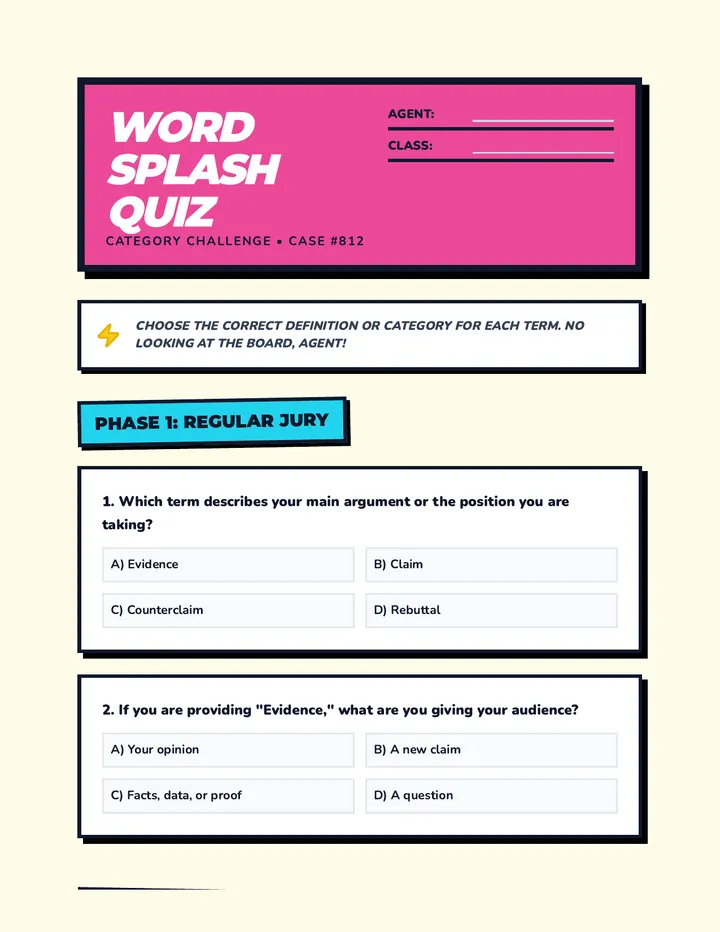
Word Splash Quiz Worksheet

Argument Arsenal

A comprehensive lesson on the structural pillars of argumentative writing, using a courtroom theme to master claims, evidence, and counter-arguments through fast-paced, high-impact activities.

V

vivianbelarmino

11
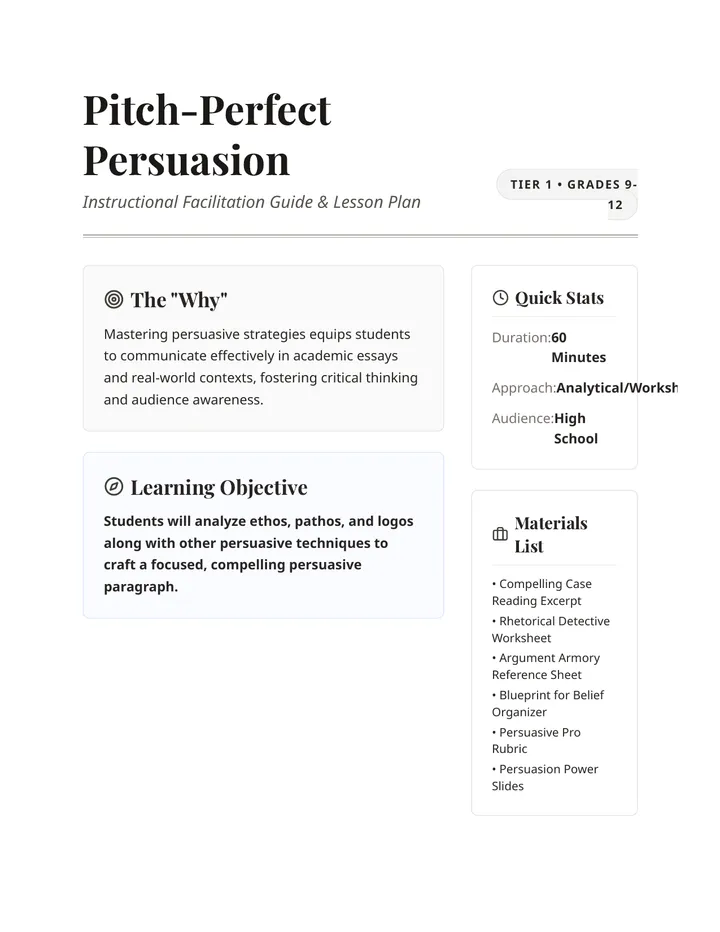
Pitch Perfect Lesson Plan

Pitch Perfect Persuasion

A 60-minute high school lesson focused on rhetorical appeals (ethos, pathos, logos) and persuasive techniques. Students analyze an op-ed excerpt and craft their own persuasive paragraph using a structured graphic organizer and peer feedback.

MM

Mollie Momenteller

7
Status Struggle Slides

Status Struggle Lesson

An 8th-grade ELA lesson focused on central ideas and evidence through the CommonLit text 'Keeping Up with the Joneses'. Students analyze the origins, social impacts, and psychological pressures of status-seeking behavior through vocabulary challenges, media analysis, and collaborative activities.

V

vivianbelarmino

8