Pitch Perfect Lesson Plan Pitch-Perfect Persuasion
Instructional Facilitation Guide & Lesson Plan
Tier 1 • Grades 9-12
The "Why"
Mastering persuasive strategies equips students to communicate effectively in academic essays and real-world contexts, fostering critical thinking and audience awareness.
Learning Objective
Students will analyze ethos, pathos, and logos along with other persuasive techniques to craft a focused, compelling persuasive paragraph.
Quick Stats
Duration: 60 Minutes
Approach: Analytical/Workshop
Audience: High School
Materials List
• Compelling Case Reading Excerpt
• Rhetorical Detective Worksheet
• Argument Armory Reference Sheet
• Blueprint for Belief Organizer
• Persuasive Pro Rubric
• Persuasion Power Slides
Teacher Preparation
Time: 10 minutes
• Review Compelling Case Reading Excerpt , Rhetorical Detective Worksheet , and Argument Armory Reference Sheet .
• Prepare digital or printed copies of the Blueprint for Belief Organizer and Persuasive Pro Rubric for each student.
• Set up the Persuasion Power Slides for display.
Instructional Sequence
00-05
min
Hook and Objective
Introduce the lesson objective: explore persuasive strategies and craft a persuasive paragraph.
Action: Read aloud the Compelling Case Reading Excerpt . Prompt a quick think-pair-share: "What makes this excerpt convincing?"
05-15
min
Rhetorical Appeals Exploration
Distribute the Rhetorical Detective Worksheet . Students work in pairs to identify examples of ethos, pathos, and logos in the excerpt.
Note: Share findings; chart key examples under each appeal on the board or digital slide.
15-25
min
Persuasive Techniques Mini-Lesson
Introduce additional techniques: repetition, rhetorical questions, call to action, and anecdotes.
Teaching Tip: Provide Argument Armory Reference Sheet . Model how a rhetorical question can strengthen an argument during this segment.
25-40
min
Guided Graphic Organizer Activity
Distribute Blueprint for Belief Organizer . Students choose a prompt or real-world issue (e.g., cell phones in school, dress code, environmental impact).
Guided Practice: Students fill out claim, supporting appeals/techniques, evidence, and audience considerations. Circulate to offer feedback.
40-55
min
Write and Review Persuasive Paragraph
Using their organizer, students write a 5–7 sentence persuasive paragraph.
Peer Review: Exchange with a partner for feedback using the Persuasive Pro Rubric . Students should revise based on peer input.
55-60
min
Closure and Reflection
Invite volunteers to share revised paragraphs. Discuss which strategies were most effective and why.
Extension: Assign students to apply these techniques in their upcoming formal essay assignment.
Persuasion Power Slides Pitch-Perfect Persuasion
"The art of persuasion is the art of making someone else's mind your own."
The Hook
How do we get people to listen? To change? To act?
Think-Pair-Share
Think about the last time someone convinced you to do something you didn't want to do.
What specific words did they use?
How did they make you feel?
Did they use facts or feelings?
The Big Three: Rhetorical Appeals
Ethos
Credibility
Convincing the audience of the speaker's character or authority.
"As a doctor with 20 years of experience..."
Pathos
Emotion
Appealing to the audience's heart and emotional responses.
"Imagine the fear of a child lost in the woods..."
Logos
Logic
Using reason, facts, and statistics to support an argument.
"Data shows that 85% of users prefer..."
Advanced Arsenal: Persuasive Techniques
Beyond the basics, writers use specific "moves" to drill their points home.
Rhetorical Questions
"Can we really afford to wait another day?"
Repetition
"We must fight. We must win. We must survive."
Call to Action (CTA)
"Pick up your phone and call your representative now."
Anecdotes
"Let me tell you about a student named Sarah..."
Your Mission
Choose a real-world issue. Use your Blueprint for Belief Organizer to plan a 5-7 sentence paragraph that is impossible to ignore.
Step 1
Craft a bold, undeniable Claim.
Step 2
Inject Ethos, Pathos, and Logos.
Step 3
End with a powerful Call to Action.
Peer Review: The Critical Eye
Exchange your paragraph. Use the Persuasive Pro Rubric to evaluate:
Targeting: Did they identify the audience?Technique: Did they use at least 2 appeals?Punch: Is the Call to Action clear?
Giving Feedback
"Your use of logos was strong because of the statistic you used, but I think you could add more pathos by describing the human impact."
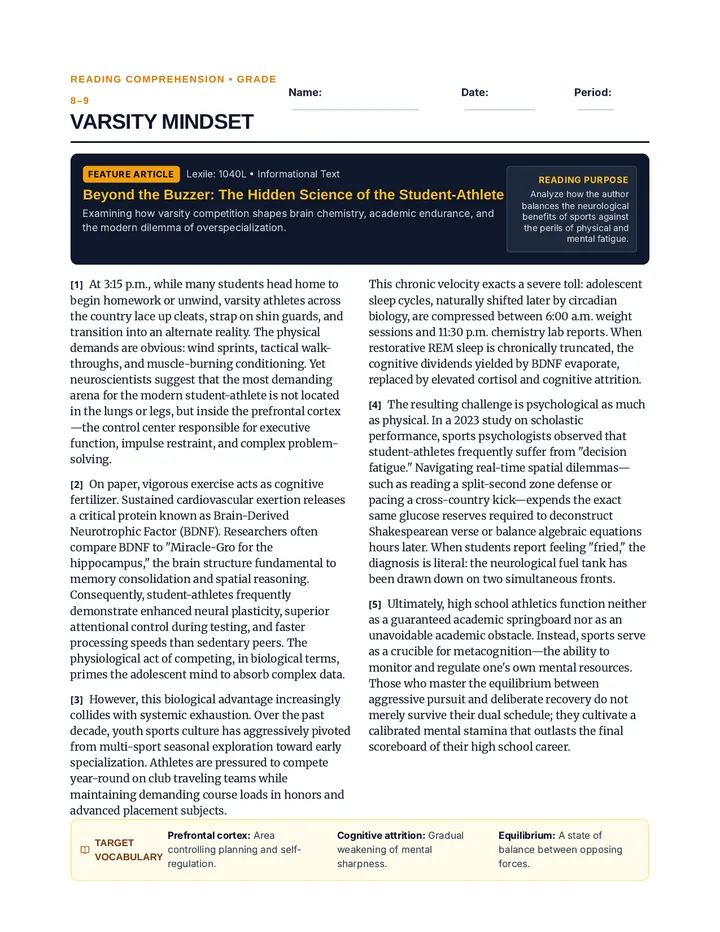
Compelling Case Reading Excerpt Opinion & Commentary • The Daily Advocate
The Case for a Later Start: Why Our Students are Dreaming of Change
By Elena Vance, Senior Education Correspondent
Imagine a world where teenagers aren't stumbling through the hallways like extras in a low-budget zombie flick. Every morning at 7:15 AM, across the nation, millions of high school students are forced to defy their biological clocks. We are essentially asking our youth to perform complex calculus and literary analysis during what their brains consider the middle of the night. Is it any wonder our test scores are stagnant and our mental health clinics are overflowing?
The science is undeniable. According to a 2023 study by the American Academy of Pediatrics, the adolescent brain undergoes a "phase shift" that delays sleep onset until roughly 11:00 PM. When we insist on a first-bell time of 7:30 AM, we are effectively cutting off the most vital stage of REM sleep—the stage responsible for emotional regulation and memory consolidation.
"It isn't just about laziness," says Dr. Julian Thorne, a leading neurologist at Johns Hopkins University. "Asking a teenager to be fully functional at 7:00 AM is the physiological equivalent of asking an adult to start their workday at 3:00 AM. We are setting them up for failure before they even find their lockers."
Opponents often cite the "logistical nightmare" of shifting bus schedules or the "real-world" necessity of early rising. But what is more real-world than the safety of our children? Schools that have shifted to an 8:30 AM start time report a 70% decrease in teen-involved car accidents. Beyond the data, there is the human cost. Consider Sarah, a straight-A student who now struggles with chronic anxiety and fatigue, simply because she cannot catch the sleep her growing body demands.
We must ask ourselves: Is the convenience of a bus schedule worth the mental and physical well-on of our future leaders? If we truly value education, we must value the biology of the learner. It is time to wake up and let our students sleep.
Reader Reflection
The Hook: How does the author grab your attention in the first paragraph? What imagery do they use?
The "Ask": What is the specific action the author wants the reader to support or take?
Rhetorical Detective Worksheet Rhetorical Detective
Case Study Analysis Worksheet
NAME:
DATE:
Instructions: Put on your analytical magnifying glass. Reread the op-ed excerpt "The Case for a Later Start." Identify one specific example for each of the rhetorical appeals below. Explain how the example works to persuade the reader.
Ethos
Credibility & Trust
Evidence from Text:
Why is it persuasive?
Pathos
Emotional Appeal
Evidence from Text:
Why is it persuasive?
Logos
Logic & Reason
Evidence from Text:
Why is it persuasive?
Beyond the Big Three
Find one example of a Rhetorical Question or an Anecdote in the text. Write it below and label which one it is.
The Master Strategist
In your opinion, which of the three appeals (Ethos, Pathos, or Logos) was the most effective in this specific op-ed? Why?
Argument Armory Reference Sheet Argument Armory
The Ultimate Guide to Persuasive Mastery
Ethos
The Goal: Credibility
Persuading by the character of the author. Why should we trust you? What makes you an expert?
Techniques:
• Stating professional titles
• Referencing years of experience
• Mentioning personal connection
Pathos
The Goal: Emotion
Persuading by appealing to the reader's emotions—sympathy, anger, fear, or joy.
Techniques:
• Vivid sensory imagery
• Powerful anecdotes (stories)
• Emotionally charged language
Logos
The Goal: Logic
Persuading by the use of reasoning, including data, facts, and logical structure.
Techniques:
• Hard data and statistics
• Cause-and-effect reasoning
• Expert testimonials
Advanced Tactical Maneuvers
Maneuver 01
Rhetorical Question
A question asked to make a point rather than to get an answer.
"Do you want to live in a world where your safety doesn't matter?"
Maneuver 02
Repetition
Repeating words or phrases for emphasis and rhythm.
"We must dream together. We must act together. We must win together."
Maneuver 03
Call to Action (CTA)
An explicit instruction for the audience to do something.
"Sign the petition today and be the voice for those who have none."
Maneuver 04
Anecdote
A short, personal story used to illustrate a larger point.
"I remember when my grandmother first told me about the old library..."
The Pro's Secret: Balance
The most persuasive arguments don't just use one appeal—they balance all three. Logos provides the foundation, Ethos builds the bridge of trust, and Pathos provides the fuel to move people into action.
Blueprint for Belief Organizer Blueprint for Belief
Strategist:
Target Date:
Persuasive Paragraph Planning Organizer
The Issue
Write your chosen topic or real-world problem here...
01. The Claim
What is your bold, undeniable stance?
02. The Audience
Who exactly are you trying to convince?
Ethos
Pathos
Logos
03. Tactical Move
Repetition, Rhetorical Question, or Anecdote?
04. Call to Action
What should the reader do NOW?
Drafting Space
5-7 Sentences
Persuasive Pro Rubric Persuasive Pro
Critical Review & Feedback Rubric
Level: Advanced
Criteria Persuasive Pro (3) Steady Strategist (2) Apprentice (1) The Claim
Clarity and focus of the argument.
| Claim is bold, specific, and impossible to ignore. Direct and clear focus. | Claim is clear but may be broad or slightly predictable. | Claim is missing, weak, or unclear. |
|
Appeals
Ethos, Pathos, and Logos usage.
| Masterfully integrates at least two appeals that feel natural and impactful. | Includes one or two appeals, but they may feel forced or underdeveloped. | Little to no evidence of rhetorical appeals being used. |
|
Techniques
Specific rhetorical "moves".
| Effectively uses an anecdote, repetition, or rhetorical questions to add "punch". | Uses one technique, but it doesn't significantly strengthen the point. | No specific persuasive techniques identified. |
|
Closing
The Call to Action.
| Ends with a powerful, specific CTA that tells the reader exactly what to do. | Includes a general CTA, but it lacks urgency or specificity. | Closing is weak or missing a Call to Action. |
Strength Spotlight
Area for Growth
Evaluator Name: _____________________
Final Rating: _____ / 12