Logic Blueprints Slides Logic Blueprints
Structural Integrity in Writing
Modus Ponens & Modus Tollens
The Architect's Vision
Most writing is "soft." It relies on feelings or vague connections.
"An undeniable argument is like a skyscraper. It doesn't stay up because it's pretty; it stays up because its frame is built on math."
Goal: Replace intuition with blueprints.
Form 01: Modus Ponens
"The Mode of Affirming"
Premise 1
If P, then Q
Premise 2
P is true
Conclusion
Therefore, Q
In Writing:
"If a city invests in bike lanes, traffic congestion decreases. Metropolis just finished its massive bike lane project. Thus, we can expect clear roads by summer."
Form 02: Modus Tollens
"The Mode of Denying"
Premise 1
If P, then Q
Premise 2
Q is false
Conclusion
Therefore, not P
In Writing:
"If the candidate were truly honest, they would release their tax returns. But they refuse to show a single page. Therefore, we cannot call this candidate honest."
Blueprint Check
Identify the structure of this paragraph:
"If the school board cared about student mental health, they would move start times to 9:00 AM. However, the schedule remains fixed at the crack of dawn. It's clear: the board's priorities lie elsewhere."
Option A
Modus Ponens
Option B
Modus Tollens
Structure Scramble Worksheet Structure Scramble
Logic Blueprint Assignment // L01-S01
Name:
Date:
Part 1: Detecting the Form
Read the following paragraph segments. For each one, identify whether the author is using Modus Ponens (MP) or Modus Tollens (MT). Write the formal logical structure (If P then Q...) beneath each text.
"If the global community is serious about carbon reduction, they must transition to nuclear power. Recent data from the UN shows that every major industrial nation has increased its commitment to nuclear energy this year. Therefore, we are finally seeing a serious push toward our climate goals."
Form Used:
Blueprint Mapping (P and Q):
"An effective educational system must produce graduates who can think critically about misinformation. However, our current test scores in media literacy are at an all-time low, with most students unable to distinguish satire from news. We must conclude that our system is failing its core mission."
Form Used:
Blueprint Mapping (P and Q):
Part 2: The Architect's Draft
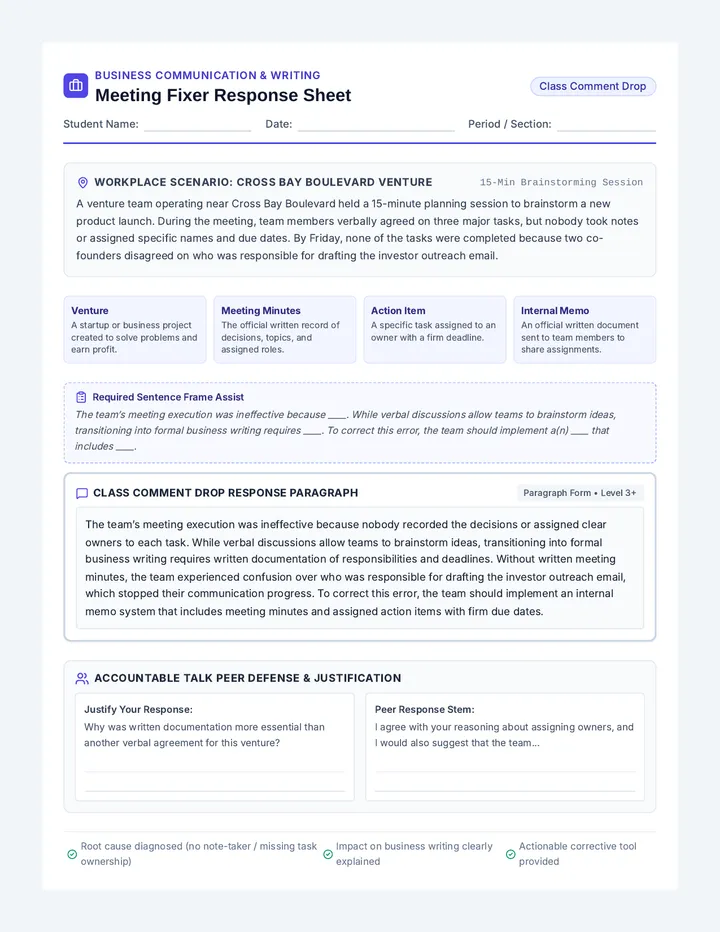
You are the lead architect for a new editorial. Choose a topic below and draft two separate paragraph structures: one using Modus Ponens and one using Modus Tollens.
Universal Basic Income
Space Colonization
Digital Privacy Laws
Form: Modus Ponens
1. Establish Premise (If P, then Q):
2. Provide Evidence (P is true):
3. Structural Conclusion (Therefore, Q):
Drafting Space (Full Paragraph):
Form: Modus Tollens
1. Establish Premise (If P, then Q):
2. Provide Evidence (Q is false):
3. Structural Conclusion (Therefore, not P):
Drafting Space (Full Paragraph):
Valid Forms Guide Teacher Resource // Logic Blueprint
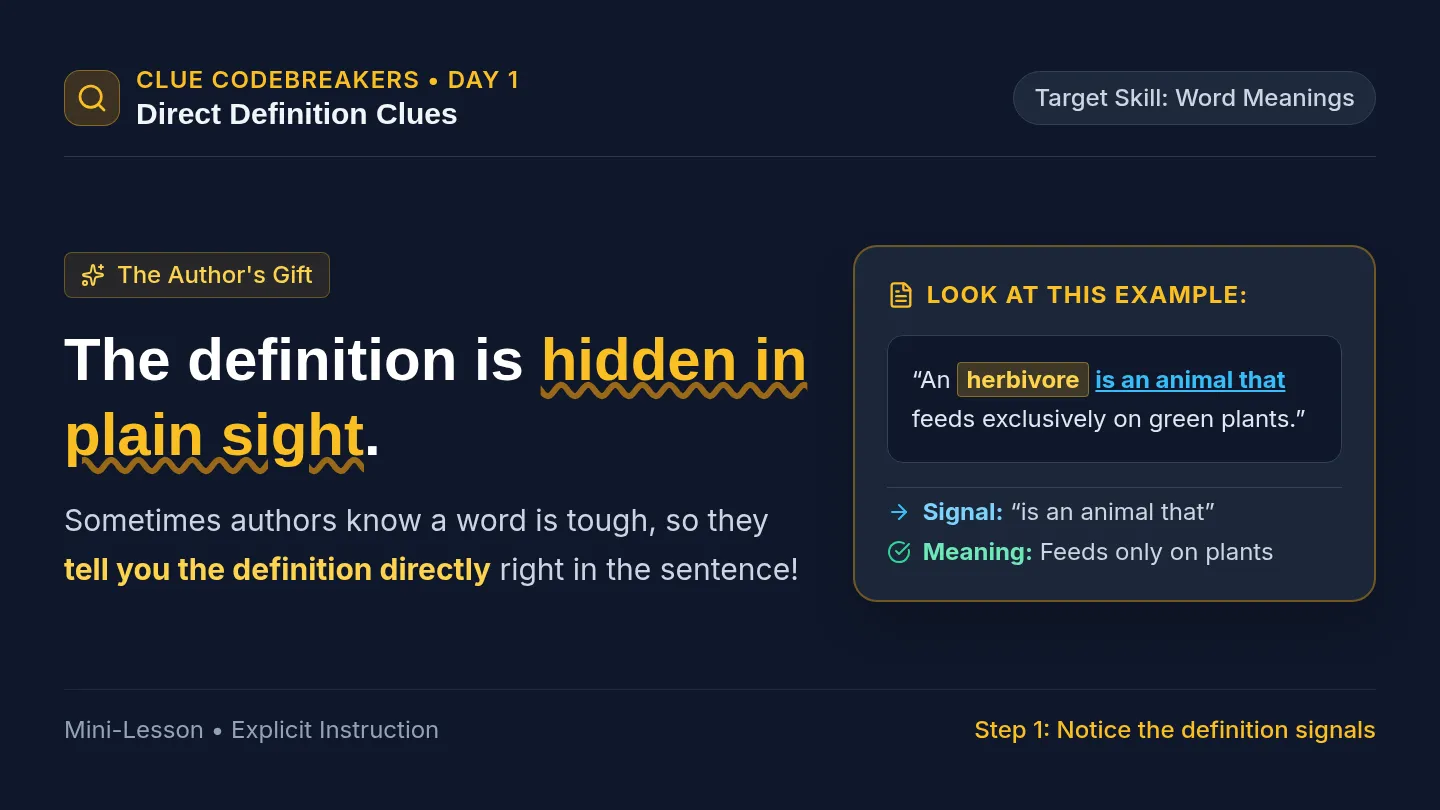
Valid Forms Guide
1
Modus Ponens (MP)
1. If P, then Q.
The Strategic Logic
This is the logic of consequences . It's used when you want to show that because a certain condition has been met, a specific outcome is guaranteed.
Key Phrases
"Since [P] is happening..."
"Given that [P] is true..."
"Because we have [P]..."
2
Modus Tollens (MT)
1. If P, then Q.
The Strategic Logic
This is the logic of disproof . It's used to show that an idea or claim (P) must be false because its expected result (Q) hasn't happened.
Key Phrases
"Yet we see no [Q]..."
"If it were [P], we'd see [Q]..."
"The lack of [Q] proves..."
Common Student Misconceptions
Affirming the Consequent (The Fake MP)
Thinking that "If P then Q" and "Q" means "P". Just because Q happened doesn't mean P caused it. (e.g., If it rains, the grass is wet. The grass is wet, so it must have rained—not necessarily, the sprinkler might be on!)
Denying the Antecedent (The Fake MT)
Thinking that "If P then Q" and "not P" means "not Q". (e.g., If it rains, the grass is wet. It isn't raining, so the grass isn't wet—again, the sprinkler!)
Answer Key: Structure Scramble
Item 1: Modus Ponens. P: Community serious about carbon. Q: Must transition to nuclear. P is true (data shows commitment). Conclusion: Serious push is happening.Item 2: Modus Tollens. P: Effective educational system. Q: Produce critical thinkers (distinguish satire). Not Q (most students unable). Conclusion: Not an effective system. Reasoning Chains Slides Logic Blueprint L2
Reasoning
Chains
Hypothetical Syllogisms
The Logical Link
Individual arguments are strong.
The Hypothetical Syllogism allows you to bridge distant ideas by creating a series of logical midpoints.
The Rule
1. If A, then B
2. If B, then C
∴ If A, then C
Anatomy of a Chain Argument
A
The Action
If we ban all smartphone use in schools...
B
The Bridge
Then students will be forced to engage face-to-face during breaks...
C
The Impact
Then social anxiety levels will drop significantly.
The Tactic
Why use this?
It forces the reader to agree with your "C" conclusion if they agree with each individual link in the chain.
How to build?
Ensure the "consequent" of the first premise (B) becomes the "antecedent" of the second.
CHAIN SYMMETRY
The Domino Effect
Your challenge: Write a 3-link hypothetical syllogism that connects this start and end point:
Start (A)
A student loses their pencil before a test.
End (E)
Modern civilization collapses into ruin.
> CONNECT THE LINKS <
Domino Effect Challenge Activity Sheet Project: Domino Challenge
The Domino Effect
Logic Chain Construction // Phase 02
Architect:
Blueprint Date:
The Structural Requirement
A chain is only as strong as its weakest link. In formal logic, the Hypothetical Syllogism allows us to connect a distant cause to a final effect. You must build a 5-step logical chain (A through E) where each premise is a valid conditional statement.
A → B
Initial Cause:
If a student loses their pencil before a critical state exam...
B → C
Bridge Premise 1:
C → D
Bridge Premise 2:
D → E
The Final Conclusion:
...Then modern civilization as we know it will collapse.
Structural Integrity Check
Verify: Does the 'then' of your previous step match the 'if' of your next step? If the chain breaks, the whole argument collapses.
Elimination Tactics Slides Lesson 03: Strategy
Elimination
Tactics
Disjunctive Syllogism
The Either/Or Power
In persuasion, control the options to control the outcome.
"We can either fund our parks today, or we can deal with urban decay tomorrow. The choice is yours."
Valid Form: DS
1 Either P or Q
2 Not P (False)
∴ Therefore, Q
The "True" Dilemma
False Dilemma
Pretending only two options exist when there are actually many.
"You either love this country or you hate it."
Disjunctive Syllogism
Presenting two mutually exclusive options where one is logically impossible.
"We either have the budget for a new library or we don't."
Mission: The Option Eraser
The Crisis
"A massive solar flare is 6 hours away. Our power grid can only handle a 50% load. We must decide which sectors to shut down: Healthcare or High-Frequency Trading."
Your Goal:
Convince the committee to pick HEALTHCARE by proving that TRADING is a fatal mistake.
Formula:
P1: Either Healthcare or Trading
Option Eraser Speech Prep Worksheet Urgent Directive
Option Eraser
Crisis Communication Prep // L03-S02
The Crisis Scenario
"Team, we are looking at a system-wide failure in 15 minutes. We have two remaining backup generators. Generator A powers the Regional Water Treatment Plant. Generator B powers the Luxury Mall's Decorative Lighting Display. We only have enough fuel to keep one running through the night. You must write a speech to the City Council that eliminates the 'wrong' choice using a Disjunctive Syllogism."
01 The "Either/Or" Framework (The Disjunction)
Present the two choices clearly. Ensure they sound like the ONLY two choices available.
02 The Elimination (The Negation)
Provide 2-3 reasons why picking the "Luxury Mall" generator is not just bad, but logically impossible for a functioning city.
03 The Final Verdict (The Conclusion)
State the undeniable conclusion based on your logic.
Crisis Manager Name:
Timestamp:
Logical Proof Essay Template Handout The Master Proof
Essay Blueprint // L04
"Your task is to write a position paper where the beauty is found in the structural integrity, not the vocabulary. Every paragraph must be a valid logical proof."
The Logical Architecture
Choose a controversial topic from the list below. Your essay must consist of exactly 5 paragraphs, each following a strict logical blueprint:
AI-Generated Art in Public Spaces
Mandatory Year-Round Schooling
Cryptocurrency as State Legal Tender
Universal Health Tracking Requirements
P1
The Introduction (Modus Ponens)
Structure: Define the stakes. If we value [X], then we must accept [Conclusion]. Establish that we indeed value [X].
P2
The Long-Range Case (Hypothetical Syllogism)
Structure: Build a chain of at least 3 conditional links (If A then B, B then C, C then D) to show the long-term impact of your position.
P3
The Elimination of Rival Views (Disjunctive Syllogism)
Structure: Present the two opposing sides. Prove why the counter-argument is logically impossible, leaving only your side.
P4
The Refutation (Modus Tollens)
Structure: If your opponent were right, we would see [Result]. We don't see [Result]. Therefore, they are wrong.
P5
The Synthesis (Master MP)
Structure: Re-affirm your primary premise and state your final undeniable conclusion.
Architect:
Total Validity Score: ____ / 100
Grading for Validity Rubric Teacher Guide Grading for Validity
The Master Proof Assessment // L04-TR
"In this assessment, we are evaluating the structure of thought . Grammatical flair and descriptive language are secondary to the necessary flow of logical premises."
Structural Link Architectural Success (20 pts) Partial Collapse (10 pts) Structural Failure (0 pts) P1: Modus Ponens The first premise (If P then Q) is clearly stated. The second premise affirms P. The conclusion necessarily follows. The structure is present but the premises are vague or don't perfectly align. The conclusion does not follow from the premises (Logical gap). P2: Chain Reasoning Successfully links A to B, B to C, and C to D. Each bridge is plausible and logically valid. Links are present but the 'middle bridge' is weak or missing a logical step. Slippery Slope fallacy occurs where links are unrelated or purely emotional. P3: Elimination Presents a true disjunction (Either A or B). Systematically negates A to prove B. Presents two options but doesn't fully disprove the rejected one. False Dilemma: Ignoring obvious third options or middle grounds. P4: Refutation (MT) If opponent was right (P), then Q. Not Q is demonstrated. Therefore not P is proven. The "Not Q" evidence is weak or anecdotal rather than structural. Mishandles the form: Denying the antecedent or affirming the consequent. P5: The Synthesis Re-unifies all previous proofs into a final, undeniable Modus Ponens closing. Restates the thesis but doesn't explicitly use a formal logical closing form. A new, unproven claim is introduced at the end.
90-100: Ironclad
The essay is logically sound. Each paragraph is a functional proof.
70-89: Structurally Sound
Mostly valid, but contains minor logical leaps or informal language.
< 70: Condemned
Foundational logical errors; conclusions do not follow from premises.
Validity Trial Peer Review Worksheet Courtroom Review
Validity Trial
Structural Integrity Audit // L05-S01
Judge Name:
Plaintiff (Peer):
Mapping the Argument
As a 'Judge', your job is to translate your partner's paragraph into a formal logical map. If you cannot find the premises, or if the conclusion doesn't match the premises, the argument is Invalid.
Para 1: Modus Ponens
Premise (If P then Q):
Affirmation (P is true):
Verdict: Does the conclusion follow?
VALID GAP FOUND
Para 2: Logic Chain
Chain Step A → B → C:
Verdict: Is the bridge unbroken?
SOLID FRACTURED
Para 3: Elimination
The Disjunction (Either P or Q):
The Negation (Proof not P):
Verdict: Is this a False Dilemma?
TRUE DILEMMA FALSE DILEMMA
Para 4: Refutation
Target Claim (If P then Q):
Counter Evidence (Not Q):
Verdict: Has P been disproven?
DISPROVEN STILL STANDS
Final Judicial Opinion
Summarize the greatest logical strength and the most significant logical gap found in the plaintiff's essay.
Judge's Bench Debrief Teacher Guide Judge's Bench
L05 Closing Facilitation Guide
01 The "Mistake" Debrief
Gather the class after the Validity Trial. Instead of asking who wrote a "good essay," ask who found a "structural fracture." This shifts the focus from writing quality to logical auditing.
Discussion Prompts:
"Who found an argument where the conclusion sounded right, but the premises didn't actually lead there?"
"In your peer review, was it harder to map the Chain Argument (HS) or the Refutation (MT)?"
"Did anyone find a 'False Dilemma' in an elimination paragraph? How would you add a third option to break their logic?"
02 The "Ironclad" Challenge
Select one exceptionally valid paragraph from a student's work. Read it aloud twice: once as a normal paragraph, and once as a formal logical list (P1, P2, Conc).
Key Takeaway:
"An undeniable argument doesn't need to shout. It just needs to be built so that if you accept the first sentence, you are mathematically forced to accept the last."
03 Reflection: Logic vs. Rhetoric
Close the sequence by asking students to contrast this 'Blueprint' style with their previous writing experiences.
The Old Way
"I feel this is true because..."
The Architect Way
"If P, then Q. Since P, the conclusion is unavoidable."
Sequence Completion Check
Students identified MP/MT in text. Students constructed complex logical chains. Students applied elimination tactics to persuasion. Students synthesized logic into a position paper. Students audited peer logic for validity.