Lenny.com
Explore
Create
ActivitiesNewMathEnglish Language ArtsScience & EngineeringSocial StudiesGlobal LanguagesHealth & Physical EducationSpecial EducationCounseling & Life SkillsArts & CreativityESL
Lenny.com
Lenny.com
Explore
Create
ActivitiesNewMathEnglish Language ArtsScience & EngineeringSocial StudiesGlobal LanguagesHealth & Physical EducationSpecial EducationCounseling & Life SkillsArts & CreativityESL
Lenny.com
Lenny.com

Solutions

Lenny for EducatorsLenny for SchoolsLenny for Districts

Product

ExploreSign inCreateSupportAbout

Resources

Getting startedMTSS Acceleration Program

© 2026 Lenny Learning Inc.

TermsPrivacyAccessibility
LinkedInInstagramX
Lenny
English Language ArtsPhonics & Reading FoundationsLetter IdentificationLearn Letters A-ZLowercase and Uppercase LettersConsonants and VowelsLetter-Sound AssociationsLetter-Sound Associations: LowercaseLetter-Sound Associations: UppercaseBeginning and Ending SoundsRhymingBlending And SegmentingShort VowelsShort Vowel SoundsConsonant BlendsConsonant DigraphsBlends, Digraphs, and TrigraphsDigraphs, Blends, and Silent LettersLong Vowel SoundsLong Vowel PatternsShort and Long VowelsShort and Long Vowel PatternsSilent EVowel SoundsVowel TeamsR-Controlled VowelsDiphthongs: Oi, Oy, Ou, OwVariant VowelsVariant, Diphthong, And R Vowel PatternsSoft G And CSight WordsIrregular WordsWord RecognitionSyllablesSyllable TypesTwo-Syllable WordsMultisyllabic WordsPhoneme ManipulationDecodable TextsVocabularyAction WordsQuestion WordsNouns and AdjectivesClassify WordsCompound WordsSynonyms and AntonymsHomophonesHomophones and HomonymsShades of MeaningContext CluesPrefixes and SuffixesGreek and Latin RootsAnalogiesIdioms and AdagesForeign Words and ExpressionsWord Choice and UsageReference SkillsReading ComprehensionRead-Along Literary TextsRead-Along Informational TextsReality vs. FictionStory ElementsCharacterSequenceMain IdeaCause And EffectCompare And ContrastReading StrategiesText StructureAuthor's PurposeAuthor's Purpose And ToneAuthor's PerspectivePoint Of ViewThemeInference And ThemeInference And AnalysisPoetry ElementsLiterary DevicesAnalyzing LiteratureAnalyzing Informational TextsComparing TextsAudience, Purpose, And ToneBusiness DocumentsNovel StudyNonfiction Book StudyGrammar & MechanicsSentencesNounsVerbsAdjectivesPronounsCapitalizationPunctuationContractionsConjunctionsPrepositionsArticlesAdjectives And AdverbsVerb TypesVerb TensePronouns And AntecedentsPronoun TypesSubject-Verb AgreementDirect And Indirect ObjectsSentences, Fragments, And Run-OnsPhrases And ClausesCommasSemicolons, Colons, And CommasDashes, Hyphens, And EllipsesSpellingAbbreviationsFormattingVerb Tense And MoodMisplaced ModifiersWritingDescriptive DetailsCreative WritingOpinion WritingTopic SentencesOrganizing WritingLinking WordsSentence VarietyIntroductions And ConclusionsPersuasive And Opinion WritingExpository WritingPersuasive StrategiesDeveloping And Supporting ArgumentsTopic Sentences And Thesis StatementsSummarizingResearch SkillsEditing And RevisingActive And Passive Voice=Writing Clearly And ConciselyDebate & Public SpeakingPublic Speaking BasicsPersuasive TechniquesClaims and EvidenceTypes of ArgumentsReasoning TypesLogical FallaciesTopic ResearchOrganizing EvidenceDebate Speech OrganizationAttacking and Defending ArgumentsClash and EngagementImpact CalculusQuestioning and Cross-ExaminationCritical ThinkingInformal LogicFormal LogicInductive Reasoning

Paragraph Patrol

A focused reading and writing mini-lesson where students become sentence detectives to identify and eliminate unrelated sentences that disrupt paragraph unity. Includes interactive presentation slides, comprehensive student practice, and an educator answer guide.

BABrittany Anderson

D Sentence (5)

Paragraph Patrol • Advanced Student Practice Page 1 of 2

Student Name:

Case File #104 • Rigorous Evidence Analysis

Part 3

Case Analysis • Explain the Nuance

Case D: The Birth of Skateboarding 4 Sentences

(1) Skateboarding was invented in Southern California during the 1950s by surfers who wanted a pastime when ocean waves were flat. (2) These inventive wave riders took flat wooden planks and attached steel roller-skate wheels directly to the underneath side. (3) Today, professional skateboarders perform complex aerial spins on sixty-foot mega ramps in world championships. (4) Originally called "sidewalk surfing," this new street activity let surfers practice carving turns and balancing maneuvers on solid pavement.

1. Underline the off-topic sentence above. Which sentence is it? Sentence: [ _____ ]

2. Detective Analysis: Why might a reader mistakenly assume Sentence (3) belongs here? Why must an editor still cut it?

Part 4

The Editor's Desk • Rewrite & Polish

Identify the subtle detour and produce a polished final draft.

Draft Passage: The Monarch Migration

(1) Every autumn, millions of monarch butterflies embark on an epic two-thousand-mile flight from Canada down to mountainous forests in central Mexico. (2) To survive the exhausting voyage, monarchs catch thermal air currents to glide smoothly and conserve their energy. (3) During summer breeding, female monarchs deposit single pinpoint-sized eggs strictly on the undersides of milkweed leaves. (4) Once they reach their winter sanctuary, monarchs gather in dense clusters on oyamel fir branches to stay shielded from mountain freezes. (5) This awe-inspiring journey is celebrated as one of the animal kingdom's greatest navigation wonders.

Editor's Task: Draw a line through the subtle intruder sentence in the draft above. Then, neatly rewrite the revised 4-sentence paragraph below so every sentence focuses strictly on the migration journey.

Final Revised Paragraph (Editor's Clean Copy):

Paragraph Patrol • Advanced Student Practice Page 2 of 2

The "Because" Strategy

Have students complete this sentence frame for each candidate: "This sentence belongs because it explains how [controlling focus]..." If the justification requires a mental leap or switch of topic, it is an intruder!

Student Conference Question

"Yes, this sentence mentions skateboarding—but is it about how skateboarding began in the 1950s, or something else entirely?"
Paragraph Patrol • Teacher Facilitation Guide & Answer Key Page 1 of 1

You might also like

Story Sleuths Facilitation Guide

Story Explorers

An interactive, high-impact reading comprehension unit targeting core foundational literature standards. Students master recounting diverse folktales, extracting central morals, and analyzing how characters respond to major events and challenges.

S

Squiretak

8
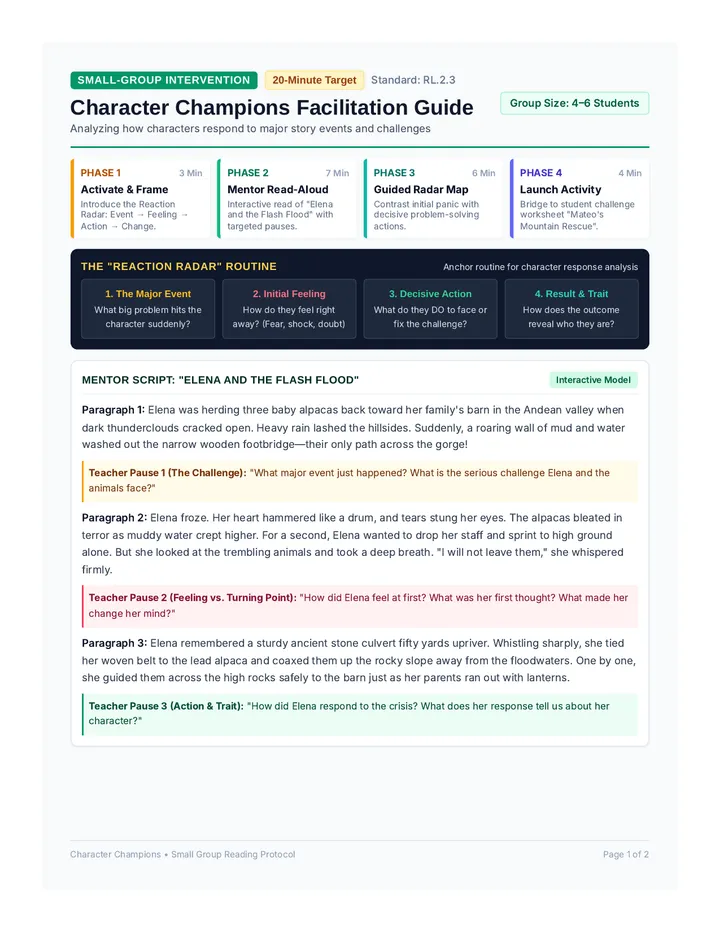
Character Champions Facilitation Guide

Character Champions

A targeted 20-minute small-group reading lesson and follow-up activity for standard RL.2.3. Students analyze major story challenges, track characters' emotional and behavioral responses, and explain how their actions overcome obstacles.

S

Squiretak

4
Sentence Sleuth Answer Key

Sentence Sleuth Answer Key

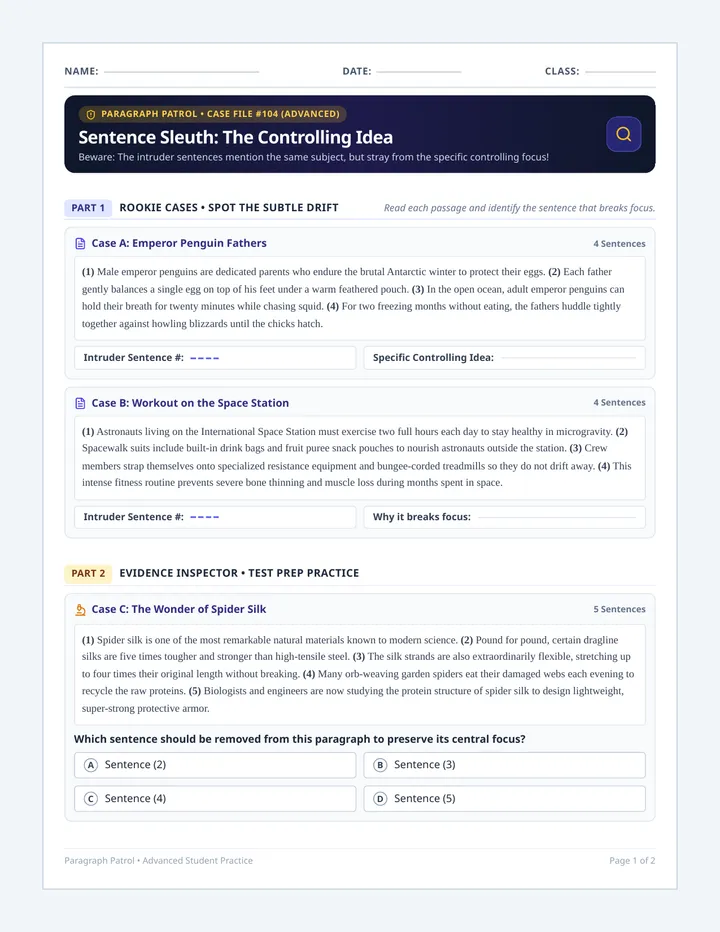
A comprehensive educator answer key and instructional guide for the advanced Sentence Sleuth worksheet. Features complete solutions, detailed rationales explaining why the subtle distractor sentences break the controlling idea, and diagnostic intervention prompts for the keyword trap.

BA

Brittany Anderson

Paw Print Teacher Guide

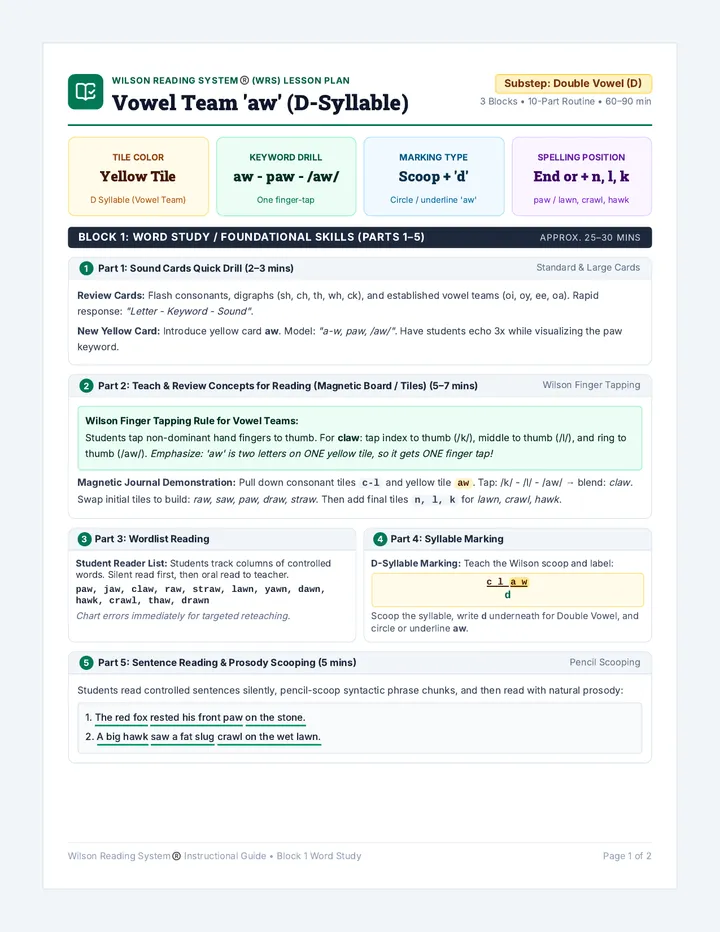
Vowel Team Aw Pathways

A comprehensive structured literacy sequence targeting the vowel team 'aw', offering dual instructional pathways using both the Classic Orton-Gillingham 7-step routine and the 10-part Wilson Reading System (WRS) framework.

KW

Kellie Walsh

10
Story Sleuths Facilitation Guide

Story Sleuths

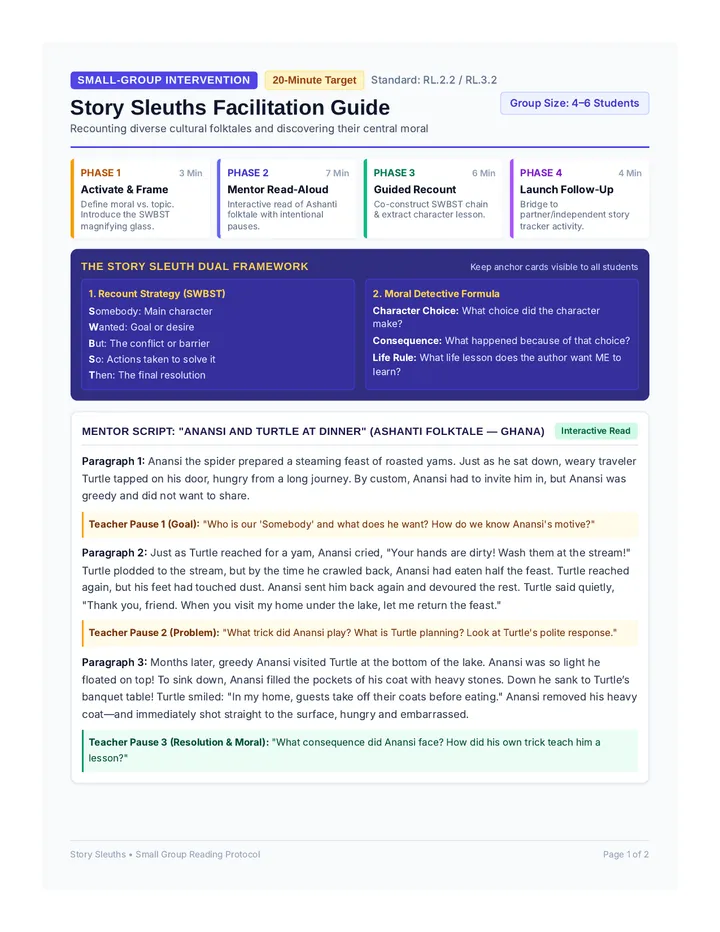
A high-impact 20-minute small-group reading intervention and guided practice lesson focusing on RL.2.2/RL.3.2. Students learn to recount diverse cultural fables and folktales using the Somebody-Wanted-But-So-Then strategy and uncover the central moral or life lesson.

S

Squiretak

4
Sentence Sleuth Worksheet

Sentence Sleuth Worksheet

A two-page printable student practice worksheet containing five high-rigor paragraphs where every sentence shares the same topic keywords. Students must analyze the specific controlling idea to detect subtle off-topic sentences, justify their reasoning, and rewrite an edited passage.

BA

Brittany Anderson

Story Showdown Activity Packet

Story Showdown

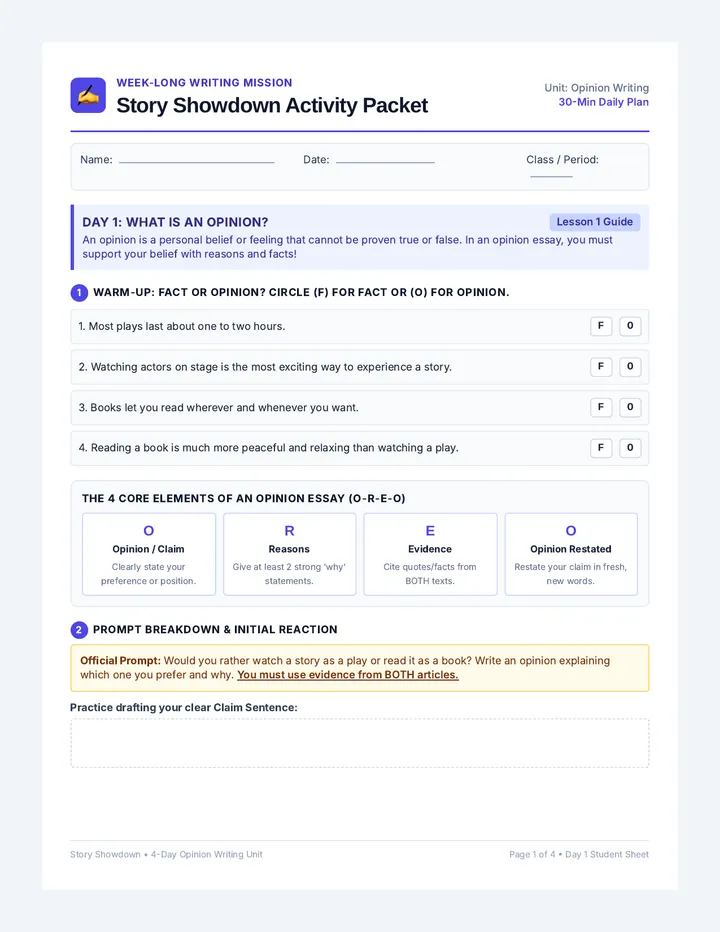
A four-day opinion writing unit guiding students through forming claims, analyzing paired texts, and crafting evidence-based essays comparing theatrical plays and books.

SM

Samantha McBath

6
Prairie Mystery Assessment

Prairie Detectives

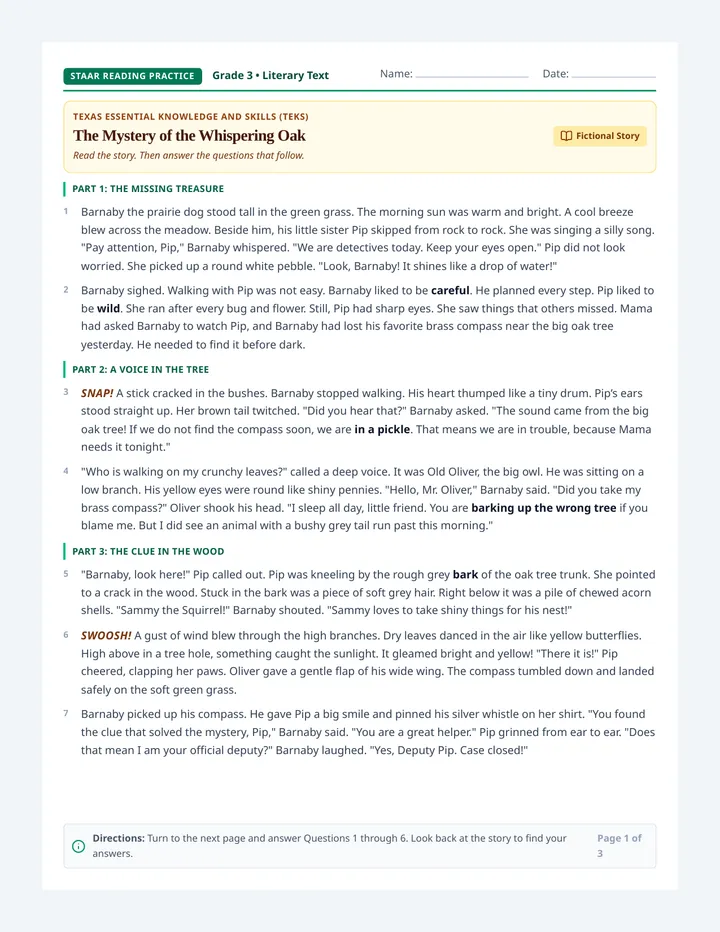
A 3rd-grade STAAR-aligned reading comprehension assessment featuring an original fictional narrative, rigorous question stems, and an instructional answer key targeting key character, vocabulary, and figurative language TEKS.

BA

Brittany Anderson

2
Paragraph Patrol Slides

Paragraph Patrol Slides

A visually engaging presentation that teaches students how to identify and eliminate unrelated sentences that disrupt paragraph unity. Features subtle, high-rigor examples where distractor sentences share the same topic words but wander from the paragraph's specific controlling idea.

BA

Brittany Anderson

Sound Safari Activity

Sound Detectives Lab

A comprehensive second-grade phonemic and auditory discrimination curriculum targeting easily confused consonant pairs and digraphs through diagnostic listening sheets, teacher scripts, and tactile sorting manipulatives.

C

cnduffy

4
Harvest Clues Slides

Harvest Clue Catchers

A third-grade reading comprehension lesson focused on standard 3.RC.5, teaching students to identify the main idea and key supporting details using autumn-themed passages and an investigative detective framework.

CJ

Courtney Jewell

4
Character Response Exit Ticket

Character Response Exit Ticket

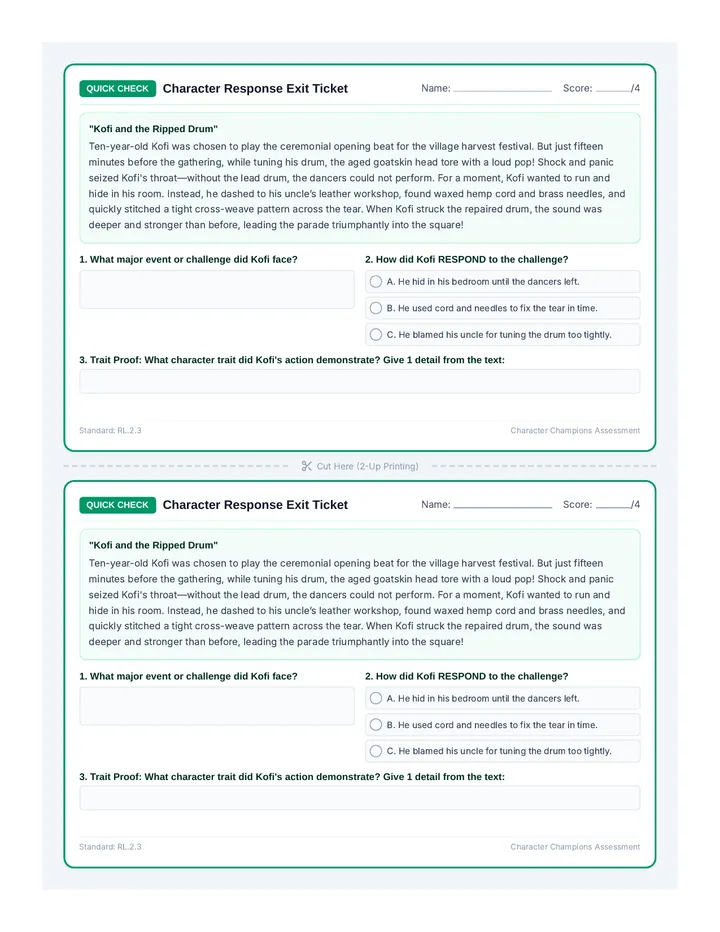
A print-efficient 2-up exit ticket featuring the story 'Kofi and the Ripped Drum', assessing students' ability to identify a major story challenge, describe the character's active response, and deduce character traits with text evidence.

S

Squiretak