Story Sleuths Facilitation Guide Small-Group Intervention 20-Minute Target Standard: RL.2.2 / RL.3.2
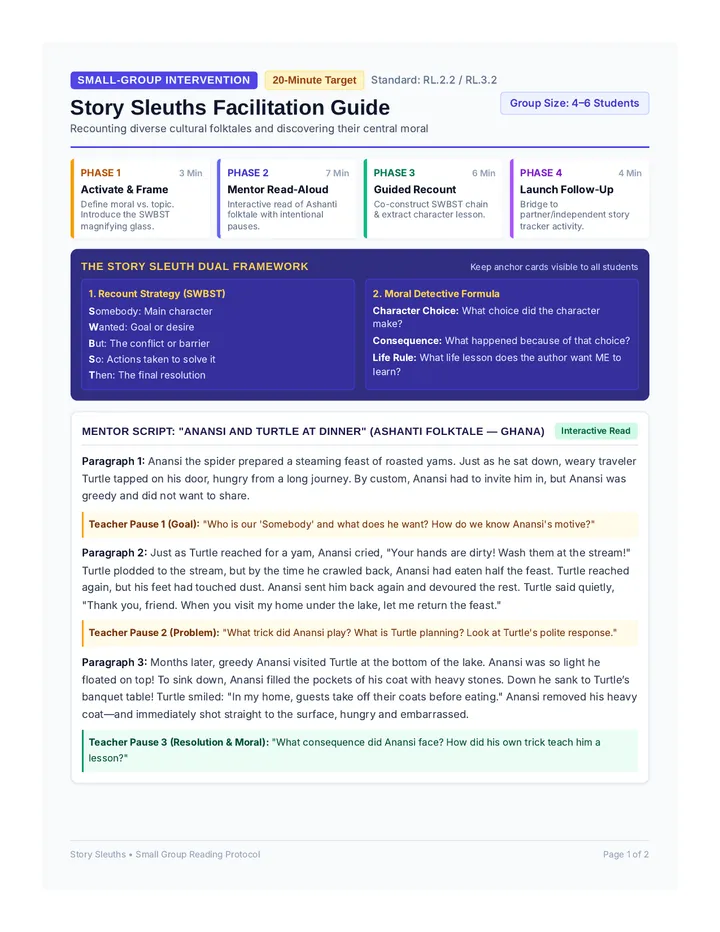
Story Sleuths Facilitation Guide
Recounting diverse cultural folktales and discovering their central moral
Group Size: 4–6 Students
Phase 1 3 Min
Activate & Frame
Define moral vs. topic. Introduce the SWBST magnifying glass.
Phase 2 7 Min
Mentor Read-Aloud
Interactive read of Ashanti folktale with intentional pauses.
Phase 3 6 Min
Guided Recount
Co-construct SWBST chain & extract character lesson.
Phase 4 4 Min
Launch Follow-Up
Bridge to partner/independent story tracker activity.
The Story Sleuth Dual Framework Keep anchor cards visible to all students
1. Recount Strategy (SWBST)
S omebody: Main characterW anted: Goal or desireB ut: The conflict or barrierS o: Actions taken to solve itT hen: The final resolution
2. Moral Detective Formula
Character Choice: What choice did the character make?
Consequence: What happened because of that choice?
Life Rule: What life lesson does the author want ME to learn?
Mentor Script: "Anansi and Turtle at Dinner" (Ashanti Folktale — Ghana)
Interactive Read
Paragraph 1: Anansi the spider prepared a steaming feast of roasted yams. Just as he sat down, weary traveler Turtle tapped on his door, hungry from a long journey. By custom, Anansi had to invite him in, but Anansi was greedy and did not want to share.
Teacher Pause 1 (Goal): "Who is our 'Somebody' and what does he want? How do we know Anansi's motive?"
Paragraph 2: Just as Turtle reached for a yam, Anansi cried, "Your hands are dirty! Wash them at the stream!" Turtle plodded to the stream, but by the time he crawled back, Anansi had eaten half the feast. Turtle reached again, but his feet had touched dust. Anansi sent him back again and devoured the rest. Turtle said quietly, "Thank you, friend. When you visit my home under the lake, let me return the feast."
Teacher Pause 2 (Problem): "What trick did Anansi play? What is Turtle planning? Look at Turtle's polite response."
Paragraph 3: Months later, greedy Anansi visited Turtle at the bottom of the lake. Anansi was so light he floated on top! To sink down, Anansi filled the pockets of his coat with heavy stones. Down he sank to Turtle’s banquet table! Turtle smiled: "In my home, guests take off their coats before eating." Anansi removed his heavy coat—and immediately shot straight to the surface, hungry and embarrassed.
Teacher Pause 3 (Resolution & Moral): "What consequence did Anansi face? How did his own trick teach him a lesson?"
Story Sleuths • Small Group Reading Protocol Page 1 of 2
Instructional Moves & Formative Tracker
Questioning stems, scaffolded feedback, and student observation data
Phases 3 & 4 Support
Higher-Order Questioning Stems
Recounting Key Sequence:
"If you told this story to a friend in two sentences using SWBST, what details MUST stay, and what can we leave out?"
Isolating Character Turning Point:
"When Anansi filled his pockets with stones, what character trait was he showing? How did that choice lead to his failure?"
Synthesizing Universal Moral:
"Is this story just about spiders and turtles, or about how people should treat each other? How can you turn this into a life rule?"
Target Misconceptions & Corrections
Pitfall: Moral = Plot Event
Student: "The moral is don't wear a coat underwater."
Teacher Pivot: "That happened to Anansi. What is the rule for real human beings? Treat others how you want to be treated."
Pitfall: Moral = One-Word Topic
Student: "The moral is sharing."
Teacher Pivot: "Sharing is the topic! What does the story teach us to DO or NOT DO about sharing?"
Follow-Up Activity Protocol: "The Empty Pot" (Chinese Folktale)
Transition students to the Moral Tracker Student Worksheet . Students read the tale of Ping, a young boy in ancient China who tends an emperor’s seed that fails to sprout. Students work independently or in pairs to fill in their own SWBST organizer and state the central message (honesty requires great courage and brings true honor).
Step 1: Code Text Underline Ping's problem and circle his brave decision.
Step 2: SWBST Map Complete all 5 recount boxes in concise sentences.
Step 3: Moral Sentence Formulate the moral using: "The author teaches that..."
Small-Group Quick Diagnostic Tracker (RL.2.2 / RL.3.2)
Date: ______________ | Group: _________
Student Name Recounts in Order (SWBST) Distinguishes Topic vs. Moral Cites Text Evidence for Moral Next Step / Support Needed 1. 3 • 2 • 1 3 • 2 • 1 3 • 2 • 1 2. 3 • 2 • 1 3 • 2 • 1 3 • 2 • 1 3. 3 • 2 • 1 3 • 2 • 1 3 • 2 • 1 4. 3 • 2 • 1 3 • 2 • 1 3 • 2 • 1 5. 3 • 2 • 1 3 • 2 • 1 3 • 2 • 1
Scoring: 3 = Mastered independently; 2 = Approaching with prompts; 1 = Needs intensive scaffolding.
Story Sleuths • Small Group Reading Protocol Page 2 of 2
Story Sleuths Lesson Slides Small-Group Reading Lab Standard RL.2.2 / RL.3.2
20-Minute Focus
Story Sleuths:
Recount Tales & Discover the Moral
Every folktale holds a secret treasure: a life lesson meant for you. Learn how to track story clues to crack the central message!
Today's Sleuth Mission:
I can recount a cultural folktale using SWBST and determine its central moral.
Tool #1
The SWBST Recount Strategy
Retell ONLY the key details!
S
Somebody
Who is the main character?
W
Wanted
What was their big goal or wish?
B
But
What problem or trick got in the way?
S
So
What action did they take to solve it?
T
Then
How did the story finally turn out?
💡 Sleuth Tip: If a detail doesn't fit into SWBST, leave it out of your recount!
Ashanti Folktale (Ghana)
Mentor Case: Anansi & Turtle at Dinner
Read & Track
Part 1: The Greedy Trick
Anansi pretends to be a polite host, but repeatedly orders hungry Turtle to wash his dusty feet. While Turtle crawls back and forth, Anansi eats the entire feast himself.
Character Choice: Selfishness & Greed
Part 2: The Underwater Lesson
Turtle invites Anansi under the lake. Anansi fills his coat pockets with rocks to sink down. When Turtle asks him to take off his coat, Anansi floats straight up to the surface with an empty stomach!
The Consequence: Tricked by his own greed!
Quick Recount: Anansi wanted to keep all the food, but Turtle used his own rules to teach him a lesson, so Anansi ended up hungry.
Tool #2
Topic vs. Moral (Life Lesson)
Don't stop at just one word!
✕
Just a TOPIC
A topic is only 1 or 2 words that tell what the story is generally about.
Examples of Topics:
• "Sharing"
• "Greed"
⚠️ Not enough! A topic does not tell a lesson.
✓
A Full MORAL
A moral is a complete sentence explaining a life rule meant for human beings.
The True Moral:
"Treat others the way you want to be treated."
Moral Tracker Student Worksheet Follow-Up Sleuth Case
Moral Tracker Student Worksheet
Name:
Date:
Case File: "The Empty Pot" — A Folktale from Ancient China
Focus: Recount & Moral
As you read:
1. Underline Ping's problem in [¶2]. 2. Star Ping's father's advice in [¶3]. 3. Circle the Emperor's secret in [¶4].
¶1
Long ago in China, a young boy named Ping had an extraordinary gift. Whatever he planted in the earth blossomed into magnificent flowers and lush trees. The Emperor of China was very old and had no children of his own. To choose an heir to his golden throne, the Emperor called all the children of the land to the imperial palace. He placed a single seed into each child’s hand and declared, "Tend this seed for one full year. Whoever brings me the most beautiful flower shall be the next Emperor!"
¶2
Ping was overjoyed. He took a glazed ceramic pot, filled it with rich dark soil, and nestled the seed gently inside. Every morning he carried fresh water from the well, and every afternoon he turned the pot toward the warm sun. Days turned into weeks, but nothing sprouted. Ping carefully transferred the seed into a larger, deeper pot and added fresh soil. Months passed. Winter came and went. The seed remained silent beneath the dirt, without a single green leaf.
¶3
When spring arrived, children all across the kingdom carried giant, colorful flowers toward the palace—scarlet peonies, bright chrysanthemums, and violet orchids. Ping wept with shame. "How can I face the Emperor with nothing?" he asked his father. His wise father put an arm around him and said, "You gave this seed your very best effort and honest care. Present your best to the Emperor." With a heavy heart, Ping walked through the palace gates holding his empty pot while the other children laughed at him.
¶4
The Emperor walked past row after row of vibrant blooms, frowning. When he stopped before Ping's empty pot, the Emperor asked sternly, "Child, why is your pot barren?" Kneeling, Ping whispered, "I planted your seed and tended it faithfully every day, but it would not grow. I brought you my honest truth." The Emperor smiled broadly and proclaimed to the crowd: "Every seed I handed out had been cooked in boiling water—it was impossible for any to sprout! All the others replaced their seeds, but Ping possessed the courage to be honest. He shall rule as Emperor!"
Sleuth Checkpoint: Character Trait
What kind of person is Ping? Write two character traits shown through his actions:
Story Sleuths • The Empty Pot Case Page 1 of 2 — Continue to Page 2 for Recount & Moral Map
Part 2: The SWBST Recount Map
Retell the most important details in order using complete sentences
Case Evidence
Story Sleuths Exit Ticket Quick Check
Story Sleuths Exit Ticket: Central Message
Name:
Score: /4
"The Little Hummingbird" (Quechua Folktale — South America) A terrible fire roared through the great forest. Terrified, the mighty Jaguar and heavy Tapir sat crying at the riverbank, saying the woods were doomed. But tiny Hummingbird darted to the river, scooped a single drop of water in her beak, and dropped it onto the blazing flames. She flew back and forth without stopping. Jaguar scoffed, "Do you really think your tiny drops can extinguish this huge blaze?" Hummingbird chirped, "I may be small, but I am doing my part." Seeing her courage, the other animals were ashamed of their fear. Together, hundreds of beasts rushed to help, carrying water until the flames died out.
1. Recount: Number the events (1–3) in order:
The animals unite to carry water.
A great fire breaks out and animals despair.
Hummingbird carries single drops of water.
2. What is the central moral of this folktale?
A. Large animals are wiser than small birds.
B. Even the smallest effort can inspire great change.
C. Fires can only be fought near rivers.
3. Evidence: Explain what detail shows the moral:
Standard: RL.2.2 / RL.3.2 Story Sleuths Assessment
Cut Here (2-Up Printing)
Quick Check
Story Sleuths Exit Ticket: Central Message
Name:
Score: /4
"The Little Hummingbird" (Quechua Folktale — South America) A terrible fire roared through the great forest. Terrified, the mighty Jaguar and heavy Tapir sat crying at the riverbank, saying the woods were doomed. But tiny Hummingbird darted to the river, scooped a single drop of water in her beak, and dropped it onto the blazing flames. She flew back and forth without stopping. Jaguar scoffed, "Do you really think your tiny drops can extinguish this huge blaze?" Hummingbird chirped, "I may be small, but I am doing my part." Seeing her courage, the other animals were ashamed of their fear. Together, hundreds of beasts rushed to help, carrying water until the flames died out.
1. Recount: Number the events (1–3) in order:
The animals unite to carry water.
A great fire breaks out and animals despair.
Hummingbird carries single drops of water.
2. What is the central moral of this folktale?
A. Large animals are wiser than small birds.
B. Even the smallest effort can inspire great change.
C. Fires can only be fought near rivers.
3. Evidence: Explain what detail shows the moral:
Standard: RL.2.2 / RL.3.2 Story Sleuths Assessment
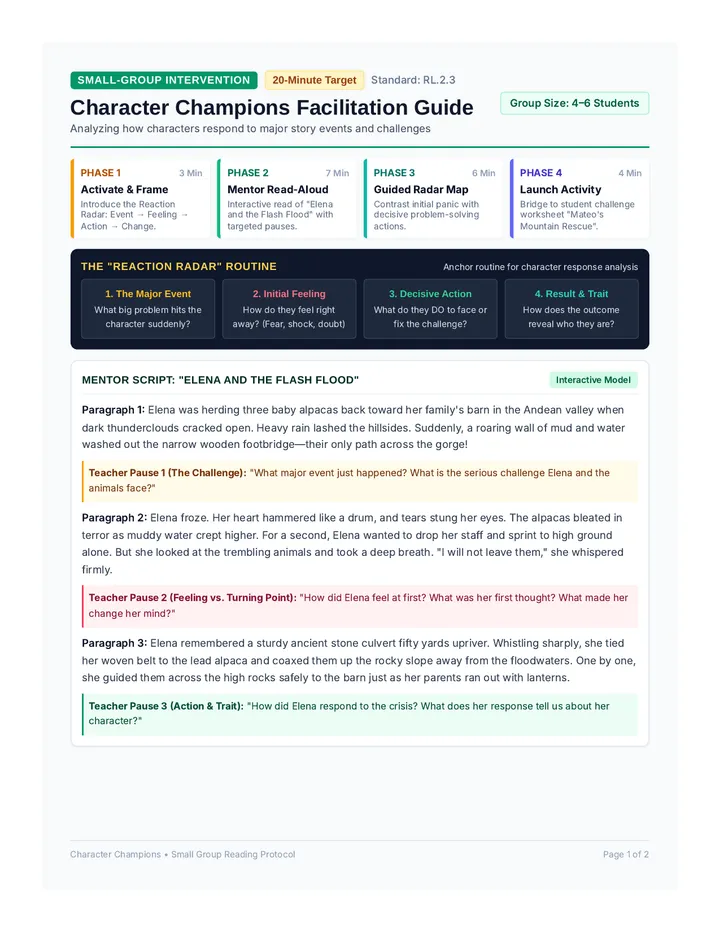
Character Champions Facilitation Guide Small-Group Intervention 20-Minute Target Standard: RL.2.3
Character Champions Facilitation Guide
Analyzing how characters respond to major story events and challenges
Group Size: 4–6 Students
Phase 1 3 Min
Activate & Frame
Introduce the Reaction Radar: Event → Feeling → Action → Change.
Phase 2 7 Min
Mentor Read-Aloud
Interactive read of "Elena and the Flash Flood" with targeted pauses.
Phase 3 6 Min
Guided Radar Map
Contrast initial panic with decisive problem-solving actions.
Phase 4 4 Min
Launch Activity
Bridge to student challenge worksheet "Mateo's Mountain Rescue".
The "Reaction Radar" Routine Anchor routine for character response analysis
1. The Major Event
What big problem hits the character suddenly?
2. Initial Feeling
How do they feel right away? (Fear, shock, doubt)
3. Decisive Action
What do they DO to face or fix the challenge?
4. Result & Trait
How does the outcome reveal who they are?
Mentor Script: "Elena and the Flash Flood"
Interactive Model
Paragraph 1: Elena was herding three baby alpacas back toward her family's barn in the Andean valley when dark thunderclouds cracked open. Heavy rain lashed the hillsides. Suddenly, a roaring wall of mud and water washed out the narrow wooden footbridge—their only path across the gorge!
Teacher Pause 1 (The Challenge): "What major event just happened? What is the serious challenge Elena and the animals face?"
Paragraph 2: Elena froze. Her heart hammered like a drum, and tears stung her eyes. The alpacas bleated in terror as muddy water crept higher. For a second, Elena wanted to drop her staff and sprint to high ground alone. But she looked at the trembling animals and took a deep breath. "I will not leave them," she whispered firmly.
Teacher Pause 2 (Feeling vs. Turning Point): "How did Elena feel at first? What was her first thought? What made her change her mind?"
Paragraph 3: Elena remembered a sturdy ancient stone culvert fifty yards upriver. Whistling sharply, she tied her woven belt to the lead alpaca and coaxed them up the rocky slope away from the floodwaters. One by one, she guided them across the high rocks safely to the barn just as her parents ran out with lanterns.
Teacher Pause 3 (Action & Trait): "How did Elena respond to the crisis? What does her response tell us about her character?"
Character Champions • Small Group Reading Protocol Page 1 of 2
Character Champions Lesson Slides Small-Group Lab Standard RL.2.3
20-Minute Focus
Character Champions:
Facing Major Events & Challenges
When disaster strikes in a story, what characters DO next reveals who they truly are. Learn how to track the Reaction Radar!
Today's Reading Target:
I can describe how characters in a story respond to major events and challenges .
Routine
The 4-Step Reaction Radar
How characters meet a crisis
1
Major Event
What big obstacle or crisis happens suddenly?
2
Initial Feeling
How does the character feel immediately inside?
3
Active Action
What physical choice or action do they take to solve it?
4
Trait Revealed
What trait does their brave action prove?
🔍 Remember: Characters cannot choose what happens, but they ALWAYS choose how to respond!
Mentor Investigation
Case Study: Elena & the Flash Flood
Guided Model
1. The Crisis
The footbridge washes away! Elena and her three baby alpacas are trapped on the wrong side of a raging flood.
2. First Feeling
Elena freezes in panic. Her heart pounds and she wants to run to high ground alone.
3. The Response
She breathes deep, ties her belt to lead the animals, and guides them up to the stone culvert to safety!
Elena's Trait: Responsible & Courageous — She put her animals before her own fear.
Key Concept
Feelings vs. Actions in a Challenge
Look beyond what they feel!
Internal Feelings
Characters often feel afraid, angry, or overwhelmed when a major event happens.
"Elena felt tears sting her eyes and wanted to run away."
Feelings are the first reaction, but not the whole response!
External Actions
The true response is what the character chooses to DO to meet the challenge.
"Elena tied her belt, whistled, and led the herd across high rocks."
Actions solve the problem and reveal character strength!
Challenge + Action = How a Character Overcomes and Grows!
Follow-Up Case
Your Mission: Mateo's Mountain Rescue
Independent / Partner Lab
Character Challenge Student Worksheet Follow-Up Challenge Lab
Character Challenge Student Worksheet
Name:
Date:
Case File: "Mateo and the Broken Oar" — An Adventure on the Rushing River
Focus: RL.2.3 Response Analysis
As you read:
1. Underline the sudden crisis in [¶2]. 2. Circle Mateo's initial feeling in [¶2]. 3. Star his problem-solving actions in [¶3].
¶1
Nine-year-old Mateo gripped the wooden oars of his family's small river dory. Strapped tightly under a canvas tarp in the bow was a sealed metal cooler of urgent fever medicine that Dr. Vega needed at the downstream clinic before nightfall. The river was swollen with autumn runoff, foaming white around slick granite boulders. Mateo had navigated this stretch of river many times with his grandfather, but never alone.
¶2
As the boat entered Dead Man's Bend, a hidden submerged tree trunk slammed into the hull with a shuddering thud. CRACK! The left oar snapped cleanly in two, its blade spinning away into the churning white rapids. The dory lurched sideways, spinning violently toward the sharp teeth of Devil's Rock. Panic flooded Mateo's chest. His hands trembled, his breath caught in his throat, and tears burned his eyes as the roaring current surged around him.
¶3
Mateo squeezed his eyes shut for one second and heard his grandfather's steady voice: "A panic steers nowhere; only actions find shore." Mateo opened his eyes and acted instantly. Dropping the useless splintered handle, he dropped to his knees to lower his center of gravity. He snatched a heavy bamboo cargo pole from the floorboards and jammed it against the riverbed, bracing his entire body to push the bow away from the deadly rocks. With his other hand, he dragged the heavy canvas tarp into the swirling water on the right, creating a homemade drag brake to slow the spin.
¶4
The dory groaned, scraped along a smooth mossy stone, and glided safely out of the rapids onto a quiet sandbar. Breathing hard, Mateo checked the medicine box. It was completely dry and intact. Looking back up at the wild river he had just conquered, Mateo smiled with quiet pride, knowing he had faced a nightmare and brought himself safely through.
Quick Checkpoint: First Reaction
How did Mateo feel right when the oar snapped, before he took action?
Character Champions • Mateo and the Broken Oar Page 1 of 2 — Continue to Page 2 for Reaction Radar & Trait Proof
Part 2: The Reaction Radar Map
Track how Mateo moves from sudden crisis to decisive response
RL.2.3 Analysis
1 MAJOR EVENT / CHALLENGE: What unexpected crisis threatened Mateo and his mission?
2 INITIAL FEELING: What physical sensations and emotions did Mateo feel at first?
Character Response Exit Ticket Quick Check
Character Response Exit Ticket
Name:
Score: /4
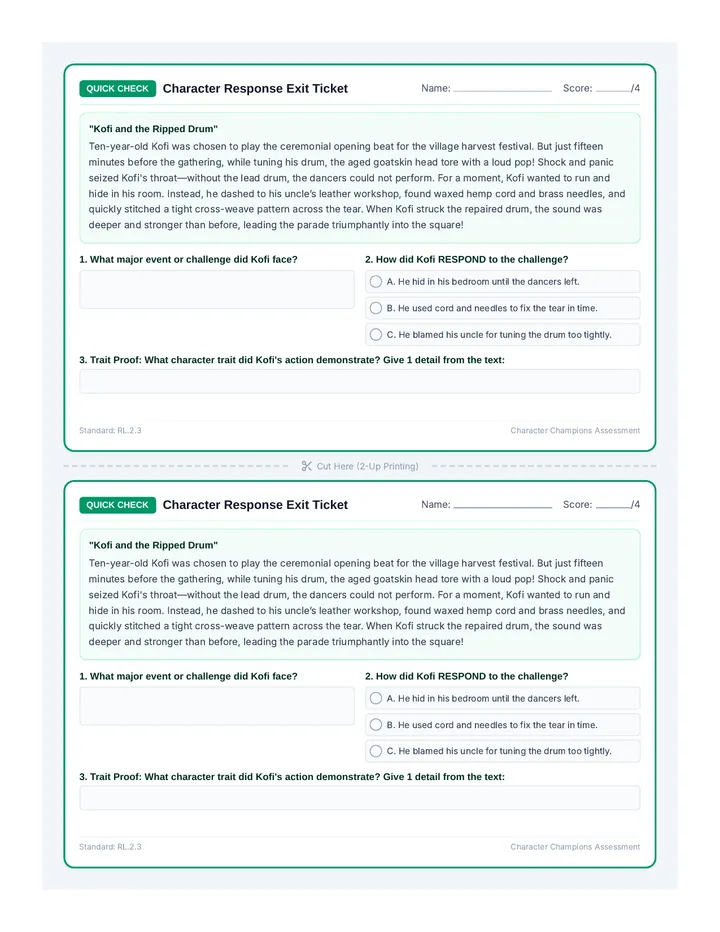
"Kofi and the Ripped Drum" Ten-year-old Kofi was chosen to play the ceremonial opening beat for the village harvest festival. But just fifteen minutes before the gathering, while tuning his drum, the aged goatskin head tore with a loud pop! Shock and panic seized Kofi's throat—without the lead drum, the dancers could not perform. For a moment, Kofi wanted to run and hide in his room. Instead, he dashed to his uncle’s leather workshop, found waxed hemp cord and brass needles, and quickly stitched a tight cross-weave pattern across the tear. When Kofi struck the repaired drum, the sound was deeper and stronger than before, leading the parade triumphantly into the square!
1. What major event or challenge did Kofi face?
2. How did Kofi RESPOND to the challenge?
A. He hid in his bedroom until the dancers left.
B. He used cord and needles to fix the tear in time.
C. He blamed his uncle for tuning the drum too tightly.
3. Trait Proof: What character trait did Kofi's action demonstrate? Give 1 detail from the text:
Standard: RL.2.3 Character Champions Assessment
Cut Here (2-Up Printing)
Quick Check
Character Response Exit Ticket
Name:
Score: /4
"Kofi and the Ripped Drum" Ten-year-old Kofi was chosen to play the ceremonial opening beat for the village harvest festival. But just fifteen minutes before the gathering, while tuning his drum, the aged goatskin head tore with a loud pop! Shock and panic seized Kofi's throat—without the lead drum, the dancers could not perform. For a moment, Kofi wanted to run and hide in his room. Instead, he dashed to his uncle’s leather workshop, found waxed hemp cord and brass needles, and quickly stitched a tight cross-weave pattern across the tear. When Kofi struck the repaired drum, the sound was deeper and stronger than before, leading the parade triumphantly into the square!
1. What major event or challenge did Kofi face?
2. How did Kofi RESPOND to the challenge?
A. He hid in his bedroom until the dancers left.
B. He used cord and needles to fix the tear in time.
C. He blamed his uncle for tuning the drum too tightly.
3. Trait Proof: What character trait did Kofi's action demonstrate? Give 1 detail from the text:
Standard: RL.2.3 Character Champions Assessment