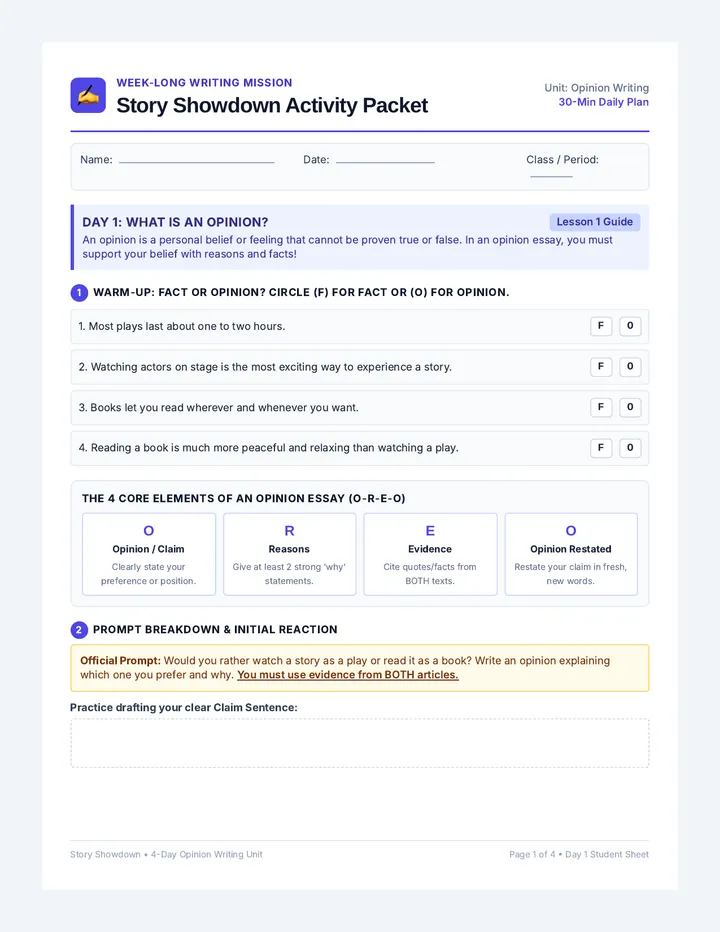
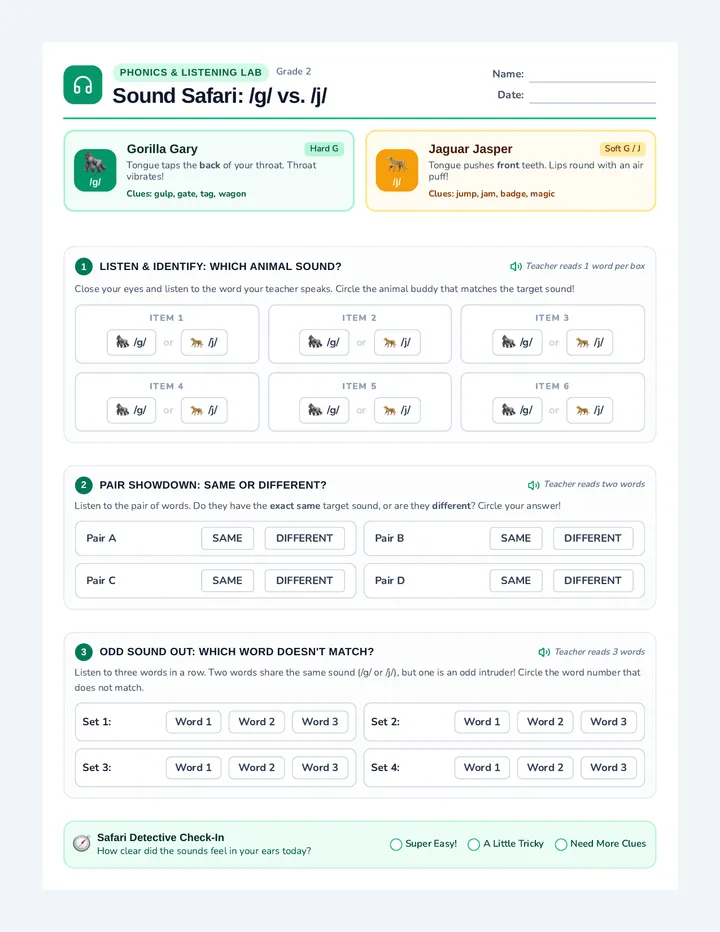
Syllable Slashers Lesson Plan Teacher Guide Grades 2–4 Intervention / Core
Day 1 of 2 • 40 Minutes
Syllable Slashers: Open & Closed Division
Explicit, multisensory instruction for dividing two-syllable words using VCCV and VCV patterns.
Learning Objectives
Identify talking vowels and code the consonant bridge.
Divide VCCV words between consonants with 90% accuracy.
Apply the VCV "first try open, then flex closed" strategy.
Materials Needed
Syllable Slashers Slides (Slides 1–5)
Dry-erase whiteboards & two-color dry-erase markers
Syllable Slashers Worksheet (Day 1, Page 1)
Day 1 Instructional Flow (40 Min)
Structured Phonics Routine
1. Warm-Up & Syllable Type Review 7 min
Routine: Review Closed syllables (vowel locked in by consonant = short sound, marked with breve ˘) and Open syllables (no consonant door = vowel shouts its name, marked with macron ¯).
"Teacher Prompt: If I say 'nap', is it open or closed? Closed! The 'p' closes the door. If I say 'no', it's open! The vowel is free to shout its long name."
2. Direct Modeling: The 4-Step Syllable Slash 10 min
Teach the 4-step surgical division strategy on the board using anchor words: nap/kin (VCCV) and ro/bot vs. cab/in (VCV).
Spot the Vowels: Underline talking vowels and write 'V' underneath.Build the Bridge: Connect the vowels and label consonants 'C' between them.Slash the Pattern: If VCCV, cut between consonants (V-C / C-V). If VCV, cut after the first vowel (V / C-V).Decode & Flex: Read each syllable, blend, and verify word meaning. (If V/CV sounds wrong, flex to VC/V!).
3. Guided Practice (We Do) 12 min
Students use whiteboards. Display words on Slide 5: mag/net , ti/ger , den/tist , lem/on . Students chant: "Spot the vowels, build the bridge, slash the word, read it big!"
Teacher Checkpoint: Ensure students do not split digraphs (e.g., sh, th, ch) and watch closely when flexing lemon from open (/lē-mən/) to closed (/lem-ən/).
4. Independent Application & Exit Ticket (You Do) 11 min
Students complete Day 1 Practice Sheet (words 1–8). Circulate with the anecdotal clipboard. Conclude with a 2-minute quick check: individual students whisper-read 2 segmented words before dismissal.
Differentiation & Corrective Feedback
Support: Use tactile plastic tiles or physical word strips that students physically cut with scissors between consonants to cement the split.
Extend: Challenge students to code syllable accent/stress marks (e.g., 'CAbin vs. ca'DET) and explain the schwa sound in unstressed syllables.
Syllable Slashers Core Phonics Curriculum Page 1 of 2 • Day 1 Protocol
Teacher Guide Grades 2–4 Intervention / Core
Day 2 of 2 • 40 Minutes
Magic E Syllables & Progress Monitoring
Integrating Magic E (VCe) syllables into multisyllabic decoding, fluency drills, and diagnostic assessment.
Learning Objectives
Recognize Magic E (VCe) units in two-syllable compound & complex words.
Decode mixed open, closed, and magic e syllables in connected text.
Complete Progress Monitoring Assessment with ≥85% accuracy.
Materials Needed
Syllable Slashers Slides (Slides 6–8)
Syllable Slashers Worksheet (Day 2, Page 2)
Progress Monitoring Assessment & Teacher Scoring Matrix
Day 2 Instructional Flow (40 Min)
Mixed Mastery & Assessment
1. Retrieval & Warm-Up: Syllable Sort 5 min
Conduct a rapid-fire auditory and visual warm-up. Flash single syllables (pic , ro , gate , sub , shine ). Students signal with thumbs up (Closed), open palm (Open), or wand gesture (Magic E).
2. Explicit Modeling: Taming the Magic E Syllable 8 min
Key Rule: Magic E stays bound to its vowel partner! When counting vowels, Magic E is silent; it sends its power back across one consonant.
Model Word: rep/tile • Step 1: Underline 'e' (talking) and 'i' (talking). Circle silent final 'e' and draw a magic arrow to 'i'. • Step 2: Bridge 'p' and 't'. • Step 3: Slash between consonants: rep (closed) + tile (magic e).
3. Partner Guided Reading & Sentences 12 min
Students pair up to complete Day 2 Worksheet Section B: Decodable Sentences containing mixed target words (e.g., pancake, escape, invite, reptile, robot ). Partner A reads, Partner B checks division and syllable codes. Switch for sentence 2.
4. Progress Monitoring Assessment Administration 15 min
Administration Format: While the class completes the independent self-check / decodable coloring puzzle, pull students individually (1.5–2 min each) to administer Part 2 (Oral Word Reading) and Part 3 (Sentence Fluency). Collect Part 1 (Written Division) from all students.
Diagnostic Focus: Record specific error types: (1) Misidentifying magic e as a separate syllable, (2) Failing to flex VCV, or (3) Vowel sound substitution.
Standardized Error Correction Script
If student reads rep/tile as /rep-tĭl-ē/: "Stop. Look at the end of the word. What letter is that? (Silent e). What does magic e do? (Makes the vowel say its name). Sound out just this syllable: /t-ī-l/ = tile. Now blend both: rep... tile... reptile!"
Syllable Slashers Core Phonics Curriculum Page 2 of 2 • Day 2 Protocol
Syllable Slashers Slides Phonics Mission Days 1 & 2 Routine
Word Surgery
Syllable Slashers
Mastering 2-syllable division with Closed, Open, and Magic E syllables.
Rule: Spot the Vowels • Bridge the Consonants • Slash to Read Let's Begin!
The 3 Syllable Superstars
Quick Recall
CL
Closed
Consonant shuts the door! Vowel is short .
năp • cat
OP
Open
No door! Vowel is free to shout its long name .
rō • mē
V-e
Magic E
Silent E sends power to make vowel long .
cāke • tīle
Every syllable has exactly one vowel sound!
Pattern 1
VCCV: Split Between the Consonants
The Rabbit Rule
When two consonants stand between talking vowels:
nap
V C (Closed)
/
kin
C V (Closed)
mag / net
rab / bit
den / tist
Both syllables are closed! Both vowels say their short sounds.
Pattern 2
VCV: Try Open First, Then Flex Closed
Tiger or Camel?
First Choice (75%) V / CV
Tiger Rule (Open)
Slash after the first vowel! The first syllable stays open and long.
ro / bot
rō-bŏt • ti / ger
Flex Choice (25%) VC / V
Camel Rule (Closed)
If open doesn't make a real word, pull consonant back to close it!
cam / el
căm-əl • lem / on
Strategy: Try long first. If it sounds goofy, flex to short!
Multisensory Routine
The 4-Step Syllable Slash
1
Spot
Find and mark the talking vowels with a 'V'.
2
Bridge
Draw a bridge and label the consonants 'C'.
3
Slash
Divide between C-C or after the first V .
4
Blend
Check syllable types, read parts, and blend fast !
Class Chant: "Spot the vowels, build the bridge, slash the word, read it big!"
Syllable Slashers Worksheet Day 1 Student Lab
Syllable Slashers: VCCV & VCV Patterns
Name:
Date:
The Division Steps: 1. Label vowels (V) • 2. Label consonants (C) • 3. Slash • 4. Blend & read!
VCCV = Split C/C • VCV = Try V/CV
A VCCV Division: Split Between the Consonants
Draw a slash ( / ) and write both syllables
Target Word Slash & Code (V/C) Syllable 1 Syllable 2
napkin nap / kin
nap (Closed)
kin (Closed)
magnet m a g n e t
cactus c a c t u s
dentist d e n t i s t
B VCV Flex Lab: Tiger Rule vs. Camel Rule
Try Open first (V/CV). If needed, flex to Closed (VC/V)
robot VCV
Draw slash • Circle Syllable 1 type:
r o b o t → Open (rō) Closed (rŏb)
Real word check:
lemon VCV (Flex!)
Draw slash • Circle Syllable 1 type:
l e m o n → Open (lē) Closed (lĕm)
Real word check:
pilot VCV
Draw slash • Circle Syllable 1 type:
p i l o t → Open (pī) Closed (pĭl)
Real word check:
cabin VCV (Flex!)
Draw slash • Circle Syllable 1 type:
c a b i n → Open (cā) Closed (căb)
Real word check:
C Sentence Slash: Read & Divide
1. The dentist left the napkin on the desk.
Slash both bold words:
2. The pilot built a silver robot at camp.
Slash both bold words:
Syllable Slashers Student Lab Page 1 of 2 • Day 1
Day 2 Student Lab
Syllable Slashers: Magic E & Mixed Patterns
Name:
Date:
Magic E Rule: Magic E does NOT get separated from its syllable! It makes the vowel long.
V-C-e Team
A Magic E Division Surgery
Draw slash, circle silent e, and write each syllable
reptile Closed + Magic E
Syllable 1:
Syllable 2:
cupcake Closed + Magic E
Syllable 1:
Syllable 2:
invite Closed + Magic E
Syllable 1:
Syllable 2:
stampede Closed + Magic E
Syllable 1:
Syllable 2:
B Mixed Syllable Sorter
Divide word • Check syllable types
Word Slash ( / ) Syllable 1 Type Syllable 2 Type
Syllable Slashers Assessment Progress Monitoring
Two-Syllable Division Diagnostic
Student:
Date:
1 Part 1: Written Division & Coding (6 Points)
Draw slash ( / ) and write each syllable
Instructions: Spot the vowels, bridge the consonants, slash the word, and write the two parts.
Word Division Slash ( / ) Syllable 1 Syllable 2
traffic
music
robin
escape
locate
sunshine
2 Part 2: Rapid Oral Reading Probe (10 Words • 10 Points)
Teacher listens and marks accuracy
Instructions to student: "Read each word across the rows clearly and accurately."
picnic
female
reptile
sunset
silent
invite
limit
athlete
hotel
explode
3 Part 3: Decodable Sentence Fluency (4 Points)
Line A: The wild reptile will escape from the stone den.
Line B: The pilot ate a sweet pancake before the flight.
Part 1: ___ / 6 Part 2: ___ / 10 Part 3: ___ / 4
Total Score: ___ / 20 (Goal: ≥17/20)
Syllable Slashers Progress Monitoring Assessment Form A • Page 1 of 2
Teacher Diagnostic Tool
Syllable Division Diagnostic Matrix
Scoring & Targeted Intervention Protocol
1. Qualitative Error Pattern Analysis
Observed Error Pattern Example Mistake Targeted Intervention Strategy
Digraph Splitting Dividing ath / lete as at / hlete Teach digraphs (th, sh, ch) as glued consonant units; underline digraph before building bridge.
Magic E Separation Dividing rep / til / e into 3 parts Remind students that Magic E is silent and counts as 0 extra syllable sounds. Circle silent e first.
Rigid Open VCV Reading robin as /rō-bin/ Practice the "Flex Switch": "If the open tiger sound makes nonsense, shift consonant left to camel!"
Vowel Substitution Short vowel substitution in Magic E Use visual macron/breve coding on vowel letters prior to syllable blending.
2. Mastery Benchmark Pathways
Benchmark Mastery 17–20 pts
Student demonstrates rapid, accurate division across open, closed, and magic e syllables.
Next: Advance to VCCCV, Cle, and vowel team syllable division.
Syllable Slashers Answer Key Teacher Resource
Syllable Slashers Worksheet Key
ANSWER KEY
Days 1 & 2 Solutions
Day 1 Practice Solutions
Section A: VCCV Division
magnet → mag / net Syllable 1: mag (Closed) Syllable 2: net (Closed)
cactus → cac / tus Syllable 1: cac (Closed) Syllable 2: tus (Closed)
dentist → den / tist Syllable 1: den (Closed) Syllable 2: tist (Closed)
Section B: VCV Tiger vs. Camel Flex
robot: ro / bot • Open (rō)
lemon: lem / on • Closed (lĕm, flexed)
pilot: pi / lot • Open (pī)
cabin: cab / in • Closed (căb, flexed)
Section C Sentences: 1. den/tist, nap/kin • 2. pi/lot, ro/bot.
Day 2 Practice Solutions
Section A: Magic E Syllable Surgery
reptile: rep / tile (rep = CL, tile = VCe)
cupcake: cup / cake (cup = CL, cake = VCe)
invite: in / vite (in = CL, vite = VCe)
stampede: stam / pede (stam = CL, pede = VCe)
Section B: Mixed Syllable Sorter
locate → lo / cate Syllable 1: Open Syllable 2: Magic E
helmet → hel / met Syllable 1: Closed Syllable 2: Closed
escape → es / cape Syllable 1: Closed Syllable 2: Magic E
Section C Story Words: rep/tile (CL/VCe), pan/cake (CL/VCe), bas/ket (CL/CL), es/cape (CL/VCe), ro/bot (OP/CL).
Syllable Slashers Answer Key Page 1 of 2 • Practice Worksheet Solutions
Teacher Resource
Assessment Key & Scoring Rubric
ASSESSMENT KEY
Form A Diagnostic Guide
Part 1: Written Division Scoring (6 Points Total)
Target Word Correct Slash Syllable 1 & 2 Breakdown Points
traffic traf / fic traf (CL) + fic (CL) 1 pt
music mu / sic mu (OP) + sic (CL) 1 pt
robin rob / in rob (CL, flexed) + in (CL) 1 pt
escape es / cape es (CL) + cape (VCe) 1 pt
locate lo / cate lo (OP) + cate (VCe) 1 pt
sunshine sun / shine sun (CL) + shine (VCe) 1 pt
Part 2: Oral Reading Word Probe Scoring (10 Points)
picnic • /pĭk-nĭk/ (Closed + Closed)
female • /fē-māl/ (Open + Magic E)
reptile • /rĕp-tīl/ (Closed + Magic E)