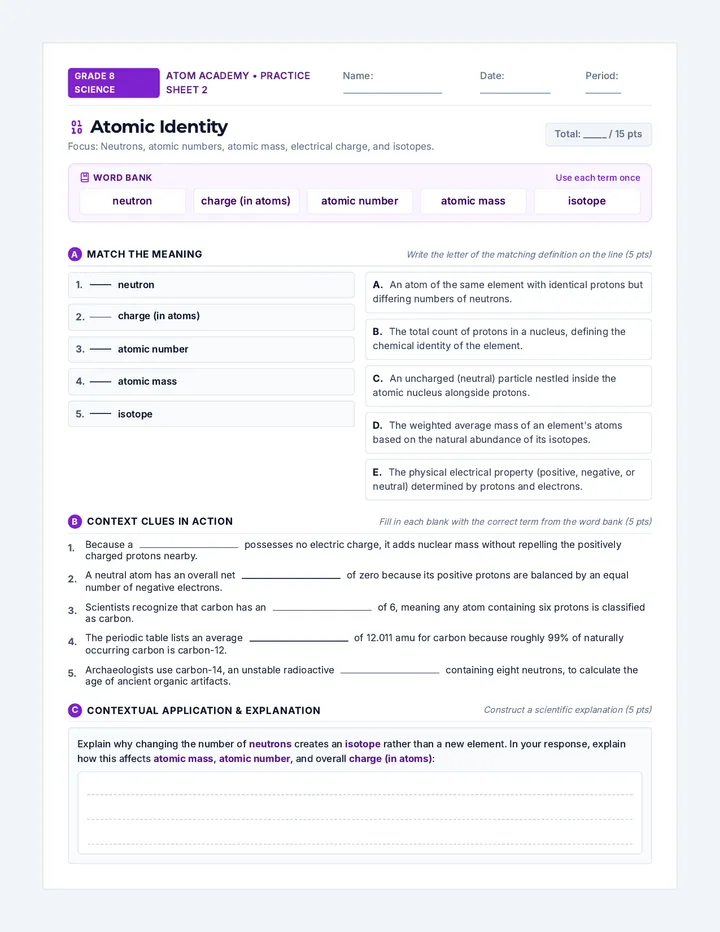
Matter Builders Worksheet Matter Builders Worksheet
Physical Science • Vocabulary Practice
Grade 8 • Set 1
Name:
Date:
Period:
1
Term & Meaning Match
Write the correct letter in each blank.
Vocabulary Terms
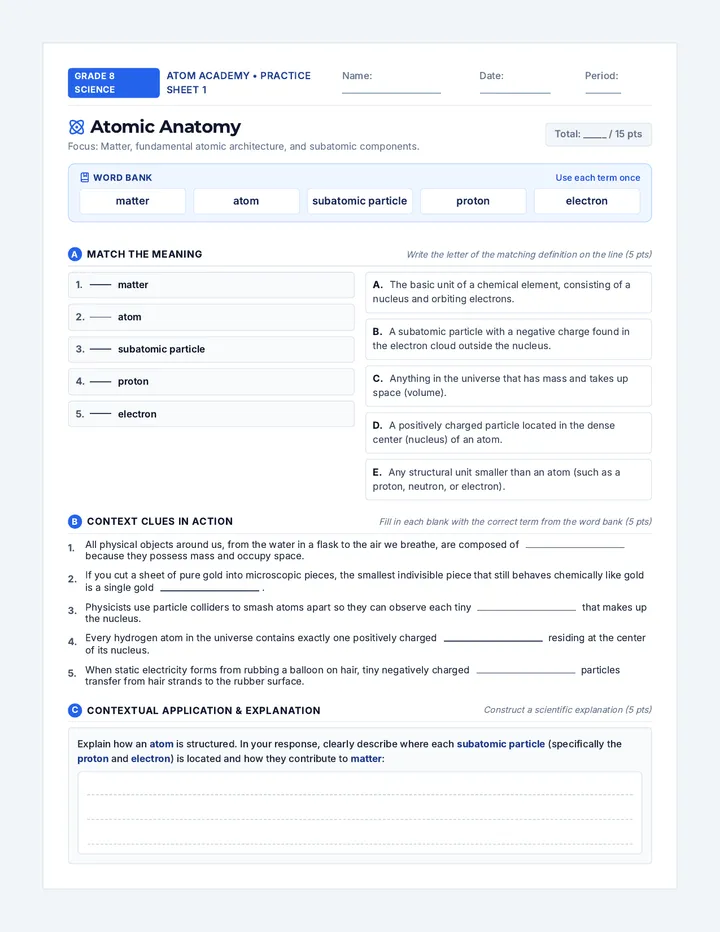
___ 1. Atom
___ 2. Element
___ 3. Matter
___ 4. Subatomic particle
___ 5. Charge
Definitions
A. Anything that has mass and takes up space.
B. A tiny bit of matter smaller than an atom that forms part of an atom (e.g., proton, neutron, electron).
C. An electrical property created by balanced or unbalanced numbers of protons and electrons.
D. A substance that can exist as a single kind of atom, unlike compounds with bonded atoms.
E. The smallest particle that has the properties of a particular element.
2
Science in Context
Fill in each blank using the word bank.
Atom Element Matter Subatomic particle Charge
Even though oxygen gas is invisible, it is classified as because it has mass and fills the container holding it.
Pure copper wire contains only one kind of atom, meaning it is an example of an rather than a chemical compound.
If you divide a sample of pure iron until it cannot be divided any further without losing its identity, you are left with one iron .
Inside every atomic structure, an electron is a tiny with almost no mass compared to the nucleus.
When an amber rod is rubbed with silk, it gains extra electrons and acquires a negative .
3
Scientific Reasoning Challenge
A classmate argues: "Since water has mass and takes up space, it must be an element." Correct their thinking in 2–3 sentences. Correctly use the terms matter and element in your response.
Subatomic Sparks Worksheet Subatomic Sparks Worksheet
Physical Science • Vocabulary Practice
Grade 8 • Set 2
Name:
Date:
Period:
1
Term & Meaning Match
Write the correct letter in each blank.
Vocabulary Terms
___ 1. Proton
___ 2. Neutron
___ 3. Electron
___ 4. Isotope
___ 5. Ion
Definitions
A. A subatomic particle in the nucleus with a mass of 1 atomic unit and no electrical charge.
B. A tiny subatomic particle with a negative charge and virtually no mass, found in energy shells around the nucleus.
C. A positively charged particle in the nucleus; its count uniquely identifies which element the atom is.
D. An atom that has gained or lost electrons, giving it an overall positive or negative charge.
E. Atoms of the same element that have different numbers of neutrons, resulting in different atomic masses.
2
Science in Context
Fill in each blank using the word bank.
Proton Neutron Electron Isotope Ion
An atom of carbon must have exactly 6 of this positively charged particle, because the number of particles in the nucleus defines the element's identity.
Although carbon-12 and carbon-14 share identical chemical behavior, carbon-14 is a heavier because it holds two additional neutrons.
Located alongside protons in the dense central nucleus, the adds mass to the atom but carries zero electrical charge.
Whizzing around the exterior shells at high speed, the tiny negative has negligible mass compared to the nucleons inside.
When a neutral sodium atom loses one negative charge, it becomes a positive (\(\text{Na}^+\)) with 11 protons and only 10 electrons.
3
Scientific Reasoning Challenge
A neutral chlorine atom has 17 protons and 17 electrons. If it gains 1 electron, does it become an isotope or an ion? Explain why in 2–3 sentences, stating its new overall charge.
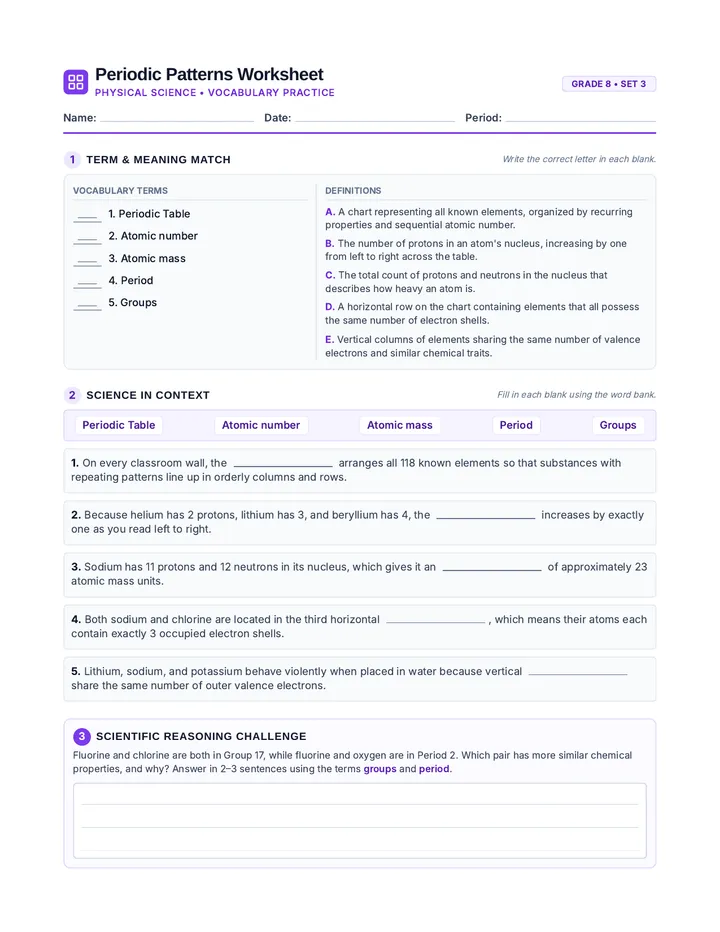
Periodic Patterns Worksheet Periodic Patterns Worksheet
Physical Science • Vocabulary Practice
Grade 8 • Set 3
Name:
Date:
Period:
1
Term & Meaning Match
Write the correct letter in each blank.
Vocabulary Terms
___ 1. Periodic Table
___ 2. Atomic number
___ 3. Atomic mass
___ 4. Period
___ 5. Groups
Definitions
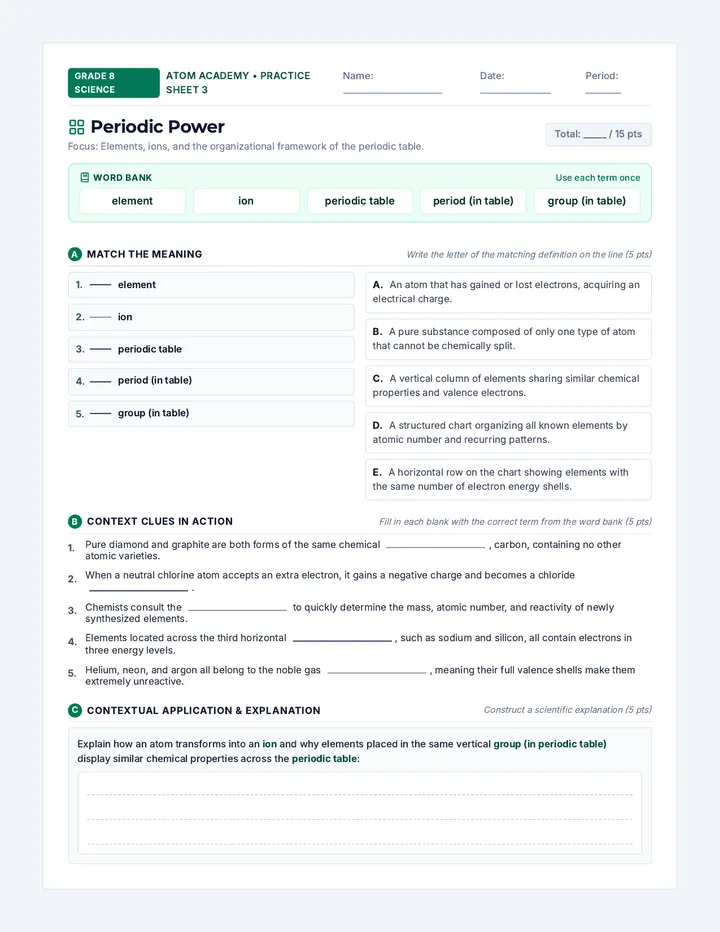
A. A chart representing all known elements, organized by recurring properties and sequential atomic number.
B. The number of protons in an atom's nucleus, increasing by one from left to right across the table.
C. The total count of protons and neutrons in the nucleus that describes how heavy an atom is.
D. A horizontal row on the chart containing elements that all possess the same number of electron shells.
E. Vertical columns of elements sharing the same number of valence electrons and similar chemical traits.
2
Science in Context
Fill in each blank using the word bank.
Periodic Table Atomic number Atomic mass Period Groups
On every classroom wall, the arranges all 118 known elements so that substances with repeating patterns line up in orderly columns and rows.
Because helium has 2 protons, lithium has 3, and beryllium has 4, the increases by exactly one as you read left to right.
Sodium has 11 protons and 12 neutrons in its nucleus, which gives it an of approximately 23 atomic mass units.
Both sodium and chlorine are located in the third horizontal , which means their atoms each contain exactly 3 occupied electron shells.
Lithium, sodium, and potassium behave violently when placed in water because vertical share the same number of outer valence electrons.
3
Scientific Reasoning Challenge
Fluorine and chlorine are both in Group 17, while fluorine and oxygen are in Period 2. Which pair has more similar chemical properties, and why? Answer in 2–3 sentences using the terms groups and period.