Lenny.com
Explore
Create
ActivitiesNewMathEnglish Language ArtsScience & EngineeringSocial StudiesGlobal LanguagesHealth & Physical EducationSpecial EducationCounseling & Life SkillsArts & CreativityESL
Lenny.com
Lenny.com
Explore
Create
ActivitiesNewMathEnglish Language ArtsScience & EngineeringSocial StudiesGlobal LanguagesHealth & Physical EducationSpecial EducationCounseling & Life SkillsArts & CreativityESL
Lenny.com
Lenny.com

Solutions

Lenny for EducatorsLenny for SchoolsLenny for Districts

Product

ExploreSign inCreateSupportAbout

Resources

Getting startedMTSS Acceleration Program

© 2026 Lenny Learning Inc.

TermsPrivacyAccessibility
LinkedInInstagramX
Lenny
Science & EngineeringLife ScienceLiving ThingsAnimalsPlantsBody SystemsTraitsAdaptationsCellsEcosystemsHeredityGenes to TraitsCell DivisionPhysicsComparing MaterialsShapes and PropertiesMagnetsMagnetismLightSoundLight and SoundMatterStates of MatterChanges of StateMixturesPhysical and Chemical ChangeHeating and CoolingHeat and Thermal EnergyEnergyForce and MotionElectrical CircuitsAtoms and MoleculesPeriodic TableMotion in One DimensionMotion in Two DimensionsScalars and VectorsForces and Laws of MotionCircular Motion and GravityMomentum and ImpulseWork, Energy, and PowerWavesElectromagnetic WavesGeometric OpticsElectricity and MagnetismSimple Harmonic MotionThermodynamicsNuclear PhysicsEarth Science & AstronomyWeatherWater CycleRocks and MineralsFossilsEarth's FeaturesEarth's ResourcesEarth's StructureWeather and ClimateEarth EventsFossils and Geologic TimePlate TectonicsHuman ImpactsAstronomyChemistryUnits and MeasurementAtomic StructurePeriodic TrendsChemical BondingNomenclatureMolecular StructureIntermolecular ForcesThe MoleStoichiometryProperties of GasesSolutionsChemical ReactionsBalancing EquationsEnergy ChangesRates of ReactionsEquilibriumAcids and BasesQuantum ModelBiologyClassificationCell StructureThe Chemistry of LifeBiomoleculesCellular TransportCell EnergyCell Growth and DivisionDNAProtein SynthesisMeiosis and Sexual ReproductionPatterns of InheritanceMulticellular OrganismsEvolutionEcologyBiodiversityComputer ScienceAlgorithms and Computational ThinkingProgramming LanguagesComputing SystemsNetworks and InternetData AnalysisCybersecurityAI and Machine LearningSoftware Design and DevelopmentBlockchainEngineering & AIDesigning ExperimentsEngineering PracticesDesign ThinkingEngineering Design ProcessMechanical EngineeringElectrical EngineeringMaterials and StructuresCAD and 3D DesignRoboticsArtificial Intelligence BasicsVibe CodingMachine LearningAI Ethics and SocietySystems ThinkingEntrepreneurship & InnovationEntrepreneurial MindsetBusiness Idea DevelopmentBusiness Plan BasicsMarketing & Customer DiscoveryFinancial Management for Startups

Avian Strike Investigation

A high school biology investigation exploring bird collision physics, clay impact modeling, and engineering design solutions for architectural windows based on the NYS Regents 'For the Birds' lab.

Jjrand

Avian Strike Investigation

A high school biology investigation exploring bird collision physics, clay impact modeling, and engineering design solutions for architectural windows based on the NYS Regents 'For the Birds' lab.

Jjrand

By dropping clay spheres from multiple controlled heights, students record the corresponding (7) diameter changes to establish a clear mathematical trend between collision speed and impact force. Because classroom drop heights cannot achieve true cruising speeds, students use their graph trends to extrapolate (8) destructive forces at natural flight velocities. Finally, students evaluate window mitigation patterns, determining how structural components (9) like dot grids and decals spaced two inches apart warn birds and prevent fatal collisions.

Pedagogical Notes & Common Student Pitfalls

  • Simulate vs. Stimulate: Watch for students misreading "simulate" (to model) as "stimulate" (to excite/provoke).
  • Extrapolate spelling: Accept standard spelling extrapolate (addressing the common student typo extropolate).
  • Inversion Analogy: Emphasize that gravity-driven vertical drops represent horizontal velocity vectors (\(v = \sqrt{2gh}\)).

NYS Regents Life Science Teacher Guide • For the Birds Teacher Key • Page 1 of 2

Part II: Exemplar Answers & Evaluation Criteria

For the Birds: Model Synthesis & Engineering Solutions

Scoring Rubric

Task 1: Evaluating the Laboratory Model Simulation (3 pts)

Model Element Real Phenomenon Exemplar Limitation / Analysis

Molded Clay Sphere Avian body mass & tissues Limitation: Clay is uniform and plastic; real birds have hollow bones, organs, and air sacs that fracture/tear differently than solid clay.

Vertical Drop Horizontal flight into glass Limitation: Gravity causes acceleration straight down, whereas real birds fly horizontally under muscular propulsion with varying angles of incidence.

Classroom Floor Vertical architectural window Limitation: Concrete or tile floors have virtually zero elasticity/give, whereas large glass panes can flex slightly, dissipating small amounts of energy.

Task 2: Data Interpretation & Extrapolation Exemplar (3 pts)

Exemplar Student Response:

"Classroom ceilings limit drops to approximately 1.5 to 2 meters (\(\sim 5\text{--}6\text{ m/s}\)), which is far below natural avian flight velocities (\(10\text{--}25\text{ m/s}\)). Dropping clay masses from higher stories creates physical hazards and equipment damage. By establishing a proportional mathematical trendline between drop velocity and clay deformation in controlled lab conditions, scientists can safely extrapolate the curve to predict blunt trauma at true high-speed flight velocities without creating physical classroom hazards."

Task 3: Engineering Solutions & Biodiversity Exemplars (6 pts)

Structural Components Selection (3 pts):

1. Ceramic Frit Dot Matrix: Baked onto the exterior glass surface spaced 2 inches apart. Birds perceive the dots as a physical barrier too narrow to fly through while preserving human visibility from within.

2. UV Patterned Decals / Coatings: Birds see ultraviolet wavelengths invisible to human vision. UV-reflective stripes or grids signal an obstruction to birds while maintaining transparent architectural aesthetics for human occupants.

Biodiversity Synthesis Response (3 pts):

Window strikes indiscriminately kill migratory songbirds, raptors, and hummingbirds. Because birds provide vital ecosystem services—including insect predation, seed dispersal, and pollination—preventing window mortality protects avian population densities and trophic food webs, directly preserving local and global biodiversity.

Regents Assessment Rubric

Level 4: Exemplary (90-100%)

All 9 cloze terms correct. Analyzes all 3 model limitations clearly. Accurately explains extrapolation and connects 2x4 rule to biodiversity conservation.

Level 3: Proficient (80-89%)

7-8 cloze terms correct. Identifies 2-3 model limitations. Explains why extrapolation is used and identifies 1 viable window engineering solution.

Level 2: Developing (65-79%)

5-6 cloze terms correct. Identifies 1 model limitation. Vague explanation of extrapolation; mentions window stickers without referencing spacing rules.

Level 1: Novice (<65%)

Fewer than 5 cloze terms correct. Incomplete analysis table; does not articulate the connection between window collision physics and biodiversity.

NYS Regents Life Science Teacher Guide • For the Birds Teacher Key • Page 2 of 2

You might also like

Helix Studio Slides

Candy Code Sequence

A multi-day competency-based biology sequence exploring DNA architecture, complementary base pairing, and semi-conservative replication through tactile candy modeling and evidence-based assessment.

TM

Teri Minami

6
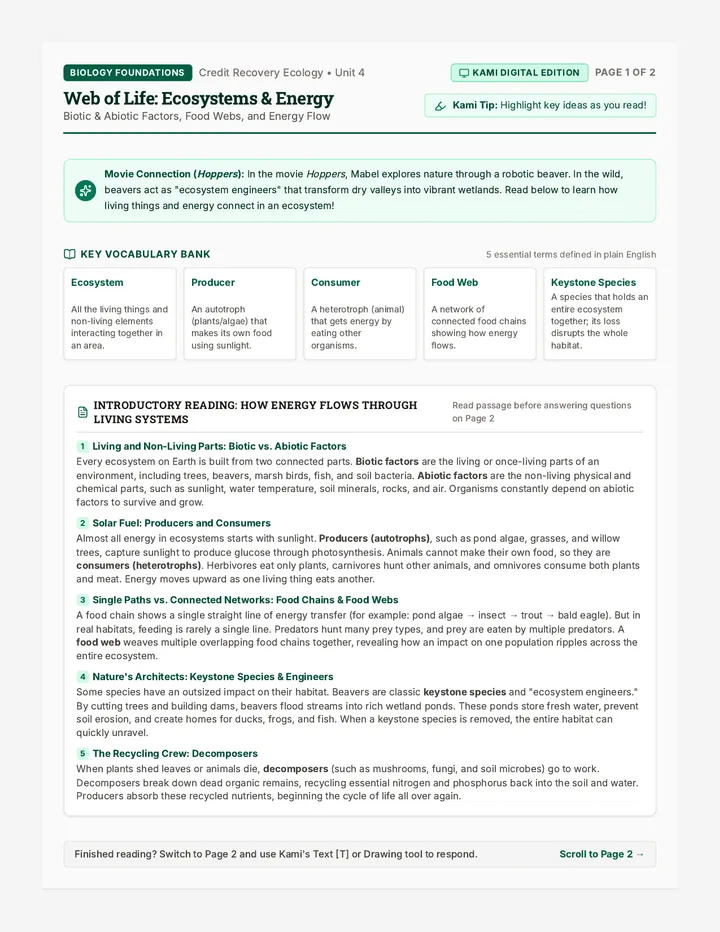
Web of Life Worksheet

Web of Life

An ecology and energy flow biology lesson designed for credit recovery students, featuring reading comprehension, movie connections, and digital activities.

MH

Meagan Hudson

2
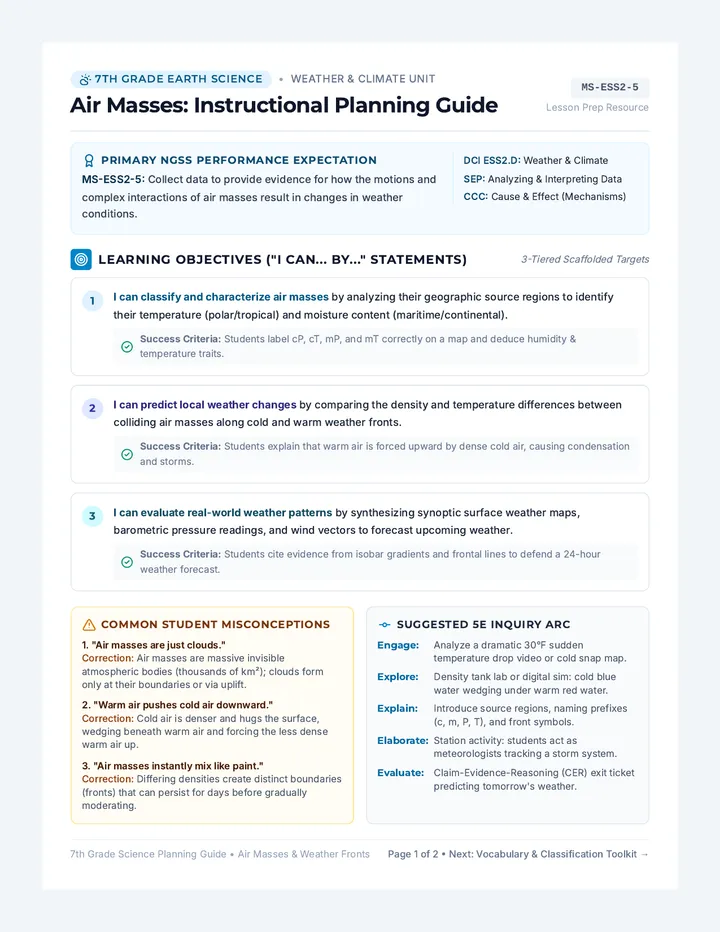
Air Masses Planning Guide

Air Masses Planning Guide

A comprehensive 7th-grade science teacher planning guide featuring NGSS standards, three scaffolded 'I can... by...' learning objectives, success criteria, an academic vocabulary matrix with source region classifications, and instructional scaffolding.

MH

Mason Hermges

Pesky Biters Slides

Bug Busters

A two-part fifth-grade science sequence investigating how insects can be annoying nuisances, bite and sting, and damage crops and homes. Specially scaffolded with high-visual supports, decodable text chunks, and guided practice for lower-literacy learners.

Lenny Avatar
Lenny
11
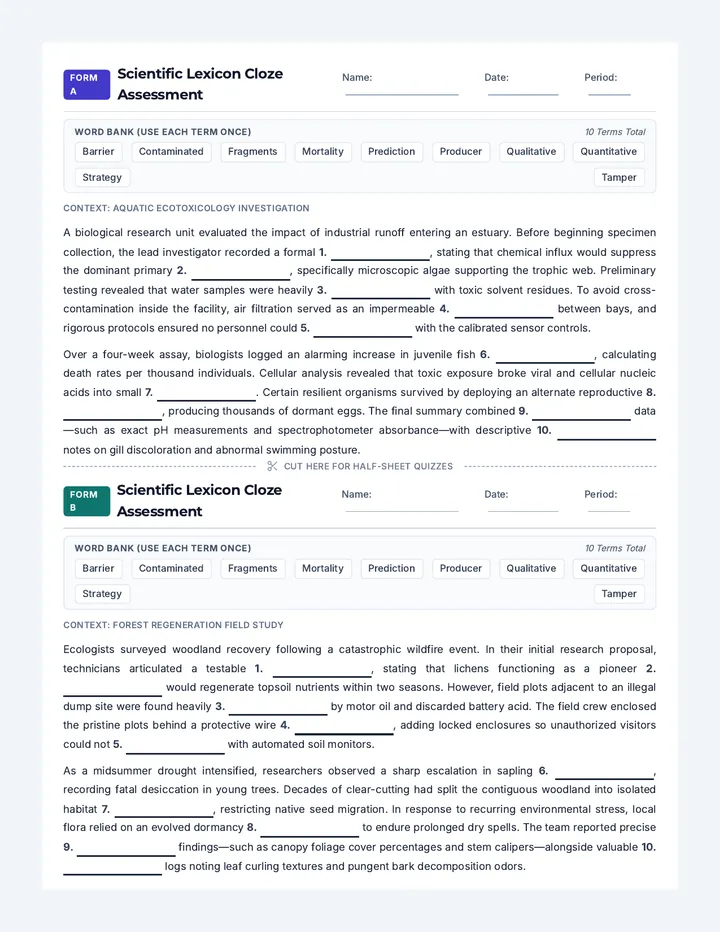
Scientific Lexicon Cloze Quiz

Scientific Lexicon Lab

A targeted vocabulary study exploring foundational scientific inquiry, ecology, and lab terminology through contextualized investigation scenarios. Includes parallel assessment forms and comprehensive grading resources.

J

jrand

2
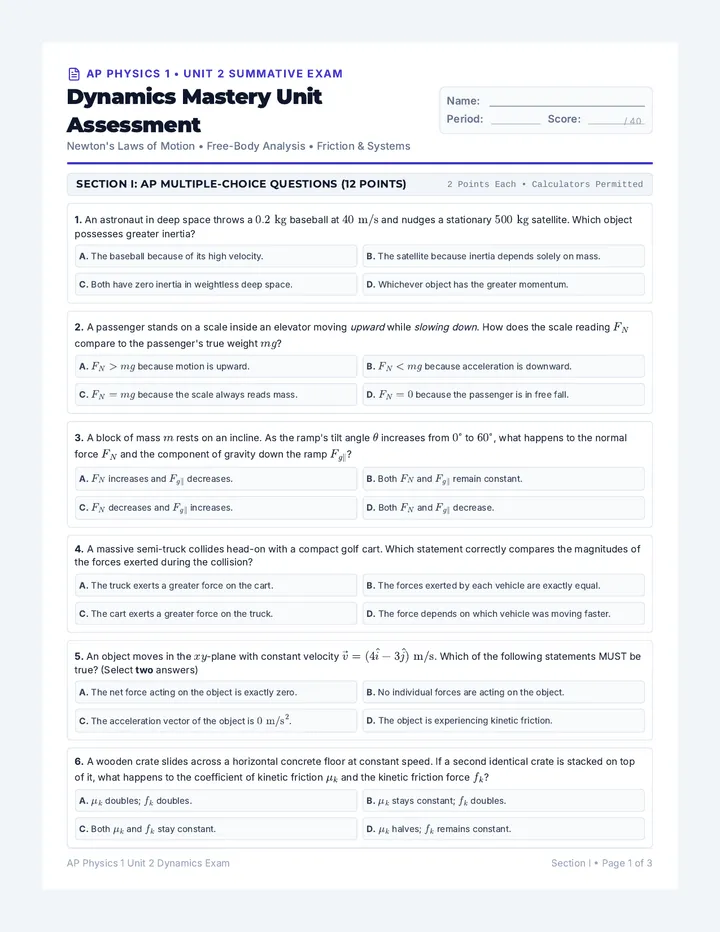
Dynamics Mastery Unit Assessment

Dynamics Mastery Unit Assessment

A three-page AP Physics 1 comprehensive unit assessment featuring AP-style multiple-choice questions, free-body diagram drawing tasks, and multi-part algebraic free response questions on Newton's laws and dynamics.

NK

Nadjia Khier

Helix Studio Slides

Candy Code Sequence

A multi-day competency-based biology sequence exploring DNA architecture, complementary base pairing, and semi-conservative replication through tactile candy modeling and evidence-based assessment.

TM

Teri Minami

4
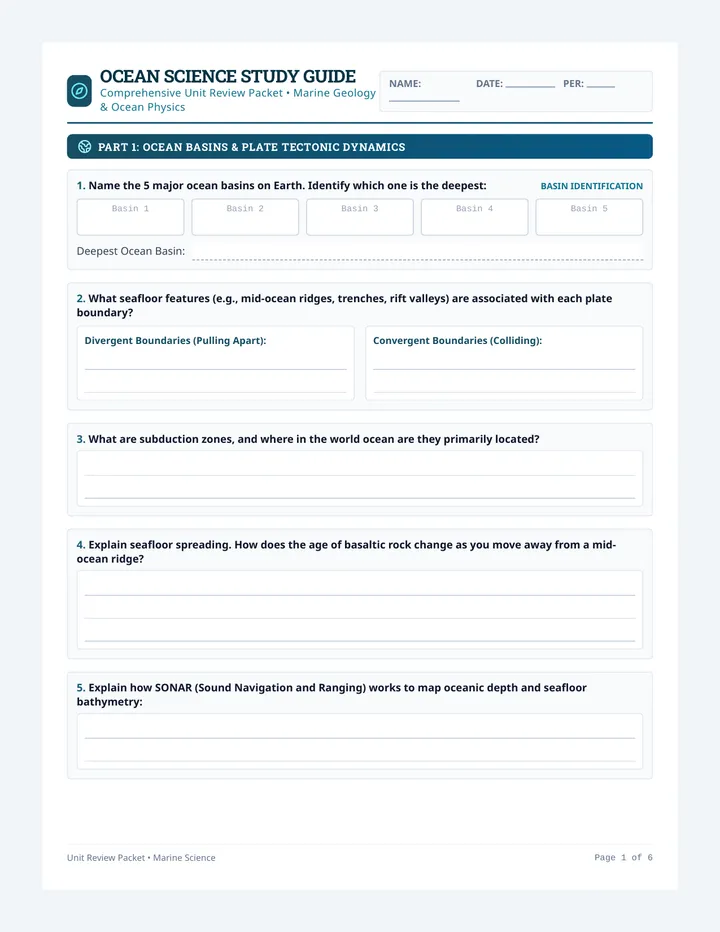
Ocean Realm Study Guide

Ocean Dynamics and Depths

An in-depth marine science unit exploring tectonic seafloor features, continental margin bathymetry, water chemistry, ocean stratification, light penetration, and hydrostatic pressure.

D

dfleisch

2
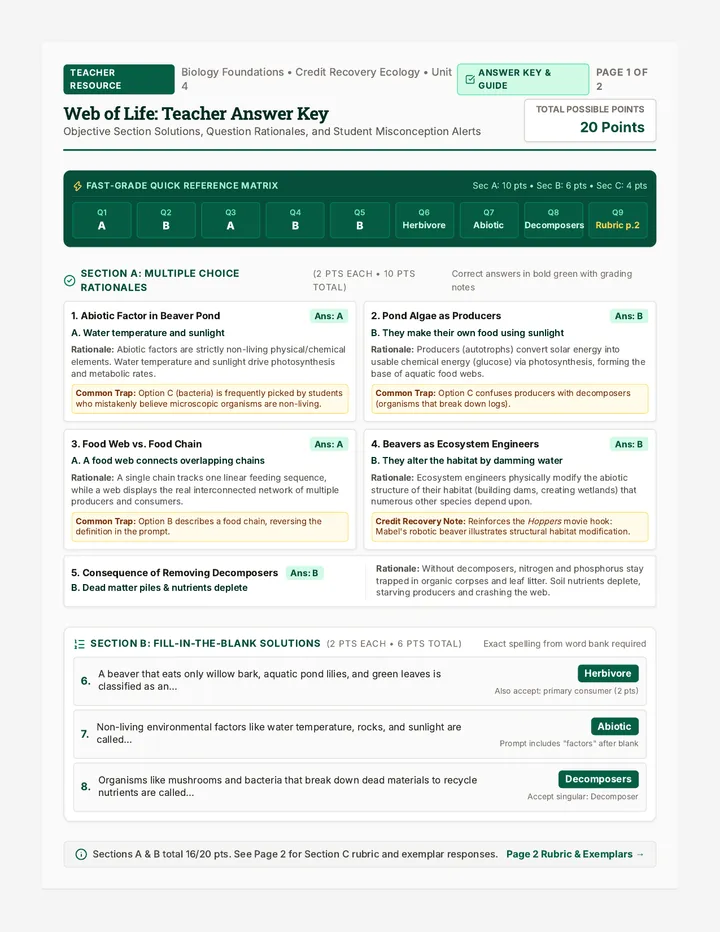
Web of Life Answer Key

Web of Life Answer Key

A complete 2-page teacher answer key and scoring guide for the Web of Life Worksheet, featuring an at-a-glance grading matrix, detailed rationales for multiple-choice questions with common student trap alerts, fill-in-the-blank answer criteria, a 4-point application rubric, tiered student exemplars, and credit recovery reteaching strategies.

MH

Meagan Hudson

Habitability Blueprint Slides

Life Beyond Limits

A one-week interdisciplinary astrobiology sequence investigating Earth's habitability, extreme biological adaptations across eleven Earth species, and the plausibility of life on other celestial bodies.

M

Megan.Tanner

7
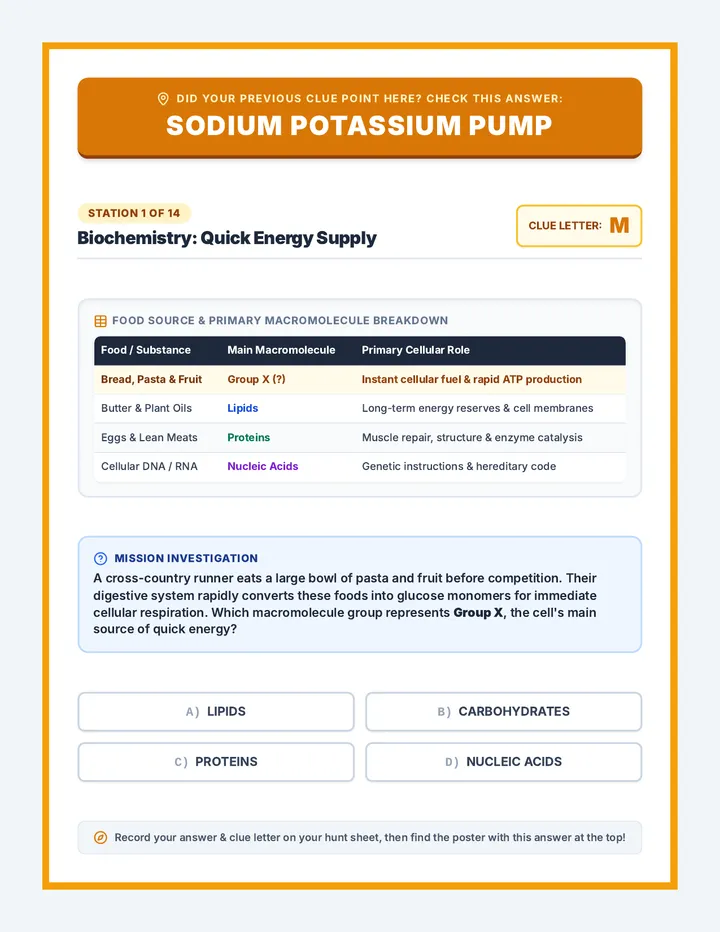
Bio Quest Station Posters

Biochem Transport Trek

A high-engagement around-the-room looping scavenger hunt covering biochemistry, macromolecules, enzyme kinetics, and cellular membrane transport. Students move dynamically through 16 clue-linked stations that form a continuous self-checking loop, featuring dedicated pure definition stations alongside graph and chart analysis.

M

MELANIE.ROBERTS

4
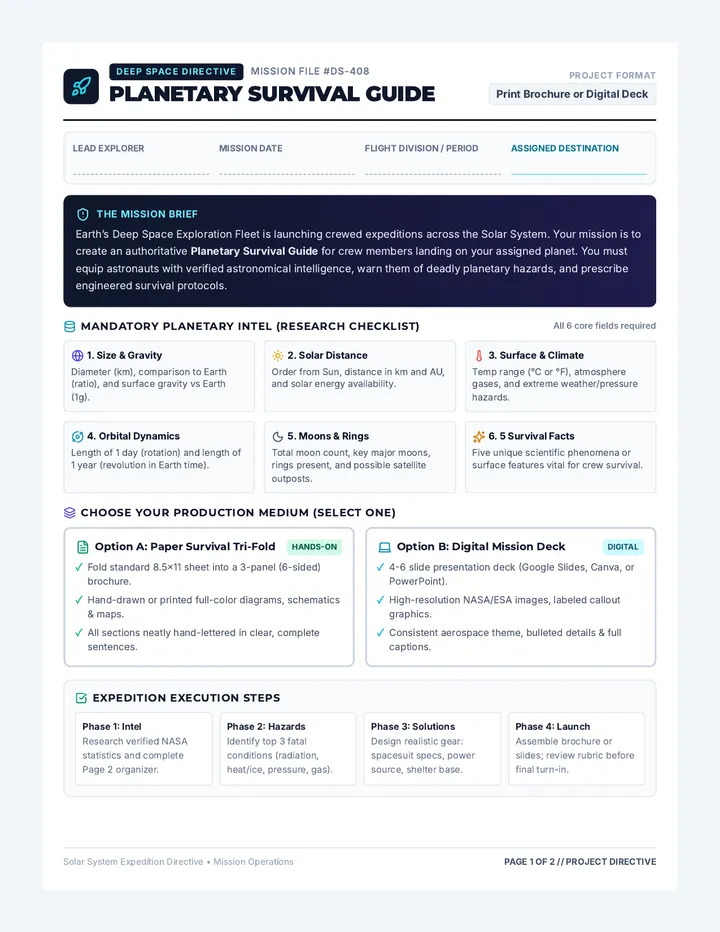
Planet Survival Project Guide

Planet Survival Project Guide

A comprehensive two-page student project guide and assessment rubric for an interplanetary survival guide. Students research planetary science conditions and design either a digital slide deck or a print tri-fold survival brochure to keep human explorers alive.

S

Shelby.Toll