Bio Quest Station Posters
Did your previous clue point here? Check this answer:
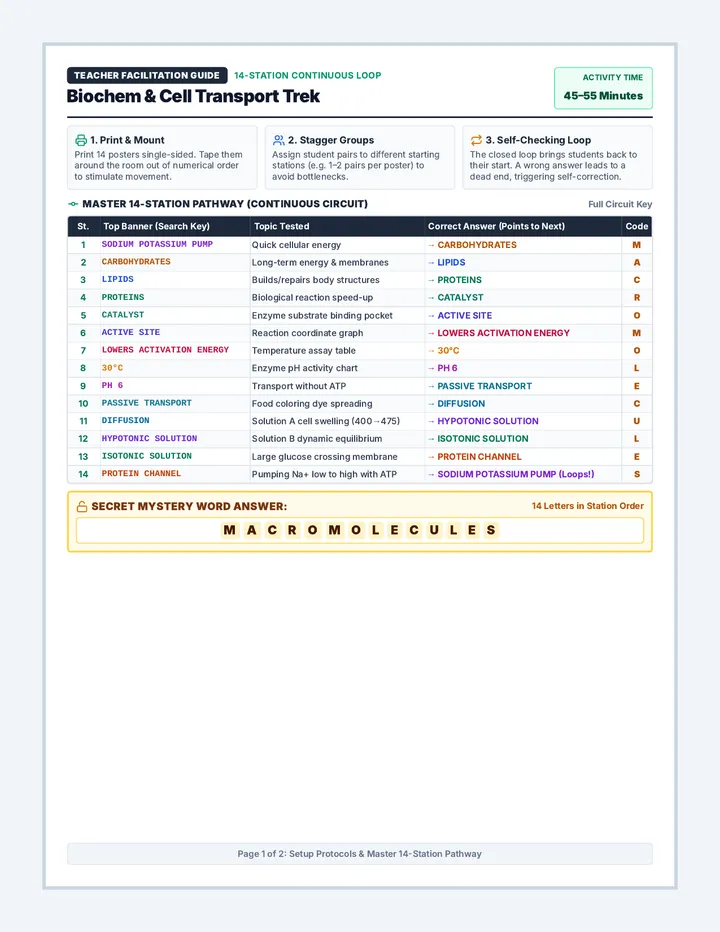
SODIUM POTASSIUM PUMP
Station 1 of 14
Biochemistry: Quick Energy Supply
Clue Letter: M
Food Source & Primary Macromolecule Breakdown
| Food / Substance | Main Macromolecule | Primary Cellular Role |
|---|
| Bread, Pasta & Fruit | Group X (?) | Instant cellular fuel & rapid ATP production |
| Butter & Plant Oils | Lipids | Long-term energy reserves & cell membranes |
| Eggs & Lean Meats | Proteins | Muscle repair, structure & enzyme catalysis |
| Cellular DNA / RNA | Nucleic Acids | Genetic instructions & hereditary code |
Mission Investigation
A cross-country runner eats a large bowl of pasta and fruit before competition. Their digestive system rapidly converts these foods into glucose monomers for immediate cellular respiration. Which macromolecule group represents Group X, the cell's main source of quick energy?
A) LIPIDS
B) CARBOHYDRATES
C) PROTEINS
D) NUCLEIC ACIDS
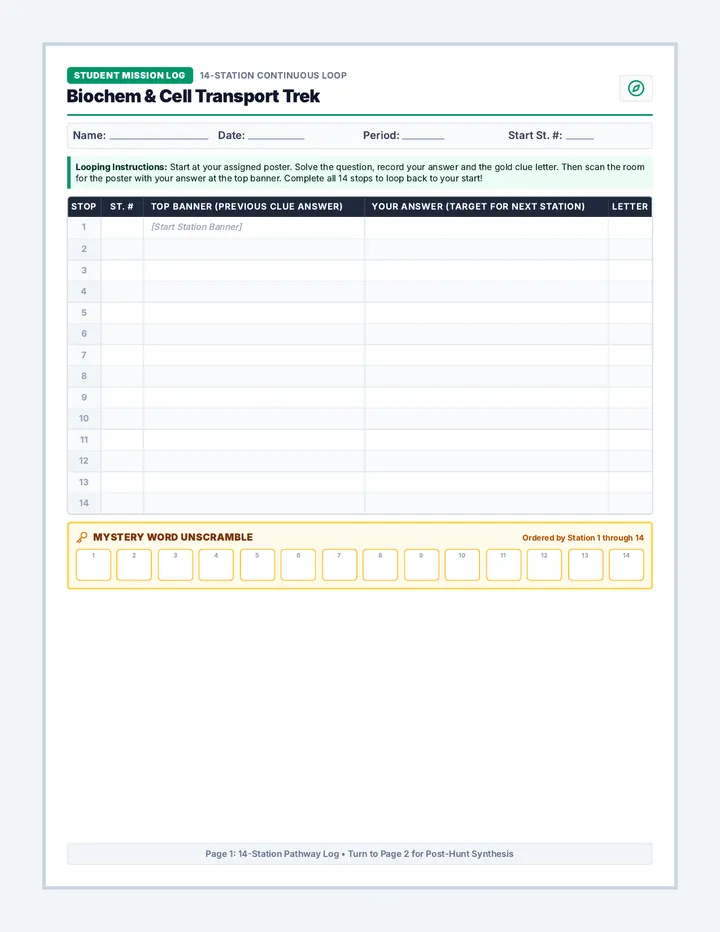
Record your answer & clue letter on your hunt sheet, then find the poster with this answer at the top!
Did your previous clue point here? Check this answer:
CARBOHYDRATES
Station 2 of 14
Biochemistry: Long-Term Storage & Barriers
Clue Letter: A
Triglyceride & Phospholipid Structural Properties
Glycerol Head Hydrophobic Hydrocarbon Chains (High Energy C-H Bonds) KEY JOBS: • 9 kcal/gram • Long-term store • Cell membranes • Waterproofing
Mission Investigation
Migrating birds and hibernating bears rely on concentrated chemical reserves to survive for months without food. Furthermore, these molecules create the waterproof boundary surrounding every cell. Which macromolecule stores energy for long periods and helps form cell membranes?
A) NUCLEIC ACIDS
B) CARBOHYDRATES
C) LIPIDS
D) ENZYME COMPLEX
Record your answer & clue letter on your hunt sheet, then find the poster with this answer at the top!
Did your previous clue point here? Check this answer:
LIPIDS
Station 3 of 14
Biochemistry: Structural Building Blocks
Clue Letter: C
Clinical Nutrition Case: Tissue Reconstruction
Patient Profile: Post-Surgery Recovery
To heal incision sites and rebuild damaged muscle filaments (actin and myosin), doctors prescribe an enriched diet of eggs, poultry, and legumes.
Target Monomer: Amino Acids linked by peptide bonds to form 3D functional polypeptides.
Polypeptide Chain Folding Amino Acid Chain → Functional Protein
Mission Investigation
A student wants food that helps build and repair body tissues, reconstruct damaged cellular structures, and produce biological catalysts. Which class of macromolecules is specifically responsible for building and repairing muscles and body structures?
A) LIPIDS
B) CARBOHYDRATES
C) PROTEINS
D) NUCLEIC ACIDS
Record your answer & clue letter on your hunt sheet, then find the poster with this answer at the top!
Did your previous clue point here? Check this answer:
PROTEINS
Station 4 of 14
Enzymes: Biological Acceleration
Clue Letter: R
Reaction Speed Comparison (With vs. Without Enzyme)
Uncatalyzed Reaction
100 Years
Molecules collide sluggishly at room temperature; bonds rarely break.
Enzyme-Assisted Reaction
0.001 Seconds!
Speed multiplied over 10 million times without altering final equilibrium.
Enzyme molecules remain unchanged and can be continuously reused for thousands of successive reactions!
Mission Investigation
Chemical reactions inside cells must occur rapidly to sustain life. Enzymes are specialized proteins that speed up the rate of chemical reactions without being consumed in the process. What general scientific term describes any agent that speeds up a reaction?
A) INHIBITOR
B) MONOSACCHARIDE
C) CATALYST
D) NUCLEOTIDE
Record your answer & clue letter on your hunt sheet, then find the poster with this answer at the top!
Did your previous clue point here? Check this answer:
CATALYST
Station 5 of 14
Enzymes: Substrate Docking Anatomy
Clue Letter: O
Lock-and-Key Catalytic Mechanism
SUBSTRATE ENZYME TARGET DOCKING ZONE (?) E-S Complex Specific Complementary Fit Products Released (Enzyme Unchanged)
Mission Investigation
Enzymes are highly selective catalysts. A chemical reaction will only occur when the reactant substrate binds directly to a specifically folded 3D pocket on the enzyme molecule. What is the job of an enzyme's active site?
A) IT STORES WATER
B) ACTIVE SITE
C) IT REPLICATES DNA
D) CELL BILAYER PORE
Record your answer & clue letter on your hunt sheet, then find the poster with this answer at the top!
Did your previous clue point here? Check this answer:
ACTIVE SITE
Station 6 of 14
Enzymes: Reaction Coordinate Kinetics
Clue Letter: M
Potential Energy vs. Reaction Progress Figure 6.1
Energy Progress of Reaction → Reactants Products Without Enzyme (High EA) With Enzyme (Low EA)
Mission Investigation
Activation energy is the minimum quantity of energy that reactant molecules must possess in order to undergo a chemical reaction. According to the graph, what does an enzyme do to the activation energy of a reaction to make it occur faster?
A) RAISES PRODUCT ENERGY
B) LOWERS ACTIVATION ENERGY
C) CREATES NEW ATOMS
D) REVERSES REACTION
Record your answer & clue letter on your hunt sheet, then find the poster with this answer at the top!
Did your previous clue point here? Check this answer:
LOWERS ACTIVATION ENERGY
Station 7 of 14
Enzyme Kinetics: Temperature Data
Clue Letter: O
Substrate Breakdown at Different Temperatures Lab Data Table 7.2
| Temperature (°C) | Food Broken Down (Units) | Observed Reaction Status |
|---|
| 10°C | 2 units | Slow molecular movement |
| 20°C | 5 units | Increasing collision rate |
| 30°C | 9 units (PEAK) | Optimum catalytic activity |
| 40°C | 6 units | Thermal breakdown begins |
| 50°C | 1 unit | Denatured (Active site lost shape) |
Thermal Denaturation: Excessive heat disrupts hydrogen bonds maintaining the enzyme's 3D shape, warping the active site so substrates can no longer bind!
Mission Investigation
A student measures how much food is broken down by an enzyme at different temperatures. Study the data table. At which temperature did this enzyme work best (optimum temperature)?
A) 10°C
B) 20°C
C) 30°C
D) 50°C
Record your answer & clue letter on your hunt sheet, then find the poster with this answer at the top!
Did your previous clue point here? Check this answer:
30°C
Station 8 of 14
Enzyme Factors: pH Optimum
Clue Letter: L
Enzyme Catalytic Activity Across pH Spectrum Assay 8.4
| pH Level | 2 | 4 | 6 | 8 | 10 |
|---|
| Enzyme Activity | 1 | 4 | 8 (MAX) | 5 | 2 |
1 pH 2 4 pH 4 8 ★ pH 6 5 pH 8 2 pH 10
Mission Investigation
Use the data chart and bar graph. Higher numbers signify greater catalytic breakdown of substrate. At which pH level did this biological enzyme achieve its highest activity?
A) PH 2
B) PH 4
C) PH 6
D) PH 10
Record your answer & clue letter on your hunt sheet, then find the poster with this answer at the top!
Did your previous clue point here? Check this answer:
PH 6
Station 9 of 14
Cell Transport: Energy Requirements
Clue Letter: E
Transport Mechanism Classification Matrix
| Type of Transport | Uses Cell Energy? | Concentration Gradient | Biological Example |
|---|
| Diffusion | NO | High → Low | Oxygen gas enters lung capillaries |
| Osmosis | NO | High → Low | Water moves across membrane |
| Facilitated Diffusion | NO | High → Low | Glucose glides through channels |
| Active Transport | YES (Uses ATP) | Low → High (Against) | Pumping minerals against gradient |
Mission Investigation
Diffusion, osmosis, and channel-facilitated diffusion allow substances to cross the membrane naturally from high to low concentration. What general category of cellular movement describes transport that does not require the cell to use energy (ATP)?
A) PASSIVE TRANSPORT
B) REVERSE OSMOSIS
C) ENDOCYTOSIS
D) CELLULAR DIGESTION
Record your answer & clue letter on your hunt sheet, then find the poster with this answer at the top!
Did your previous clue point here? Check this answer:
PASSIVE TRANSPORT
Station 10 of 14
Passive Transport: Spontaneous Spreading
Clue Letter: C
Observation: Food Coloring Dispersal Over Time Demo 10.3
0 Seconds Concentrated Drop
2 Minutes High → Low Gradient
10 Minutes Dynamic Equilibrium
Mission Investigation
A single drop of food coloring is placed in a glass of still water. Over time, the color particles disperse evenly throughout the liquid. What is the fundamental movement of particles from an area of high concentration to low concentration called?
A) DIFFUSION
B) ACTIVE PINOCYTOSIS
C) PEPTIDE SYNTHESIS
D) SODIUM INVERSION
Record your answer & clue letter on your hunt sheet, then find the poster with this answer at the top!
Did your previous clue point here? Check this answer:
DIFFUSION
Station 11 of 14
Osmosis: Solution A Volume Analysis
Clue Letter: U
Solution A Osmosis Trial: Cell Swelling Trial A
Outside Solution A 450 Solute • 550 Water CELL 600 Solute 400 Water
Water Trial Measurements:
Inside Cell at Start:400 units water
Outside Solution A:550 units water
Cell After 10 min:475 units water
Cell GAINED water → SWELLS!
Mission Investigation
A cell is placed in Solution A. The surrounding solution has less dissolved solute (450 vs. 600) and more water than the cell. Water moves into the cell, expanding its volume from 400 to 475 units. What happened, and what type of solution is Solution A?
A) HYPOTONIC SOLUTION
B) HYPERTONIC SOLUTION
C) EQUILIBRATED ACID
D) PLASMOLYZED BRINE
Record your answer & clue letter on your hunt sheet, then find the poster with this answer at the top!
Did your previous clue point here? Check this answer:
HYPOTONIC SOLUTION
Station 12 of 14
Osmosis: Solution B Dynamic Equilibrium
Clue Letter: L
Solution B Osmosis Trial: Balanced Water Exchange Trial B
Outside Solution B 300 Solute • 700 Water CELL 300 Solute 700 Water
Equilibrium Measurements:
Inside Cell Solute:300 units
Outside Solution Solute:300 units
Cell Water Change:700 → 700 (0 Change)
Water flows in and out EQUALLY!
Mission Investigation
Look at Solution B in the chart. There are 300 units of solute and 700 units of water inside the cell, and exactly 300 units of solute and 700 units of water in the surrounding beaker. Water moves into and out of the cell at equal rates, maintaining constant cell volume. What type of solution is Solution B?
A) HYPERTONIC SOLUTION
B) ISOTONIC SOLUTION
C) DISSOLVED ACID
D) POLAR SOLVENT
Record your answer & clue letter on your hunt sheet, then find the poster with this answer at the top!
Did your previous clue point here? Check this answer:
ISOTONIC SOLUTION
Station 13 of 14
Facilitated Transport: Channel Gateways
Clue Letter: E
Membrane Penetration: Small Oxygen vs. Large Glucose Figure 13.5
Lipid Bilayer Oxygen (Small) Slips through lipids Glucose (Large) Open Pore ← MYSTERY PROTEIN (Passive Facilitated Diffusion: NO ATP)
Mission Investigation
Look at the membrane transport diagram. Small oxygen molecules slip easily through the hydrophobic lipid bilayer. However, large polar molecules like glucose require a specialized transmembrane tunnel to glide into the cell down their gradient without energy. What is this protein structure called?
A) LIPID LEAFLET
B) PROTEIN CHANNEL
C) FATTY ACID TAIL
D) PEPTIDOGLYCAN
Record your answer & clue letter on your hunt sheet, then find the poster with this answer at the top!
Did your previous clue point here? Check this answer:
PROTEIN CHANNEL
Station 14 of 14
Active Transport: ATP-Powered Pumps
Clue Letter: S
Active Transport: Moving Ions Against Gradient Schematic 14.6
PUMP ATP Fuel → [HIGH] [LOW]
Sodium Ion (Na+) Table:
<table class="w-full text-[10px] text-center border"><tbody><tr class="bg-slate-100 font-bold"><td>Time</td><td>Inside Cell</td><td>Outside Cell</td></tr><tr><td>0 sec</td><td>250 mM</td><td>550 mM</td></tr><tr><td>90 sec</td><td>400 mM</td><td>400 mM</td></tr></tbody></table>
Transporters that move molecules from low to high concentration use ATP energy as fuel!
Mission Investigation
Protein pumps work by moving ions from low concentration to high concentration across the membrane using ATP energy as fuel, unlike passive diffusion. What active transporter actively pumps sodium and potassium against their concentration gradients to power nerve cells?
A) SODIUM POTASSIUM PUMP
B) PASSIVE PORE
C) AMINO ACID CHANNEL
D) PHOSPHATE TAIL
Record your final answer & clue letter! This clue leads you directly back to Station 1 to close your loop!