Lenny.com
Explore
Create
ActivitiesNewMathEnglish Language ArtsScience & EngineeringSocial StudiesGlobal LanguagesHealth & Physical EducationSpecial EducationCounseling & Life SkillsArts & CreativityESL
Lenny.com
Lenny.com
Explore
Create
ActivitiesNewMathEnglish Language ArtsScience & EngineeringSocial StudiesGlobal LanguagesHealth & Physical EducationSpecial EducationCounseling & Life SkillsArts & CreativityESL
Lenny.com
Lenny.com

Solutions

Lenny for EducatorsLenny for SchoolsLenny for Districts

Product

ExploreSign inCreateSupportAbout

Resources

Getting startedMTSS Acceleration Program

© 2026 Lenny Learning Inc.

TermsPrivacyAccessibility
LinkedInInstagramX
Lenny
Science & EngineeringLife ScienceLiving ThingsAnimalsPlantsBody SystemsTraitsAdaptationsCellsEcosystemsHeredityGenes to TraitsCell DivisionPhysicsComparing MaterialsShapes and PropertiesMagnetsMagnetismLightSoundLight and SoundMatterStates of MatterChanges of StateMixturesPhysical and Chemical ChangeHeating and CoolingHeat and Thermal EnergyEnergyForce and MotionElectrical CircuitsAtoms and MoleculesPeriodic TableMotion in One DimensionMotion in Two DimensionsScalars and VectorsForces and Laws of MotionCircular Motion and GravityMomentum and ImpulseWork, Energy, and PowerWavesElectromagnetic WavesGeometric OpticsElectricity and MagnetismSimple Harmonic MotionThermodynamicsNuclear PhysicsEarth Science & AstronomyWeatherWater CycleRocks and MineralsFossilsEarth's FeaturesEarth's ResourcesEarth's StructureWeather and ClimateEarth EventsFossils and Geologic TimePlate TectonicsHuman ImpactsAstronomyChemistryUnits and MeasurementAtomic StructurePeriodic TrendsChemical BondingNomenclatureMolecular StructureIntermolecular ForcesThe MoleStoichiometryProperties of GasesSolutionsChemical ReactionsBalancing EquationsEnergy ChangesRates of ReactionsEquilibriumAcids and BasesQuantum ModelBiologyClassificationCell StructureThe Chemistry of LifeBiomoleculesCellular TransportCell EnergyCell Growth and DivisionDNAProtein SynthesisMeiosis and Sexual ReproductionPatterns of InheritanceMulticellular OrganismsEvolutionEcologyBiodiversityComputer ScienceAlgorithms and Computational ThinkingProgramming LanguagesComputing SystemsNetworks and InternetData AnalysisCybersecurityAI and Machine LearningSoftware Design and DevelopmentBlockchainEngineering & AIDesigning ExperimentsEngineering PracticesDesign ThinkingEngineering Design ProcessMechanical EngineeringElectrical EngineeringMaterials and StructuresCAD and 3D DesignRoboticsArtificial Intelligence BasicsVibe CodingMachine LearningAI Ethics and SocietySystems ThinkingEntrepreneurship & InnovationEntrepreneurial MindsetBusiness Idea DevelopmentBusiness Plan BasicsMarketing & Customer DiscoveryFinancial Management for Startups

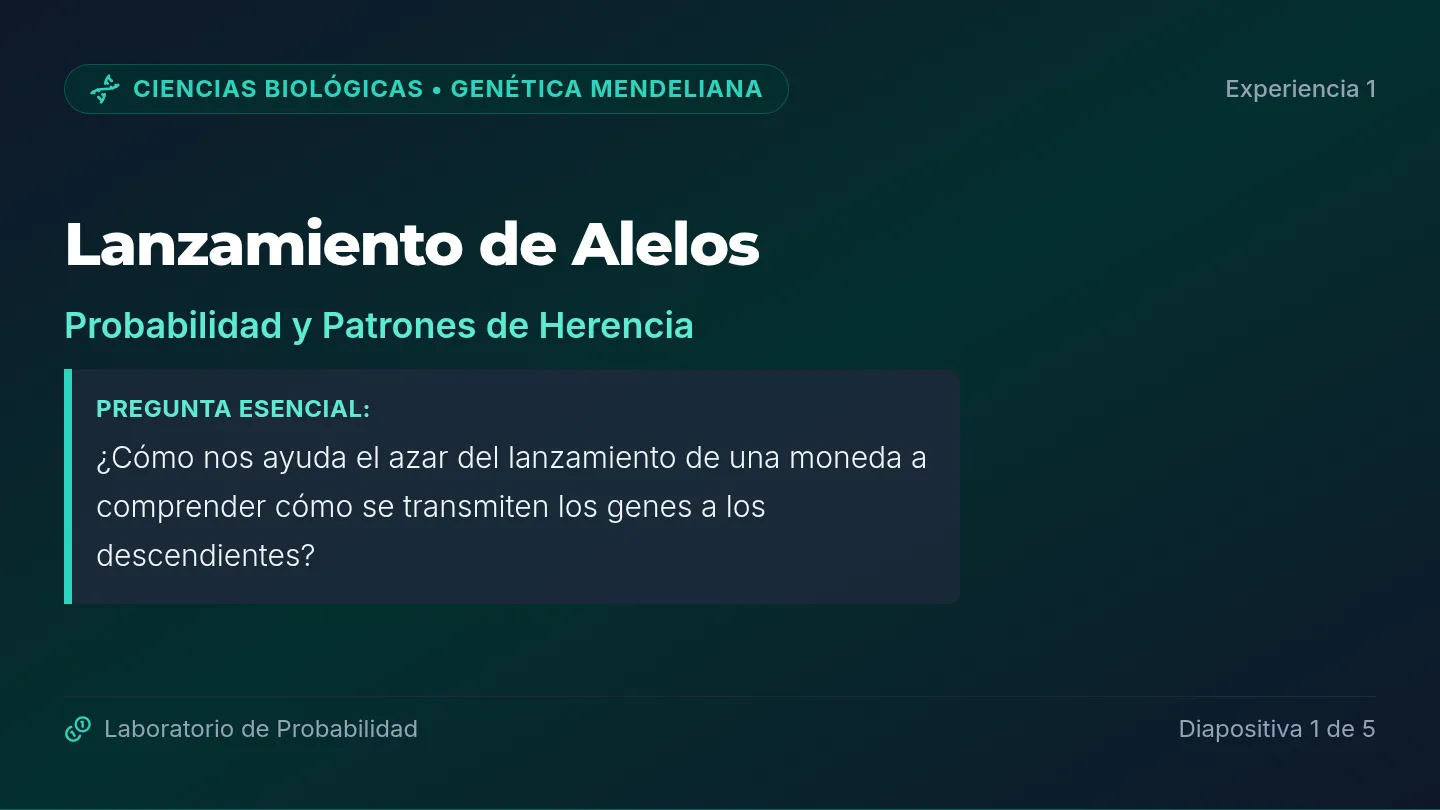
Lanzamiento de Alelos

Una lección interactiva de biología que conecta la probabilidad matemática del lanzamiento de monedas con los patrones de herencia mendeliana y la ley de segregación de alelos.

MBMarsha Bolden

Lanzamiento de Alelos

Una lección interactiva de biología que conecta la probabilidad matemática del lanzamiento de monedas con los patrones de herencia mendeliana y la ley de segregación de alelos.

MBMarsha Bolden
C Cara (C)50% (5 de 10)
X Cruz (X)50% (5 de 10)
Total100% (10 de 10)

Siguiente Paso: ¡Pasa a la Página 2 para analizar tus resultados y conectarlos con la genética mendeliana!

Laboratorio de Probabilidad con Monedas • Herencia Mendeliana Página 1 de 2

3 Parte 3: Tanque de Pensamiento Estudiantil

Responde en oraciones científicas completas utilizando los datos obtenidos en la Página 1.

Análisis de Laboratorio y Genética

Guía de Oración Científica (Utilízala para estructurar tu respuesta):

“Mi probabilidad experimental fue de _______ %, mientras que la probabilidad teórica era del 50%. Los resultados difirieron debido a que .”

P1

¿Coincidieron tus resultados reales con tus predicciones? Explica por qué los lanzamientos individuales son impredecibles aunque se conozca la probabilidad teórica general.

P2

¿Fue tu probabilidad experimental exactamente 50% caras y 50% cruces? ¿Por qué podría diferir, y qué ocurriría con tu porcentaje si lanzaras la moneda 1,000 veces en lugar de 10?

P3

Conexión con la Genética: ¿De qué manera el lanzamiento de una moneda nos ayuda a comprender la probabilidad de que un descendiente herede un alelo específico de un progenitor heterocigoto (genotipo Aa)?

Ley de Segregación de Mendel

Así como una moneda tiene un 50% de probabilidad de caer en Cara y 50% en Cruz, un progenitor heterocigoto (Aa) tiene un 50% de probabilidad de transmitir el alelo A y un 50% de transmitir el alelo a a cada gameto durante la meiosis.

Lista de Autoevaluación del Estudiante

Registré con precisión las 10 predicciones y resultados reales de los lanzamientos. Calculé la frecuencia y el porcentaje experimental aplicando la fórmula correcta. Comparé la probabilidad experimental y teórica explicando las razones de su diferencia. Expliqué cómo la probabilidad de la moneda se conecta directamente con la herencia de alelos.

Laboratorio de Probabilidad con Monedas • Herencia Mendeliana Página 2 de 2

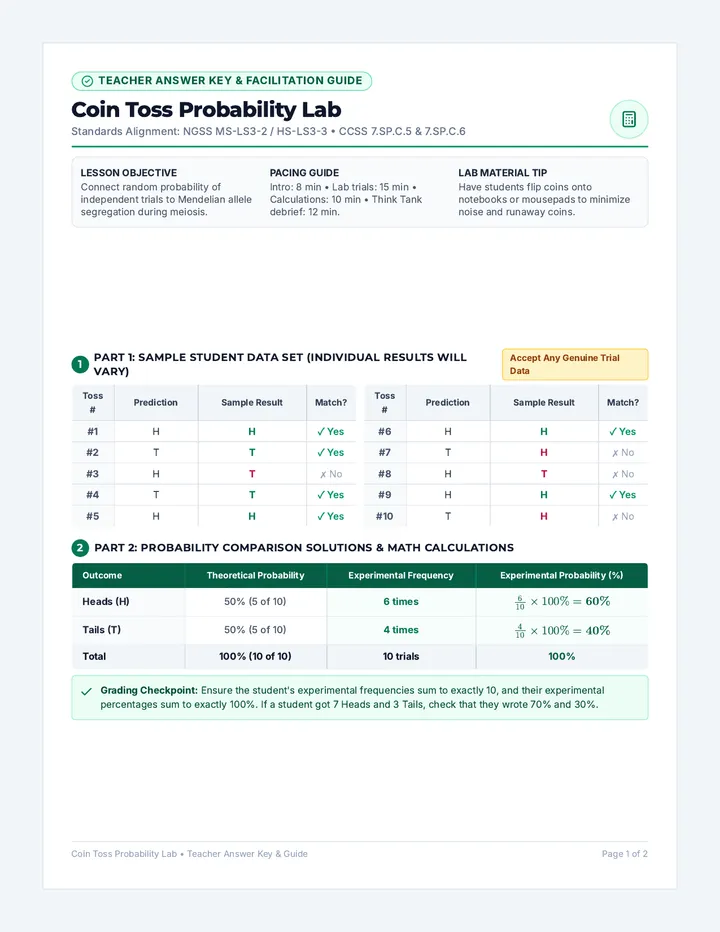
Coin Toss Probability Lab • Teacher Answer Key & Guide Page 1 of 2

3 Part 3: Think Tank Exemplar Responses & Rubric

Sample high-scoring student responses and core conceptual criteria.

Scoring Guide

Q1 Predictions vs. Actual Results (Mutual Independence) 2 pts

Exemplar Student Response: “My predictions did not match all actual results because each coin flip is an independent random event. Even though the overall chance of landing on heads or tails is always 50%, the coin has no memory of previous flips, making each individual toss unpredictable.”

Key Criterion: Student identifies that individual flips are independent events governed by chance.

Q2 Sample Size & Law of Large Numbers 3 pts

Exemplar Student Response: “My experimental probability was 60% heads and 40% tails, not exactly 50%. It differed because 10 tosses is a very small sample size, allowing random chance to cause variations. If I tossed the coin 1,000 times, the experimental probability would get much closer to the theoretical 50% due to the law of large numbers.”

Key Criterion: Student notes that small sample sizes produce variance and larger sample sizes converge toward 50%.

Q3 Genetics Connection: Mendel's Law of Segregation 3 pts

Exemplar Student Response: “In an organism with genotype Aa, the homologous chromosomes separate during meiosis. There is a 50% chance that a sperm or egg cell will receive allele A and a 50% chance it receives allele a. Flipping a coin models this 50/50 chance perfectly, where Heads represents allele A and Tails represents allele a.”

Key Criterion: Student links coin sides (H/T) to alleles (A/a) and the 50/50 segregation probability during meiosis.

Common Student Misconceptions & How to Address Them

  • Gambler's Fallacy: Students often think if they flip 3 heads in a row, the next flip “must” be tails. Remind them: the coin has no memory! Each toss is 50/50.
  • Punnett Square Guarantee: Students often believe a 3:1 Punnett square ratio guarantees exactly 3 dominant and 1 recessive in 4 children. Emphasize that Punnett squares show theoretical odds per fertilization event, not fixed outcomes.

Interactive Extension: Class Data Pool

Combine all student toss data on the board (e.g., 30 students × 10 tosses = 300 tosses). Watch the experimental percentage shift closer to 50% in real time!

Coin Toss Probability Lab • Teacher Answer Key & Guide Page 2 of 2

Reflexión Final

Muestra Pequeña (10 tiros)

Con pocas repeticiones, el azar causa variaciones notables: es normal obtener 60%-40%, 70%-30% o incluso 80%-20%.

Muestra Grande (1,000 tiros)

Ley de los Grandes Números: a mayor número de ensayos, la probabilidad experimental se aproxima casi exactamente al 50%.

Pregunta para el Cierre de Clase:

Si combinamos los datos de los 30 estudiantes del salón (300 lanzamientos), ¿se acercará el resultado más al 50%?

Tanque de Pensamiento Estudiantil Diapositiva 5 de 5
You might also like

Signal Anatomy Slides

Signal Masters

A hands-on systems engineering unit where 7th-grade students deconstruct communication components, model feedback loops and signal degradation, and engineer a custom communication system to solve a real-world scenario.

TC

Theresa Crafts

8
Design Brief Slides

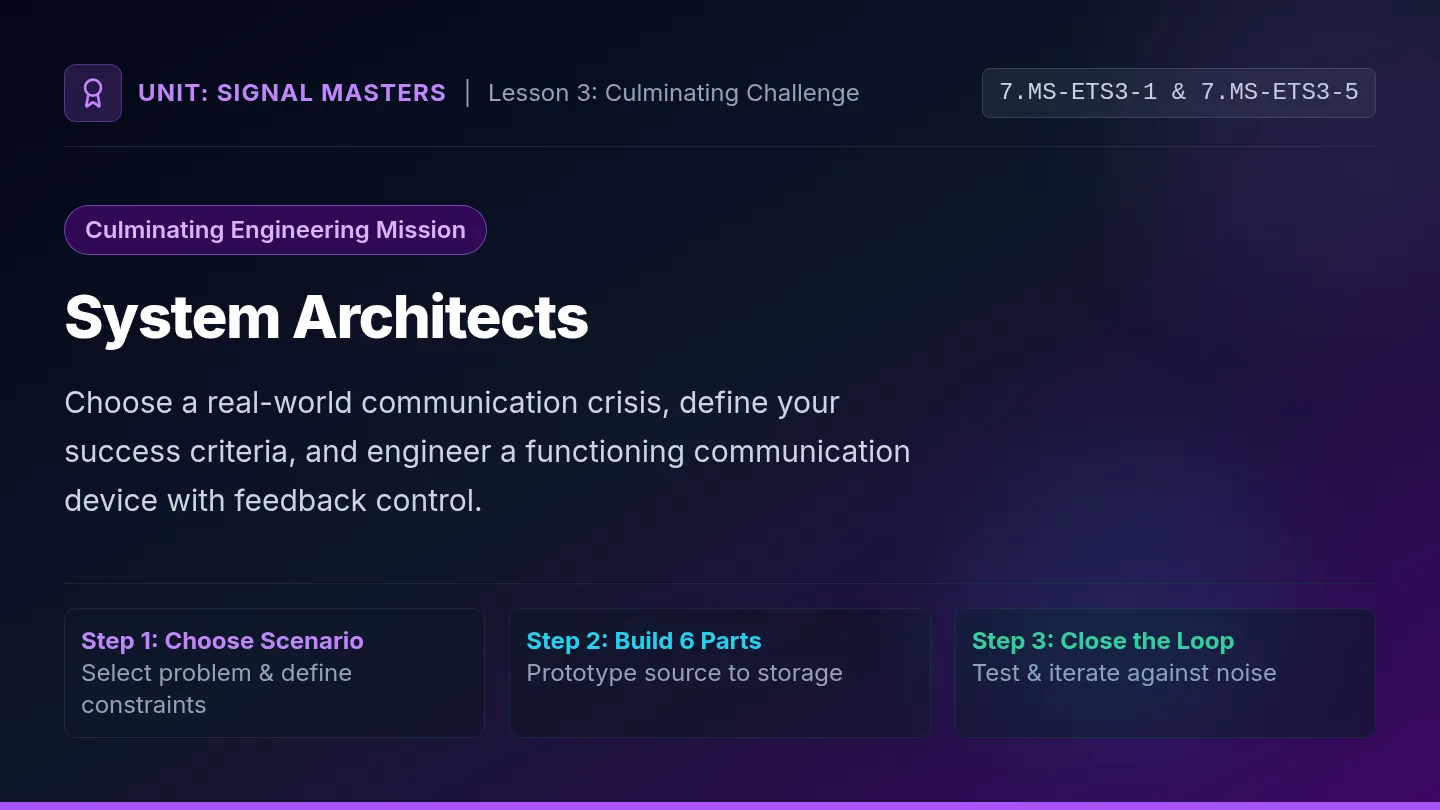
System Architects

Student teams select an authentic communication challenge, define criteria and constraints, engineer a functioning physical prototype, and validate performance with iterative feedback loops.

TC

Theresa Crafts

3
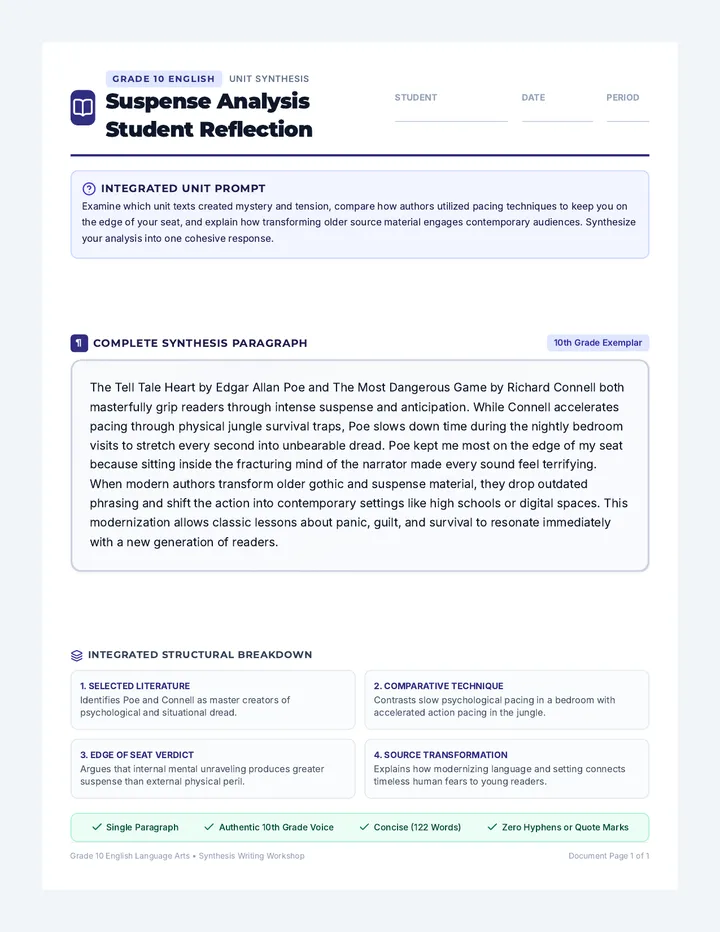
Suspense Analysis Student Reflection

Suspense Analysis Student Reflection

A single-paragraph tenth grade English Language Arts synthesis integrating text selection, comparative pacing techniques, psychological suspense, and source material transformations without hyphens or quote marks.

Lenny Avatar
Lenny
Helix Studio Slides

Candy Code Sequence

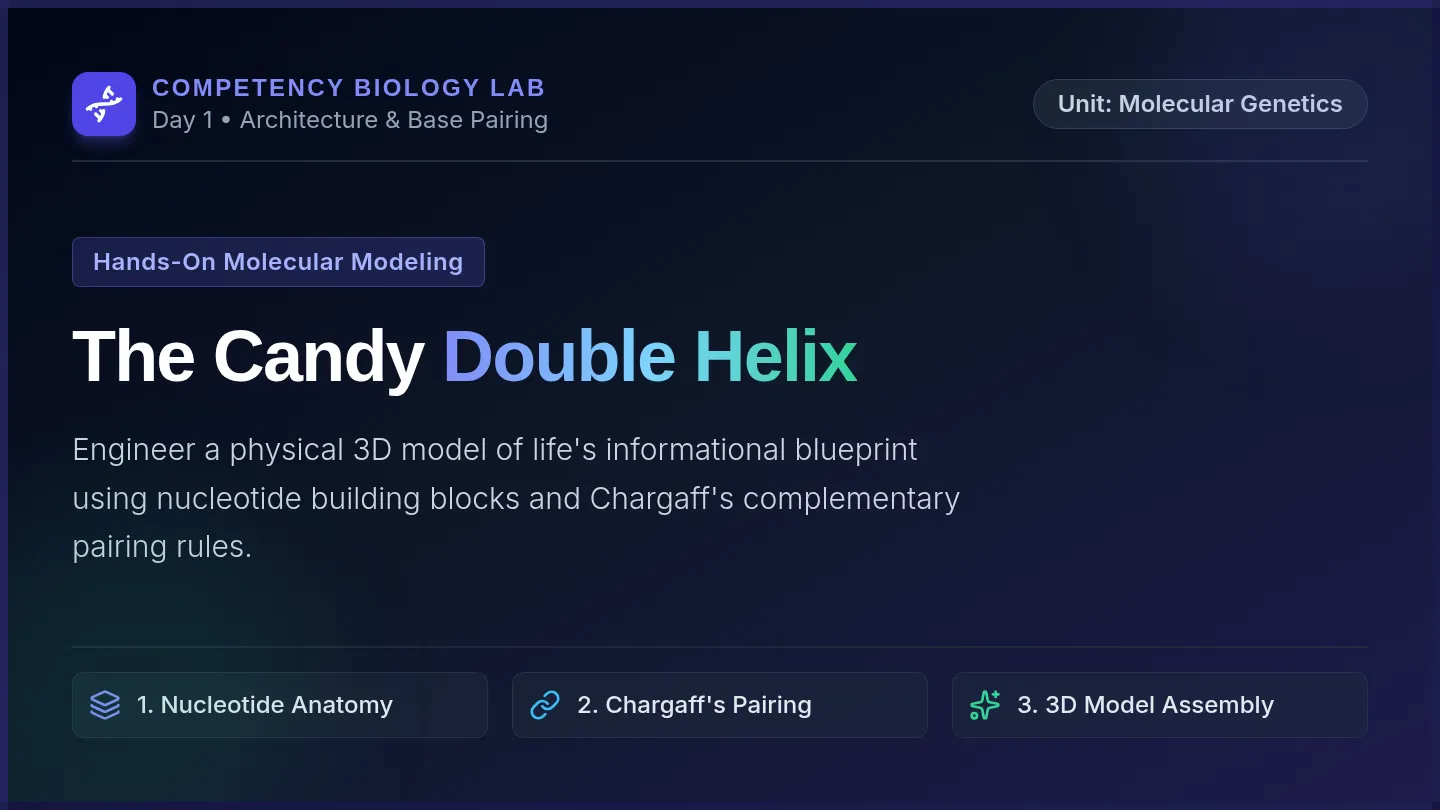
A multi-day competency-based biology sequence exploring DNA architecture, complementary base pairing, and semi-conservative replication through tactile candy modeling and evidence-based assessment.

TM

Teri Minami

6
System Feedback Slides

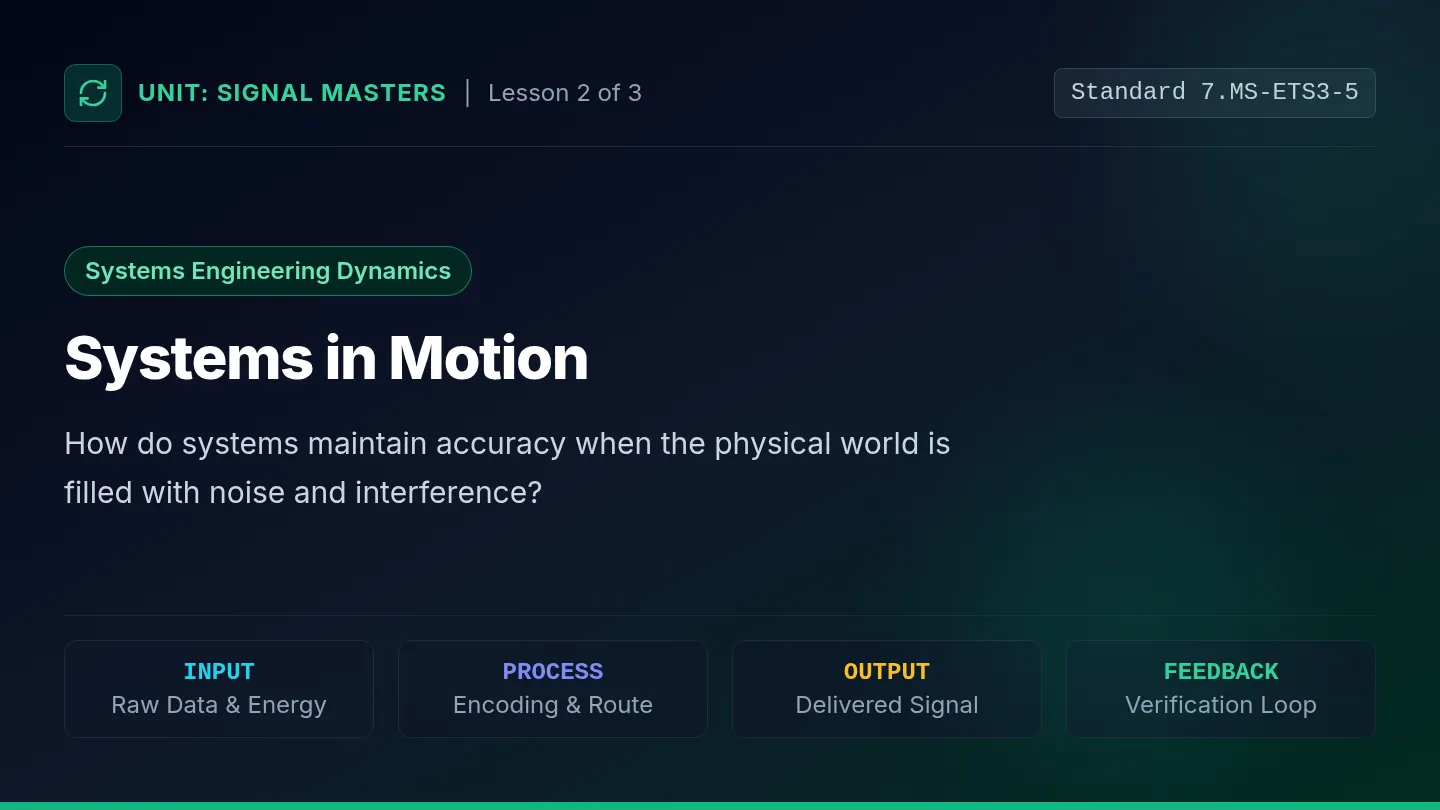
Feedback Loops

Students apply systems engineering concepts to analyze inputs, processes, outputs, noise interference, and feedback mechanisms within communication networks.

TC

Theresa Crafts

2
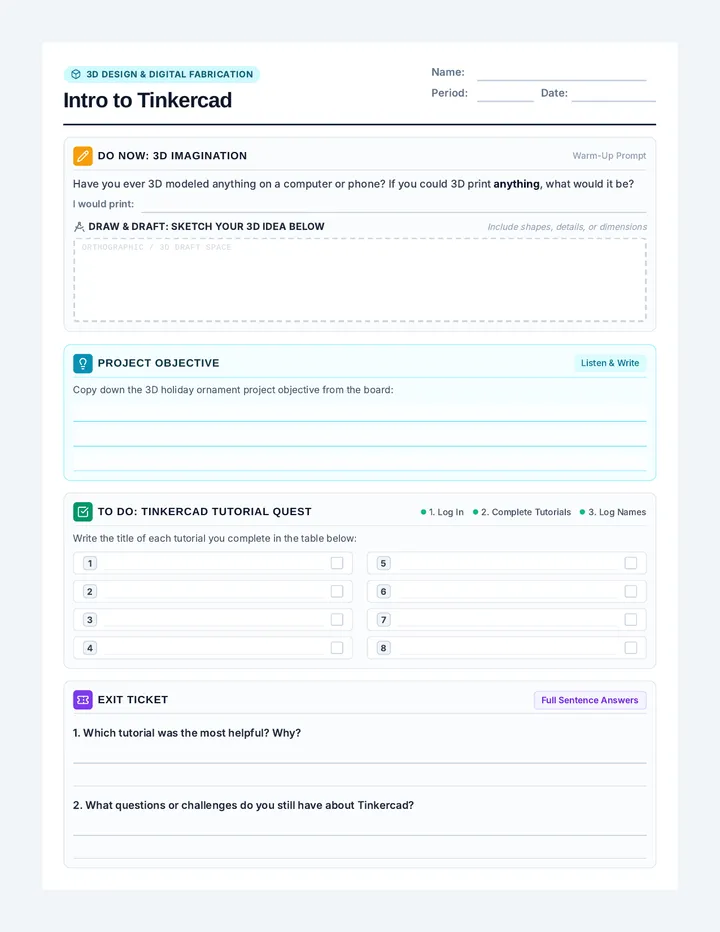
Tinkercad Kickoff Worksheet

Tinkercad Kickoff Worksheet

A student-ready, print-ready introductory 3D modeling worksheet for Tinkercad featuring a Do Now ideation warm-up and sketch grid, followed by a dedicated Project Objective section with writing lines to copy down the objective, an 8-part tutorial completion log, and an exit ticket.

LD

Laura Desimine

Pesky Biters Slides

Bug Busters

A two-part fifth-grade science sequence investigating how insects can be annoying nuisances, bite and sting, and damage crops and homes. Specially scaffolded with high-visual supports, decodable text chunks, and guided practice for lower-literacy learners.

Lenny Avatar
Lenny
11
Signal Anatomy Slides

Signal Anatomy

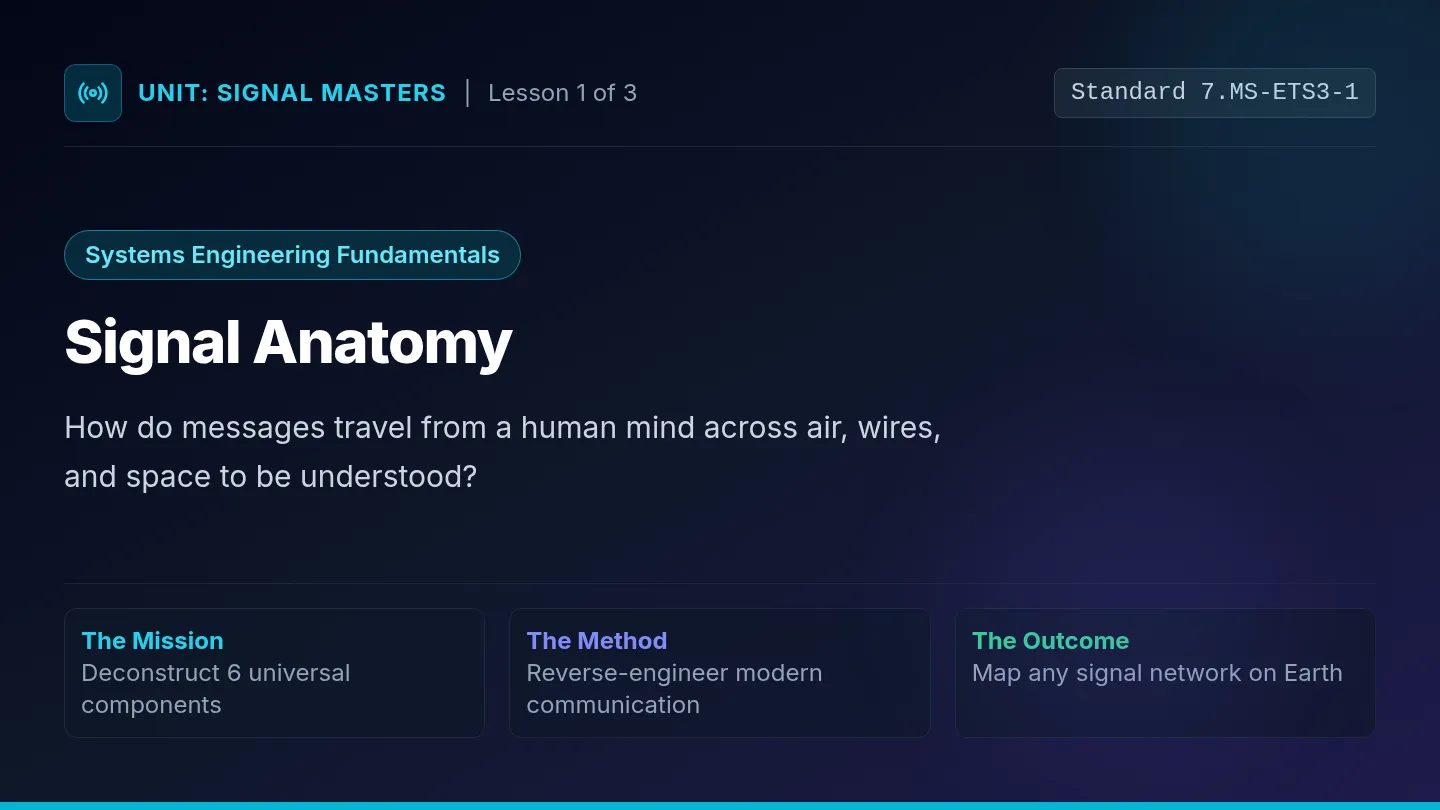
Students deconstruct how messages travel by investigating the six fundamental components of every communication system: source, encoder, transmitter, receiver, decoder, and storage.

TC

Theresa Crafts

3
Lanzamiento de Alelos Slides

Lanzamiento de Alelos Slides

Diapositivas instructivas en español para guiar la lección sobre probabilidad y genética mendeliana, explicando la probabilidad teórica vs experimental, la ley de segregación y la ley de los grandes números.

MB

Marsha Bolden

Helix Studio Slides

Candy Code Sequence

A multi-day competency-based biology sequence exploring DNA architecture, complementary base pairing, and semi-conservative replication through tactile candy modeling and evidence-based assessment.

TM

Teri Minami

4
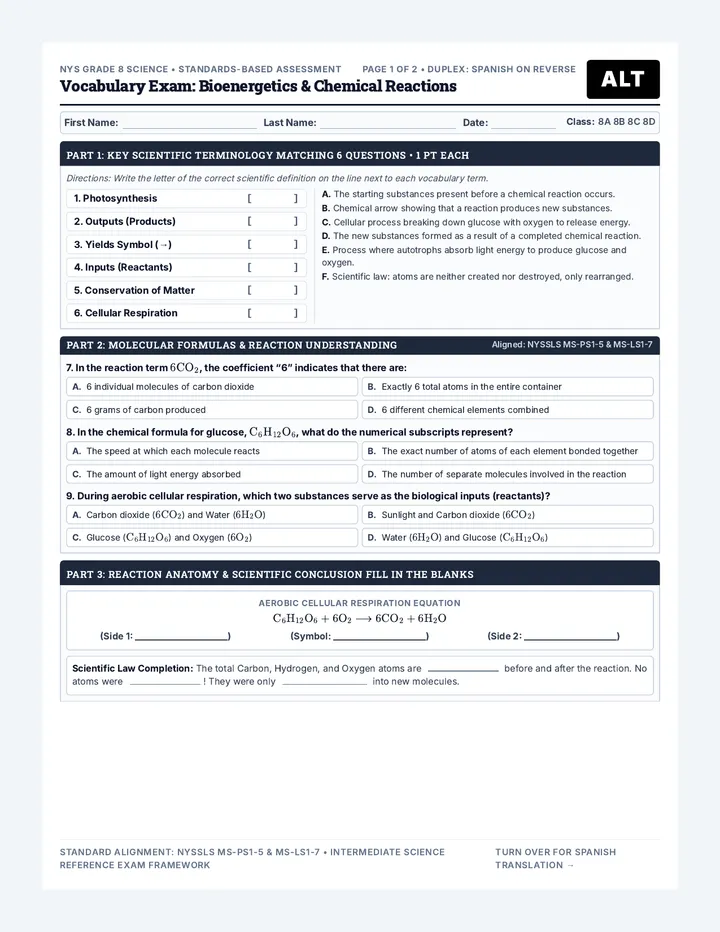
Bioenergetics Alternate Exam

Energy and Matter

A comprehensive science lesson focusing on cellular energy, photosynthesis, and respiration.

JE

Jeffrey Elterman

1
Coin Toss Teacher Key

Coin Toss Teacher Key

A comprehensive two-page teacher answer key and instructional guide in English featuring sample lab data, step-by-step probability calculations, exemplar responses, common misconceptions, and Mendelian genetics extensions.

MB

Marsha Bolden