Bioenergetics Alternate Exam
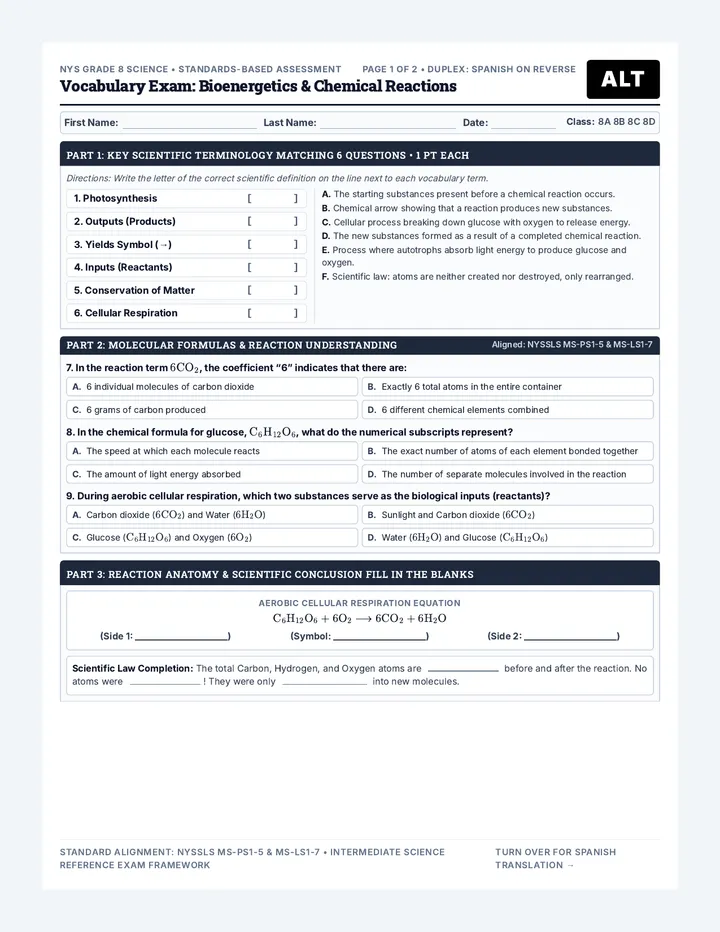
NYS GRADE 8 SCIENCE • STANDARDS-BASED ASSESSMENT Page 1 of 2 • Duplex: Spanish on Reverse
Vocabulary Exam: Bioenergetics & Chemical Reactions
ALT
First Name:
Last Name:
Date:
Class: 8A 8B 8C 8D
PART 1: KEY SCIENTIFIC TERMINOLOGY MATCHING 6 Questions • 1 pt each
Directions: Write the letter of the correct scientific definition on the line next to each vocabulary term.
1. Photosynthesis [ ]
2. Outputs (Products) [ ]
3. Yields Symbol (→) [ ]
4. Inputs (Reactants) [ ]
5. Conservation of Matter [ ]
6. Cellular Respiration [ ]
A. The starting substances present before a chemical reaction occurs.
B. Chemical arrow showing that a reaction produces new substances.
C. Cellular process breaking down glucose with oxygen to release energy.
D. The new substances formed as a result of a completed chemical reaction.
E. Process where autotrophs absorb light energy to produce glucose and oxygen.
F. Scientific law: atoms are neither created nor destroyed, only rearranged.
PART 2: MOLECULAR FORMULAS & REACTION UNDERSTANDING Aligned: NYSSLS MS-PS1-5 & MS-LS1-7
7. In the reaction term \(6\text{CO}_2\), the coefficient “6” indicates that there are:
A. 6 individual molecules of carbon dioxide
B. Exactly 6 total atoms in the entire container
C. 6 grams of carbon produced
D. 6 different chemical elements combined
8. In the chemical formula for glucose, \(\text{C}_6\text{H}_{12}\text{O}_6\), what do the numerical subscripts represent?
A. The speed at which each molecule reacts
B. The exact number of atoms of each element bonded together
C. The amount of light energy absorbed
D. The number of separate molecules involved in the reaction
9. During aerobic cellular respiration, which two substances serve as the biological inputs (reactants)?
A. Carbon dioxide (\(6\text{CO}_2\)) and Water (\(6\text{H}_2\text{O}\))
B. Sunlight and Carbon dioxide (\(6\text{CO}_2\))
C. Glucose (\(\text{C}_6\text{H}_{12}\text{O}_6\)) and Oxygen (\(6\text{O}_2\))
D. Water (\(6\text{H}_2\text{O}\)) and Glucose (\(\text{C}_6\text{H}_{12}\text{O}_6\))
PART 3: REACTION ANATOMY & SCIENTIFIC CONCLUSION Fill in the Blanks
AEROBIC CELLULAR RESPIRATION EQUATION
\(\text{C}_6\text{H}_{12}\text{O}_6 + 6\text{O}_2 \longrightarrow 6\text{CO}_2 + 6\text{H}_2\text{O}\)
(Side 1: _____________________)
(Symbol: _____________________)
(Side 2: _____________________)
Scientific Law Completion: The total Carbon, Hydrogen, and Oxygen atoms are before and after the reaction. No atoms were ! They were only into new molecules.
Standard Alignment: NYSSLS MS-PS1-5 & MS-LS1-7 • Intermediate Science Reference Exam Framework Turn Over for Spanish Translation →
CIENCIAS DE 8.º GRADO DE NYS • EVALUACIÓN BASADA EN ESTÁNDARES Página 1 de 2 • Dúplex: Inglés al reverso
Examen de Vocabulario: Bioenergética y Reacciones Químicas
ALT
Nombre:
Apellido:
Fecha:
Clase: 8A 8B 8C 8D
PARTE 1: PAREO DE TERMINOLOGÍA CIENTÍFICA CLAVE 6 Preguntas • 1 punto c/u
Instrucciones: Escribe la letra de la definición correcta en la línea al lado de cada término.
1. Fotosíntesis [ ]
2. Salidas (Productos) [ ]
3. Símbolo Produce (→) [ ]
4. Entradas (Reactivos) [ ]
5. Conservación de Materia [ ]
6. Respiración Celular [ ]
A. Sustancias iniciales presentes antes de ocurrir una reacción química.
B. Flecha química que indica la formación de nuevas sustancias.
C. Proceso celular que degrada glucosa con oxígeno para liberar energía.
D. Sustancias nuevas formadas al completarse una reacción química.
E. Proceso donde autótrofos absorben luz para formar glucosa y oxígeno.
F. Ley: los átomos no se crean ni destruyen, solo se reorganizan.
PARTE 2: FÓRMULAS MOLECULARES Y COMPRENSIÓN DE REACCIONES Alineado: NYSSLS MS-PS1-5 y MS-LS1-7
7. En el término reactivo \(6\text{CO}_2\), el coeficiente “6” indica que hay:
A. 6 moléculas individuales de dióxido de carbono
B. Exactamente 6 átomos en total en el recipiente
C. 6 gramos de carbono producidos
D. 6 elementos químicos distintos combinados
8. En la fórmula química de la glucosa, \(\text{C}_6\text{H}_{12}\text{O}_6\), ¿qué representan los subíndices?
A. La velocidad a la que reacciona cada molécula
B. El número exacto de átomos enlazados de cada elemento
C. La cantidad de energía solar absorbida
D. El número de moléculas individuales en la reacción
9. En la respiración celular aeróbica, ¿cuáles dos sustancias actúan como entradas (reactivos)?
A. Dióxido de carbono (\(6\text{CO}_2\)) y Agua (\(6\text{H}_2\text{O}\))
B. Luz solar y Dióxido de carbono (\(6\text{CO}_2\))
C. Glucosa (\(\text{C}_6\text{H}_{12}\text{O}_6\)) y Oxígeno (\(6\text{O}_2\))
D. Agua (\(6\text{H}_2\text{O}\)) y Glucosa (\(\text{C}_6\text{H}_{12}\text{O}_6\))
PARTE 3: ANATOMÍA DE LA REACCIÓN Y CONCLUSIÓN CIENTÍFICA Completa los Espacios
ECUACIÓN DE RESPIRACIÓN CELULAR AERÓBICA
\(\text{C}_6\text{H}_{12}\text{O}_6 + 6\text{O}_2 \longrightarrow 6\text{CO}_2 + 6\text{H}_2\text{O}\)
(Lado 1: _____________________)
(Símbolo: _____________________)
(Lado 2: _____________________)
Ley Científica: Los átomos totales de Carbono, Hidrógeno y Oxígeno son antes y después de la reacción. ¡No se ningún átomo! Solo fueron en nuevas moléculas.
Alineación con Estándares: NYSSLS MS-PS1-5 y MS-LS1-7 • Marco de Examen de Ciencias Intermedias Continúe en la Página 2 (Inglés al reverso) →
NYS GRADE 8 SCIENCE • PERFORMANCE-BASED APPLICATION Page 2 of 2 • Duplex: Spanish on Reverse
Part 4: Atom Accounting & Matter Conservation
ALT
First Name:
Last Name:
Date:
Class: 8A 8B 8C 8D
PHOTOSYNTHESIS CHEMICAL REACTION Light Energy Absorbed
\(6\text{CO}_2 + 6\text{H}_2\text{O} \longrightarrow \text{C}_6\text{H}_{12}\text{O}_6 + 6\text{O}_2\)
Task: Tally the total number of atoms for each element on both sides of the reaction to prove matter is conserved.
| ELEMENT | INPUTS (REACTANTS SIDE) | OUTPUTS (PRODUCTS SIDE) | CONSERVED? |
|---|
| O Oxygen (Atomic #8) | From \(6\text{CO}_2 + 6\text{H}_2\text{O}\): | From \(\text{C}_6\text{H}_{12}\text{O}_6 + 6\text{O}_2\): | = |
| C Carbon (Atomic #6) | From \(6\text{CO}_2\): | From \(\text{C}_6\text{H}_{12}\text{O}_6\): | = |
| H Hydrogen (Atomic #1) | From \(6\text{H}_2\text{O}\): | From \(\text{C}_6\text{H}_{12}\text{O}_6\): | = |
10. Synthesize Both Reactions: Photosynthesis & Cellular Respiration NYSSLS MS-LS1-6 & MS-LS1-7
Write an explanation for the relationship between the outputs of photosynthesis and the inputs of cellular respiration. Consider what molecules plants produce and how organisms use them:
11. Scientific Explanation: Conservation of Matter NYSSLS MS-PS1-5
Using evidence from your atom accounting table above, explain why the photosynthesis reaction proves the Law of Conservation of Matter. Your response must address whether atoms were lost or created, and what happened to them during the reaction:
Hand in this Do Now - Exit Slip Examination at the end of the lesson. Turn Over for Spanish Translation →
CIENCIAS DE 8.º GRADO DE NYS • APLICACIÓN BASADA EN DESEMPEÑO Página 2 de 2 • Dúplex: Inglés al reverso
Parte 4: Contabilidad de Átomos y Conservación de la Materia
ALT
Nombre:
Apellido:
Fecha:
Clase: 8A 8B 8C 8D
REACCIÓN QUÍMICA DE LA FOTOSÍNTESIS Energía Luminosa Absorbida
\(6\text{CO}_2 + 6\text{H}_2\text{O} \longrightarrow \text{C}_6\text{H}_{12}\text{O}_6 + 6\text{O}_2\)
Tarea: Cuenta el total de átomos de cada elemento en ambos lados de la fotosíntesis para demostrar que la materia se conserva.
| ELEMENTO | ENTRADAS (REACTIVOS) | SALIDAS (PRODUCTOS) | ¿CONSERVA? |
|---|
| O Oxígeno (# Atómico 8) | De \(6\text{CO}_2 + 6\text{H}_2\text{O}\): | De \(\text{C}_6\text{H}_{12}\text{O}_6 + 6\text{O}_2\): | = |
| C Carbono (# Atómico 6) | De \(6\text{CO}_2\): | De \(\text{C}_6\text{H}_{12}\text{O}_6\): | = |
| H Hidrógeno (# Atómico 1) | De \(6\text{H}_2\text{O}\): | De \(\text{C}_6\text{H}_{12}\text{O}_6\): | = |
10. Sintetizar Ambas Reacciones: Fotosíntesis y Respiración Celular NYSSLS MS-LS1-6 y MS-LS1-7
Escribe una explicación sobre la relación entre las salidas de la fotosíntesis y las entradas de la respiración celular. Considera qué moléculas producen las plantas y cómo las usan los seres vivos:
11. Explicación Científica: Conservación de la Materia NYSSLS MS-PS1-5
Usando la evidencia de tu tabla de contabilidad de átomos arriba, explica por qué la fotosíntesis demuestra la Ley de Conservación de la Materia. Señala si se perdieron o crearon átomos y qué ocurrió con ellos durante la reacción:
Entregue este examen de Do Now - Boleto de Salida al final de la lección. Fin del Examen • Versión en español