Lenny.com
Explore
Create
ActivitiesNewMathEnglish Language ArtsScience & EngineeringSocial StudiesGlobal LanguagesHealth & Physical EducationSpecial EducationCounseling & Life SkillsArts & CreativityESL
Lenny.com
Lenny.com
Explore
Create
ActivitiesNewMathEnglish Language ArtsScience & EngineeringSocial StudiesGlobal LanguagesHealth & Physical EducationSpecial EducationCounseling & Life SkillsArts & CreativityESL
Lenny.com
Lenny.com

Solutions

Lenny for EducatorsLenny for SchoolsLenny for Districts

Product

ExploreSign inCreateSupportAbout

Resources

Getting startedMTSS Acceleration Program

© 2026 Lenny Learning Inc.

TermsPrivacyAccessibility
LinkedInInstagramX
Lenny
Science & EngineeringLife ScienceLiving ThingsAnimalsPlantsBody SystemsTraitsAdaptationsCellsEcosystemsHeredityGenes to TraitsCell DivisionPhysicsComparing MaterialsShapes and PropertiesMagnetsMagnetismLightSoundLight and SoundMatterStates of MatterChanges of StateMixturesPhysical and Chemical ChangeHeating and CoolingHeat and Thermal EnergyEnergyForce and MotionElectrical CircuitsAtoms and MoleculesPeriodic TableMotion in One DimensionMotion in Two DimensionsScalars and VectorsForces and Laws of MotionCircular Motion and GravityMomentum and ImpulseWork, Energy, and PowerWavesElectromagnetic WavesGeometric OpticsElectricity and MagnetismSimple Harmonic MotionThermodynamicsNuclear PhysicsEarth Science & AstronomyWeatherWater CycleRocks and MineralsFossilsEarth's FeaturesEarth's ResourcesEarth's StructureWeather and ClimateEarth EventsFossils and Geologic TimePlate TectonicsHuman ImpactsAstronomyChemistryUnits and MeasurementAtomic StructurePeriodic TrendsChemical BondingNomenclatureMolecular StructureIntermolecular ForcesThe MoleStoichiometryProperties of GasesSolutionsChemical ReactionsBalancing EquationsEnergy ChangesRates of ReactionsEquilibriumAcids and BasesQuantum ModelBiologyClassificationCell StructureThe Chemistry of LifeBiomoleculesCellular TransportCell EnergyCell Growth and DivisionDNAProtein SynthesisMeiosis and Sexual ReproductionPatterns of InheritanceMulticellular OrganismsEvolutionEcologyBiodiversityComputer ScienceAlgorithms and Computational ThinkingProgramming LanguagesComputing SystemsNetworks and InternetData AnalysisCybersecurityAI and Machine LearningSoftware Design and DevelopmentBlockchainEngineering & AIDesigning ExperimentsEngineering PracticesDesign ThinkingEngineering Design ProcessMechanical EngineeringElectrical EngineeringMaterials and StructuresCAD and 3D DesignRoboticsArtificial Intelligence BasicsVibe CodingMachine LearningAI Ethics and SocietySystems ThinkingEntrepreneurship & InnovationEntrepreneurial MindsetBusiness Idea DevelopmentBusiness Plan BasicsMarketing & Customer DiscoveryFinancial Management for Startups

Cell Detectives

A foundational life science lesson introducing plant and animal cells for self-contained classrooms, featuring high-contrast visual diagrams, simple analogies, and hands-on matching.

CFCarissa Fenner

Cell Detectives

A foundational life science lesson introducing plant and animal cells for self-contained classrooms, featuring high-contrast visual diagrams, simple analogies, and hands-on matching.

CFCarissa Fenner

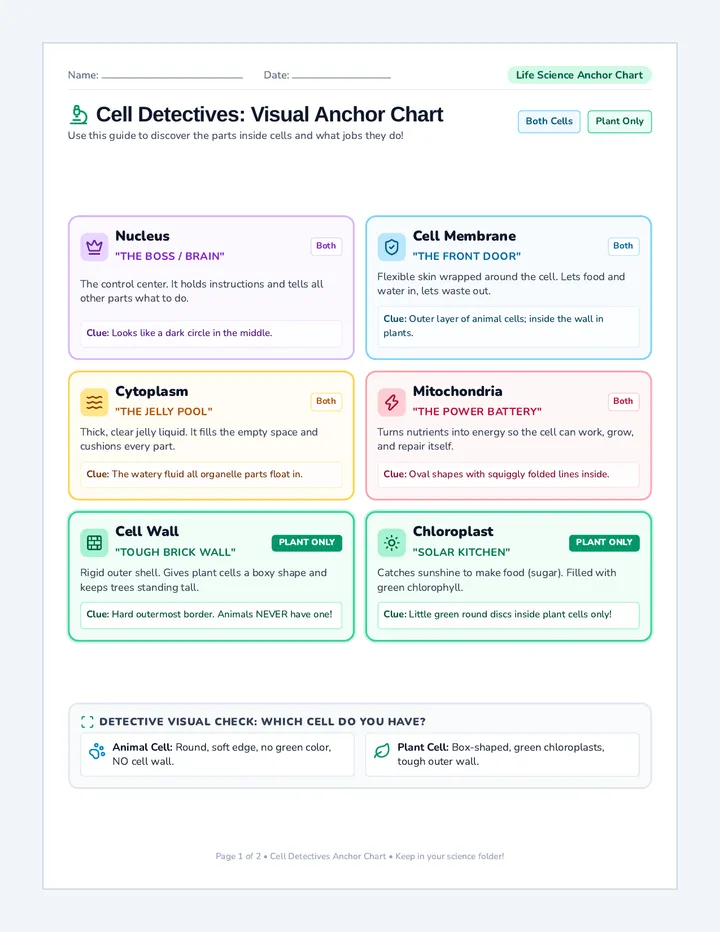
Both plant and animal cells share four key helpers. The nucleus is the boss that controls the cell. The cell membrane is the door that lets food in. The cytoplasm is the jelly that holds the parts. The mitochondria act like batteries to make power!

3. Plant Superpowers

Plants cannot walk around to buy food or find shelter. Instead, plant cells have a stiff cell wall to stand tall like a brick house. Plant cells also have green chloroplasts that use sunlight to cook their own food! Animals do not have these two parts.

Part A: Match the Cell Part

Use words from the bank

Nucleus Cell Wall Mitochondria Chloroplast

  1. The boss or brain that controls the cell is the

  2. The stiff outside layer found ONLY in plants is the

  3. The battery that makes power and energy for the cell is the

  4. The green kitchen that catches sunlight to make food is the

Part B: Detective Circle Choice

Circle the correct answer for each clue:

5. Which cell has a stiff, boxy shape and looks green?

Plant Cell Animal Cell

6. Which cell has a flexible round shape with NO cell wall?

Plant Cell Animal Cell

7. Can an animal cell make its own food using chloroplasts?

YES NO

Page 2 of 2 • Cell Detectives Reading & Check

The stiff outer wall that keeps plants standing tall.

The green kitchen using sunlight to make sugar food.

Cut-Out Badges: Cell Type Traits (3 Cards for Bottom Mat)

Has Cell Wall + Chloroplasts Makes own food with sun

Has Nucleus & Mitochondria Needs energy to live

Round & Flexible Edge Membrane only (No Wall)

Page 2 of 2 • Cell Match Cut-Out Sheet • Cut pieces carefully and paste onto Page 1!

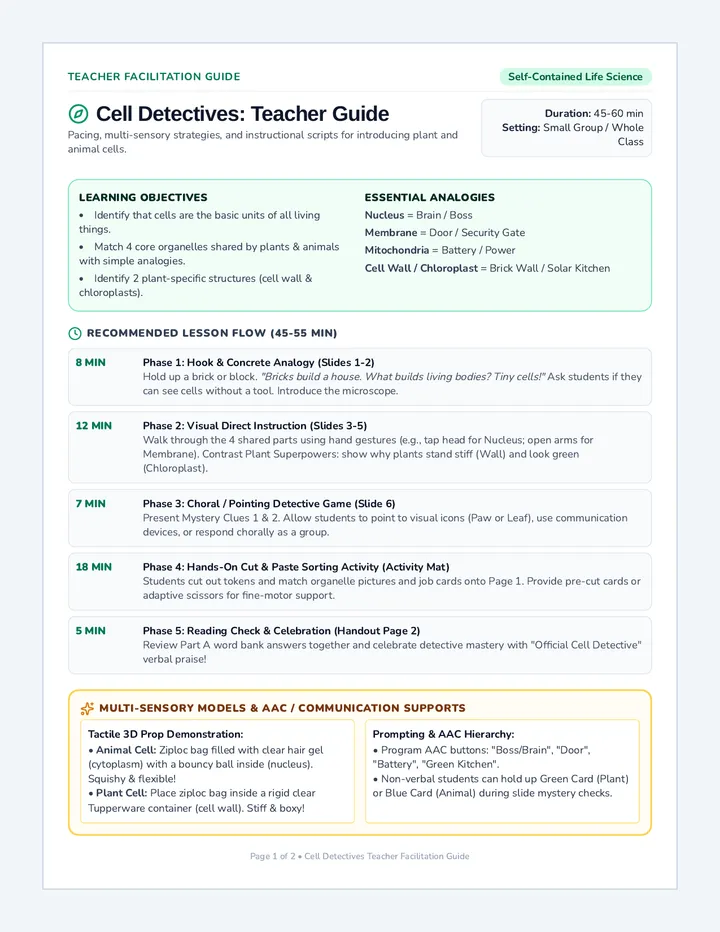
Prompting & AAC Hierarchy: • Program AAC buttons: "Boss/Brain", "Door", "Battery", "Green Kitchen".
• Non-verbal students can hold up Green Card (Plant) or Blue Card (Animal) during slide mystery checks.

Page 1 of 2 • Cell Detectives Teacher Facilitation Guide

Teacher Reference Answer Keys & Assessment

Master Answer Keys & Differentiation Tiers

Quick-reference solutions for student materials and assessment criteria.

Handout Page 2: Reading & Check Answer Key

Part A: Fill in the Blank

1. Boss/brain that controls cell = Nucleus

2. Stiff outside layer in plants = Cell Wall

3. Battery that makes energy = Mitochondria

4. Green kitchen making food = Chloroplast

Part B: Detective Circle Choice

5. Stiff, boxy shape & green = Plant Cell

6. Flexible round shape, no wall = Animal Cell

7. Animal cells make own food? = NO (Only plants)

Sorting Activity Mat Answer Key

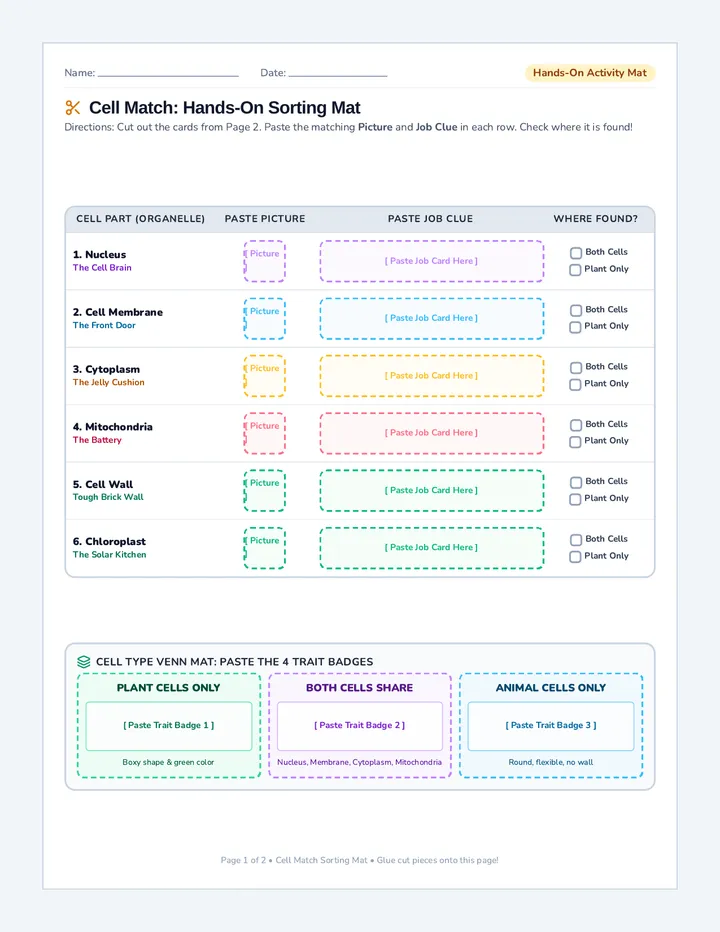
Cell PartPicture ClueJob Strip MatchWhere Found?
NucleusCrown / BrainBoss/brain that controls activitiesBoth Cells
Cell MembraneShield / DoorFront door controlling in & outBoth Cells
CytoplasmWaves / JellyClear jelly fluid that cushionsBoth Cells
MitochondriaLightning BatteryPower battery making energyBoth Cells
Cell WallBrick WallStiff outer wall holding plants tallPlant Only
ChloroplastSun KitchenGreen kitchen making sugar foodPlant Only

Venn Badges Placement: Plant Only = "Has Cell Wall + Chloroplasts" • Both Share = "Has Nucleus & Mitochondria" • Animal Only = "Round & Flexible Edge".

3-Tier Differentiation Guidelines

Tier 1: Maximum Support

Provide pre-cut tokens. Have student match picture-to-picture (icon on card to icon in teacher anchor chart). Verbal choices of 2 options.

Tier 2: Targeted Support

Students cut cards independently. Match organelle name to function clue. Complete fill-in-the-blank with word bank support.

Tier 3: Extension

Student explains orally or in writing why trees need a cell wall (to stand tall without bones) and why humans don't have green chloroplasts.

Exit Mastery Check: Student accurately differentiates at least 1 plant superpower (Wall or Chloroplast) and 2 core organelles.
80%+ Target

Page 2 of 2 • Cell Detectives Teacher Reference & Answer Keys

You might also like

Earth Sun Dance Lab Log

Stellar Explorers

A four-week, 20-session astronomy lab and enrichment curriculum for sixth-grade public school students, structured for 47-minute class periods. Spanning Earth-Sun-Moon celestial mechanics, comparative planetary science, stellar lifecycles and galaxies, and modern space exploration engineering.

B

bfox

8
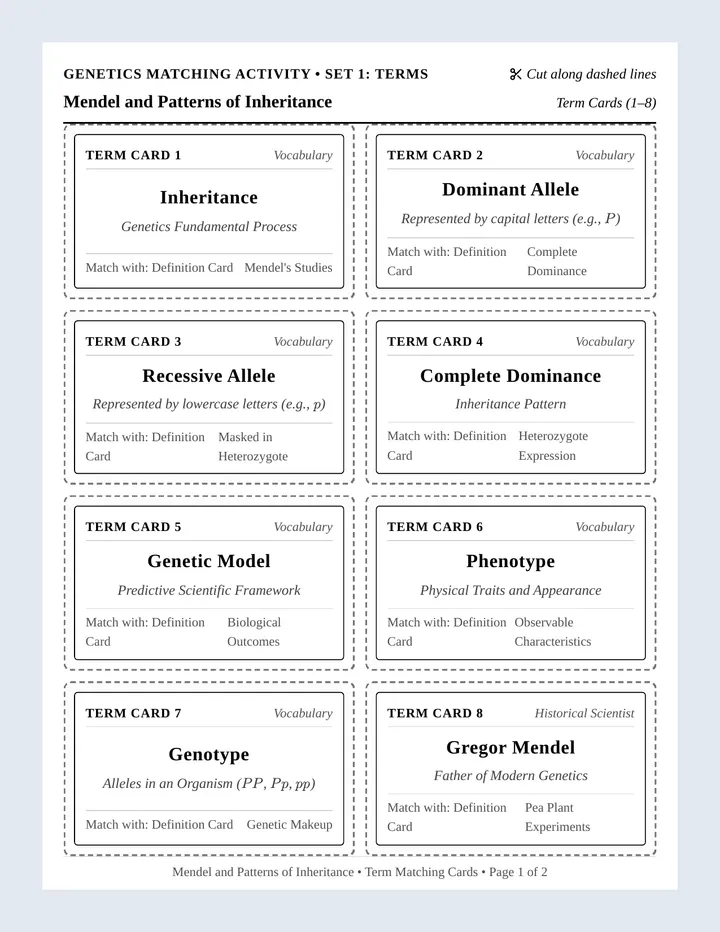
Mendel Inheritance Matching Cards

Mendel Inheritance

An introductory genetics lesson exploring Gregor Mendel's foundational pea plant experiments, inheritance patterns, allele types, genotype versus phenotype, and complete dominance.

MB

Marsha Bolden

4
Cell Detectives Teacher Guide

Cell Detectives Teacher Guide

A 2-page instructional guide for teachers containing lesson pacing, multi-sensory accommodations, communication support cues, full answer keys, and tiered rubrics.

CF

Carissa Fenner

Helix Studio Slides

Candy Code Sequence

A multi-day competency-based biology sequence exploring DNA architecture, complementary base pairing, and semi-conservative replication through tactile candy modeling and evidence-based assessment.

TM

Teri Minami

6
Cosmic Voyagers Lab Log

Cosmic Voyagers

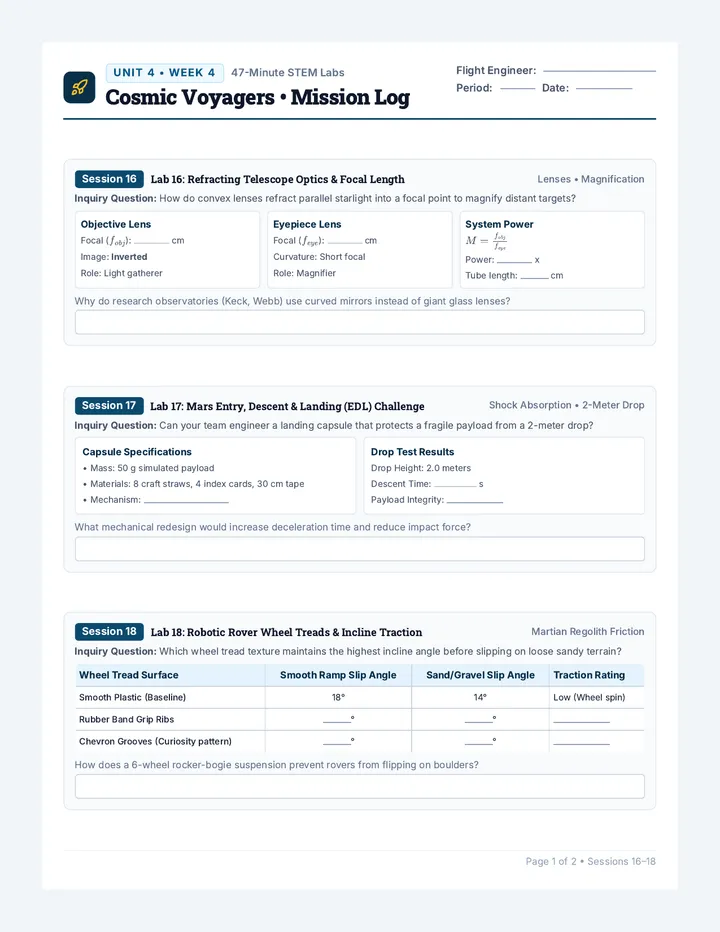
Week four covers sessions 16 through 20, focusing on space mission architecture, telescope optics, robotic rover mobility engineering, radio signal communication delays, and exoplanet transit detection. Sixth graders apply engineering design and observational techniques in daily 47-minute periods.

B

bfox

2
Cell Match Sorting Activity

Cell Match Sorting Activity

A 2-page hands-on cut-and-paste sorting activity featuring a structured matching mat on Page 1 and tactile cut-out tokens (pictures, names, and job analogies) on Page 2 for self-contained learners.

CF

Carissa Fenner

Pesky Biters Slides

Bug Busters

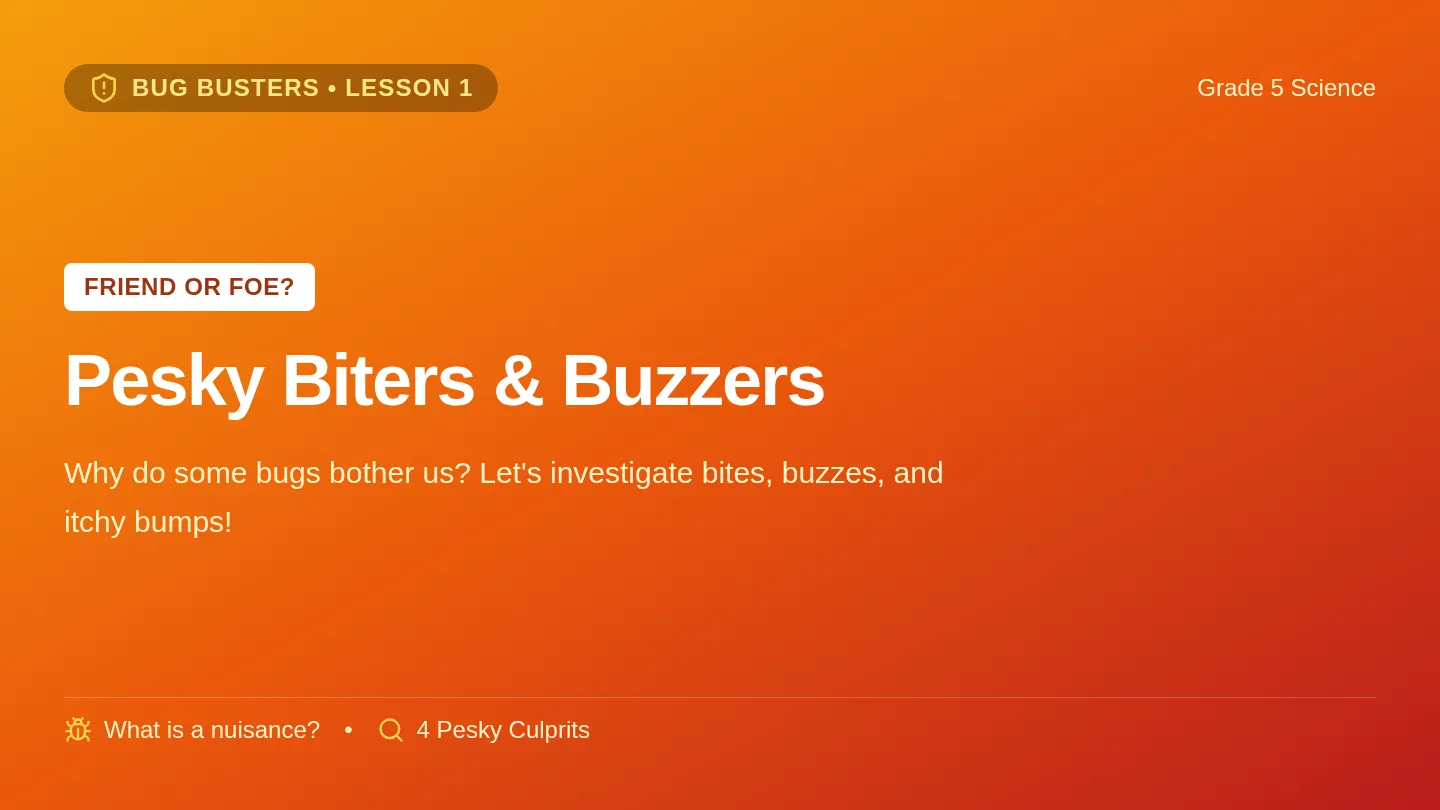
A two-part fifth-grade science sequence investigating how insects can be annoying nuisances, bite and sting, and damage crops and homes. Specially scaffolded with high-visual supports, decodable text chunks, and guided practice for lower-literacy learners.

Lenny Avatar
Lenny
11
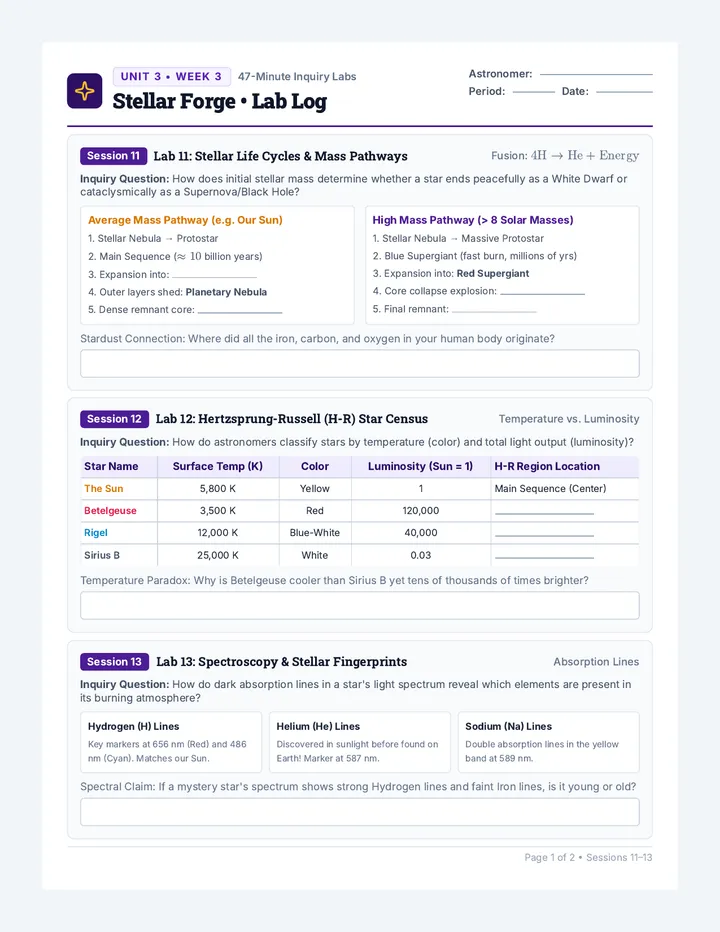
Stellar Forge Lab Log

Stellar Forge

Week three covers sessions 11 through 15, investigating stellar lifecycles, the Hertzsprung-Russell diagram, stellar spectroscopy, 3D constellation parallax, and galaxy morphological classification. Students explore cosmic nucleosynthesis and deep space structures in daily 47-minute periods.

B

bfox

2
Cell Parts Anchor Handout

Cell Parts Anchor Handout

A 2-page visual anchor chart and simplified reading passage introducing cell organelles, plain-language job analogies, and structured comprehension questions tailored for self-contained learners.

CF

Carissa Fenner

Habitability Blueprint Slides

Life Beyond Limits

A one-week interdisciplinary astrobiology sequence investigating Earth's habitability, extreme biological adaptations across eleven Earth species, and the plausibility of life on other celestial bodies.

M

Megan.Tanner

7
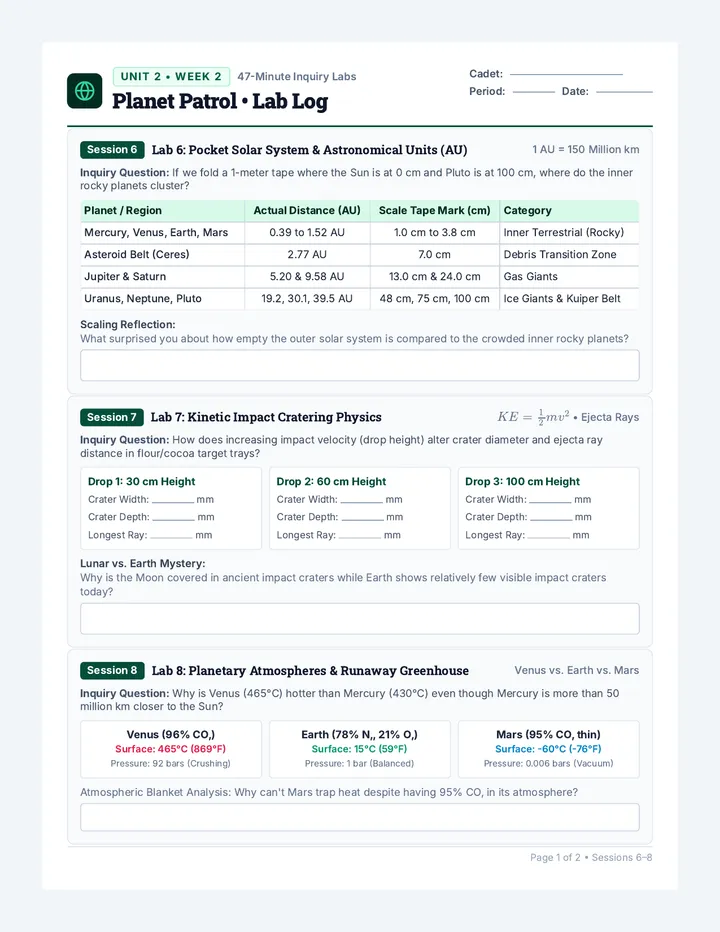
Planet Patrol Lab Log

Planet Patrol

Week two covers sessions 6 through 10, examining interplanetary scaling, planetary geology, atmospheric composition, impact cratering, and extreme ocean moons. Sixth graders conduct kinetic impact experiments, analyze greenhouse atmospheres, and evaluate asteroid resources in daily 47-minute periods.

B

bfox

2
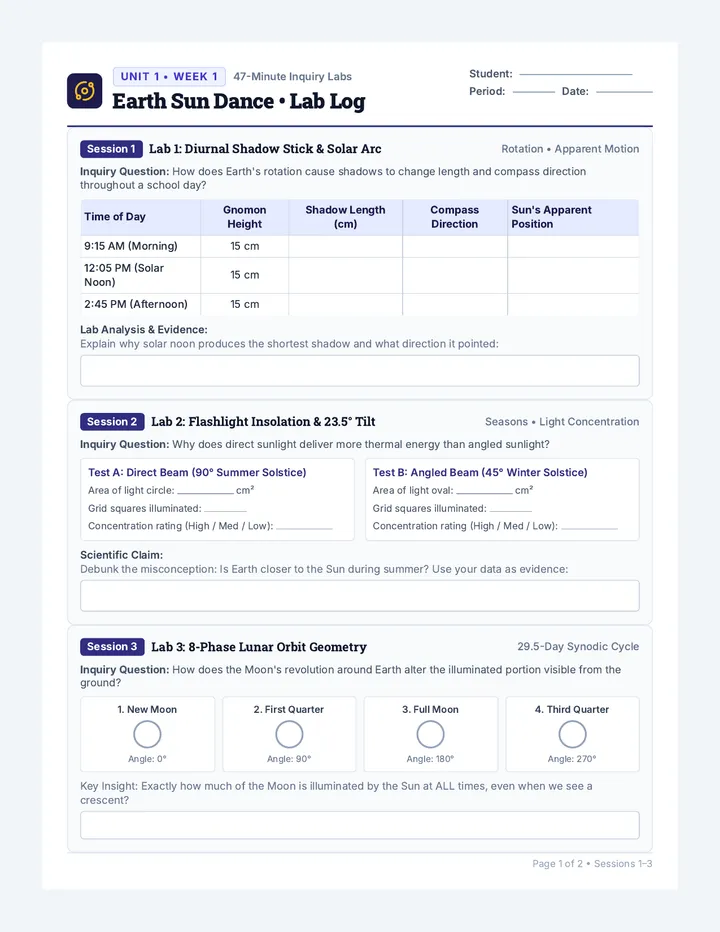
Earth Sun Dance Lab Log

Earth Sun Dance

Week one covers sessions 1 through 5, focusing on Earth's axial tilt, seasonal solar intensity, lunar phase geometry, solar and lunar eclipses, and diurnal shadow motions through five hands-on inquiry labs. Sixth graders model orbital dynamics and celestial mechanics in daily 47-minute periods.

B

bfox

2