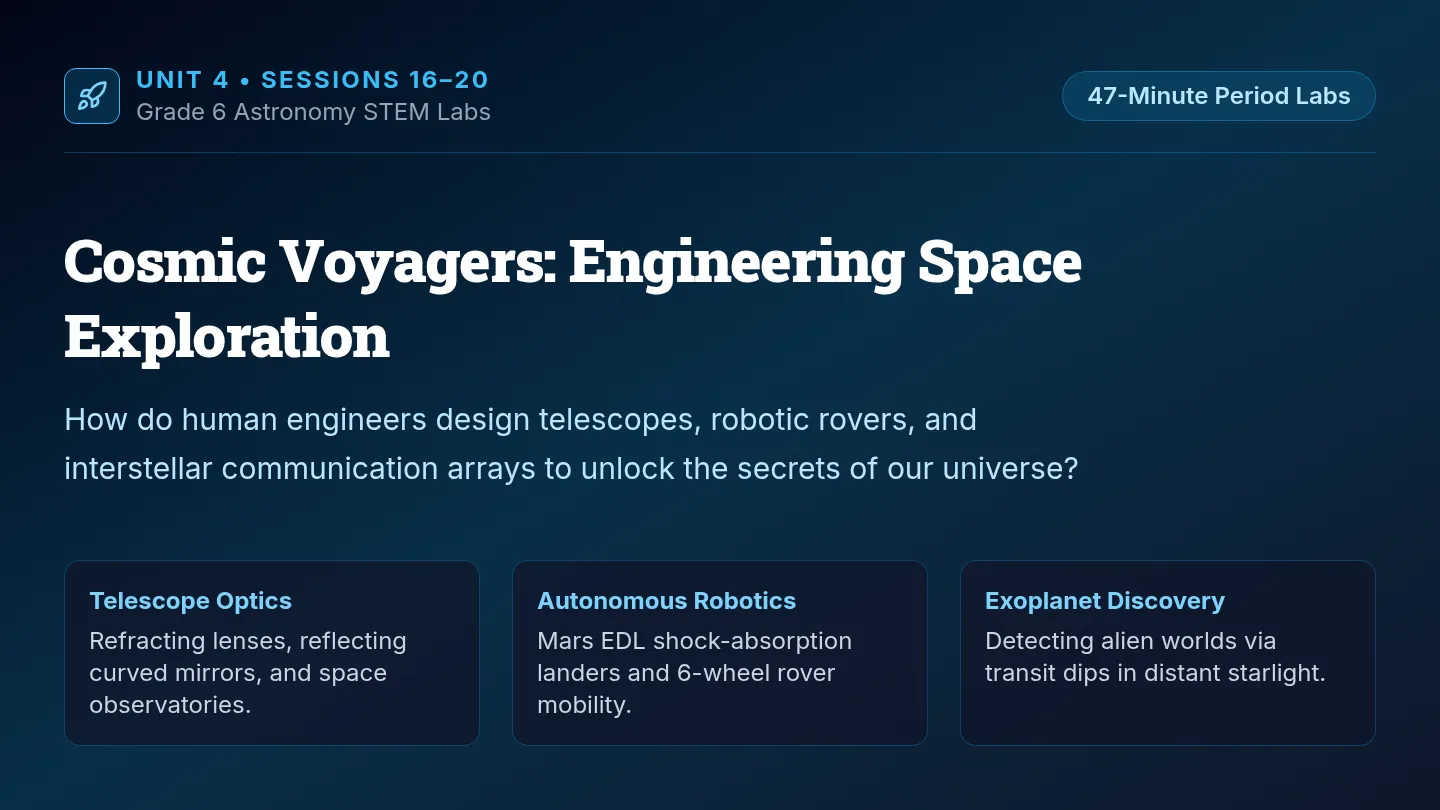
A four-week, 20-session astronomy lab and enrichment curriculum for sixth-grade public school students, structured for 47-minute class periods. Spanning Earth-Sun-Moon celestial mechanics, comparative planetary science, stellar lifecycles and galaxies, and modern space exploration engineering.
Protocol: Place a central 150-watt incandescent or high-output LED bulb in room center. Students hold white foam balls at arm's length, standing with their bodies representing Earth. As students pivot counterclockwise through 0° (New Moon), 90° (First Quarter), 180° (Full Moon), and 270° (Third Quarter), they sketch exactly what portion of the illuminated side their eyes view.
Teacher Guide • Page 1 of 2
Teacher Guide • Unit 1
Facilitation Guides & Complete Answer Key
Sessions 4 & 5 Solutions
Daily Facilitation Plans (Sessions 4–5)
Session 4: Eclipse Shadow Ray Tracing (Umbra vs. Penumbra) Standard: MS-ESS1-1
Protocol: Using small flashlights and ball stands, students map shadow geometries on tracing paper. Clarify that the Moon's shadow on Earth is surprisingly small (approx. 100-160 km wide umbra), explaining why total solar eclipses are rare at any single location. Explain why the Moon turns copper-red during a lunar eclipse (Earth's atmosphere bends red wavelengths into the umbra, acting like every sunrise and sunset projected simultaneously).
Protocol: Provide students with printed authentic long-exposure star trail photographs centered on Polaris. Students use protractors to measure the arc angles of circular star trails and calculate the camera exposure time using the mathematical constant \( 360^\circ / 24\text{ hours} = 15^\circ/\text{hour} \). Conclude with the Week 1 Synthesis assessment.
Exemplar Student Responses & Master Solutions
Grade 6 Grading Benchmark
Lab 1 (Shadow Stick): Shortest shadow occurs at solar noon because the Sun reaches its daily maximum altitude in the sky. Shadow points due North in the Northern Hemisphere (above 23.5°N).
Lab 2 (Insolation): Earth is NOT closer in summer; seasons are caused by the 23.5° tilt. At 90°, light is concentrated into a smaller area with high intensity; at 45°, the same energy spreads over more area.
Lab 3 (Moon Phases): Key insight: Exactly 50% (one half) of the Moon is always illuminated by the Sun at all times; our changing view is determined by our viewing angle from Earth.
Lab 4 (Eclipses): Solar Eclipse: Sun → Moon → Earth (New Moon). Lunar Eclipse: Sun → Earth → Moon (Full Moon). Eclipses do not occur monthly because Moon's orbit is tilted 5° relative to the ecliptic plane.
Lab 5 (Star Trails Math): Rate = \( 15^\circ/\text{hr} \). A 45° arc indicates a 3-hour exposure (\( 45^\circ \div 15^\circ/\text{hr} = 3\text{ hrs} \)). Polaris does not leave a trail because it sits almost exactly on Earth's northern rotational axis.
Week 1 Synthesis: Tilt points toward the Sun in Northern summer while simultaneously pointing away from the Sun in the Southern Hemisphere. Moon phases depend only on Moon-Sun-Earth angle, seen equally worldwide.
Scaffolding for Emerging Learners
Provide pre-cut styrofoam models with pre-marked axes. Use tactile shadow tracking cards with compass rose overlays. Pair visual diagram cards with hands-on models.
Extension for Advanced Learners
Challenge students to calculate the angle of sunlight on equinox days using local latitude (\( 90^\circ - \text{latitude} \)). Model precession of equinoxes over 26,000-year cycles.
Teacher Guide • Page 2 of 2
Atmospheric Blanket Analysis: Why can't Mars trap heat despite having 95% CO‚ in its atmosphere?
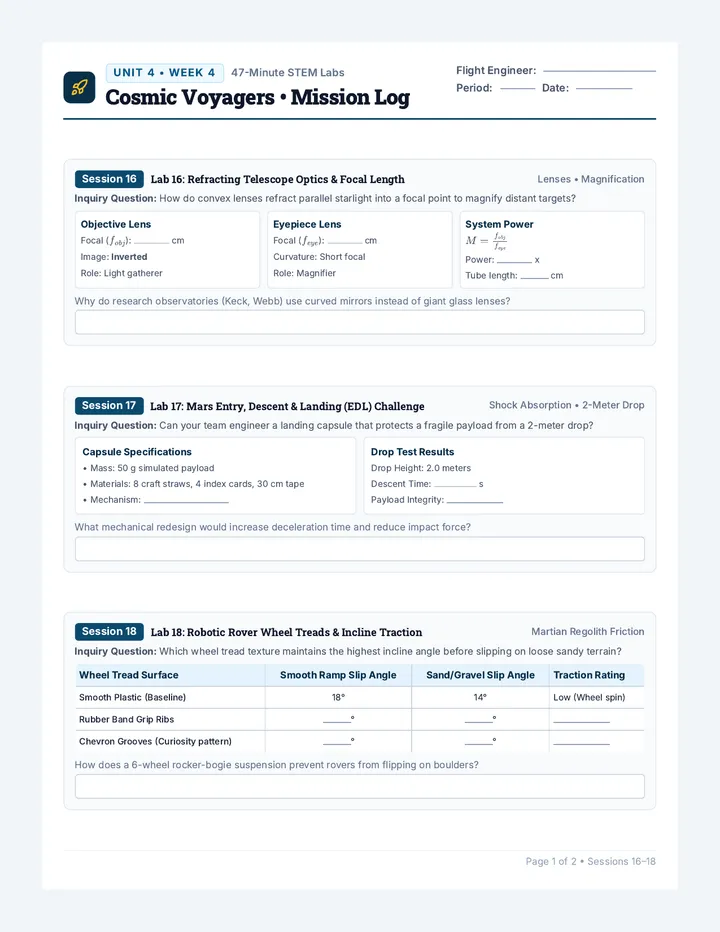
Page 1 of 2 • Sessions 6–8
Week 2 • Continued
Ocean Moons, Asteroids & Defense
Sessions 9 & 10 Investigations
Session 9
Lab 9: Extreme Ocean Moons & Habitability Index
Tidal Heating • Cryovolcanoes
Inquiry Question: How can moons located billions of kilometers from the Sun sustain liquid saltwater oceans beneath their ice shells?
Europa (Jupiter)
Cracked ice crust (15-25 km thick) covering a global saltwater ocean 100 km deep. Warmed by gravitational tidal kneading.
Life Potential: Hydrothermal Vents
Enceladus (Saturn)
Tiger stripe fissures erupting geysers of water vapor, organic molecules, and silica salts into space. 100% ocean beneath south pole.
Life Potential: Organic Precursors
Titan (Saturn)
Dense nitrogen atmosphere (1.5x Earth pressure). Rivers, lakes, and rainfall composed of liquid methane and ethane (\( CH_4 \)).
Life Potential: Exotic Methane Life
Habitability Evaluation:
Rank these three moons for where NASA should send a robotic submarine first, and justify your choice:
Session 10
Lab 10: Asteroid Mineral Prospecting & DART Deflection
Near-Earth Objects (NEOs)
Inquiry Question: How can scientists redirect a hazardous Near-Earth Asteroid without blowing it into dangerous fragments?
Kinetic Impactor (NASA DART Mission)
Ram a 500-kg spacecraft at 6 km/second into the asteroid to alter its orbital period by a fraction of a percent years before impact.
Advantage: Fast, proven technology. Risk: May shatter rubble-pile asteroids.
Gravity Tractor Defense
Station a massive robotic spacecraft alongside the asteroid. The mutual gravitational attraction slowly tugs the asteroid off course over years.
Advantage: No risk of fragmentation. Risk: Requires 10–20 years of advance notice.
Deflection Engineering Trade-Off:
If an asteroid is discovered with only 18 months before potential impact, which defense method must Earth choose and why?
Week 2 Comparative Planetology Synthesis
Sessions 6–10 Exit Assessment
Summarize the Goldilocks conditions: What three environmental factors make Earth unique compared to Venus (too hot) and Mars (too cold and thin)?
Lab Station #: Teacher Verification Stamp:
Page 2 of 2 • Sessions 9–10
Titan
Moon of Saturn
The only moon with a thick atmosphere and liquid lakes on its surface, made of frigid liquid methane and ethane!
The 3 Ingredients for Habitability:
1. Liquid Solvent (Water) 2. Energy Source (Heat) 3. Essential Chemistry (C, H, N, O, P, S)
Small Bodies & Planetary Defense
Session 10 Challenge
NASA DART Mission
In 2022, NASA intentionally crashed the DART spacecraft into asteroid moonlet Dimorphos at 14,000 mph.
Result: Shortened its orbital period by 33 minutes, proving humanity can nudge asteroid trajectories!
Planetary Defense Toolkit
• Kinetic Impactor: Rapid smash to divert course
• Gravity Tractor: Gentle gravitational tug over years
• Laser Ablation: Vaporize rock to create thrust
Ready for Session 10 Lab? Open Lab Log Page 2 • Asteroid Deflection Design
Discovered in sunlight before found on Earth! Marker at 587 nm.
Sodium (Na) Lines
Double absorption lines in the yellow band at 589 nm.
Spectral Claim: If a mystery star's spectrum shows strong Hydrogen lines and faint Iron lines, is it young or old?
Page 1 of 2 • Sessions 11–13
Week 3 • Continued
Constellation Parallax & Galaxy Scale
Sessions 14 & 15 Investigations
Session 14
Lab 14: 3D Constellation Parallax & True Depth
Orion Depth Model
Inquiry Question: Are the stars of familiar constellations physically close to one another, or is their apparent grouping an optical projection from Earth?
Orion's Key Stars & Light-Year Distances:
• Betelgeuse: 642 light-years from Earth
• Bellatrix: 252 light-years from Earth
• Rigel: 860 light-years from Earth
• Alnitak (Belt): 1,260 light-years from Earth
Perspective Shift Observation:
When viewed from a spacecraft 500 light-years to the side of our solar system, does the "Hunter" pattern still exist?
Answer: No! The 3D distortion dissolves the pattern completely.
Parallax Finger Test:
Hold your thumb at arm's length and alternate closing your left and right eyes. Explain how this models stellar parallax:
Session 15
Lab 15: Hubble Galaxy Census & Morphologies
Spirals • Ellipticals • Irregulars
Inquiry Question: How do galactic shapes reveal their age, gas content, star-formation activity, and collision history?
Spiral / Barred Pinwheel arms • Active gas
Rich in blue newborn stars and dust lanes. (e.g. Milky Way, Andromeda)
Elliptical Smooth footballs • Old stars
Little dust or new star birth; composed mostly of ancient yellow/red stars.
Irregular Chaotic • Colliding
Tidally warped by gravitational collisions. (e.g. Magellanic Clouds)
Hubble Ultra-Deep Field Reflection:
A tiny patch of sky the size of a grain of sand held at arm's length revealed nearly 10,000 galaxies. What does this indicate about the scale of the observable universe?
Week 3 Deep Space Synthesis
Sessions 11–15 Exit Assessment
Trace the cosmic hierarchy: Place these cosmic structures in correct order from smallest to largest: Solar System, Milky Way Galaxy, Moon, Observable Universe, The Sun, Local Group.
Lab Station #: Teacher Verification Stamp:
Page 2 of 2 • Sessions 14–15
Protocol: Dim classroom lights. Students view gas discharge tubes or illuminated full-color spectral line charts through diffraction gratings. Students identify the distinct "fingerprint barcodes" of Hydrogen (Balmer series), Helium, and Sodium to diagnose chemical signatures from distant starlight.
Protocol: Students mount white beads on bamboo skewers of measured lengths representing Orion's actual distances (Bellatrix 252 ly, Betelgeuse 642 ly, Rigel 860 ly, Alnitak 1,260 ly). When viewed directly from the front peephole, the 2D hunter appears. When viewed from the side, students realize stars in constellations have no physical relationship to one another.
Session 15: Hubble Galaxy Morphological Census & Deep Field Standard: MS-ESS1-2
Protocol: Groups sort 18 genuine telescope galaxy images into Spirals (arms, central bulge), Ellipticals (smooth, featureless spheroids), and Irregulars (asymmetrical collisions). Debrief the Hubble Deep Field: an exposure of an apparently blank patch of night sky revealed over 10,000 galaxies stretching back billions of years.
Exemplar Student Responses & Master Solutions
Grade 6 Grading Benchmark
Lab 11 (Life Cycles): Average star: Red Giant → White Dwarf. Massive star: Red Supergiant → Supernova → Neutron Star or Black Hole. Heavy elements in human body (iron, calcium) were synthesized during stellar fusion and supernova blasts.
Lab 12 (H-R Diagram): Betelgeuse: Red Supergiant (top right). Rigel: Blue Supergiant (top left). Sirius B: White Dwarf (bottom left). Betelgeuse is cooler than Sirius B but brighter because its diameter is over 700 times larger!
Lab 13 (Spectroscopy): A star with strong Hydrogen lines and faint Iron lines is a younger generation star or early-stage main sequence star that has not yet fused heavy metallic elements.
Lab 14 (3D Parallax): Alternating eyes changes the viewing baseline, shifting thumb position relative to background walls. Similarly, Earth's 6-month orbital baseline shifts apparent star positions against distant galaxies.
Lab 15 (Hubble Census): Finding 10,000 galaxies in a grain-of-sand field of view proves the observable universe contains hundreds of billions of galaxies, each containing hundreds of billions of stars.
Week 3 Synthesis Hierarchy: Moon → The Sun → Solar System → Milky Way Galaxy → Local Group → Observable Universe.
Scaffolding for Emerging Learners
Color-code the H-R diagram axes (blue on left, red on right). Provide pre-labeled spectral matching cards with clear vertical alignment marks.
Extension for Advanced Learners
Introduce redshift and Hubble's Law (\( v = H_0 \cdot d \)). Have students calculate the recessional velocity of distant quasars from spectral line Doppler shifts.
Teacher Guide • Page 2 of 2
Sessions 19 & 20 Investigations
Session 19
Lab 19: Speed-of-Light Radio Delay & Autonomous AI
\( c = 300,000\text{ km/s} \)
Inquiry Question: Why is it physically impossible to drive a Mars rover with a real-time joystick from Earth?
Mission Target
Distance from Earth
One-Way Radio Lag
Round-Trip Command Lag
Lunar Gateway (Moon)
384,000 km
1.28 seconds
2.56 seconds
Mars (Closest Approach)
54,600,000 km
min
min
Mars (Furthest Opposition)
401,000,000 km
22.3 minutes
44.6 minutes
Voyager 1 (Interstellar)
24,000,000,000 km
22.2 hours
44.4 hours
If a rover detects a cliff edge 2 meters ahead, why must onboard software stop independently?
Session 20
Lab 20: Transit Photometry & Alien Worlds
Kepler / TESS Light Curves
Inquiry Question: How does the periodic dip in a distant star's brightness reveal the orbital period and diameter of an exoplanet?