Density Quest Review Packet
6th Grade Physical Science • Review Packet
Density Detective Guide
Name:
Date:
Mission Progress:
Goal 1: Vocab Goal 2: Math Goal 3: Sink/Float Goal 4: Mystery ID
Goal 1
Define & Compare: Mass, Volume, and Density
Mass (M)
The amount of matter (stuff) inside an object.
Unit: Grams (g) ⚖️ Heaviness
Volume (V)
The amount of 3D space an object takes up.
Unit: \( \text{cm}^3 \) or mL 📦 Size
Density (D)
How tightly packed the particles are.
Unit: \( \text{g/cm}^3 \) 🧲 Packing
A Look at the two storage cubes below (Both cubes have identical volume): Equal Volume
Cube 1
5 particles (spread out)
Low Density
Cube 2
12 particles (crowded)
High Density
1. Compare Volume:
Cube 1 and Cube 2 have the same volume because they both take up the same amount of
2. Compare Mass:
Cube 2 has [ more / less ] mass than Cube 1 because
3. Compare Density:
Cube 2 has a [ higher / lower ] density because its particles are
B
Gym Bag Scenario: Two sports bags are the exact same size. Bag A is packed with cast-iron dumbbells. Bag B is packed with foam dodgeballs.
What is the SAME?
Which measurement stays identical?
What is DIFFERENT?
Which bag has more mass and density?
Checkpoint 1: Concept & Definitions Page 1 of 4
Density Detective Guide
Goal 2: Calculate an Object's Density
✓ Goal 1 Done Goal 2 In Progress
Formula Anchor
The "Density Triangle" Tool
Cover what you want to find with your finger! To find Density (D), cover D. You see M on top of V.
Formula: \( \text{Density} = \frac{\text{Mass}}{\text{Volume}} \) (\( D = \frac{M}{V} \))
M
D V
Mass ÷ Volume = Density
1 Find M & V
2 Write Formula
3 Plug In Numbers
4 Divide + Unit
Worked Example Problem b: Volcanic Obsidian Rock
Follow this Model
A geologist discovers a smooth sample of black obsidian glass with a mass of 50g and a volume of 20 \( \text{cm}^3 \). What is the density of the obsidian?
1. Variables
m = 50g
v = 20 \( \text{cm}^3 \)
2. Formula
\( D = \frac{m}{v} \)
3. Plug In
\( D = \frac{50\text{ g}}{20\text{ cm}^3} \)
4. Final Answer
2.5 \( \text{g/cm}^3 \)
Your Turn Problem c: Mars Rover Heat Shield Tile
Use the 4 steps!
An aerospace engineer tests an ultra-light heat shield tile for a Mars rover. The tile has a mass of 18g and a volume of 45 \( \text{cm}^3 \). What is the density of the tile?
1. Variables
m = ______ g
v = ______ \( \text{cm}^3 \)
2. Formula
D =
3. Plug In
4. Answer + Unit
Language Frame:
The density of this rover tile is ____________________ because its mass of 18g divided by its volume of 45 \( \text{cm}^3 \) equals ____________________.
Checkpoint 2: Math Calculation Page 2 of 4
Density Detective Guide
Goal 3: Predict & Explain Sink or Float
✓ Goals 1-2 Done Goal 3 In Progress
💧
The Water Benchmark Rule
Density of pure water = 1.0 \( \text{g/cm}^3 \) (or 1.0 g/mL)
- LESS than 1.0: The object FLOATS 🎈 (rises up)
- GREATER than 1.0: The object SINKS ⚓ (drops down)
Visual Guide
Float (\( D < 1.0 \)) ↑ Up
Water Level (\( 1.0 \text{ g/cm}^3 \))
Sink (\( D > 1.0 \)) ↓ Down
A Toy Sailboat Challenge: Step 1: Calculate • Step 2: Explain
A carved cedarwood toy sailboat has a mass of 140g and a volume of 200 \( \text{cm}^3 \). Would this sailboat float on water? Why or why not?
Formula \( D = \frac{m}{v} \)
Variables m=140g, v=200
Plug In \( D = \frac{140}{200} \)
Density Result ____ \( \text{g/cm}^3 \)
Scientific Claim & Evidence:
This sailboat will [ SINK / FLOAT ] in water because its density of \( \text{g/cm}^3 \) is [ greater than / less than ] the density of water (1.0 \( \text{g/cm}^3 \)).
B Kitchen Science Liquid Layering Challenge: Rule: Less dense floats ON TOP!
A science cylinder contains 50 mL of Vegetable Oil (mass = 46g) and 50 mL of Dish Soap (mass = 53g). Which liquid will float to the top?
Vegetable Oil Liquid 1
\( D = \frac{46\text{ g}}{50\text{ mL}} \)
= 0.92 g/mL
Dish Soap Liquid 2
\( D = \frac{53\text{ g}}{50\text{ mL}} \)
= 1.06 g/mL
Jar Layers
Top: ____________
Bottom: _________
Explanation: ___________________________ will be on top because its density of _________________ g/mL is [ less / more ] dense than the other liquid.
Checkpoint 3: Sinking, Floating, and Layering Page 3 of 4
Density Detective Guide
Goal 4: Identify a Substance by Density
✓ Goals 1-3 Done Final Mission
Technique
Liquid Displacement Method (Finding Volume)
Volume = Water Level 2 – Water Level 1
50 mL
Step 1
Water Alone
50 mL
58 mL
Step 2
With Coin
Rises to 58 mL
Coin Volume
58 mL – 50 mL
= 8 mL (\( 8 \text{ cm}^3 \))
Case File The Sunken Treasure Coin Mystery
Museum Lab Test
Divers recover an ancient silver coin from a colonial shipwreck! You need to determine if it is Pure Silver or cheap Fake Pewter. You find its mass is 84g. In a graduated cylinder, the water level rises from 50 mL to 58 mL.
Reference Chart: Pure Silver = 10.5 \( \text{g/cm}^3 \) | Pewter (Fake Silver) = 7.3 \( \text{g/cm}^3 \)
A. Find Volume
58 mL – 50 mL =
______ \( \text{cm}^3 \)
B. Set Up Formula
\( D = \frac{M}{V} = \frac{84\text{ g}}{\_\_\_\_\_} \)
\( D = \) ______
C. Calculated Density
84 ÷ 8 =
______ \( \text{g/cm}^3 \)
Your Verdict: PURE SILVER PEWTER (FAKE)
Scientific Reasoning:
I conclude this coin is ___________________________ because its calculated density is ___________________ \( \text{g/cm}^3 \), which matches the known density of ______________________.
Self-Reflection: Check off what you have mastered! 4 Goals
Goal 1: Vocab
Goal 2: Math
Goal 3: Sink/Float
Goal 4: ID Metal
All Goals Completed • Ready for Review Page 4 of 4
Density Quest Answer Key
Teacher Resource • Facilitation & Answer Key
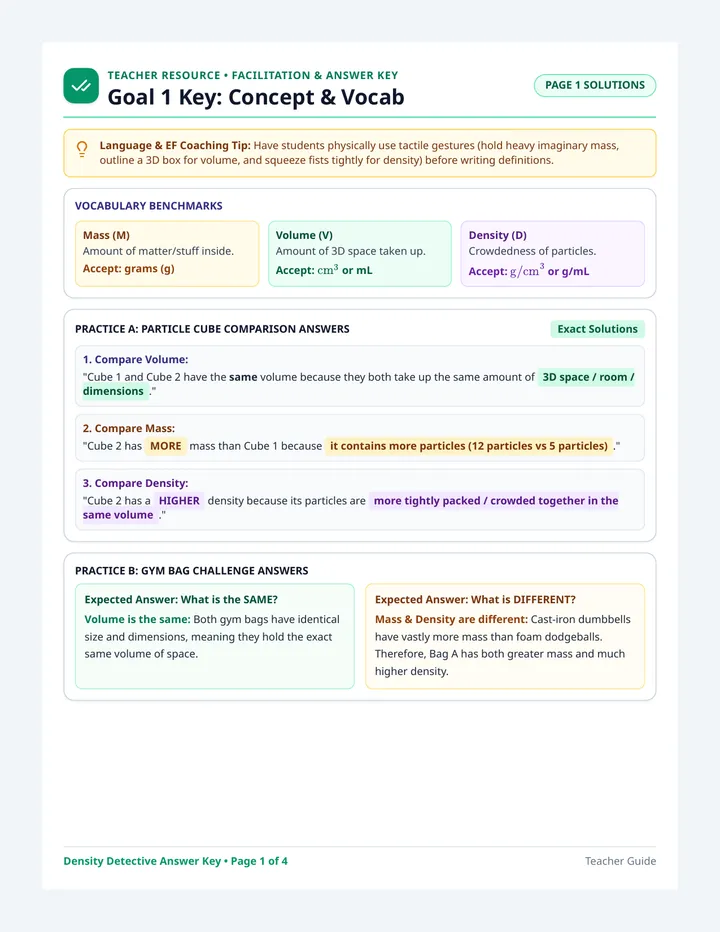
Goal 1 Key: Concept & Vocab
PAGE 1 SOLUTIONS
Language & EF Coaching Tip: Have students physically use tactile gestures (hold heavy imaginary mass, outline a 3D box for volume, and squeeze fists tightly for density) before writing definitions.
Vocabulary Benchmarks
Mass (M)
Amount of matter/stuff inside.
Accept: grams (g)
Volume (V)
Amount of 3D space taken up.
Accept: \( \text{cm}^3 \) or mL
Density (D)
Crowdedness of particles.
Accept: \( \text{g/cm}^3 \) or g/mL
Practice A: Particle Cube Comparison Answers Exact Solutions
1. Compare Volume:
"Cube 1 and Cube 2 have the same volume because they both take up the same amount of 3D space / room / dimensions."
2. Compare Mass:
"Cube 2 has MORE mass than Cube 1 because it contains more particles (12 particles vs 5 particles)."
3. Compare Density:
"Cube 2 has a HIGHER density because its particles are more tightly packed / crowded together in the same volume."
Practice B: Gym Bag Challenge Answers
Expected Answer: What is the SAME?
Volume is the same: Both gym bags have identical size and dimensions, meaning they hold the exact same volume of space.
Expected Answer: What is DIFFERENT?
Mass & Density are different: Cast-iron dumbbells have vastly more mass than foam dodgeballs. Therefore, Bag A has both greater mass and much higher density.
Density Detective Answer Key • Page 1 of 4 Teacher Guide
Teacher Resource • Facilitation & Answer Key
Goal 2 Key: Math Calculations
PAGE 2 SOLUTIONS
Common Student Math Misconception: Students often divide the larger number by the smaller number. For the Mars Rover tile (\( 18\text{ g} \div 45\text{ cm}^3 \)), remind students that mass always stays in the numerator: \( \frac{\text{Mass}}{\text{Volume}} \).
Problem b: Volcanic Obsidian Rock (m = 50g, v = 20 \( \text{cm}^3 \)) Worked Model
Variables
m = 50g
v = 20 \( \text{cm}^3 \)
Formula
\( D = \frac{m}{v} \)
Setup
\( D = \frac{50}{20} \)
Answer
2.5 \( \text{g/cm}^3 \)
Problem c: Mars Rover Heat Shield Tile Student Work Check
Mass = 18g, Volume = 45 \( \text{cm}^3 \). Calculate density.