Lenny.com
Explore
Create
ActivitiesNewMathEnglish Language ArtsScience & EngineeringSocial StudiesGlobal LanguagesHealth & Physical EducationSpecial EducationCounseling & Life SkillsArts & CreativityESL
Lenny.com
Lenny.com
Explore
Create
ActivitiesNewMathEnglish Language ArtsScience & EngineeringSocial StudiesGlobal LanguagesHealth & Physical EducationSpecial EducationCounseling & Life SkillsArts & CreativityESL
Lenny.com
Lenny.com

Solutions

Lenny for EducatorsLenny for SchoolsLenny for Districts

Product

ExploreSign inCreateSupportAbout

Resources

Getting startedMTSS Acceleration Program

© 2026 Lenny Learning Inc.

TermsPrivacyAccessibility
LinkedInInstagramX
Lenny
Science & EngineeringLife ScienceLiving ThingsAnimalsPlantsBody SystemsTraitsAdaptationsCellsEcosystemsHeredityGenes to TraitsCell DivisionPhysicsComparing MaterialsShapes and PropertiesMagnetsMagnetismLightSoundLight and SoundMatterStates of MatterChanges of StateMixturesPhysical and Chemical ChangeHeating and CoolingHeat and Thermal EnergyEnergyForce and MotionElectrical CircuitsAtoms and MoleculesPeriodic TableMotion in One DimensionMotion in Two DimensionsScalars and VectorsForces and Laws of MotionCircular Motion and GravityMomentum and ImpulseWork, Energy, and PowerWavesElectromagnetic WavesGeometric OpticsElectricity and MagnetismSimple Harmonic MotionThermodynamicsNuclear PhysicsEarth Science & AstronomyWeatherWater CycleRocks and MineralsFossilsEarth's FeaturesEarth's ResourcesEarth's StructureWeather and ClimateEarth EventsFossils and Geologic TimePlate TectonicsHuman ImpactsAstronomyChemistryUnits and MeasurementAtomic StructurePeriodic TrendsChemical BondingNomenclatureMolecular StructureIntermolecular ForcesThe MoleStoichiometryProperties of GasesSolutionsChemical ReactionsBalancing EquationsEnergy ChangesRates of ReactionsEquilibriumAcids and BasesQuantum ModelBiologyClassificationCell StructureThe Chemistry of LifeBiomoleculesCellular TransportCell EnergyCell Growth and DivisionDNAProtein SynthesisMeiosis and Sexual ReproductionPatterns of InheritanceMulticellular OrganismsEvolutionEcologyBiodiversityComputer ScienceAlgorithms and Computational ThinkingProgramming LanguagesComputing SystemsNetworks and InternetData AnalysisCybersecurityAI and Machine LearningSoftware Design and DevelopmentBlockchainEngineering & AIDesigning ExperimentsEngineering PracticesDesign ThinkingEngineering Design ProcessMechanical EngineeringElectrical EngineeringMaterials and StructuresCAD and 3D DesignRoboticsArtificial Intelligence BasicsVibe CodingMachine LearningAI Ethics and SocietySystems ThinkingEntrepreneurship & InnovationEntrepreneurial MindsetBusiness Idea DevelopmentBusiness Plan BasicsMarketing & Customer DiscoveryFinancial Management for Startups

Life Chemistry Assessment

Comprehensive assessment resources for high school biology students on matter, chemical formulas, conservation of mass, and organic biochemistry. Includes standard and alternate exam versions alongside an accelerated dual-form answer key.

JEJeffrey Elterman

Life Chemistry Assessment

Comprehensive assessment resources for high school biology students on matter, chemical formulas, conservation of mass, and organic biochemistry. Includes standard and alternate exam versions alongside an accelerated dual-form answer key.

JEJeffrey Elterman

Part II: Regents Multiple Choice (8 Pts • 2 pts each)

Official Exam Answers

STANDARD FORM SEQUENCE Key: (2), (3), (3), (1)

  1. Inorganic compound → (2) carbon dioxide (CO2)

Organic must contain both C & H.

  1. Elements in all organic cmpds → (3) carbon and hydrogen

  2. Atoms during chemical reaction → (3) remains the same

  3. Glucose + Glucose reaction → (1) dehydration synthesis

FORM ALT SEQUENCE Key: (1), (2), (2), (3)

  1. Atoms during reaction [was #9] → (1) remains the same

Option position moved from (3) to (1).

  1. Glucose + Glucose rxn [was #10] → (2) dehydration synthesis

  2. Inorganic compound [was #7] → (2) carbon dioxide (CO2)

  3. Elements in organic [was #8] → (3) carbon and hydrogen

Part III: Atom Conservation Tally (6 Pts Total)

Table: 4 pts • Conclusion: 2 pts

Equation: 6CO2 + 6H2O  →  C6H12O6 + 6O2

ElementReactants (Inputs) Work & CountProducts (Outputs) Work & Count
Carbon (C)6 × 1 = 6 (Given model)1 × 6 = 6 (Given model)
Hydrogen (H) [2 pts]6 × 2 = 121 × 12 = 12
Oxygen (O) [2 pts](6 × 2) + (6 × 1) = 12 + 6 = 18(1 × 6) + (6 × 2) = 6 + 12 = 18

#11 Conservation Conclusion [2 pts]: Award 1 pt for stating that the total number of reactant atoms equals the total number of product atoms (36 total atoms / equal per element: 6 C, 12 H, 18 O). Award 1 pt for explicitly stating that no atoms were destroyed or created; atoms were only rearranged to form new molecules.

Chemistry of Life Dual Answer Key • NYS Regents Life Science Page 1 of 2 • Turn Over for Part IV Scoring Rubrics & NYS Exemplars →

PART IV: REGENTS CONSTRUCTED RESPONSE SCORING CRITERIA

Verbatim NYS Living Environment Rubrics & Student Exemplars (10 Points Total)

GRADING REFERENCE

Chemical Potential Energy in Living Organisms Std: #14 ALT: #12

4 Points • Jan 2016, Q44

Prompt: State what happens to the chemical potential energy stored in the bonds of food molecules (like glucose) when those bonds are broken during cellular digestion or respiration.

[2 pts] Energy Release: Student states that the stored potential energy is released when chemical bonds are broken.

[2 pts] Energy Conversion / Transfer: Student identifies that this energy is transferred to ATP / usable cellular energy or released as heat/thermal energy.

Acceptable Student Exemplars: “The chemical bond energy is released and used to synthesize ATP for cellular work.” or “The stored potential energy is released as heat and kinetic energy for cellular processes.”

Do not award full credit if student claims energy is “destroyed” or “disappears.”

Organic Molecule Classification Elements Std: #12 ALT: #13

2 Points • Jan 2014, Q56

Prompt: Identify the two chemical elements that must be present in a compound for it to be classified as organic.

Element 1 [1 pt]: Carbon (accept symbol “C”)

Element 2 [1 pt]: Hydrogen (accept symbol “H”)

Note: Both elements must be present together. Oxygen (O) or Nitrogen (N) alone do not qualify a molecule as organic without both C and H present.

Dehydration Synthesis vs. Hydrolysis Analysis Std: #13 ALT: #14

4 Points • June 2017, Q36-37

Maltose + H2O  →  Glucose + Glucose

Part a [2 pts]: Reaction Type: Hydrolysis (also accept: hydrolytic cleavage, enzymatic digestion, or chemical breakdown of disaccharide).

Part b [2 pts]: Water & Chemical Bond Role:

  • Water (H2O) [1 pt]: Water is added, consumed, or split (H and OH added to split monosaccharides).
  • Chemical Bond [1 pt]: The bond connecting the two glucose monomers is broken or cleaved.

Sample Full-Credit Response: “Water is split and added to break the chemical bond linking the glucose units, separating them into two free simple sugars.”

Anti-Cheating Rapid Audit Diagnostic:

If a student handed the ALT Form writes down standard key answers (e.g. Vocabulary: C, E, A... instead of B, C, A...; or Multiple Choice Q7 writes (2) CO2 instead of (1) remains the same), this indicates direct copying from an adjacent neighbor taking the Standard Form.

NYS Regents Life Science Chemistry Assessment Master Page 2 of 2 • Official Answer Key

You might also like

Helix Studio Slides

Candy Code Sequence

A multi-day competency-based biology sequence exploring DNA architecture, complementary base pairing, and semi-conservative replication through tactile candy modeling and evidence-based assessment.

TM

Teri Minami

6
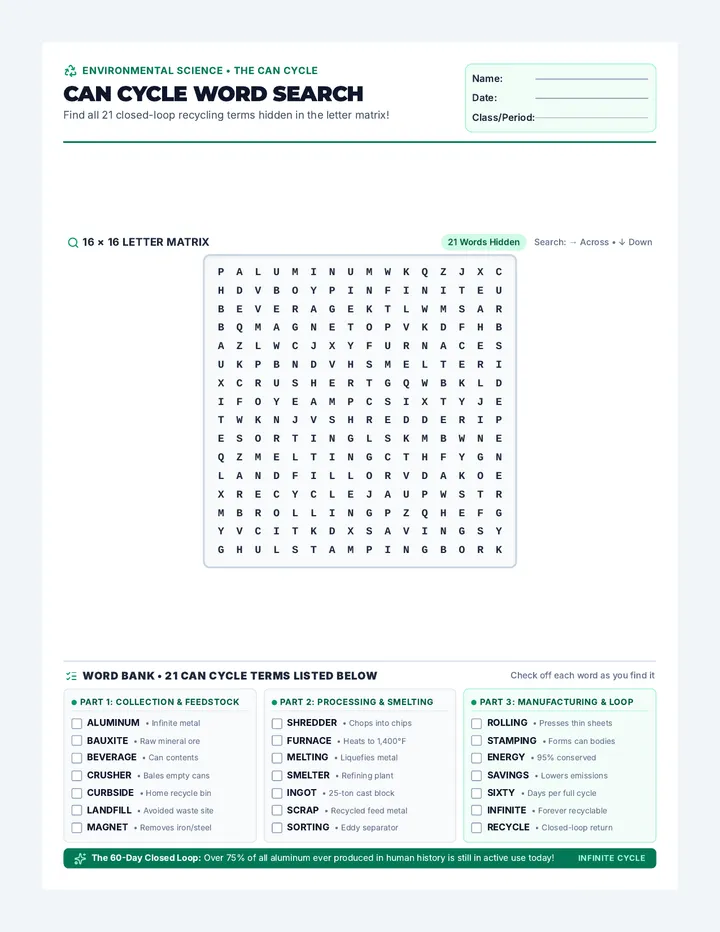
Infinite Loop Word Search

Can Cycle Loop

An environmental science lesson exploring closed-loop aluminum recycling, industrial metal sorting, and resource conservation through vocabulary study and puzzle challenges.

JD

Jenny Daniels

2
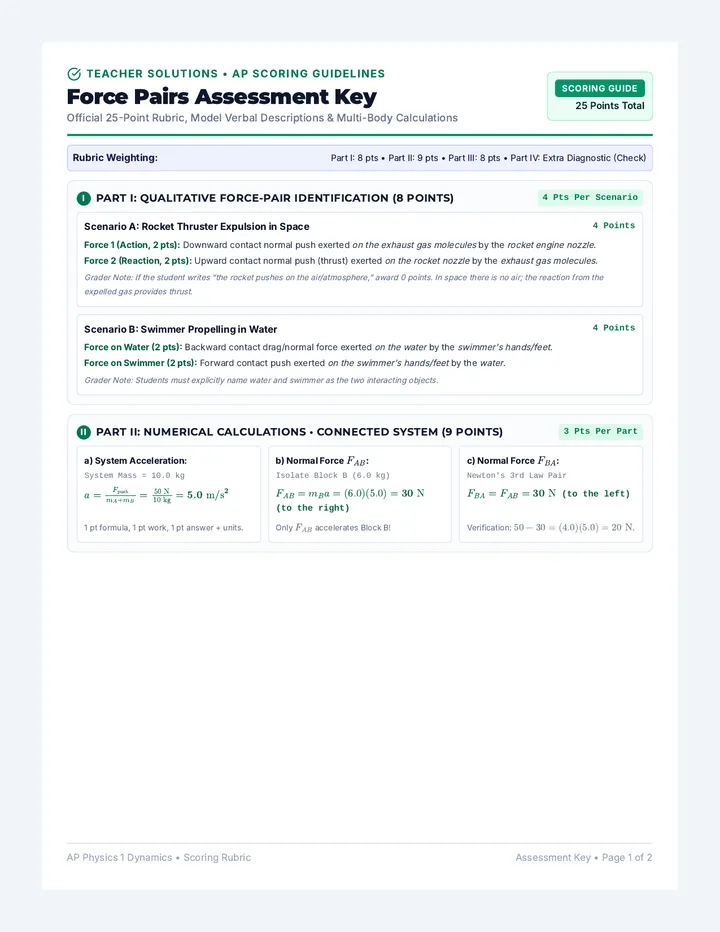
Force Pairs Assessment Key

Force Pairs Assessment Key

A two-page AP Physics 1 teacher scoring rubric and complete solutions key for the Force Pairs Mastery Assessment, detailing point allocations, verbal force pair models, calculations, and misconception refutations.

NK

Nadjia Khier

Pesky Biters Slides

Bug Busters

A two-part fifth-grade science sequence investigating how insects can be annoying nuisances, bite and sting, and damage crops and homes. Specially scaffolded with high-visual supports, decodable text chunks, and guided practice for lower-literacy learners.

Lenny Avatar
Lenny
11
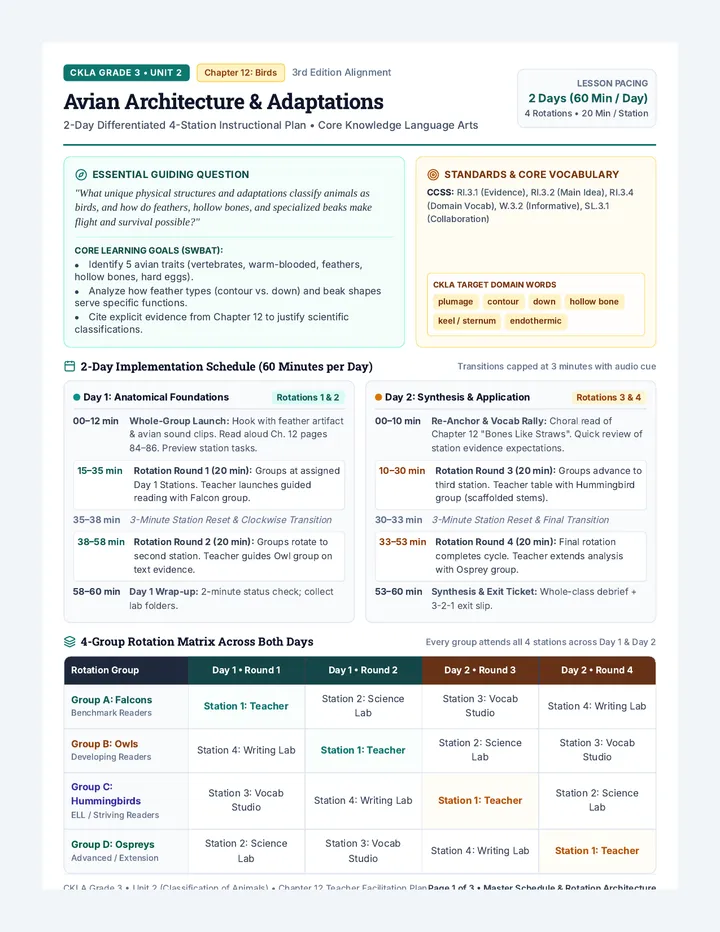
Avian Rotations Lesson Plan

Avian Champions Rotations

A 2-day CKLA Grade 3 animal classification lesson on birds featuring 4 structured rotation stations covering text analysis, hands-on lab investigation, domain vocabulary, and informative writing.

JR

Janine Rye

3
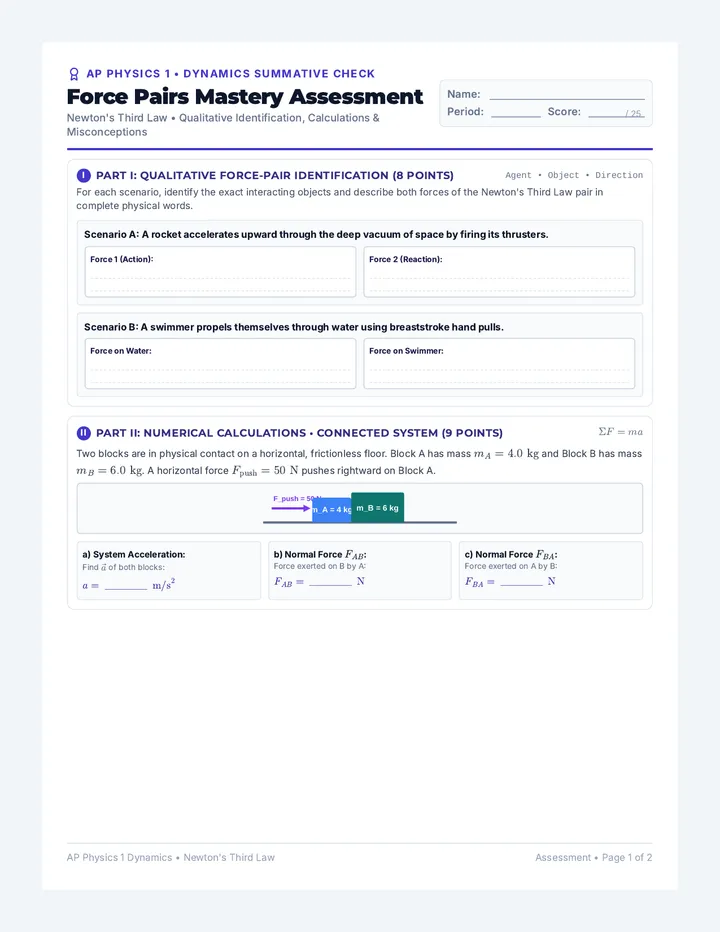
Force Pairs Mastery Assessment

Force Pairs Mastery Assessment

A two-page AP Physics 1 summative assessment covering qualitative agent-object force-pair identification, numerical multi-body contact calculations, and misconception refutation for the horse-cart paradox and gravitational attraction.

NK

Nadjia Khier

Helix Studio Slides

Candy Code Sequence

A multi-day competency-based biology sequence exploring DNA architecture, complementary base pairing, and semi-conservative replication through tactile candy modeling and evidence-based assessment.

TM

Teri Minami

4
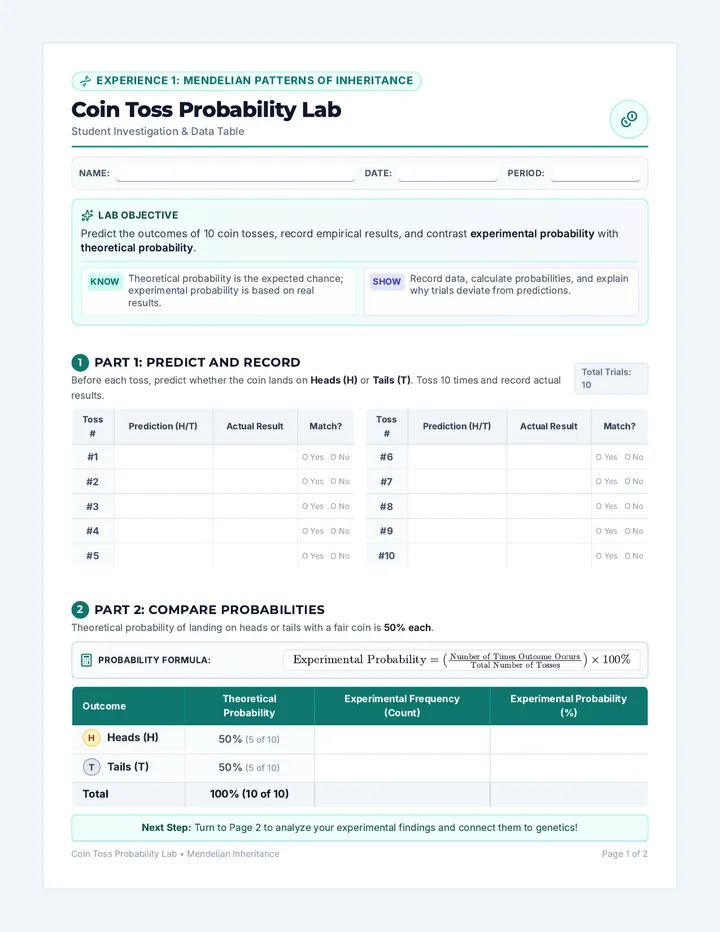
Coin Toss Genetics Worksheet

Lanzamiento de Alelos

Una lección interactiva de biología que conecta la probabilidad matemática del lanzamiento de monedas con los patrones de herencia mendeliana y la ley de segregación de alelos.

MB

Marsha Bolden

4
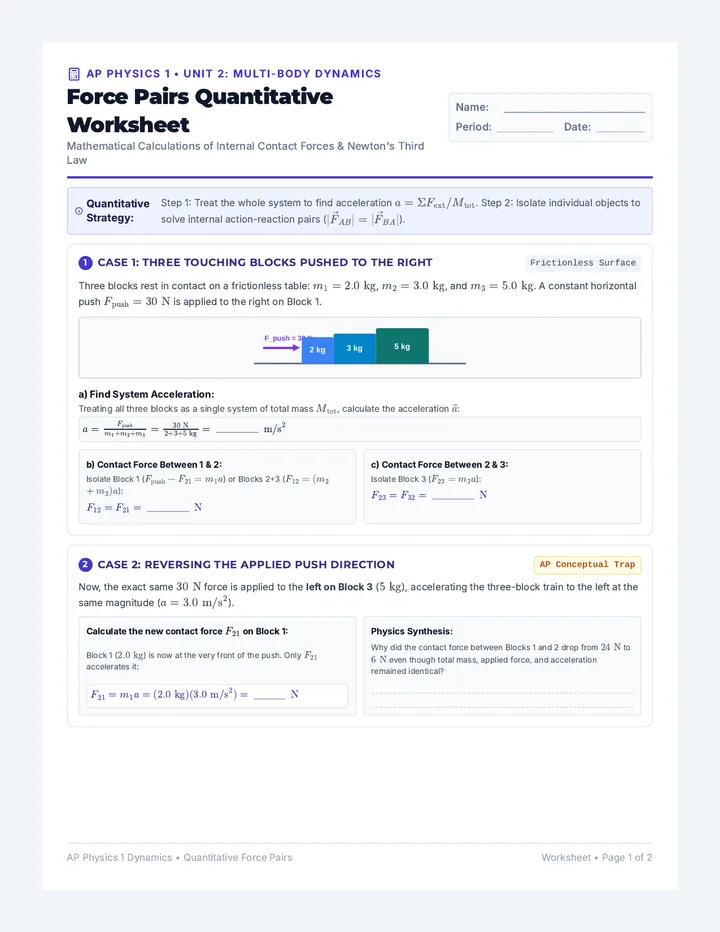
Force Pairs Quantitative Worksheet

Force Pairs Quantitative Worksheet

A two-page AP Physics 1 quantitative worksheet featuring multi-body numerical and symbolic calculations for internal contact forces, connected tensions, gravitational accelerations, and Newton's Third Law pairs.

NK

Nadjia Khier

Habitability Blueprint Slides

Life Beyond Limits

A one-week interdisciplinary astrobiology sequence investigating Earth's habitability, extreme biological adaptations across eleven Earth species, and the plausibility of life on other celestial bodies.

M

Megan.Tanner

7
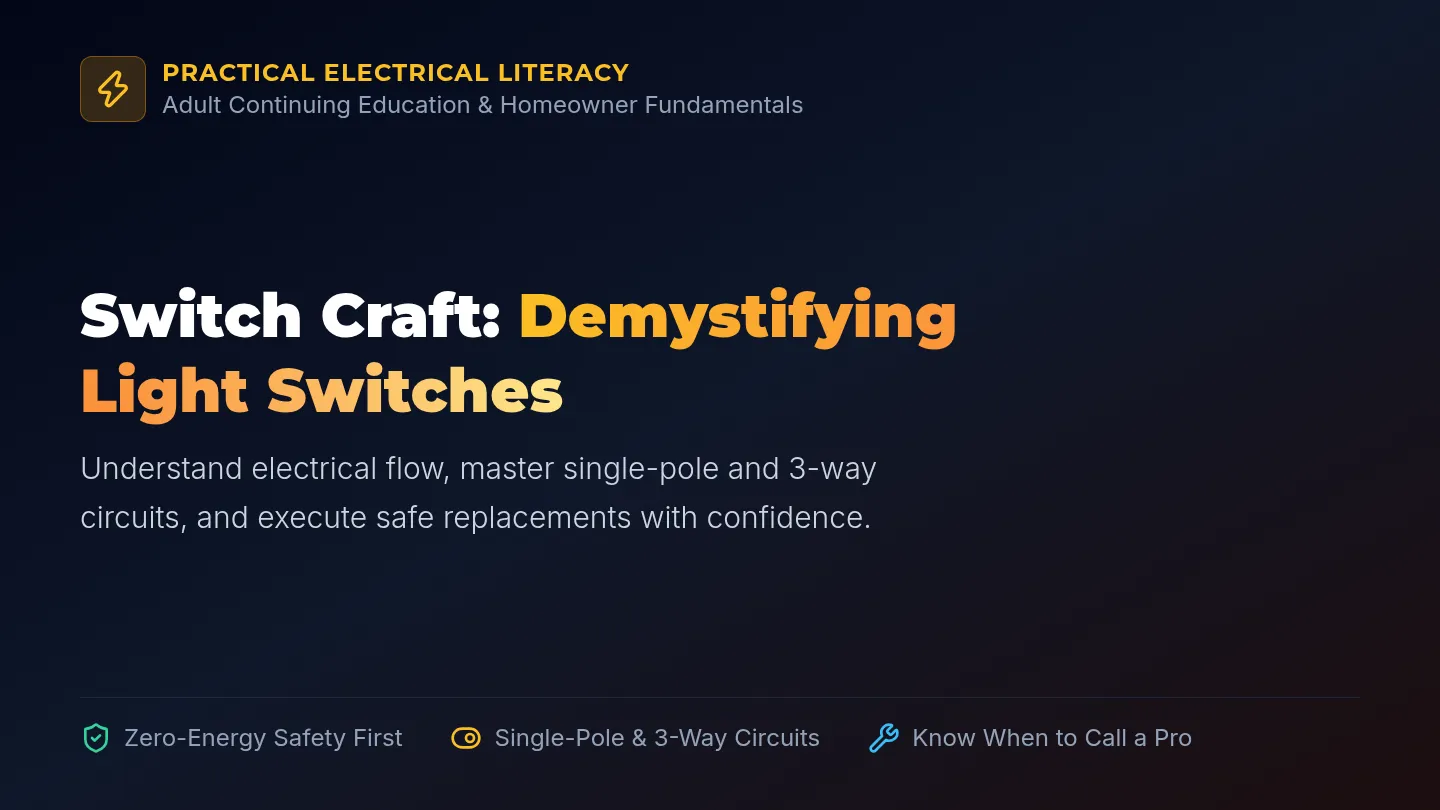
Switch Mastery Slides

Switch Craft

A comprehensive adult learning unit exploring residential light switch wiring, circuit topology, and household electrical safety. Adult learners master single-pole and three-way switch mechanics, terminal identification, wire color standards, and strict zero-energy verification protocols.

JW

J Watson

5
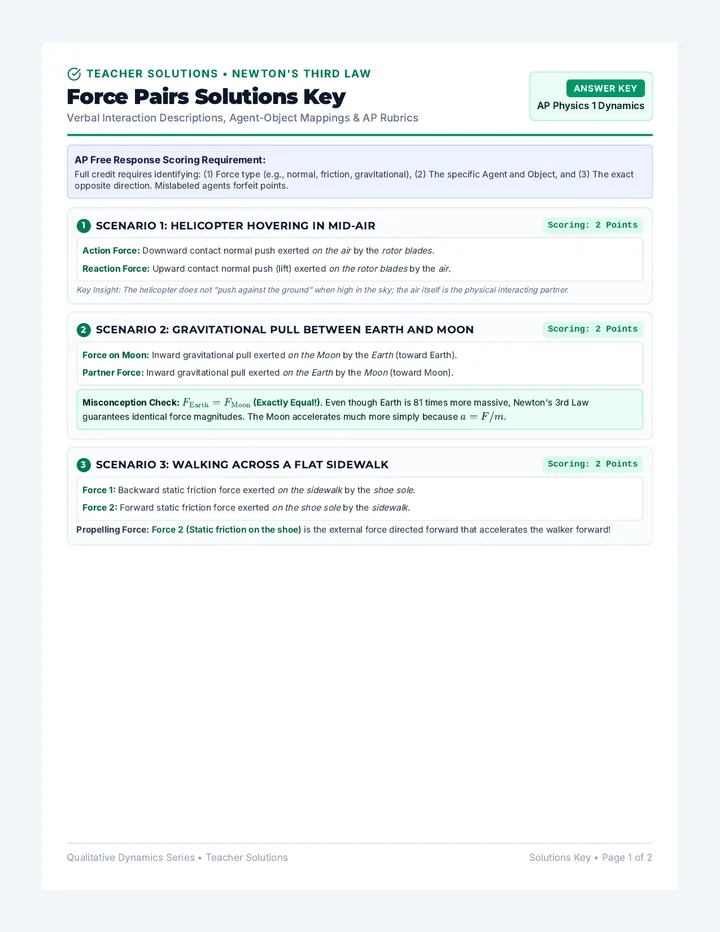
Force Pairs Solutions Key

Force Pairs Solutions Key

A two-page AP Physics 1 teacher answer key providing fully worked verbal force-pair descriptions, agent-object mappings, and physical justifications for the qualitative force pairs worksheet.

NK

Nadjia Khier