Switch Craft Bench Reference Manual • Page 1 of 2 National Electrical Code (NEC) Article 404 Compliant
Field Reference Sheet Residential Electrical Series
Dual-Location Switching
Hallways, Staircases, Large Rooms
BLANK
COM
T1
T2
G
3-Way Switch (3 Terminals + Ground)
Dark Common Screw: Connects to Line or Load.
Brass Traveler Screws: Connect traveler pair.
• No "ON / OFF" markings on toggle!
In a three-way circuit, two switches control the same light fixture from different locations. Current travels between the two switches across a pair of alternate conductors called travelers (usually 14/3 or 12/3 cable containing black and red wires).
Switch 1 Position Switch 2 Position Light State
UP (Path A) UP (Path A) ON (Circuit Complete)
UP (Path A) DOWN (Path B) OFF (Circuit Broken)
DOWN (Path B) UP (Path A) OFF (Circuit Broken)
DOWN (Path B) DOWN (Path B) ON (Circuit Complete)
Critical Rule: If either switch is replaced, identify and tag the wire connected to the common terminal before removing old screws!
Complete Three-Way Circuit Topology 14/2 FEED + 14/3 TRAVELER CABLE
SWITCH 1 (LINE) From Panel
COMMON Incoming Hot (Line)
Traveler 1 Black Traveler
Traveler 2 Red Traveler
White Neutral passes through
14/3 TRAVELER CABLE
TRAVELER A (BLACK)
TRAVELER B (RED)
NEUTRAL (BYPASSES SWITCHES)
SWITCH 2 (LOAD) To Fixture
Traveler 1 Black Traveler
Traveler 2 Red Traveler
COMMON Switched Hot (Load)
Carries current out to light
FIXTURE
Controlled from either end
The Tape Tag Technique
Before unscrewing the old switch, wrap a strip of blue electrical tape around the wire on the dark common screw. Connect that tagged wire to the dark common screw on your new switch.
Traveler Reversibility
It does not matter which traveler connects to which brass screw. Reversing travelers simply flips which toggle position corresponds to ON/OFF without affecting operation.
Classic Failure Mode
If the light works only when Switch A is in one specific position, a traveler wire and the common wire were accidentally swapped. Swap the common wire with one traveler to correct.
Switch Craft Bench Reference Manual • Page 2 of 2 National Electrical Code (NEC) Article 404 Compliant
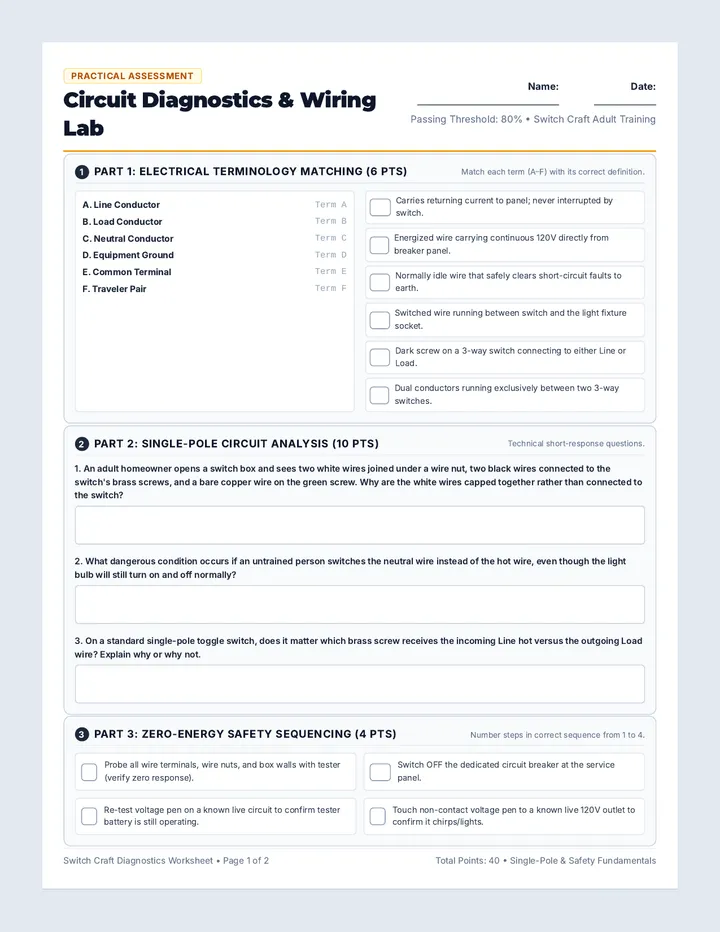
Common Terminal
The single dark screw on a 3-way switch connecting directly to Line power or Fixture load.
Pigtail Jumper
A short 6-inch wire linking a device screw to multiple conductors capped in a wire nut.
Know Your Limits
Aluminum Wiring
Silver conductors (common 1965-72). Requires CO/ALR switches and anti-oxidant. Fire hazard!
Knob & Tube / Cloth
Brittle crumbling insulation, zero equipment ground. Bending conductors cracks insulation.
Shared Neutrals
Multi-wire circuits share one neutral across two breakers. Can shock even with one breaker off!
Box Overcrowding
Forcing bulky smart dimmers into shallow boxes violates NEC box fill limits and pinches wires.
Switch Craft Reference Handout • Safety & Code Compliance National Electrical Code (NEC) Standards
A The Green Ground Terminal
B The Dark Common Terminal
C Traveler Terminal 1
D Traveler Terminal 2
4.2 What happens if an installer reverses the two brass traveler wires?
A The circuit breaker immediately trips on short circuit.
B The circuit continues to work normally with inverted toggle positions.
C The light bulb will burn out prematurely.
D Switch 2 will lose power entirely.
Diagnose the root cause and prescribe the correct fix.
Case A: A homeowner replaces a 3-way switch in a hallway. Now, the light turns on and off from Switch B ONLY when Switch A is in the UP position. If Switch A is flipped DOWN, Switch B does nothing. What wiring mistake was made?
Case B: A homeowner installs a single-pole switch. They attach the incoming black hot to brass screw 1, the outgoing black to brass screw 2, and connect the neutral white wire directly to the switch's green ground screw. What happens the moment they flip the switch ON?
Case C: You purchase a Wi-Fi smart switch that specifies "Neutral Wire Required." When you open your 1950s switch box, you see only two wires: one black and one white connected to the old switch, with no other wires in the box. Can you install this switch? Explain.
Indicate whether you can safely DIY or must Call a Licensed Electrician.
1. Opening box reveals silver-colored aluminum branch wiring with standard copper-only switch.
Action: ___________________
2. Replacing standard single-pole switch in modern 2015 house with copper NM-B cable and grounding.
Action: ___________________
3. Switch box contains multiple circuits with a shared multi-wire neutral and charred wire nut.
Action: ___________________
Switch Craft Diagnostics Worksheet • Page 2 of 2 Passing Score: 32 / 40 (80%) • Complete & Review with Instructor
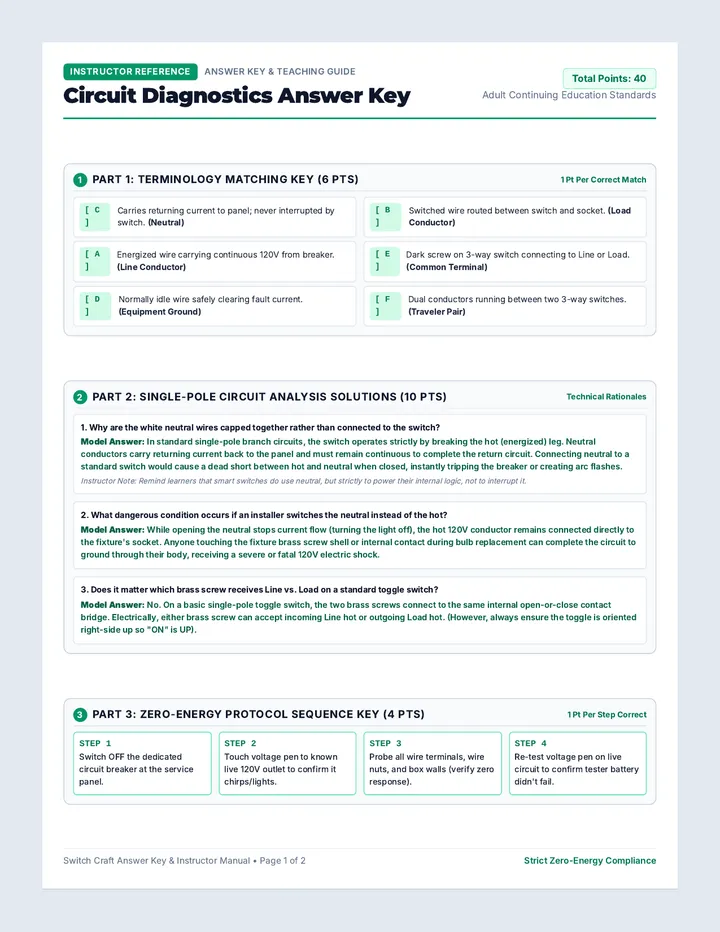
STEP 2
Touch voltage pen to known live 120V outlet to confirm it chirps/lights.
STEP 3
Probe all wire terminals, wire nuts, and box walls (verify zero response).
STEP 4
Re-test voltage pen on live circuit to confirm tester battery didn't fail.
Switch Craft Answer Key & Instructor Manual • Page 1 of 2 Strict Zero-Energy Compliance
Instructor Reference Answer Key & Teaching Guide
Part 4, 5 & 6 Solutions • Facilitation Notes
4 Pts Each
4.1 Dark Terminal Identification B
Correct: B (The Dark Common Terminal). Three-way switches feature one distinctly darker screw (black or oxidized brass) marked "COMMON". Traveler screws are bright brass.
4.2 Reversing Brass Travelers B
Correct: B (Circuit works normally with inverted positions). Because both travelers merely provide parallel pathways, swapping traveler brass screws does not cause short circuits or failures.
3 Pts Per Case
Case A Solution: Common and Traveler Wires Accidental Swap
Root Cause: The homeowner accidentally attached one of the traveler wires to the dark common screw, and attached the true common wire to a brass traveler screw. When Switch A is UP, it powers the mismatched traveler; when Switch A is DOWN, power is cut completely to Switch B.
Remedy: Identify the true feed or load conductor using a multimeter or tracing, attach it to the dark common terminal, and restore the travelers to the two brass screws.
Case B Solution: Immediate Direct Short Circuit to Ground
Root Cause: Connecting neutral directly to the switch ground screw creates a direct short between the 120V line and the grounded metallic yoke the moment the switch toggle closes. The circuit breaker will instantly trip with an audible snap and arc flash.
Case C Solution: Switch Loop / No Neutral Available
Root Cause: No, this smart switch cannot be installed. The box contains a vintage "switch loop" where the white wire was re-purposed as a hot feed from the ceiling light fixture, meaning there is zero neutral return conductor in the wall box.
Remedy: The homeowner must either purchase a "No-Neutral Required" smart dimmer (such as Lutron Caséta) or pull a new 3-conductor cable containing a neutral to the box.
1 Pt Each
1. CALL LICENSED PRO
Aluminum wiring creeps under copper screws, causing fires. Requires COPALUM crimps or AlumiConn splices.
2. SAFE TO DIY
Standard copper NM-B with ground in modern home is standard DIY scope following the 5-step shutoff rule.
3. CALL LICENSED PRO
Shared neutrals can carry lethal return current even with one breaker off. Charring indicates active arcing damage.
1. The "Tape It First" Habit: Adult learners often rush to unscrew all terminals simultaneously. Emphasize physical wire tagging before touching screws with screwdrivers.
2. Live-Dead-Live Demonstrations: Have learners witness tester battery failure in the shop so they understand why the 4th step (re-testing the tester) saves lives.
Switch Craft Answer Key & Instructor Manual • Page 2 of 2 National Electrical Code (NEC) Article 404 Guidelines