Barbados Lighting Reference Guide
Barbados Vocational Technical Series GEED & BS 7671 Aligned
Single-Phase 115V / 230V · 50 Hz
Barbados Lighting Reference Guide
Foundational reference for adult electrical trainees: Supply characteristics, cable color identification, and basic schematic conventions.
1
Barbados Grid Context & Legal Authorities
Utility Provider
Barbados Light & Power (BL&P) delivers single-phase domestic supplies at 115V / 230V, 50 Hz. Dual-voltage split-phase service is standard residential infrastructure.
Statutory Regulator
The Government Electrical Engineering Dept. (GEED) inspects and certifies all installations. Uncertified work cannot be lawfully energized or connected to the national grid.
Regulatory Standard
Local installations primarily reference BS 7671 (IET Wiring Regulations) modified by local public utility bylaws, alongside specific NEC provisions for 115V branch equipment.
2
Conductor Color Standards in Barbados
Critical: Harmonized vs. Pre-2004 Legacy
Because many Bajan dwellings feature legacy wiring, trainees must confidently identify both current harmonized standards and older UK installations:
Current Standard (Harmonized) BS 7671 Current
Line / Live (L): BROWN
Neutral (N): BLUE
Protective Earth (CPC): GREEN / YELLOW
Pre-2004 Legacy (Common in BL&P grid) Legacy Bajan
Line / Live (L): RED
Neutral (N): BLACK
Protective Earth (CPC): BARE / GREEN SLEEVED
3
Standard Schematic & Wiring Symbols
1-Way Switch (SPST) Single pole, single throw
2-Way Switch (SPDT) COM, L1, L2 terminals
Luminaire (Lamp) Lighting point / load
Protective Earth CPC safety bond
Trainee Safety Notice: This document is designed exclusively for educational concept study and classroom laboratory boards under certified instructor supervision. Working on energized mains without a licensed wireman certification issued in Barbados violates national safety codes and presents fatal shock and fire risks.
Barbados Electrical Reference Guide · Vocational Education Series Page 1 of 4 · National Standards & Symbols
Circuit Module 01 Radial Lighting Topology
Single-Switch (One-Way) Control Circuit
Schematic breakdown of a single point-of-control lighting circuit with proper conductor sleeving and earthing.
Conceptual Schematic: Loop-In Ceiling Rose with Switch Drop
115V / 230V AC Supply
CONSUMER UNIT 6A MCB LINE (L) NEUTRAL EARTH CEILING ROSE / JUNCTION POINT LOOP (L) SW-LIVE NEUTRAL LAMP 1-WAY SWITCH (SPST) COM L1 LINE (Brown) SLEEVE Switched Line NEUTRAL (Blue) CPC / EARTH
Line Conductor: Brown Neutral Conductor: Blue Switched-Line: Brown Sleeved Earth/CPC: Green/Yellow
Topology A: Loop-In at Ceiling Rose
The permanent live and neutral feed run directly into the ceiling rose terminal block. A twin-and-earth cable drops down to the switch.
- Feed: Arrives at ceiling point first.
- Switch Drop: Carries permanent live down and switched-live back up.
- Advantage: Fewer cables jammed into shallow switch boxes.
Topology B: Loop-In at Switch Box
The mains supply enters the switch backbox first. Permanent live feeds COM, neutral connects through a terminal block, and switched live leaves L1 to the lamp.
- Feed: Arrives at wall switch first.
- Neutral: Linked through lever/screw block behind switch.
- Advantage: Simplified wiring for decorative ceiling fixtures.
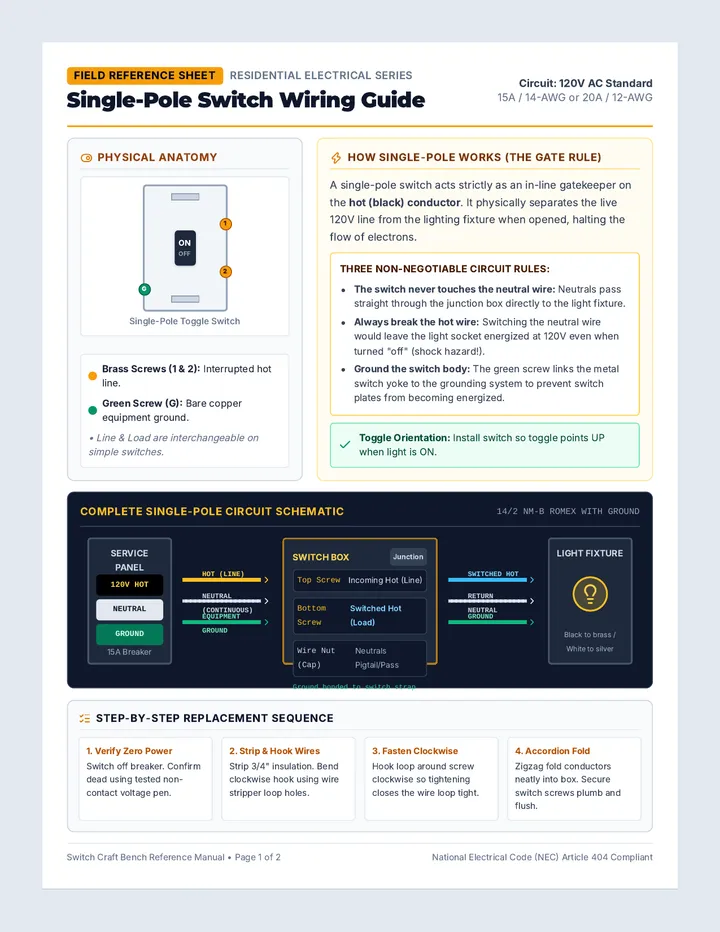
Mandatory Code Rule: Never Switch the Neutral
The switch must always interrupt the Line (Live) conductor, never the Neutral. If a switch breaks the neutral wire, the lamp will turn off (breaking the circuit), but the entire lamp socket remains energized at full 115V/230V mains potential. Anyone changing a bulb could receive a lethal shock even with the switch off!
Conductor Sleeving (Flagging) Requirement
When standard twin-and-earth cable (brown/blue) is used for a switch drop, the blue core acts as the return switched-live conductor. You must sleeve or tape this blue conductor with brown tape at both ends (inside the switch box and inside the ceiling rose) to warn future technicians that this wire becomes energized when switched on.
Barbados Electrical Reference Guide · Vocational Education Series Page 2 of 4 · Single-Switch Architecture
Circuit Module 02 Dual-Control Configuration
Two-Way Switching (Dual Location Control)
Operating mechanics and schematic for controlling a single lighting point from two separate locations.
Conceptual Schematic: Two-Way Switching via Strappers (Travelers)
SPDT Architecture
SWITCH A (2-WAY) Location 1 (e.g. Hallway Bottom) COM L1 L2 SWITCH B (2-WAY) Location 2 (e.g. Hallway Top) L1 L2 COM STRAPPER 1 (L1) STRAPPER 2 (L2) LINE (L) Switched Live LAMP (ON) NEUTRAL (N) ACTIVE CLOSED PATH
Both switches aligned to L1 = Continuous closed circuit (Lamp Lit) Standard 2-Wire Strapper Topology
Two-Way Switching Logic Matrix (Truth Table)
Toggling either switch changes state
| State | Switch A Contact | Switch B Contact | Current Flow Path | Lamp Status |
|---|
| 1 | Position L1 | Position L1 | Line → COM-A → L1 → Strapper 1 → L1 → COM-B → Lamp | ON (Lit) |
| 2 | Position L1 | Position L2 | Circuit Broken at Switch B (Air Gap at L1) | OFF |
| 3 | Position L2 | Position L1 | Circuit Broken at Switch A (Air Gap at L2) | OFF |
| 4 | Position L2 | Position L2 | Line → COM-A → L2 → Strapper 2 → L2 → COM-B → Lamp | ON (Lit) |
Field Pitfalls & Diagnostic Checkpoints
Common-to-Strapper Transposition Error: Connecting the permanent live feed to L1 instead of COM causes the light to work only when the opposing switch is in one specific position. Always verify COM terminal markings.
Strapper Conductor Identification: In 3-core cables (brown/black/grey), both black and grey wires act as live strappers. Both must be properly marked with brown sleeving to designate active phase carriers.
Barbados Electrical Reference Guide · Vocational Education Series Page 3 of 4 · Two-Way Switching
Protocol Module 03 Occupational Safety Standard
Safe Isolation Procedure & Site Compliance
Standard operating procedure for dead-circuit verification, test instrumentation, and Barbados legal compliance.
The 5-Step Safe Isolation Procedure (Mandatory Standard)
Never Work Live
1
Identify Circuit & Seek Permission:
Locate the correct branch miniature circuit breaker (MCB) or fuse in the distribution board feeding the specific lighting circuit.
2
Isolate & Lock-Out / Tag-Out (LOTO):
Switch the MCB to the OFF position. Attach an approved padlock lockout device and a danger warning tag. Retain the only key on your person.
3
Verify Test Instrument on Known Source (Test 1):
Use an approved two-pole voltage detector (GS38 compliant). Test it against a calibrated Proving Unit or verified live source to confirm the tester functions correctly.
4
Test the Isolated Circuit for Dead Condition:
Test all conductor combinations at the work point: Line to Neutral, Line to Earth, and Neutral to Earth. Verify that zero voltage is detected.
5
Re-Verify Test Instrument on Proving Unit (Test 2):
Re-test your voltage detector on the proving unit once more to ensure the tester did not fail during testing. Only now is the circuit declared safe to touch.
Required Instrumentation
- Two-Pole Voltage Tester: Must have finger barriers, fused leads, and exposed probe tips under 4mm (GS38 spec).
- No "Neon Screwdrivers": Neon test pens are unsafe, unreliable, and prohibited on accredited training sites.
- Multimeter CAT Rating: CAT III 600V minimum for domestic distribution testing.
PPE & Hand Tool Specs
- Insulated Hand Tools: VDE 1000V rated screwdrivers and terminal pliers (IEC 60900 certified).
- Safety Footwear: Dielectric or rubber-soled work boots without exposed conductive plates.
- Eye Protection: Impact-resistant safety glasses when opening enclosures or cutting conductors.
Barbados Legal Framework: The GEED Certification Process
Under the Laws of Barbados, any new installation, major alteration, or addition to domestic lighting or power circuits must be executed under the direct supervision of a Barbados Licensed Wireman. Upon completion, a certificate of compliance is submitted to the Government Electrical Engineering Department (GEED) for formal on-site inspection and testing before permanent authorization.
Laboratory Practice Verification
Safe isolation demonstrated
Brown sleeving verified
CPC continuity tested
Barbados Electrical Reference Guide · Vocational Education Series Page 4 of 4 · Isolation & Legal Compliance