Pest Spotters Slides Bug Busters • Lesson 1 Grade 5 Science
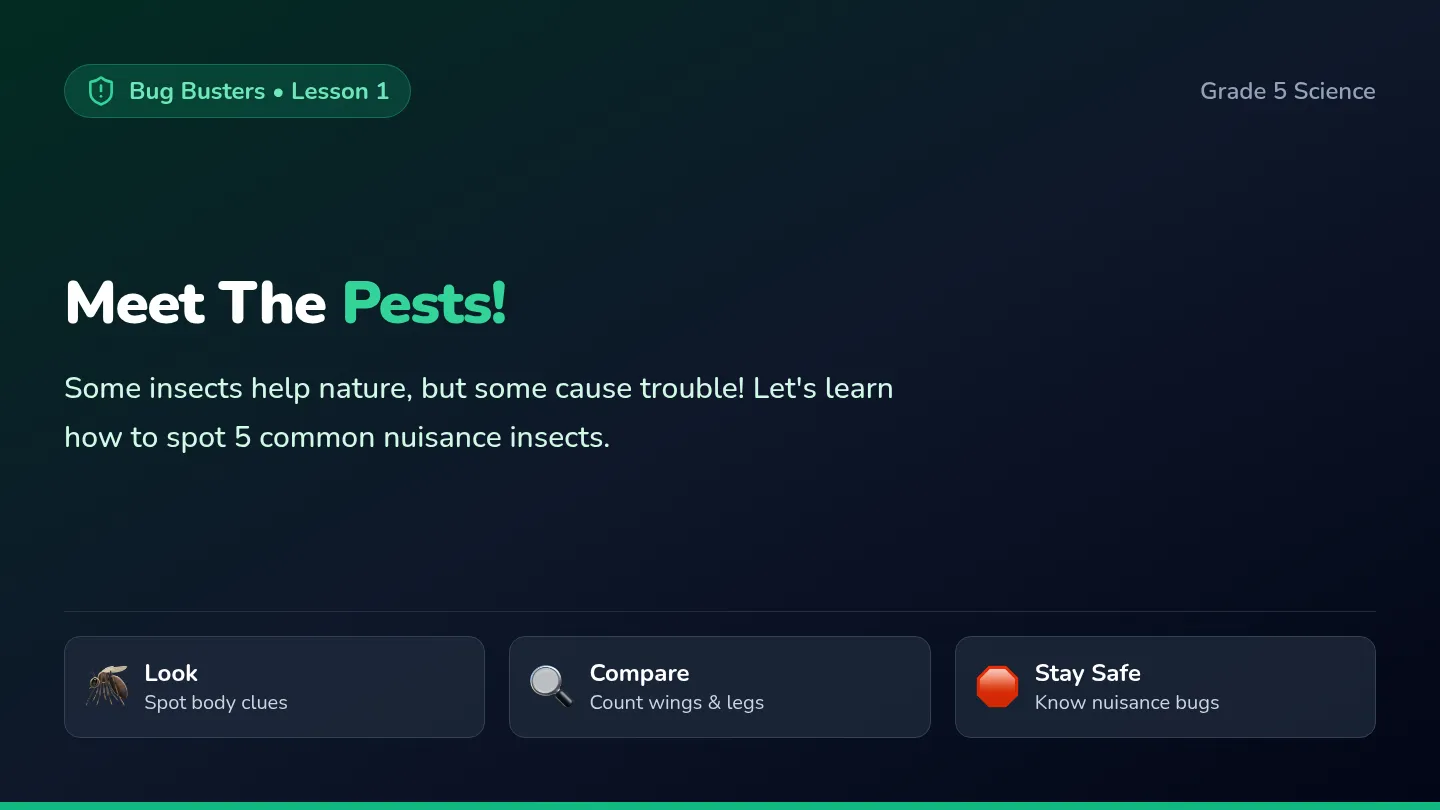
Meet The Pests!
Some insects help nature, but some cause trouble! Let's learn how to spot 5 common nuisance insects.
🦟
Look
Spot body clues
🔍
Compare
Count wings & legs
🛑
Stay Safe
Know nuisance bugs
Pest #1
Mosquito
🦟
Body Clues
• Needle Mouth: Long, thin tube used to pierce skin
• Thin Body: Slender shape with long, skinny legs
• 2 Wings: Make a high-pitched buzzing sound
Why It's a Nuisance
Females bite humans and animals to drink blood, leaving itchy red bumps!
Detective Clue: Look for them hovering near still water.
Action Word: Buzz & Bite 6 Legs • 2 Wings • Piercing Needle
Pest #2
Housefly
🪰
Body Clues
• Giant Eyes: Two huge reddish eyes that see everywhere
• Hairy Body: Gray thorax with dark stripes and hairs
• Sponge Mouth: Laps up liquid food like a mop
Why It's a Nuisance
They land on trash and animal waste, then land on our food and spread germs!
Detective Clue: Look for them circling trash cans and tables.
Action Word: Land & Spread Germs Big Eyes • 2 Clear Wings • Hairy Legs
Pest #3
Cockroach
🪳
Body Clues
• Flat Shield: Flat, shiny oval body to squeeze into tiny cracks
• Long Feelers: Waving antennae longer than its body
• Speed Legs: Spiny legs built for sprinting in the dark
Why It's a Nuisance
They hide inside walls, contaminate food, and can trigger asthma or allergies!
Detective Clue: They scurry away when lights turn on at night.
Action Word: Scurry & Hide Flat Body • Long Antennae • Fast Runner
Pest #4
Wasp & Yellowjacket
🐝
Body Clues
• Striped Pattern: Bright black and yellow warning stripes
• Narrow Waist: Very skinny middle between body sections
• Smooth Stinger: Pointy weapon at the tail tip (can sting multiple times)
Why It's a Nuisance
They defend nests aggressively near porches and picnic tables, delivering painful stings!
Detective Clue: Attracted to sweet drinks, fruit, and meat outdoors.
Action Word: Hover & Sting Skinny Waist • Yellow Stripes • Sharp Stinger
The Bug Detective Golden Rule
6 Legs
All True Insects Have 6 Legs
Count them: 3 legs on the left side, 3 legs on the right side. If it has 8 legs, it is a spider, not an insect!
3 Parts
Head • Thorax • Abdomen
Head: Eyes and feelers.Thorax: Legs and wings connect here.Abdomen: Tail section at the back.
Ready for practice? Let's inspect our Pest Clues Worksheet!
Pest Clues Worksheet 🔍
Pest Clues Worksheet
Bug Busters • Lesson 1 Detective Sheet
Name:
Date:
Detective Mission: Read the visible body clues. Check the matching boxes and identify each nuisance bug!
1 Bug Clue Check: Read & Check the Features
Check all clues that fit
🦟 Pest A: Mosquito
Water Lover
Long needle-like piercing mouth Skinny legs and slender body Makes high buzzing sound
Main trouble: Itchy bites / drinks blood
🪰 Pest B: Housefly
Trash Lover
Two huge reddish-brown eyes Sponging mouth for liquid food Short, hairy body with 2 clear wings
Main trouble: Spreads germs on food
🪳 Pest C: Cockroach
Night Runner
Flat, shiny oval shield body Long feelers (antennae) on head Runs very quickly into dark cracks
Main trouble: Contaminates kitchen food
🐝 Pest D: Wasp
Stinger
Bright yellow and black stripes Very narrow skinny waist Sharp smooth stinger at tail tip
Main trouble: Painful defensive sting
2 Mystery Clue Match: Write the Correct Pest Name
[ Mosquito ] [ Housefly ] [ Cockroach ] [ Wasp ]
Clue 1: "I have a flat brown body and run into dark wall cracks when lights switch on."
Mystery Bug:
Clue 2: "I hover over puddles and have a needle mouth to drink blood."
Mystery Bug:
Clue 3: "I have yellow warning stripes, a narrow waist, and can sting more than once."
Mystery Bug:
Clue 4: "I have giant reddish eyes and sponge up food crumbs around trash bins."
Mystery Bug:
3 True Insect Count: Fill in the Blanks
Every true insect has
legs. (Count: 4, 6, or 8?)
An insect's body has
main parts (Head, Thorax, Tail).
Pest Spotters Teacher Guide 📋
Pest Spotters Teacher Guide
Lesson 1 Facilitation & Scaffolding Plan
35–40 Minutes
Target: 5th Grade Lower Literacy
Lesson Flow & Active Routines
Time
Phase
Key Teacher Actions & Lower-Literacy Moves
5 Mins
Hook & Gesture
Display Slide 1. Ask: "Have you ever had a bug ruin your picnic or sleep?" Introduce physical gesture: hold up 6 fingers for 6 legs.
15 Mins
Guided Spotting
Slides 2–5. Use Choral Reading on the bold "Action Words" (Buzz & Bite, Land & Spread, Scurry & Hide, Hover & Sting). Pair each with a sound/action.
12 Mins
Detective Practice
Distribute Pest Clues Worksheet . Model Part 1 together using the Mosquito card. Let students complete Part 2 in pairs.
5 Mins
Wrap-Up Check
Chant the Bug Rule: "3 Body Parts, 6 Walking Legs!" Review Part 3 answers aloud.
Kinesthetic Memory Cues (Gestures)
Needle Mouth (Mosquito): Pinch two index fingers together and make a gentle poking tap on forearm.Sponge Mouth (Fly): Pat palms together like dabbing a sponge.Antennae (Cockroach): Two wiggling fingers above forehead like radar dishes.Narrow Waist (Wasp): Hands squeezing inward at your waistline.
Common Misconceptions to Clarify
"Spiders are insects": Clarify that spiders have 8 legs and 2 body segments. Insects always have 6 legs and 3 parts."All bugs bite": Flies do not bite; they sponge liquids. Cockroaches do not actively hunt humans to bite; they contaminate."Wasps die when they sting": Honeybees die after one sting, but wasps have smooth stingers and can sting repeatedly.
Pest Clues Worksheet Answer Key
Part 1 Checkboxes:
All checkboxes on cards A, B, C, and D are accurate features. Students should check all 3 on each card after reading aloud.
Part 2 Mystery Match:
1. Cockroach
2. Mosquito
3. Wasp
4. Housefly
Part 3 Quick Check:
• Every true insect has 6 legs.
• Body has 3 main parts.
Word Safari Slides Bug Busters • Lesson 2 Grade 5 Vocabulary
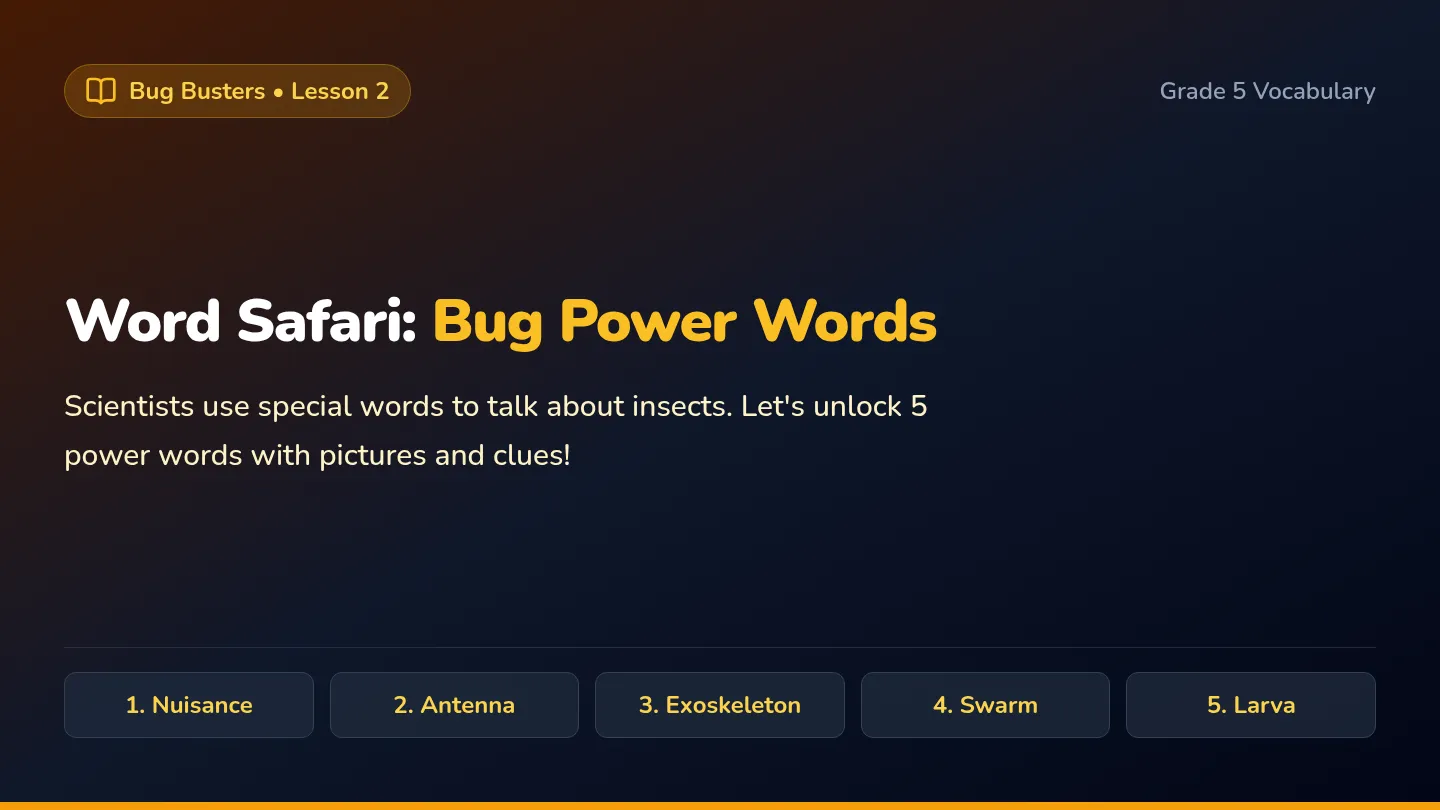
Word Safari: Bug Power Words
Scientists use special words to talk about insects. Let's unlock 5 power words with pictures and clues!
1. Nuisance
2. Antenna
3. Exoskeleton
4. Swarm
5. Larva
Power Word #1 Say it: NOO-sins
Nuisance
Simple Meaning:
Something that causes trouble, annoys you, or disturbs peace.
In a sentence: "The buzzing mosquito was a huge nuisance while we tried to sleep."
😤
Picture Anchor
Think of a mosquito buzzing right in your ear: annoying, disruptive, and troublesome!
Troublemaker
Opposite word: Helper or Peaceful Action: Wave hands like shooing a bug
Power Word #2 Say it: an-TEN-uh
Antenna
Simple Meaning:
Sensors on a bug's head used to touch, smell, and detect danger.
In a sentence: "The cockroach waved its long antennae to smell food crumbs in the dark."
📡
Picture Anchor: Bug Radar!
Bugs do not have noses like us. Their antennae act like living radar dishes that sniff and feel!
Plural: Antennae (two feelers)
Bug Sense: Smell + Touch + Balance Action: Wiggle two fingers on your head
Power Word #3 Say it: EK-so-SKEL-uh-tun
Exoskeleton
Simple Meaning:
A hard shell on the OUTSIDE of an insect's body that protects it like armor.
In a sentence: "A beetle has a shiny, tough exoskeleton to protect its body."
🛡️
Picture Anchor: Body Armor
Humans have bones on the inside. Insects wear their skeleton on the outside!
"Exo" means Outside!
Key Clue: Outside Skeleton = Armor Shell Action: Cross arms firmly over chest
Power Word #4 Say it: SWORM
Swarm
Simple Meaning:
A large crowd of flying insects moving together as a group.
In a sentence: "A big swarm of gnats flew around the outdoor light."
☁️🦟
Picture Anchor: Bug Cloud
Not just one insect, but dozens or hundreds flying together in a noisy cloud!
Group Power
Group Noun: A Swarm of Wasps or Flies Action: Circle hands together quickly
Word Match Activity 🔤
Word Match Activity
Bug Busters • Lesson 2 Vocabulary Practice
Name:
Date:
Mission: Match each bug power word to its picture and simple meaning, then complete the detective sentences!
1 Draw a Line: Connect the Word to its Picture & Clue
A. NUISANCE
B. ANTENNA
C. EXOSKELETON
D. SWARM
E. LARVA
↔
🛡️
Hard outside shell that protects like armor Skeleton on the outside
🐛
Baby insect stage that looks like a little worm Wriggler before growing wings
😤
Something that causes trouble, pain, or annoyance Pest troublemaker
☁️
A large cloud or group of bugs flying together Crowd of flying pests
📡
Feelers on head used to smell and detect danger Living bug radar
2 Word Bank Sentences: Fill in the Missing Word
nuisance antenna exoskeleton swarm larva
A beetle's tough outside shell is called its
.
When thousands of gnats fly together in a cloud, they form a
.
A bug uses its head feelers, or
, to sniff out sweet food crumbs.
A baby mosquito that wiggles in puddle water is called a
.
Any bug that bites or spreads disease is a troublesome
.
3 Bug Word Check: Circle YES or NO
Does an insect have bones inside its skin?
YES NO
Can an insect smell food with its antennae?
YES NO
Bug Words Poster ⭐ Bug Busters Official Word Bank ⭐
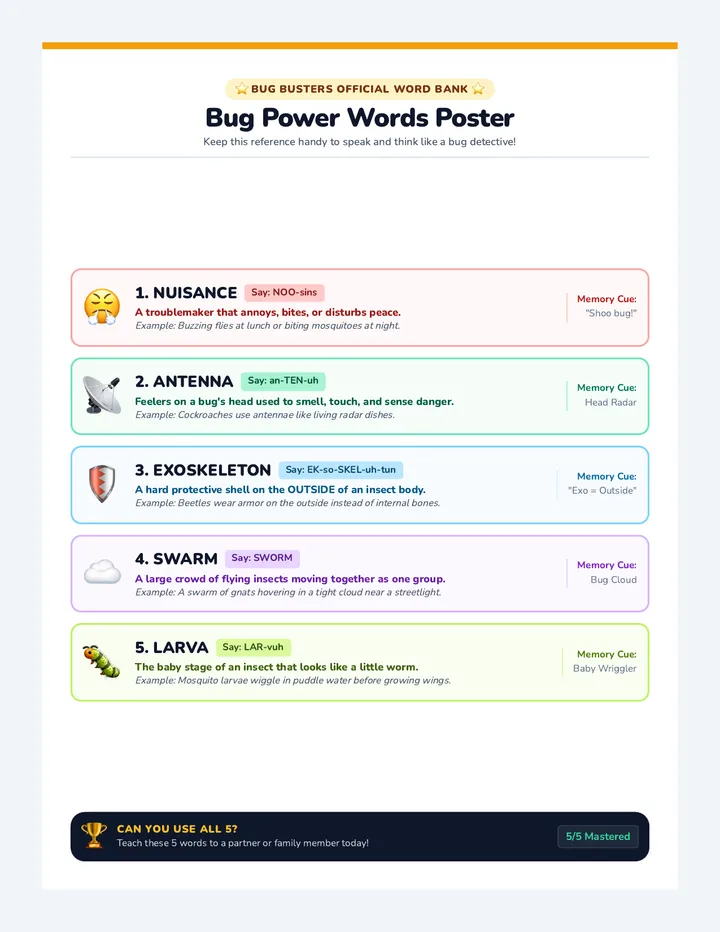
Bug Power Words Poster
Keep this reference handy to speak and think like a bug detective!
😤
1. NUISANCE
Say: NOO-sins
A troublemaker that annoys, bites, or disturbs peace.
Example: Buzzing flies at lunch or biting mosquitoes at night.
Memory Cue: "Shoo bug!"
📡
2. ANTENNA
Say: an-TEN-uh
Feelers on a bug's head used to smell, touch, and sense danger.
Example: Cockroaches use antennae like living radar dishes.
Memory Cue: Head Radar
🛡️
3. EXOSKELETON
Say: EK-so-SKEL-uh-tun
A hard protective shell on the OUTSIDE of an insect body.
Example: Beetles wear armor on the outside instead of internal bones.
Memory Cue: "Exo = Outside"
☁️
4. SWARM
Say: SWORM
A large crowd of flying insects moving together as one group.
Example: A swarm of gnats hovering in a tight cloud near a streetlight.
Memory Cue: Bug Cloud
🐛
5. LARVA
Say: LAR-vuh
The baby stage of an insect that looks like a little worm.
Example: Mosquito larvae wiggle in puddle water before growing wings.
Memory Cue: Baby Wriggler
🏆
Can You Use All 5?
Teach these 5 words to a partner or family member today!
5/5 Mastered
Bug Havens Slides Bug Busters • Lesson 3 Grade 5 Science
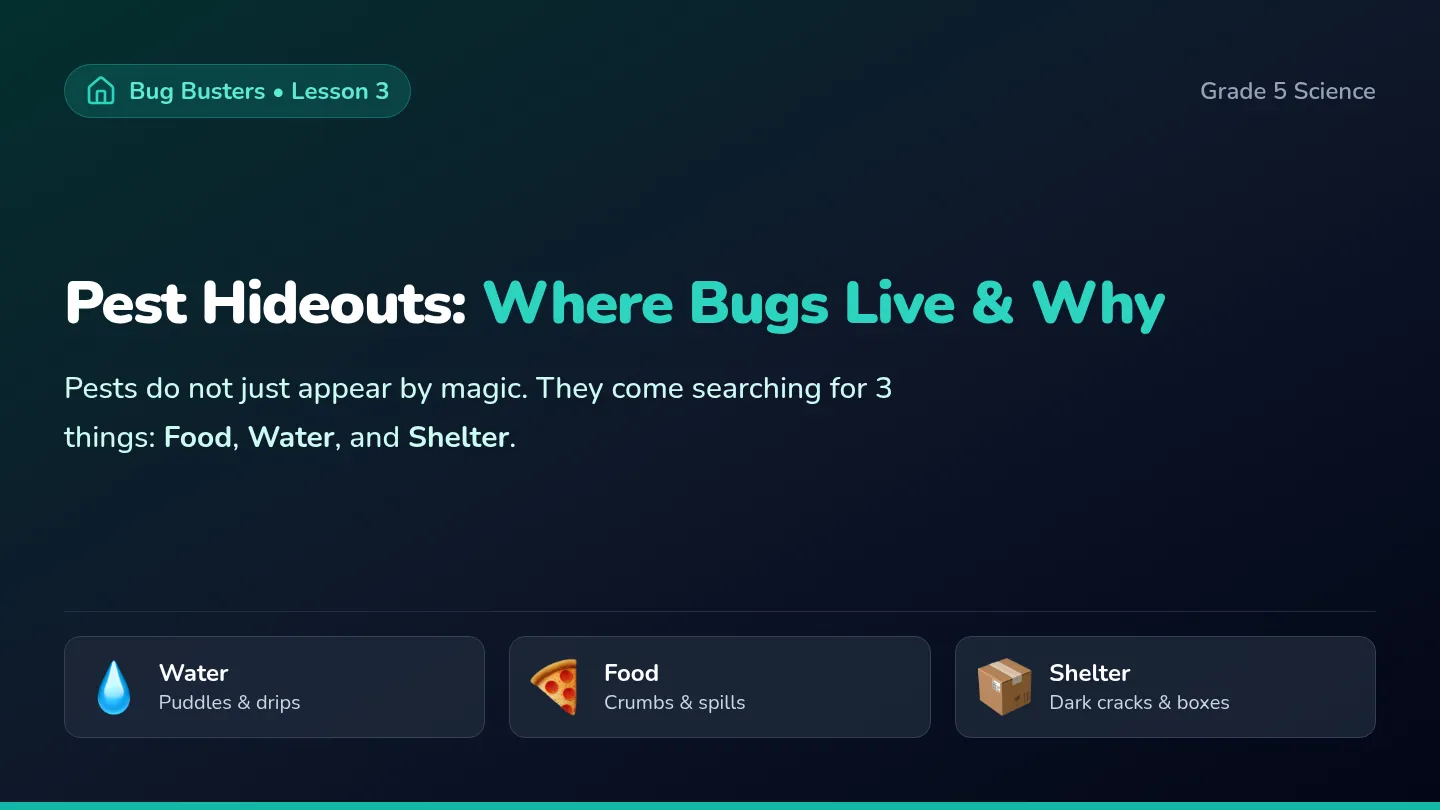
Pest Hideouts: Where Bugs Live & Why
Pests do not just appear by magic. They come searching for 3 things: Food , Water , and Shelter .
💧
Water
Puddles & drips
🍕
Food
Crumbs & spills
📦
Shelter
Dark cracks & boxes
Attractant #1
Standing Water
💧
Who Loves It?
🦟
Mosquitoes!
They lay hundreds of eggs on still water.
Common Havens: Birdbaths, old tires, flower pot saucers, dog bowls, and clogged gutters.
Detective Solution: Dump It!
Tip out standing water once a week. Without water, mosquito eggs cannot hatch!
Rule: No still water = No mosquito nursery!
Key Habit: Check yards after rain Action: Turn empty pots upside-down
Attractant #2
Crumbs & Open Trash
🗑️
Who Loves It?
🪰🐜
Flies & Ants!
They follow sugar, grease, and rotten food.
Common Havens: Open garbage cans, sticky kitchen counters, dirty soda cans, pet food left out overnight.
Detective Solution: Wipe & Seal!
Keep food in airtight containers and always snap garbage lids tightly shut!
Rule: Clean counters = Starving pests!
Key Habit: Wipe counters daily Action: Put tight lids on all bins
Attractant #3
Dark Cracks & Clutter
🪳
Who Loves It?
🪳
Cockroaches!
They crave warm, dark, damp hiding spots.
Common Havens: Behind warm refrigerators, under leaky sinks, inside damp cardboard boxes.
Detective Solution: Seal & Dry!
Seal wall gaps, fix leaky water pipes, and recycle damp cardboard boxes!
Rule: Dry & sealed cracks = No hiding spots!
Key Habit: Fix leaky water pipes Action: Clear cardboard clutter
The 3 B's of Pest Busting
🚫
1. BLOCK
Seal door gaps, window screens, and wall cracks so bugs cannot crawl inside.
House Hazard Worksheet 🏠
House Hazard Worksheet
Bug Busters • Lesson 3 Habitat Inspection
Name:
Date:
Home Inspector Mission: Inspect each hazard zone below. Which pest is attracted, and how can we fix the danger?
Solution Word Bank:
Dump the water Snap the lid shut Wipe the crumbs Fix leaky pipe
A Backyard: Old Tire Filled With Rainwater
Standing Water
Which pest moves in to lay eggs?
Mosquito Cockroach
Inspector Action: How do you fix it?
Action:
B Kitchen Counter: Sticky Juice & Cookie Crumbs
Sweet Food Spill
Which pest lands to feed and spread germs?
Housefly Mosquito
Inspector Action: How do you fix it?
Action:
C Kitchen Corner: Overflowing Garbage Can (No Lid)
Open Waste
Which pests swarm around the smelly scraps?
Flies and Wasps Earthworms
Inspector Action: How do you fix it?
Action:
D Under Sink: Dripping Pipe in Dark Cabinet
Dark Moisture
Which nocturnal pest scurries to live here?
Cockroach Honeybee
Inspector Action: How do you fix it?
Action:
🛡️ Home Inspector Pledge: "I will keep food sealed, counters clean, and water drained!"
Inspector Initials:
Bug Buster Review Ticket 🏅
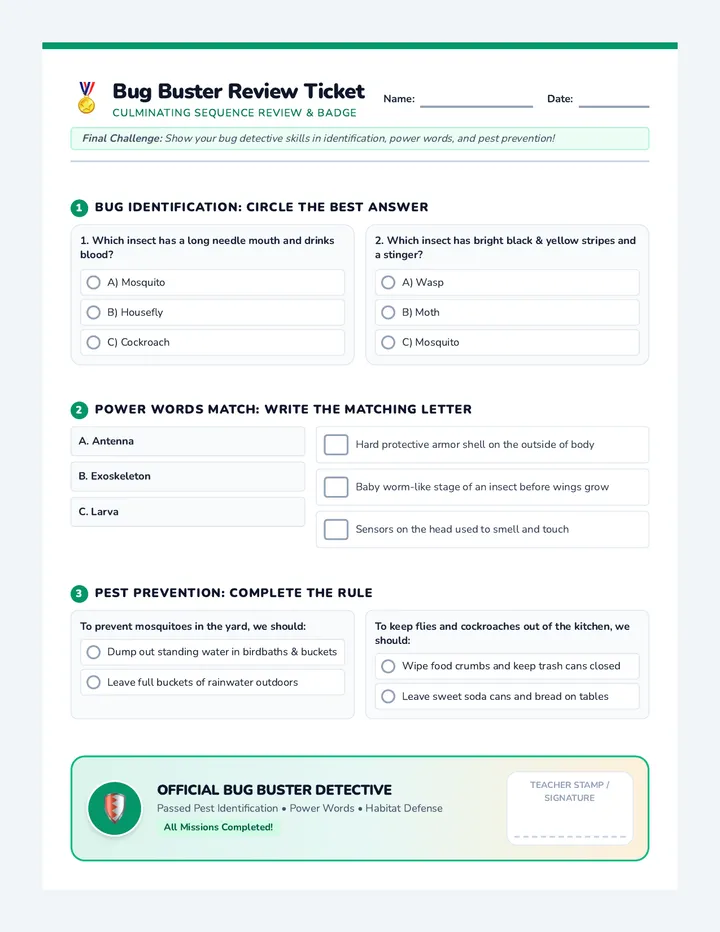
Bug Buster Review Ticket
Culminating Sequence Review & Badge
Name:
Date:
Final Challenge: Show your bug detective skills in identification, power words, and pest prevention!
1 Bug Identification: Circle the Best Answer
1. Which insect has a long needle mouth and drinks blood?
A) Mosquito
B) Housefly
C) Cockroach
2. Which insect has bright black & yellow stripes and a stinger?
A) Wasp
B) Moth
C) Mosquito
2 Power Words Match: Write the Matching Letter
A. Antenna
B. Exoskeleton
C. Larva
Hard protective armor shell on the outside of body
Baby worm-like stage of an insect before wings grow
Sensors on the head used to smell and touch
3 Pest Prevention: Complete the Rule
To prevent mosquitoes in the yard, we should:
Dump out standing water in birdbaths & buckets Leave full buckets of rainwater outdoors
To keep flies and cockroaches out of the kitchen, we should:
Wipe food crumbs and keep trash cans closed Leave sweet soda cans and bread on tables
🛡️
Official Bug Buster Detective
Passed Pest Identification • Power Words • Habitat Defense
All Missions Completed!
Teacher Stamp / Signature