Starlight Secrets Slides AZ Science Standard 3.E1U1.4 • Day 1 Solar Power Patrol
Cosmic Mystery
Starlight Secrets:
Why Does the Sun Outshine Every Star?
Look up at the daytime sky. You see one blinding ball of light. Look up at night, and you see thousands of tiny twinkles. Let's uncover the cosmic reason why!
Lesson Goal: Discover why our Sun looks so different from nighttime stars
20-Minute Focus
The Daytime Mystery
Observe & Wonder
☀️
The Daytime Sky
The Sun is so blindingly bright that it lights up our entire atmosphere and hides every other star.
Question: Is the Sun the biggest, brightest star in the universe?
✨
The Night Sky
At night, thousands of stars look like tiny, flickering pinpricks of cool, faint light.
Surprise: Many of those tiny dots are actually hundreds of times bigger than our Sun!
What makes our Sun look so giant to us? Talk with a neighbor for 30 seconds!
Science Truth: The Sun Is a Star!
Star Classification
Huge
Red Supergiants
Stars like Betelgeuse are up to 700 times larger than our Sun!
☀️
Our Sun
A medium-sized yellow star. In the universe, it is average in size!
Tiny
Red Dwarfs
Smaller and cooler than our Sun, but they make up most stars in our galaxy!
If our Sun is only medium-sized, why does it look billions of times brighter than giant stars?
The Secret: Distance Changes Everything!
Cosmic Scale
93 Million Miles
Our Sun is in our Cosmic Front Yard!
Light from our Sun reaches Earth in just 8 minutes. That is why it looks like a dazzling giant disc.
25 Trillion Miles
The Very Next Closest Star (Proxima Centauri)
Its light takes over 4 years to reach us! Because it is so unimaginably far away, it shrinks to a tiny twinkle.
Rule to Remember: Closer stars look brighter and larger. Distant stars look tiny and faint!
Third Grade Scientist Check
Wrap-Up Prompt
Complete the Cosmic Statement:
"The Sun is not the largest star in space. It appears larger and brighter than all other stars because it is _________ to Earth!"
Word Bank
Much Closer • Millions of Times Nearer
Next Activity
Reading Comprehension & Questions
Be ready to cite evidence on your reading comprehension sheet!
Ready, Set, Explore!
Starlight Secrets Reading AZ Standard 3.E1U1.4 • Day 1 Solar Power Patrol
Starlight Secrets: Our Cosmic Neighbor
Name: ___________________________
Date: ___________________________
Science Reading: The Brightest Star in the Sky
When you look into the night sky from your backyard, you see thousands of twinkling dots. Some look blue, some look white, and others look reddish-orange. Did you know that every single one of those twinkling dots is a giant ball of burning gas called a star ?
During the day, only one star is visible: our Sun . The Sun shines so brightly that our entire sky glows bright blue, hiding all the other stars. This might make you think our Sun is the biggest or most powerful star in the entire universe. But astronomers have discovered a surprising secret: our Sun is actually just an average, medium-sized star !
If our Sun is only medium-sized, why does it look like a giant glowing ball while other stars look like tiny specks? The answer is distance . Our Sun is located about 93 million miles from Earth. That sounds far, but in space, that is our cosmic front yard! The next closest star is over 25 trillion miles away. Just like a flashlight held right near your face looks blindingly bright while a huge stadium light miles away looks like a tiny flicker, the Sun appears brighter and larger simply because it is much, much closer to us.
Text-Based Questions & Evidence
1. According to the text, what kind of star is our Sun compared to other stars in the universe?
A The biggest red supergiant in space
B An average, medium-sized yellow star
C The coldest star in our galaxy
D A planet made of solid rock
2. Why do nighttime stars look like tiny, dim dots even though many are larger than the Sun?
A They are turned off during nighttime
B They are much farther away from Earth
C Earth's clouds block their real size
D They only shine with reflected moonlight
3. Scientist Explanation: Use the flashlight comparison from the passage to explain why our Sun looks so bright to people on Earth.
4. Quick Check: Fill in the missing words using CLOSER or FARTHER.
Our Sun: Appears large and bright because it is ___________________ to Earth.
Night Stars: Appear small and faint because they are ___________________ from Earth.
Arizona Science Standards • Third Grade Earth & Space Science Lesson 1 of 4: Sun & Starlight
Solar Spark Slides AZ Science Standards 3.E1U1.4 & 3.L2U1.8 • Day 2 Solar Power Patrol
Properties & Clean Power
Solar Spark:
Sun Properties & Solar Energy
Our Sun is a raging ball of superhot energy. What is it made of, how does it affect objects on Earth, and how do we capture its rays for clean energy?
Lesson Goal: Connect solar properties to heat, light, and solar power innovations
20-Minute Focus
Key Properties of Our Sun
Cosmic Powerhouse
🔥
Superhot Gases
The Sun is not solid rock! It is an enormous sphere of churning hydrogen and helium gas heated to 10,000°F at the surface!
Core temp: 27 million°F!
💡
Light & Heat
The Sun radiates enormous amounts of light energy and thermal (heat) energy across space every second.
Fuels life on planet Earth
🧲
Mighty Gravity
Containing 99.8% of all mass in our solar system, the Sun's immense gravity keeps Earth and all planets locked in their orbits.
Anchors all 8 planets
Without the Sun's light, heat, and gravity, Earth would be a frozen, dark rock drifting through space!
What Happens to Objects Exposed to Sunlight?
Light to Heat
🚗
Dark Objects Absorb Light
Dark asphalt roads, black car seats, and metal playground slides absorb light energy and quickly convert it into intense thermal heat!
🧊
Changes in States of Matter
Sunlight melts solid ice into liquid water and warms swimming pools. Sunlight also causes water on sidewalks to evaporate into the air.
💡
Big Science Rule: When sunlight hits an object, the object absorbs the light energy and warms up!
Arizona Connection: Desert temperatures can make dark car hoods reach over 150°F!
Putting Sunlight to Work: Solar Energy Projects!
Clean Innovation
🏫
School Solar Roofs
Schools install solar panels to convert bright desert sunshine into electricity for lights, computers, and AC!
🏜️
Desert Solar Farms
Miles of solar panels in sunny Arizona generate clean electricity for hundreds of thousands of family homes.
🥘
Solar Ovens & Cookers
Using reflective foil, simple solar ovens trap sunlight to bake cookies, roast hot dogs, or purify drinking water!
Why use solar power? It is clean, renewable, and creates zero air pollution!
Solar Spark Reading AZ Standards 3.E1U1.4 & 3.L2U1.8 • Day 2 Solar Power Patrol
Solar Spark: Sunlight & Clean Energy
Name: ___________________________
Date: ___________________________
Science Reading: The Super Star That Powers Our World
The Sun is not a giant rock like the Moon or Earth. Instead, it is an enormous sphere of superheated, glowing gases—mostly hydrogen and helium. Its surface temperature reaches a scorching 10,000 degrees Fahrenheit! The Sun constantly releases two vital forms of energy into space: light energy and thermal (heat) energy .
Why is the Sun so important to Earth? Without its warmth, our planet would freeze solid in minutes, turning into an ice-covered wasteland. Sunlight keeps our oceans liquid, creates wind and weather cycles, and gives living things the warmth they need to survive. When sunlight hits objects on Earth—like dark asphalt roads, cars, or playground slides—those objects absorb the light energy and quickly convert it into thermal energy, making them hot to the touch.
Today, people use this power through solar energy projects . In sunny Arizona, where the sun shines over 300 days a year, engineers install dark solar panels on school rooftops and open desert fields. These panels capture sunlight and instantly turn it into clean electricity for homes, computers, and refrigerators. Solar energy is renewable , which means it will never run out and produces zero air pollution!
Text-Based Questions & Scientific Evidence
1. What are the two main forms of energy that the Sun sends across space to Earth?
A Sound energy and magnetic energy
B Light energy and thermal (heat) energy
C Wind energy and electrical lightning
D Chemical energy and nuclear rock dust
2. What happens when a dark object (like asphalt or a black car seat) is left in the bright sun?
A It absorbs light and turns it into heat
B It cools down and turns to solid ice
C It creates brand new gas atoms
D It reflects 100% of the light without warming
3. Engineering Thinking: Name two benefits of using solar panels to power homes and schools instead of burning fossil fuels.
4. Cause & Effect Table: Match the solar effect by filling in the blanks.
Cause: Ice cube sits in midday desert sunshine.
Effect: The ice absorbs heat and ______________________.
Cause: Sunlight shines on dark solar rooftop panels.
Effect: Panels convert sunlight into ___________________.
Arizona Science Standards • Third Grade Physical & Space Science Lesson 2 of 4: Solar Energy & Heat
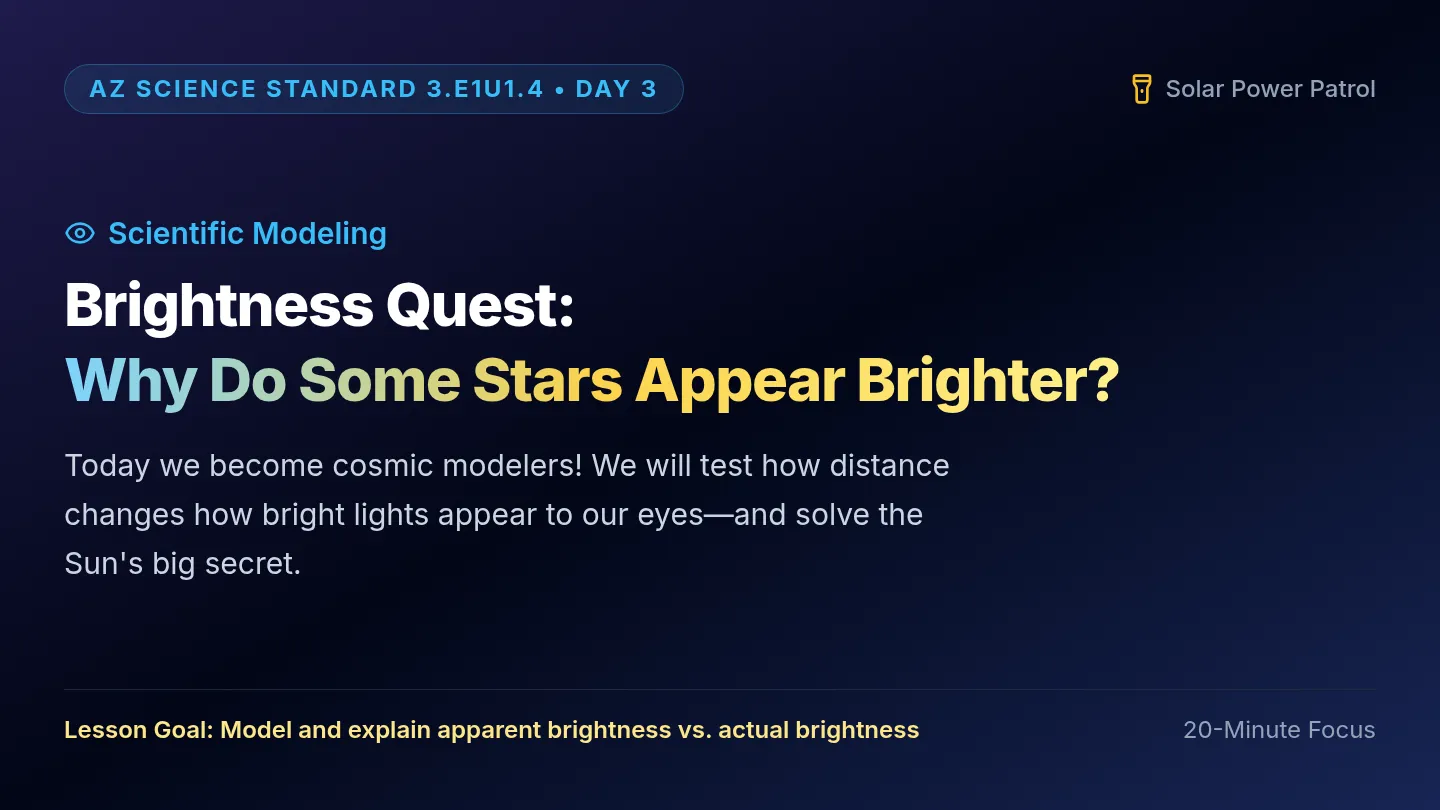
Brightness Quest Slides AZ Science Standard 3.E1U1.4 • Day 3 Solar Power Patrol
Scientific Modeling
Brightness Quest:
Why Do Some Stars Appear Brighter?
Today we become cosmic modelers! We will test how distance changes how bright lights appear to our eyes—and solve the Sun's big secret.
Lesson Goal: Model and explain apparent brightness vs. actual brightness
20-Minute Focus
The Two Brightness Rules
Core Science Concept
⚡
1. Actual Brightness
How much light the star truly gives off in space, based on its size and temperature.
Like comparing a 10-watt nightlight to a 10,000-watt searchlight.
📏
2. Apparent Brightness
How bright the star looks to our eyes right here on Earth, which depends heavily on its distance!
Distance changes what our eyes see!
A dimmer light up close can easily look brighter than a monster light far away!
Our Flashlight Model Investigation
Hands-On Evidence
🔦 Investigation Step 1
Hold two identical flashlights side by side. They look equally bright.
Now walk one flashlight 50 feet away: The distant flashlight instantly appears smaller, dimmer, and fainter!
💡 Investigation Step 2
Hold a tiny mini-flashlight 6 inches from your eyes.
Compare to a giant streetlamp 1 mile away: The tiny mini-flashlight up close appears WAY brighter to your eyes!
Key Conclusion: Apparent brightness drops dramatically as distance increases!
Cosmic Showdown: Sun vs. Rigel
Real Data
☀️ Our Sun
• Actual Brightness: 1 Solar Unit (Average)
• Distance: Only 93 million miles away
• Apparent Look from Earth: Blinding, daylight-making powerhouse disc!
💎 Giant Star Rigel
• Actual Brightness: 40,000 times brighter than the Sun!
• Distance: 5,000 trillion miles away
• Apparent Look from Earth: A tiny blue pinprick in the constellation Orion!
Evidence Claim: Rigel is 40,000x brighter in reality, but the Sun looks brighter because it is millions of times closer!
Modeler Check for Understanding
Evidence Builder
Explain Like a 3rd Grade Astronomer:
"Two stars in the night sky have the exact same actual brightness. Star A looks twice as bright as Star B. Which star is closer to Earth?"
Brightness Quest Reading AZ Standard 3.E1U1.4 • Day 3 Solar Power Patrol
Cosmic Brightness: Modeling Star Light
Name: ___________________________
Date: ___________________________
Science Reading: Apparent vs. Actual Brightness
When you look at the stars at night, some sparkle like brilliant diamonds, while others look so faint you can barely see them. Why does this happen? In science, we describe a star's light in two ways: actual brightness and apparent brightness .
Actual brightness is how much light energy a star really produces in space. Giant, burning stars give off vastly more light than smaller, cooler stars. But apparent brightness is how bright the star looks to our eyes here on Earth. Apparent brightness depends almost entirely on how far away the star is from us.
You can test this with a simple classroom model. Imagine you hold a small flashlight right in front of your face. It looks blindingly bright! Now imagine a classmate takes that exact same flashlight and walks down a long hallway 100 feet away. The light beam spreads out over the distance, making the flashlight appear small and dim to your eyes. The flashlight never changed its actual power—only its distance changed! This explains our Sun: even though huge stars like Rigel produce 40,000 times more light than our Sun, the Sun appears millions of times brighter to us simply because it is right next door.
Modeling Questions & Scientific Explanations
1. What does a star's "apparent brightness" mean to an astronomer on Earth?
A How bright the star looks to our eyes on Earth
B The total weight of the star in space
C How many planets orbit around the star
D How cold the star becomes during the winter
2. In the flashlight model, what happens to a flashlight's light as it is moved farther away?
A The light beam disappears instantly
B The light spreads out and appears dimmer
C The flashlight gets hotter and brighter
D The bulb changes from white to purple
3. Construct an Explanation: The star Rigel is 40,000 times brighter than our Sun in space, but from Earth, our Sun looks billions of times brighter. Why?
4. Scientist Claim & Evidence: Circle TRUE or FALSE for each statement based on your model.
A star that is closer always appears brighter than an identical star far away. [ TRUE / FALSE ]
Our Sun appears brighter because it produces more light than any star in the galaxy. [ TRUE / FALSE ]
Arizona Science Standards • Third Grade Earth & Space Science Lesson 3 of 4: Modeling Star Brightness
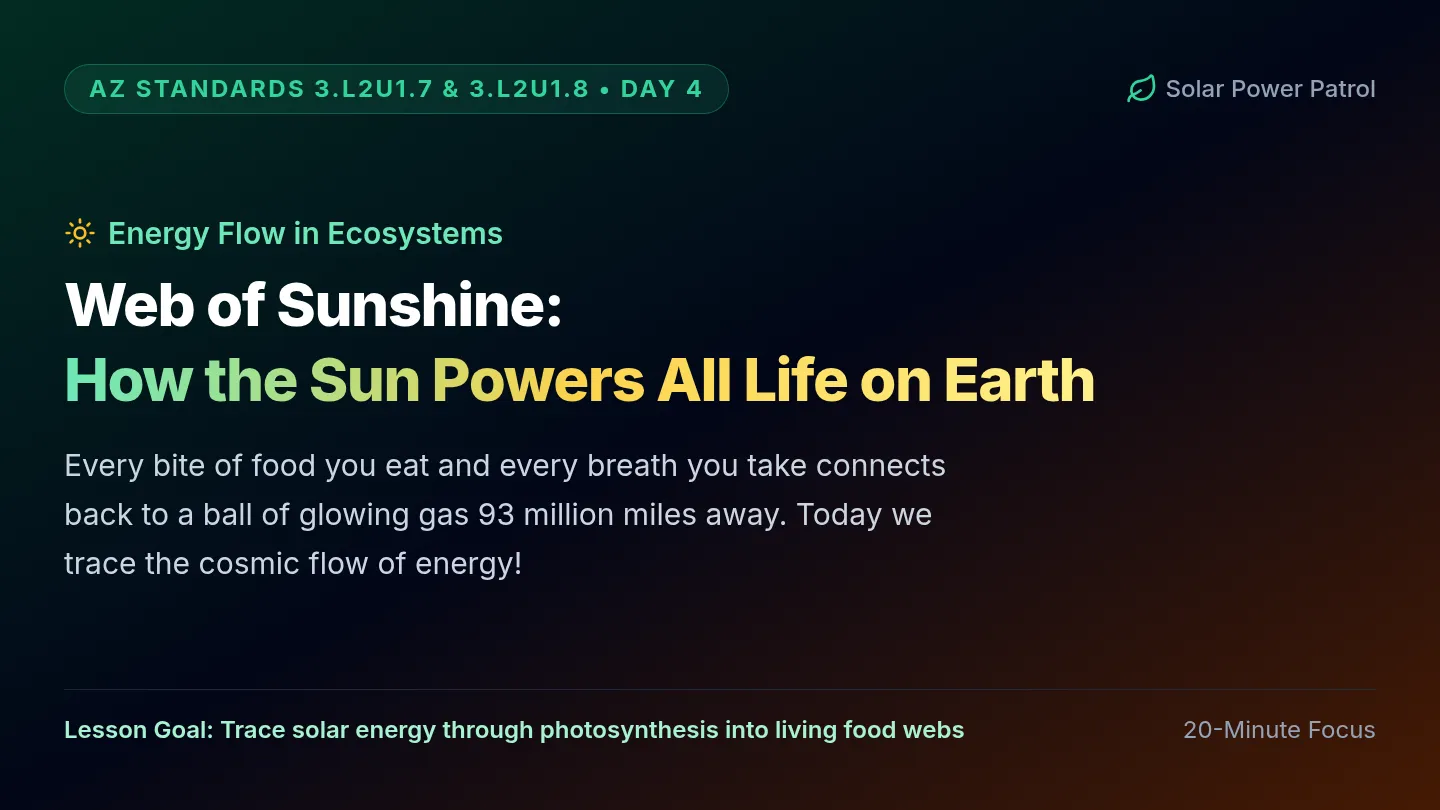
Sunshine Web Slides AZ Standards 3.L2U1.7 & 3.L2U1.8 • Day 4 Solar Power Patrol
Energy Flow in Ecosystems
Web of Sunshine:
How the Sun Powers All Life on Earth
Every bite of food you eat and every breath you take connects back to a ball of glowing gas 93 million miles away. Today we trace the cosmic flow of energy!
Lesson Goal: Trace solar energy through photosynthesis into living food webs
20-Minute Focus
Why the Sun Is Life's Greatest Gift
Earth's Power Station
🌡️
Warms Our Planet
Thermal energy keeps Earth at the exact temperature needed for liquid water, rivers, and living bodies to thrive.
Without it: -455°F deep freeze
🌱
Fuels Plant Food
Plants use light energy to make their own food through photosynthesis. They are nature's solar factories!
The starting point of all food
🦎
Warms Living Things
Cold-blooded desert animals like horned lizards and tortoises bask on warm rocks to get energy to move and hunt!
Basking for body heat
When objects or living things absorb sunlight, that energy transforms into chemical energy and heat!
Nature's Solar Recipe: Photosynthesis
Science Process
☀️ Sunlight (Light Energy)
💧 Water (From Soil)
💨 Carbon Dioxide (From Air)
=
🍎 Glucose (Sugar) + Fresh Oxygen!
Plants (Producers) turn light energy into edible chemical energy for animals and humans!
Energy Flowing Through an Arizona Food Web
Ecosystem Model
☀️
1. The Sun
Source of ALL energy in the ecosystem.
➔ ➔ ➔
🌵
2. Producer
Saguaro & desert plants make food with light.
➔ ➔ ➔
🐇
3. Herbivore
Desert cottontail eats plant fruits for energy.
➔ ➔ ➔
🦅
4. Carnivore
Red-tailed hawk eats the rabbit to gain energy!
Top Predator
Every organism in the food web runs on sunlight energy passed from one link to the next!
Energy Detective Challenge
Final Unit Debrief
Trace Your Energy:
"You ate an apple or a slice of toast for breakfast. How did the Sun's energy make that food possible?"
Sunshine Web Reading AZ Standards 3.L2U1.7 & 3.L2U1.8 • Day 4 Solar Power Patrol
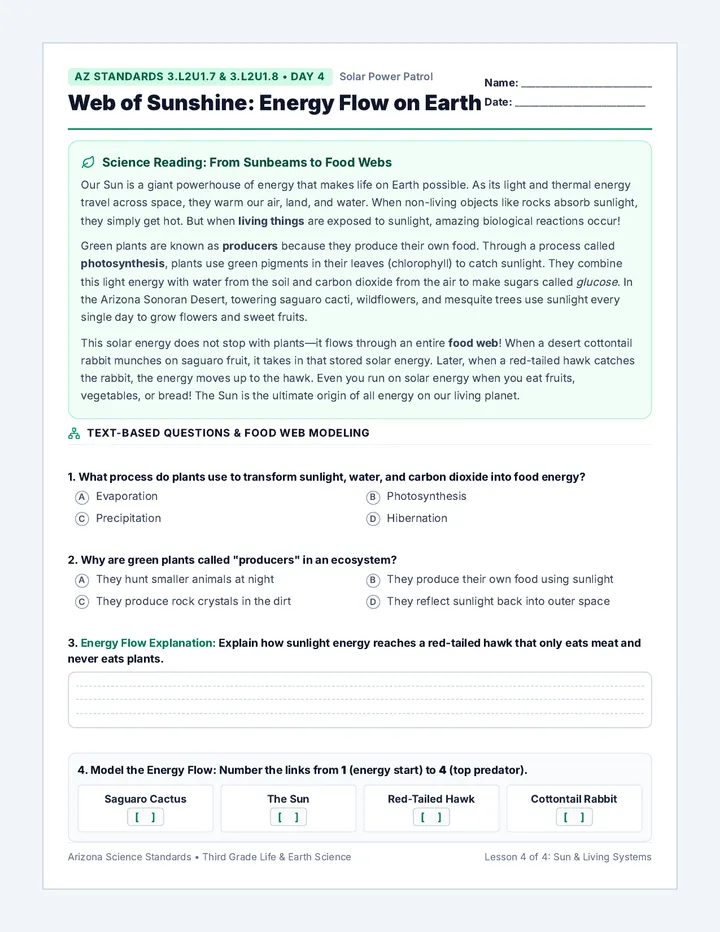
Web of Sunshine: Energy Flow on Earth
Name: ___________________________
Date: ___________________________
Science Reading: From Sunbeams to Food Webs
Our Sun is a giant powerhouse of energy that makes life on Earth possible. As its light and thermal energy travel across space, they warm our air, land, and water. When non-living objects like rocks absorb sunlight, they simply get hot. But when living things are exposed to sunlight, amazing biological reactions occur!
Green plants are known as producers because they produce their own food. Through a process called photosynthesis , plants use green pigments in their leaves (chlorophyll) to catch sunlight. They combine this light energy with water from the soil and carbon dioxide from the air to make sugars called glucose . In the Arizona Sonoran Desert, towering saguaro cacti, wildflowers, and mesquite trees use sunlight every single day to grow flowers and sweet fruits.
This solar energy does not stop with plants—it flows through an entire food web ! When a desert cottontail rabbit munches on saguaro fruit, it takes in that stored solar energy. Later, when a red-tailed hawk catches the rabbit, the energy moves up to the hawk. Even you run on solar energy when you eat fruits, vegetables, or bread! The Sun is the ultimate origin of all energy on our living planet.
Text-Based Questions & Food Web Modeling
1. What process do plants use to transform sunlight, water, and carbon dioxide into food energy?
A Evaporation
B Photosynthesis
C Precipitation
D Hibernation
2. Why are green plants called "producers" in an ecosystem?
A They hunt smaller animals at night
B They produce their own food using sunlight
C They produce rock crystals in the dirt
D They reflect sunlight back into outer space
3. Energy Flow Explanation: Explain how sunlight energy reaches a red-tailed hawk that only eats meat and never eats plants.
4. Model the Energy Flow: Number the links from 1 (energy start) to 4 (top predator).
Saguaro Cactus
[ ]
The Sun
[ ]
Red-Tailed Hawk
[ ]
Cottontail Rabbit
[ ]
Arizona Science Standards • Third Grade Life & Earth Science Lesson 4 of 4: Sun & Living Systems