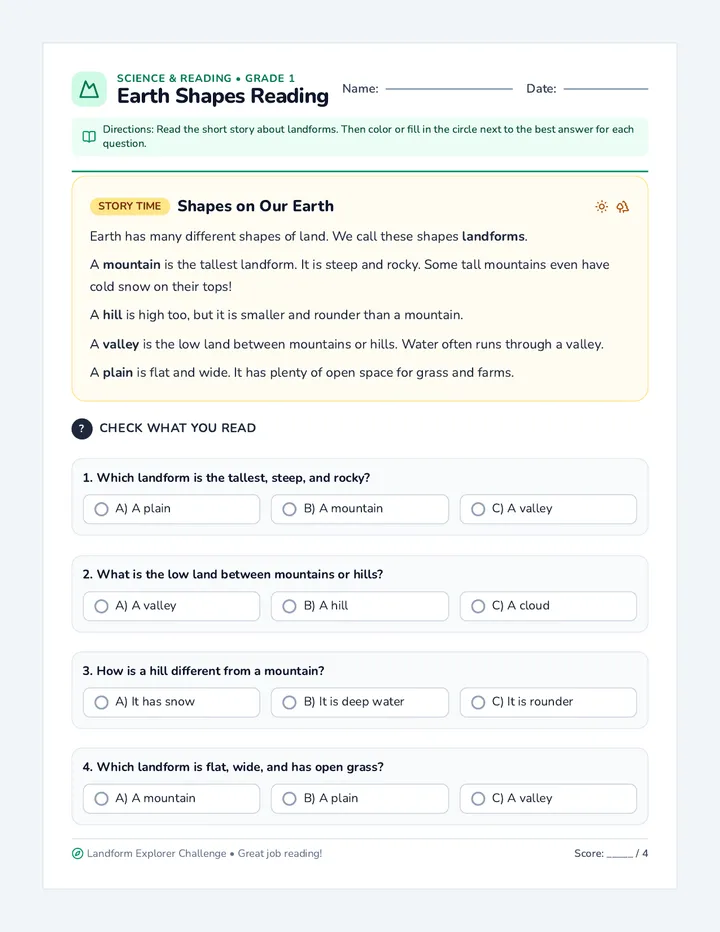
Earth Shapes Reading Worksheet Science & Reading • Grade 1
Earth Shapes Reading
Name:
Date:
Directions: Read the short story about landforms. Then color or fill in the circle next to the best answer for each question.
Story Time
Shapes on Our Earth
Earth has many different shapes of land. We call these shapes landforms .
A mountain is the tallest landform. It is steep and rocky. Some tall mountains even have cold snow on their tops!
A hill is high too, but it is smaller and rounder than a mountain.
A valley is the low land between mountains or hills. Water often runs through a valley.
A plain is flat and wide. It has plenty of open space for grass and farms.
?
Check What You Read
1. Which landform is the tallest, steep, and rocky?
A) A plain
B) A mountain
C) A valley
2. What is the low land between mountains or hills?
A) A valley
B) A hill
C) A cloud
3. How is a hill different from a mountain?
A) It has snow
B) It is deep water
C) It is rounder
4. Which landform is flat, wide, and has open grass?
A) A mountain
B) A plain
C) A valley
Landform Explorer Challenge • Great job reading! Score: _____ / 4
Earth Shapes Answer Key Teacher Resource Grade 1 • Science & ELA
Earth Shapes Answer Key
Total Score 4 Questions (1 pt each)
Target Standards: RI.1.1 (Key Details) • ESS2.A (Earth Materials & Landforms) Answer Key • Master Copy
1. Which landform is the tallest, steep, and rocky?
Correct: B
A) A plain
B) A mountain
C) A valley
Text Evidence: “A mountain is the tallest landform. It is steep and rocky.”
2. What is the low land between mountains or hills?
Correct: A
A) A valley
B) A hill
C) A cloud
Text Evidence: “A valley is the low land between mountains or hills.”
3. How is a hill different from a mountain?
Correct: C
A) It has snow
B) It is deep water
C) It is rounder
Text Evidence: “A hill is high too, but it is smaller and rounder than a mountain.”
4. Which landform is flat, wide, and has open grass?
Correct: B
A) A mountain
B) A plain
C) A valley
Text Evidence: “A plain is flat and wide. It has plenty of open space for grass and farms.”
Teacher Notes • First-Grade Instructional Tips
Sight Words & Decodables: Point out high-frequency words before reading: shapes, land, water, between, smaller . Model blending the compound word land + form .
Common Misconception: Students often mistake valleys for rivers. Emphasize that a valley is the land , and water simply flows across it because it is lower than the surrounding hills.
Earth Shapes • Grade 1 Answer Key Page 1 of 1
Valley Wonders Reading Worksheet Landform Focus • Grade 1
Valley Wonders Reading
Name:
Date:
Directions: Read the passage about valleys. Then fill in the circle next to the best answer for each question.
Spotlight On Valleys
Life in the Valley
A valley is a low piece of land. It sits down low between hills or tall mountains.
Many valleys have a fresh river or stream flowing right through the middle. Water brings life to the valley!
Plants, trees, and wildflowers love to grow here because the soil is rich and dark. Many farmers build farms in valleys to grow yummy food.
Some valleys are deep and shaped like the letter V . Flowing river water carved them out over a very long time!
?
Valley Questions
1. Where is a valley located?
A) In the clouds
B) Between hills
C) Under the ocean
2. What often flows through the middle of a valley?
A) A river
B) Hot lava
C) Cold snow
3. Why do farmers build farms in valleys?
A) It is very rocky
B) The soil is rich
C) No sun shines
4. What letter shape can some valleys look like?
A) The letter O
B) The letter Z
C) The letter V
Valley Explorer • Excellent reading detective work! Score: _____ / 4
Valley Wonders Answer Key Teacher Resource Grade 1 • Science & ELA
Valley Wonders Answer Key
Total Score 4 Questions (1 pt each)
Target Standards: RI.1.1 (Key Details) • 2-ESS2-2 (Shapes & Kinds of Land and Water) Answer Key • Master Copy
1. Where is a valley located?
Correct: B
A) In the clouds
B) Between hills
C) Under the ocean
Text Evidence: “It sits down low between hills or tall mountains.”
2. What often flows through the middle of a valley?
Correct: A
A) A river
B) Hot lava
C) Cold snow
Text Evidence: “Many valleys have a fresh river or stream flowing right through the middle.”
3. Why do farmers build farms in valleys?
Correct: B
A) It is very rocky
B) The soil is rich
C) No sun shines
Text Evidence: “Plants, trees, and wildflowers love to grow here because the soil is rich and dark.”
4. What letter shape can some valleys look like?
Correct: C
A) The letter O
B) The letter Z
C) The letter V
Text Evidence: “Some valleys are deep and shaped like the letter V.”
Teacher Discussion & Kinesthetic Tips
Kinesthetic Anchor: Have students hold up both arms to make a wide “V” shape. Point out that their hands are high like mountains, and the space between their elbows is down low like the valley floor.
Guided Discussion: Ask: “Why is river water so helpful to farmers?” Prompt students to connect water and healthy, rich soil to growing crops.
Valley Wonders • Grade 1 Answer Key Page 1 of 1
Mountain Giants Reading Worksheet Landform Focus • Grade 1
Mountain Giants Reading
Name:
Date:
Directions: Read the passage about giant mountains. Then fill in the circle next to the best answer for each question.
Spotlight On Mountains
High on the Mountain
A mountain is the tallest kind of land on Earth. Mountains are very steep and rocky.
The very tip-top of a mountain is called the peak . Some peaks reach high up into the clouds!
High up on the peak, the air is very cold and windy. Many mountain peaks have bright white snow all year long.
Mountain goats have thick, warm coats. They love to jump and climb across the steep rocky cliffs. Mountains are giant wonders of our world!
?
Mountain Questions
1. What is the very top of a mountain called?
A) The peak
B) The valley
C) The plain
2. What is the weather like high up on mountain peaks?
A) Hot and sunny
B) Cold and windy
C) Warm and rainy
3. Which animal has a thick coat and climbs steep rocks?
A) A mountain goat
B) A gold fish
C) A tree frog
4. How does the passage describe mountains?
A) Low and muddy
B) Flat and wide
C) Tallest and steep
Mountain Explorer • Way to reach the summit! Score: _____ / 4
Mountain Giants Answer Key Teacher Resource Grade 1 • Science & ELA
Mountain Giants Answer Key
Total Score 4 Questions (1 pt each)
Target Standards: RI.1.1 (Key Details) • 2-ESS2-2 (Earth Landforms) Answer Key • Master Copy
1. What is the very top of a mountain called?
Correct: A
A) The peak
B) The valley
C) The plain
Text Evidence: “The very tip-top of a mountain is called the peak.”
2. What is the weather like high up on mountain peaks?
Correct: B
A) Hot and sunny
B) Cold and windy
C) Warm and rainy
Text Evidence: “High up on the peak, the air is very cold and windy.”
3. Which animal has a thick coat and climbs steep rocks?
Correct: A
A) A mountain goat
B) A gold fish
C) A tree frog
Text Evidence: “Mountain goats have thick, warm coats. They love to jump and climb across the steep rocky cliffs.”
4. How does the passage describe mountains?
Correct: C
A) Low and muddy
B) Flat and wide
C) Tallest and steep
Text Evidence: “A mountain is the tallest kind of land on Earth. Mountains are very steep and rocky.”
Vocabulary & Science Teaching Tips
Vocabulary Anchor (Peak): Teach the vowel team ea in peak . Have students stand on tiptoes and make a pointy triangle above their head with their hands to visualize the peak.
Animal Adaptation Prompt: Ask students: “Why do mountain goats need thick warm fur and special hooves?” Connect the harsh, rocky mountain environment to animal survival.
Mountain Giants • Grade 1 Answer Key Page 1 of 1
Wide Plains Reading Worksheet Landform Focus • Grade 1
Wide Plains Reading
Name:
Date:
Directions: Read the passage about wide plains. Then fill in the circle next to the best answer for each question.
Spotlight On Plains
Across the Flat Plains
A plain is a very large area of flat land. Plains do not have tall peaks or steep rocky hills.
Because the land is so flat and open, you can see far, far away!
Plains have lots of tall grass blowing in the warm wind. Big wild animals like bison love to graze on the open green grass.
Farmers love plains too. They plant big fields of wheat and corn because the flat ground is easy to farm. Plains are peaceful, sunny places on our Earth!
?
Plains Questions
1. What is a plain?
A) Flat open land
B) A steep peak
C) Cold deep water
2. Why can you see far away on a plain?
A) It has tall walls
B) The land is so flat
C) It is very dark
3. Which big animal grazes on the open grass of the plains?
A) A bison
B) A monkey
C) A dolphin
4. Why do farmers like to grow wheat and corn on plains?
A) It has lots of snow
B) It is too rocky
C) Flat ground is easy to farm
Plains Explorer • Wonderful reading on the grasslands! Score: _____ / 4
Wide Plains Answer Key Teacher Resource Grade 1 • Science & ELA
Wide Plains Answer Key
Total Score 4 Questions (1 pt each)
Target Standards: RI.1.1 (Key Details) • 2-ESS2-2 (Earth Landforms) Answer Key • Master Copy
1. What is a plain?
Correct: A
A) Flat open land
B) A steep peak
C) Cold deep water
Text Evidence: “A plain is a very large area of flat land. Plains do not have tall peaks or steep rocky hills.”
2. Why can you see far away on a plain?
Correct: B
A) It has tall walls
B) The land is so flat
C) It is very dark
Text Evidence: “Because the land is so flat and open, you can see far, far away!”
3. Which big animal grazes on the open grass of the plains?
Correct: A
A) A bison
B) A monkey
C) A dolphin
Text Evidence: “Big wild animals like bison love to graze on the open green grass.”
4. Why do farmers like to grow wheat and corn on plains?
Correct: C
A) It has lots of snow
B) It is too rocky
C) Flat ground is easy to farm
Text Evidence: “They plant big fields of wheat and corn because the flat ground is easy to farm.”
Geography & Science Discussion Prompts
Visual Contrast: Contrast a flat desk surface with a mountain of crumpled paper. Ask: “Which one would be easier to drive a tractor over or plant seeds on?”
Vocabulary Word (Graze): Define graze for first graders: animals eating wild grass slowly throughout the day. Connect to horses, cows, and bison on open grasslands.
Wide Plains • Grade 1 Answer Key Page 1 of 1
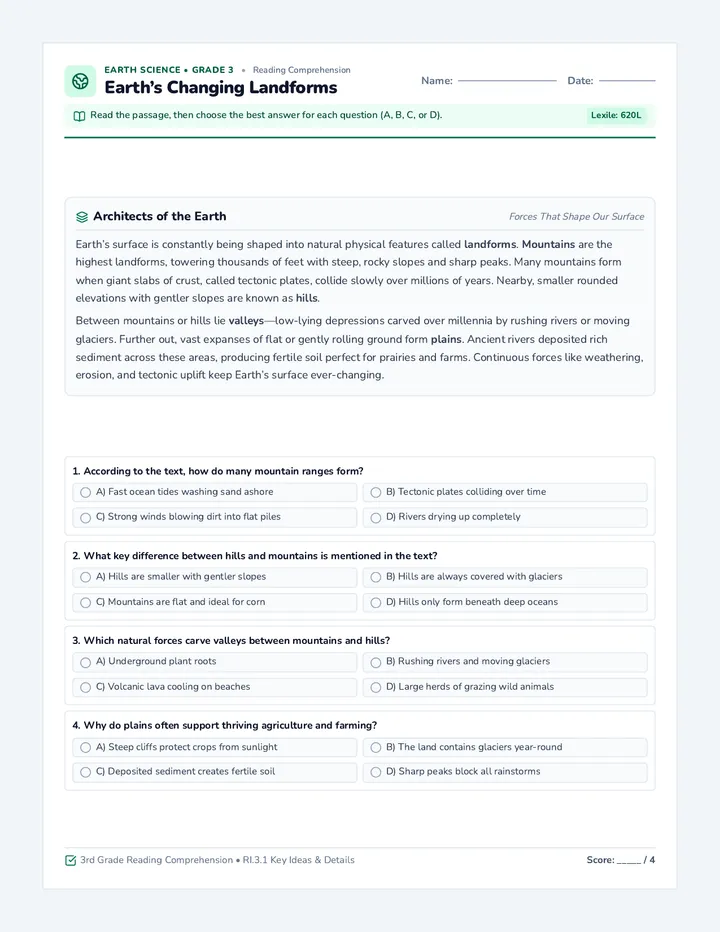
Earth Sculptures Reading Worksheet Earth Science • Grade 3 • Reading Comprehension
Earth’s Changing Landforms
Name:
Date:
Read the passage, then choose the best answer for each question (A, B, C, or D). Lexile: 620L
Architects of the Earth
Forces That Shape Our Surface
Earth’s surface is constantly being shaped into natural physical features called landforms . Mountains are the highest landforms, towering thousands of feet with steep, rocky slopes and sharp peaks. Many mountains form when giant slabs of crust, called tectonic plates, collide slowly over millions of years. Nearby, smaller rounded elevations with gentler slopes are known as hills .
Between mountains or hills lie valleys —low-lying depressions carved over millennia by rushing rivers or moving glaciers. Further out, vast expanses of flat or gently rolling ground form plains . Ancient rivers deposited rich sediment across these areas, producing fertile soil perfect for prairies and farms. Continuous forces like weathering, erosion, and tectonic uplift keep Earth’s surface ever-changing.
1. According to the text, how do many mountain ranges form?
A) Fast ocean tides washing sand ashore
B) Tectonic plates colliding over time
C) Strong winds blowing dirt into flat piles
D) Rivers drying up completely
2. What key difference between hills and mountains is mentioned in the text?
A) Hills are smaller with gentler slopes
B) Hills are always covered with glaciers
C) Mountains are flat and ideal for corn
D) Hills only form beneath deep oceans
3. Which natural forces carve valleys between mountains and hills?
A) Underground plant roots
B) Rushing rivers and moving glaciers
C) Volcanic lava cooling on beaches
D) Large herds of grazing wild animals
4. Why do plains often support thriving agriculture and farming?
A) Steep cliffs protect crops from sunlight
B) The land contains glaciers year-round
C) Deposited sediment creates fertile soil
D) Sharp peaks block all rainstorms
3rd Grade Reading Comprehension • RI.3.1 Key Ideas & Details Score: _____ / 4
Carved Valleys Reading Worksheet Earth Science • Grade 3 • Reading Comprehension
Carved by Water and Ice
Name:
Date:
Read the passage about valley formation, then answer the comprehension questions. Lexile: 650L
The Science of Valleys
V-Shapes and U-Shapes
A valley is an elongated lowland between hills, mountains, or plateaus. While they appear calm today, valleys are evidence of relentless natural erosion. Fast-flowing mountain streams carry gravel and sediment that scrape against rocky ground like coarse sandpaper. Over countless centuries, this river erosion carves out steep, narrow walls, creating a classic V-shaped valley . When a river cuts exceptionally deep with nearly vertical walls, it forms a dramatic canyon .
Not all valleys are carved by liquid water. During past ice ages, enormous moving rivers of ice called glaciers crept slowly through mountain passes. The sheer weight and friction of these frozen giants scraped away rocky slopes, widening the bottom and straightening the sides into a broad U-shaped valley . Because valleys collect nutrient-rich runoff, valley floors have historically provided humans with fertile land, freshwater, and natural transportation routes.
1. What process causes a rushing river to carve a V-shaped valley?
A) Fast-cooling volcanic lava filling craters
B) Carried sediment scraping rock like sandpaper
C) Powerful tornadoes lifting topsoil away
D) Tree branches growing into cracked stone
2. How do glaciers produce U-shaped valleys instead of V-shaped valleys?
A) Their massive width and weight widen the base
B) They melt into boiling volcanic hot springs
C) They deposit sand dunes along windy coastlines
D) They push tall mountain peaks deep underground
3. What is a canyon, according to the text?
A) A shallow pond located on an open prairie
B) A deep valley with exceptionally steep walls
C) A frozen river that never flows or melts
D) A high mountain peak with eternal snow
4. Why have humans historically settled in valley bottoms?
A) Valleys contain fertile land and freshwater
B) Valley air has the lowest amount of oxygen
C) Glaciers provide constant ice for building homes
D) Valleys are protected from all sunshine
3rd Grade Reading Comprehension • RI.3.3 Scientific Connections Score: _____ / 4
Towering Peaks Reading Worksheet Earth Science • Grade 3 • Reading Comprehension
Giants of the Earth
Name:
Date:
Read the passage about mountain geology and ecosystems, then answer the questions below. Lexile: 660L
How Mountains Rise and Survive
Tectonic Collisions & Alpine Climates
Mountains are landforms that rise dramatically above their surroundings, typically featuring steep slopes and a pointed summit or peak . Most of the world’s major mountain ranges formed through collisions between enormous tectonic plates. When continental plates slam together, the immense pressure forces rock layers to buckle, bend, and crumple upward into gigantic fold mountains , such as the Himalayas and the Rocky Mountains.
As altitude increases up a mountain, environmental conditions change drastically. Temperatures drop rapidly, winds intensify, and the atmosphere holds less oxygen. Past a certain elevation known as the tree line , conditions become too cold and windy for trees to grow. Above this boundary lies the harsh alpine zone, where specialized animals like snow leopards and mountain goats survive. During spring, melting alpine snowpacks provide vital freshwater that feeds rivers downstream.
1. What happens when continental tectonic plates crash into each other?
A) Flat plains sink into ocean trenches
B) Rock layers buckle upward into fold mountains
C) Entire continents dissolve into liquid water
D) Rivers reverse direction and freeze solid
2. How does the climate change as you climb higher up a mountain slope?
A) Temperatures drop and winds intensify
B) The air becomes humid, calm, and hot
C) Soil becomes deeper and swampy
D) Sunlight disappears completely
3. What is the “tree line” described in the reading passage?
A) A stone fence built to keep wildlife safe
B) The elevation where it is too cold for trees
C) A row of apple orchards planted in valleys
D) The deepest underground layer of tree roots
4. Why are alpine snowpacks crucial for valleys and communities downstream?
A) They reflect heat to cause volcanic eruptions
B) Melting snow feeds rivers with freshwater
C) They prevent rocks from rolling down cliffs
D) They push clouds into outer space
3rd Grade Reading Comprehension • RI.3.4 Domain-Specific Vocabulary Score: _____ / 4
Sprawling Plains Reading Worksheet Earth Science • Grade 3 • Reading Comprehension
The Expansive Plains
Name:
Date:
Read the passage about Earth's great plains and prairies, then complete the questions below. Lexile: 640L
Grasslands and Flat Horizons
Coastal and Interior Plains
A plain is a broad expanse of flat or gently undulating land with very little change in elevation. Geologists classify plains into two primary categories. Coastal plains stretch along ocean shorelines, where waves and tides deposit sand and marine silt. In contrast, interior plains lie deep inland, formed across ancient sea floors and river basins where rivers deposited thick layers of nutrient-rich sediment over millions of years.
In North America, the vast interior plain is known as the Great Plains. This region was once covered in wild prairie grasses that sustained millions of bison. Today, these flat terrains serve as productive agricultural “breadbaskets,” yielding immense harvests of wheat, corn, and soybeans. Because plains lack mountains to block gusty weather, winds can sweep across the open horizon, making soil conservation and prairie grass preservation essential.
1. How do interior plains differ from coastal plains?
A) Interior plains lie inland on ancient sea floors
B) Coastal plains are surrounded by high volcanic peaks
C) Interior plains never have any soil or grass
D) Coastal plains are always frozen solid by ice
2. What makes the soil on plains so exceptionally productive for farming?
A) Hard volcanic granite that never erodes
B) Thick layers of deposited nutrient-rich sediment
C) Salt crystals left behind by drying oceans
D) Steep rocky slopes that drain rain rapidly
3. Why are North America’s Great Plains nicknamed “breadbaskets”?
A) Bakers built stone ovens across the grasslands
B) They produce immense harvests of wheat and grain
C) The terrain is shaped like a giant loaf of bread
D) Wild animals store bread underground for winter
4. Why is soil conservation critical on open plains?
A) Without mountains, strong winds can blow dry soil away
B) Ocean tides flood the Great Plains each night
C) Bison herds dig huge underground caverns
D) Falling snow turns the topsoil into bedrock
3rd Grade Reading Comprehension • RI.3.1 Evidence & Inferences Score: _____ / 4
Earth Sculptures Answer Key Teacher Key • Grade 3 • Science & Reading
Earth Sculptures Answer Key
Total Score 4 Questions (1 pt each)
Standards: CCSS.ELA-LITERACY.RI.3.1 (Key Details) • NGSS 2-ESS2-2 / 3-LS4-3 Master Reference Copy
1. According to the text, how do many mountain ranges form?
Answer: B
A) Fast ocean tides washing sand ashore
B) Tectonic plates colliding over time
Evidence: “Mountains often form when giant slabs of crust, called tectonic plates, collide slowly over millions of years.”
2. What key difference between hills and mountains is mentioned in the text?
Answer: A
A) Hills are smaller with gentler slopes
B) Hills are always covered with glaciers
Evidence: “Nearby, smaller rounded elevations with gentler slopes are known as hills.”
3. Which natural forces carve valleys between mountains and hills?
Answer: B
A) Underground plant roots
B) Rushing rivers and moving glaciers
Evidence: “Between mountains or hills lie valleys—low-lying depressions carved over millennia by rushing rivers or moving glaciers.”
4. Why do plains often support thriving agriculture and farming?
Answer: C
C) Deposited sediment creates fertile soil
D) Sharp peaks block all rainstorms
Evidence: “Ancient rivers deposited rich sediment across these areas, producing fertile soil perfect for prairies and farms.”
Instructional Support & Discussion Prompts
Text-to-World Connection: Ask students: “Which landforms exist in our state or region? Have you ever noticed how rivers create low channels through hills?”
Key Geological Concept: Reinforce that landforms are not permanent; weathering breaks rock into sediment, and erosion transports it to new locations over immense spans of time.
Earth Sculptures • Grade 3 Teacher Answer Key Page 1 of 1
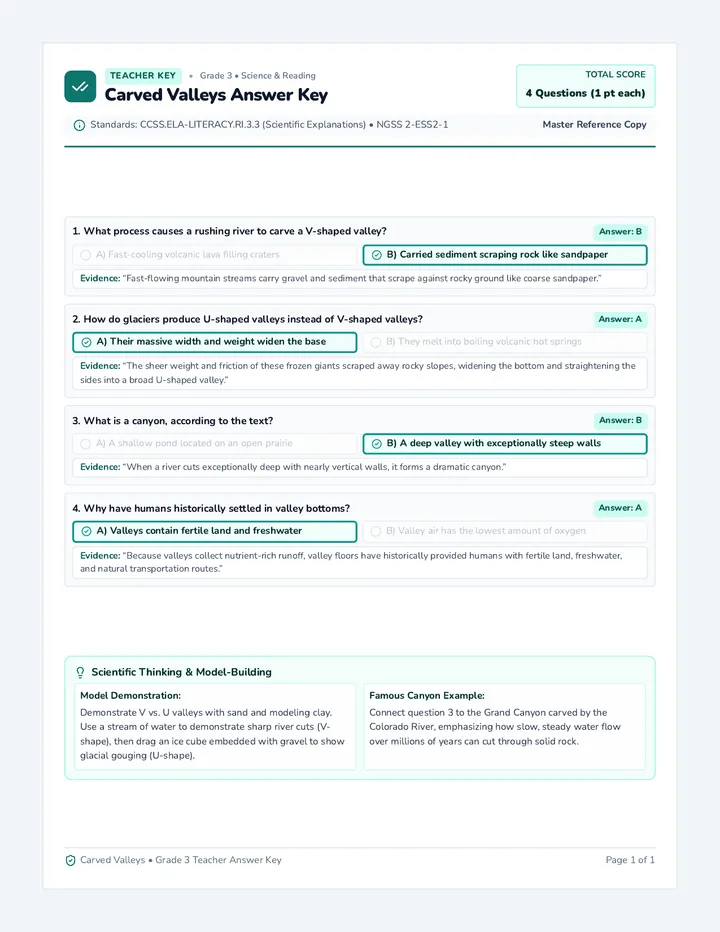
Carved Valleys Answer Key Teacher Key • Grade 3 • Science & Reading
Carved Valleys Answer Key
Total Score 4 Questions (1 pt each)
Standards: CCSS.ELA-LITERACY.RI.3.3 (Scientific Explanations) • NGSS 2-ESS2-1 Master Reference Copy
1. What process causes a rushing river to carve a V-shaped valley?
Answer: B
A) Fast-cooling volcanic lava filling craters
B) Carried sediment scraping rock like sandpaper
Evidence: “Fast-flowing mountain streams carry gravel and sediment that scrape against rocky ground like coarse sandpaper.”
2. How do glaciers produce U-shaped valleys instead of V-shaped valleys?
Answer: A
A) Their massive width and weight widen the base
B) They melt into boiling volcanic hot springs
Evidence: “The sheer weight and friction of these frozen giants scraped away rocky slopes, widening the bottom and straightening the sides into a broad U-shaped valley.”
3. What is a canyon, according to the text?
Answer: B
A) A shallow pond located on an open prairie
B) A deep valley with exceptionally steep walls
Evidence: “When a river cuts exceptionally deep with nearly vertical walls, it forms a dramatic canyon.”
4. Why have humans historically settled in valley bottoms?
Answer: A
A) Valleys contain fertile land and freshwater
B) Valley air has the lowest amount of oxygen
Evidence: “Because valleys collect nutrient-rich runoff, valley floors have historically provided humans with fertile land, freshwater, and natural transportation routes.”
Scientific Thinking & Model-Building
Model Demonstration: Demonstrate V vs. U valleys with sand and modeling clay. Use a stream of water to demonstrate sharp river cuts (V-shape), then drag an ice cube embedded with gravel to show glacial gouging (U-shape).
Famous Canyon Example: Connect question 3 to the Grand Canyon carved by the Colorado River, emphasizing how slow, steady water flow over millions of years can cut through solid rock.
Carved Valleys • Grade 3 Teacher Answer Key Page 1 of 1
Towering Peaks Answer Key Teacher Key • Grade 3 • Science & Reading
Towering Peaks Answer Key
Total Score 4 Questions (1 pt each)
Standards: CCSS.ELA-LITERACY.RI.3.4 (Vocabulary) • NGSS 3-LS4-3 (Habitats & Adaptations) Master Reference Copy
1. What happens when continental tectonic plates crash into each other?
Answer: B
A) Flat plains sink into ocean trenches
B) Rock layers buckle upward into fold mountains
Evidence: “When continental plates slam together, the immense pressure forces rock layers to buckle, bend, and crumple upward into gigantic fold mountains.”
2. How does the climate change as you climb higher up a mountain slope?
Answer: A
A) Temperatures drop and winds intensify
B) The air becomes humid, calm, and hot
Evidence: “Temperatures drop rapidly, winds intensify, and the atmosphere holds less oxygen.”
3. What is the “tree line” described in the reading passage?
Answer: B
A) A stone fence built to keep wildlife safe
B) The elevation where it is too cold for trees
Evidence: “Past a certain elevation known as the tree line, conditions become too cold and windy for trees to grow.”
4. Why are alpine snowpacks crucial for valleys and communities downstream?
Answer: B
A) They reflect heat to cause volcanic eruptions
B) Melting snow feeds rivers with freshwater
Evidence: “During spring, melting alpine snowpacks provide vital freshwater that feeds rivers downstream.”
Science Exploration & Plate Tectonics
Hands-On Fold Mountain Activity: Lay down three strips of different colored felt or towels. Push them together from both ends to demonstrate how flat layers “buckle and fold” upward into mountain peaks.
Cross-Curricular Science Concept: Point out how mountains act as “water towers of the world” by capturing snow that melts gradually to replenish reservoirs, agriculture, and municipal drinking water.
Towering Peaks • Grade 3 Teacher Answer Key Page 1 of 1
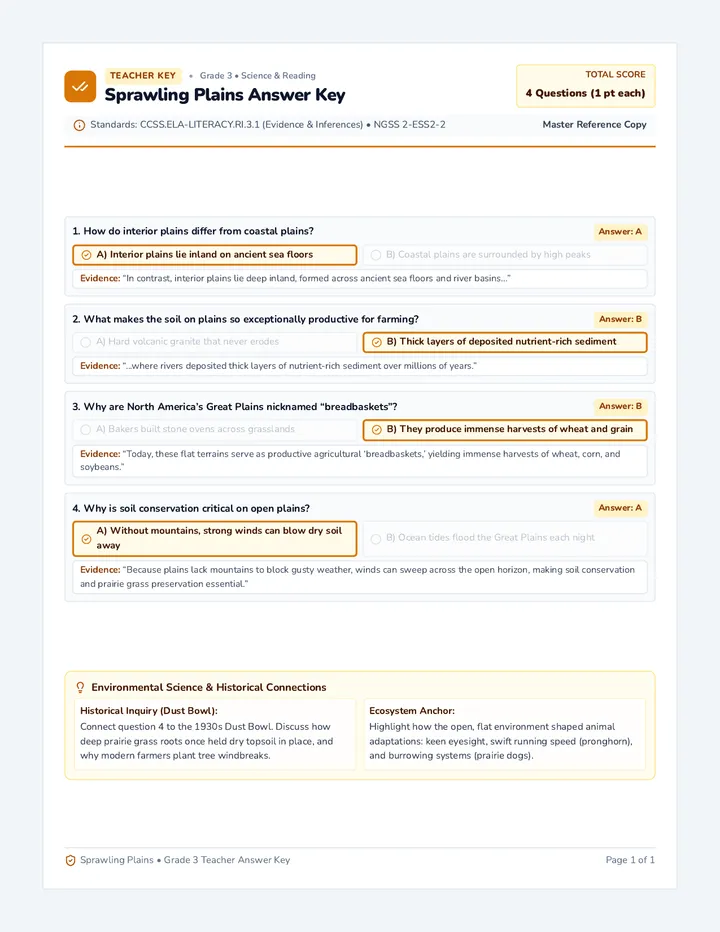
Sprawling Plains Answer Key Teacher Key • Grade 3 • Science & Reading
Sprawling Plains Answer Key
Total Score 4 Questions (1 pt each)
Standards: CCSS.ELA-LITERACY.RI.3.1 (Evidence & Inferences) • NGSS 2-ESS2-2 Master Reference Copy
1. How do interior plains differ from coastal plains?
Answer: A
A) Interior plains lie inland on ancient sea floors
B) Coastal plains are surrounded by high peaks
Evidence: “In contrast, interior plains lie deep inland, formed across ancient sea floors and river basins...”
2. What makes the soil on plains so exceptionally productive for farming?
Answer: B
A) Hard volcanic granite that never erodes
B) Thick layers of deposited nutrient-rich sediment
Evidence: “...where rivers deposited thick layers of nutrient-rich sediment over millions of years.”
3. Why are North America’s Great Plains nicknamed “breadbaskets”?
Answer: B
A) Bakers built stone ovens across grasslands
B) They produce immense harvests of wheat and grain
Evidence: “Today, these flat terrains serve as productive agricultural ‘breadbaskets,’ yielding immense harvests of wheat, corn, and soybeans.”
4. Why is soil conservation critical on open plains?
Answer: A
A) Without mountains, strong winds can blow dry soil away
B) Ocean tides flood the Great Plains each night
Evidence: “Because plains lack mountains to block gusty weather, winds can sweep across the open horizon, making soil conservation and prairie grass preservation essential.”
Environmental Science & Historical Connections
Historical Inquiry (Dust Bowl): Connect question 4 to the 1930s Dust Bowl. Discuss how deep prairie grass roots once held dry topsoil in place, and why modern farmers plant tree windbreaks.
Ecosystem Anchor: Highlight how the open, flat environment shaped animal adaptations: keen eyesight, swift running speed (pronghorn), and burrowing systems (prairie dogs).
Sprawling Plains • Grade 3 Teacher Answer Key Page 1 of 1