A two-week middle school life science sequence investigating plant anatomy, vascular transport, and photosynthetic energy transformation. Students explore organ systems and biochemical processes that sustain plant life and drive terrestrial ecosystems.
Unit 1: Plant Anatomy • Student Guided Notes Page 1 of 2
Part II: Specialized Tissues & Reproduction Name:
4. Leaf Microscopic Cross-Section (The Food Factory)
Directions: Match each leaf layer to its specialized role by writing the correct letter in the blank.
Leaf Structures
1. Waxy Cuticle
2. Palisade Mesophyll
3. Spongy Mesophyll
4. Vascular Bundle (Vein)
5. Stomata (Pores)
6. Guard Cells
Specialized Functions
A. Contains xylem and phloem to bring water and carry sugar.
B. Waterproof lipid layer preventing water loss from the top.
C. Swell or shrink to open and close the gas exchange pore.
D. Loosely packed cells with air pockets for gas circulation.
E. Tightly packed column cells loaded with chloroplasts for photosynthesis.
F. Microscopic openings on the leaf underside allowing CO₂ in and O₂ out.
5. Flowers, Fruits & Seeds: Plant Perpetuation
🌸 Flower Anatomy
Petals: Attract _______________
Stamen (Male): Produces powdery _______________ in the anther.
Pistil (Female): Includes sticky _______________ and ovary with egg cells.
🌰 Seed Anatomy
Seed Coat: Outer tough layer that _______________ the inside.
Embryo: The tiny undeveloped _______________ plant.
Cotyledon: Stored _______________ supply until germination occurs.
🍎 Fruit Role
Biological Definition: The ripened _______________ containing seeds.
Dispersal Strategies: Carried by wind, float in water, or eaten by _______________.
6. Systems Synthesis: What Happens on a Scorching Day?
Imagine an outdoor tomato plant at 2:00 PM on a dry, 98°F afternoon. Explain how the root hairs, xylem, and guard cells collaborate to protect the plant from dying:
1. Guard Cells:
2. Xylem:
3. Root Hairs:
Unit 1: Plant Anatomy • Student Guided Notes Page 2 of 2
1. Why do root cells need oxygen from soil air pockets? What happens to roots when waterlogged?
2. If the roots rot and die, explain why the leaves wilt even though there is plenty of water in the pot:
3. What two specific actions should Maya take immediately to save the plant?
Unit 1: Plant Anatomy • Student Practice Worksheet Page 2 of 2
Part 1 (Matching): 1-C (Xylem), 2-E (Phloem), 3-F (Stomata), 4-A (Guard Cells), 5-B (Root Hairs), 6-D (Cuticle).
Part 2 (Biome Adaptations):
Cactus: Stem is green to conduct photosynthesis and store massive water reserves; spines reduce surface area to limit transpiration and protect against herbivores; shallow radial roots capture brief rainfall instantly.
Monstera: Slits allow hurricane winds and light to penetrate to lower leaves without tearing; waxy drip tips shed excess water preventing fungal growth; aerial roots anchor to canopy trees and gather humidity.
Part 3 (Pathway Numbering): Pathway A (Water): 4, 1, 2, 3 (Order: Absorb [1] ➔ Cohesion in xylem [2] ➔ Mesophyll cells [3] ➔ Evaporate out stomata [4]). Pathway B (Sugar): 4, 1, 2, 3 (Order: Synthesized in leaf [1] ➔ Pumped into phloem [2] ➔ Pushed down stem [3] ➔ Stored as starch in roots [4]).
Part 4 (Drowning Houseplant Inquiry):
1. Roots require O₂ to generate ATP for cellular respiration and active transport. In stagnant water, anaerobic bacteria rot root tissues.
2. Since the root hair cells are dead, they cannot take in water or minerals. Without water entering xylem, leaves dehydrate and wilt.
3. Drain standing water immediately; repot in fresh, well-aerated soil with drainage holes; trim away blackened, rotted roots.
Differentiation & Scaffolding Strategies
Support / IEP / ELL:
Provide word banks for Guided Notes. Use color-coded highlighters: blue for xylem/water pathways and orange for phloem/sugar pathways.
Enrichment / Advanced:
Challenge students to research how aphids tap exclusively into phloem tubes without damaging xylem, and how maple syrup harvesting relies on spring phloem pressure.
Unit 1: Plant Anatomy • Teacher Facilitation Guide Page 2 of 2
Part 4: Claim • Evidence • Reasoning (CER) Argument
Prompt: How does distance from a light source impact the rate of plant photosynthesis?
CLAIM (Directly answer the question in one complete sentence):
EVIDENCE (Cite at least two specific numerical data points from the lab table):
REASONING (Connect your evidence to chloroplasts, light energy, and photon absorption):
Part 5: Extension: The Green Filter Mystery
If the students placed a green transparent film over the lamp at 10 cm, predict what would happen to the bubble count. Explain your reasoning using chlorophyll light absorption.
Unit 2: Photosynthesis • Student Investigation Worksheet Page 2 of 2
Part 2 (Variables): 1. Distance of lamp (light intensity) | 2. Rate of oxygen bubbles per minute | 3. Oxygen gas (\(\text{O}_2\)) released during photolysis of water.
Part 4 (Exemplar CER Response):
Claim: As the distance between the plant and light source decreases, the rate of photosynthesis increases significantly.
Evidence: At 10 cm, the plant released an average of 50 bubbles/min, whereas at 50 cm, bubble production plummeted to only 6 bubbles/min.
Reasoning: Closer lamp proximity delivers higher photon energy to chlorophyll pigments in thylakoid membranes, speeding the splitting of water molecules and accelerating glucose synthesis.
Part 5 (Green Light Extension): Bubble production would drop drastically near zero because chlorophyll reflects green light rather than absorbing it.
Quick Check Answers
1. B (Glucose and oxygen gas) • 2. C (Carbon dioxide gas from air incorporates into cellulose and lignin).
Scientific Explanation (CER) Evaluation Rubric
Criteria
Proficient (3 pts)
Developing (2 pts)
Beginning (1 pt)
Claim
Accurate, direct relationship clearly stated.
Partially accurate or vague relationship.
Missing or scientifically inaccurate claim.
Evidence
Cites 2+ accurate data pairs with units.
Cites 1 data point or omits metric units.
Personal opinions with no data reference.
Reasoning
Explains chlorophyll, photon absorption, & rate.
Mentions sunlight but lacks organelle link.
Merely repeats the data without science principles.
Unit 2: Photosynthesis • Teacher Facilitation & Assessment Page 2 of 2
Matter & Energy Conservation Reflections:
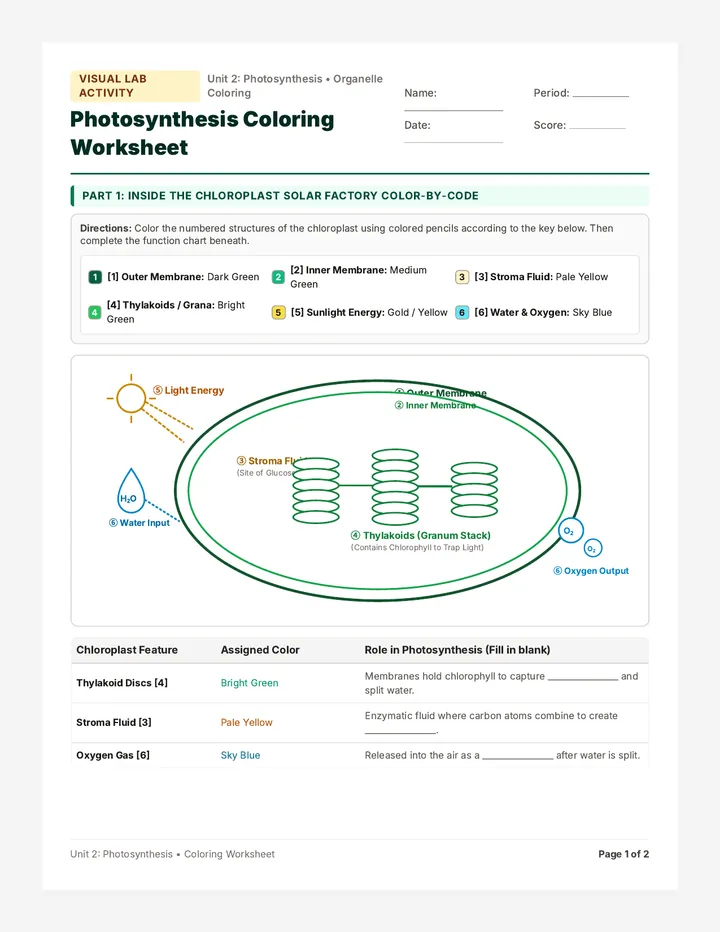
1. Why is arrow [A] (Sunlight) called an energy flow rather than matter?
2. Where does the orange sugar [E] end up during winter when leaves drop?
Unit 2: Photosynthesis • Coloring Worksheet Page 2 of 2