A 4-day 6th-grade science unit investigating the immense size and scale of the solar system, Milky Way galaxy, and observable universe using historical and ongoing space mission data. Students progress from Astronomical Units to light-years and cosmic deep fields through collaborative investigations and evidence-based modeling.
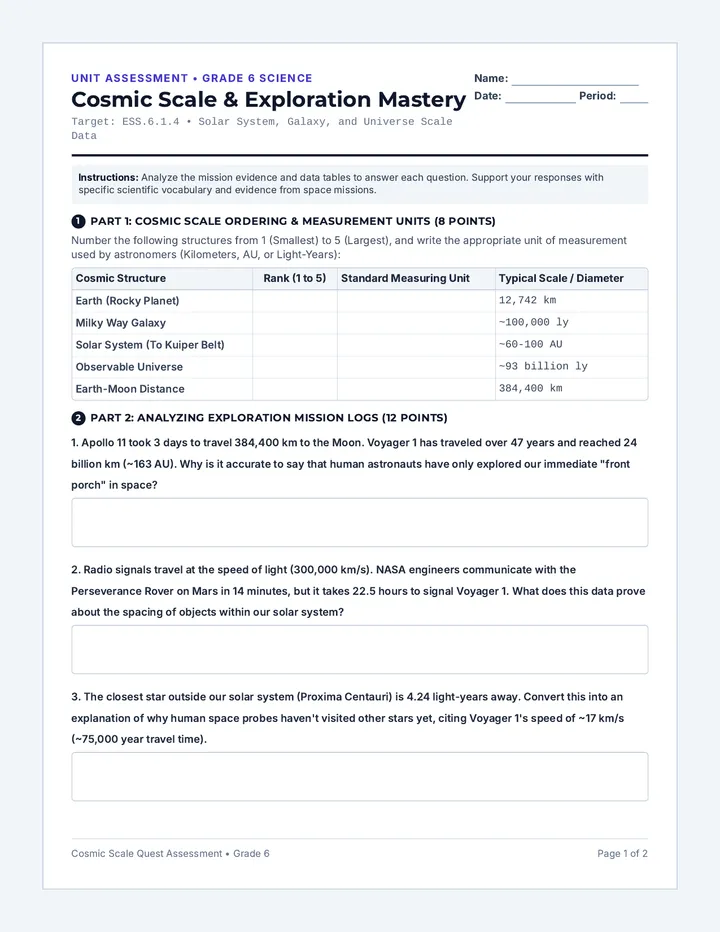
4. In our 100 cm strip, all four rocky inner planets (Mercury, Venus, Earth, Mars) are crowded into the first 5 cm (5% of the strip). What does this tell you about where most of the solar system's physical volume and space lies?
Critique This Scientific Model
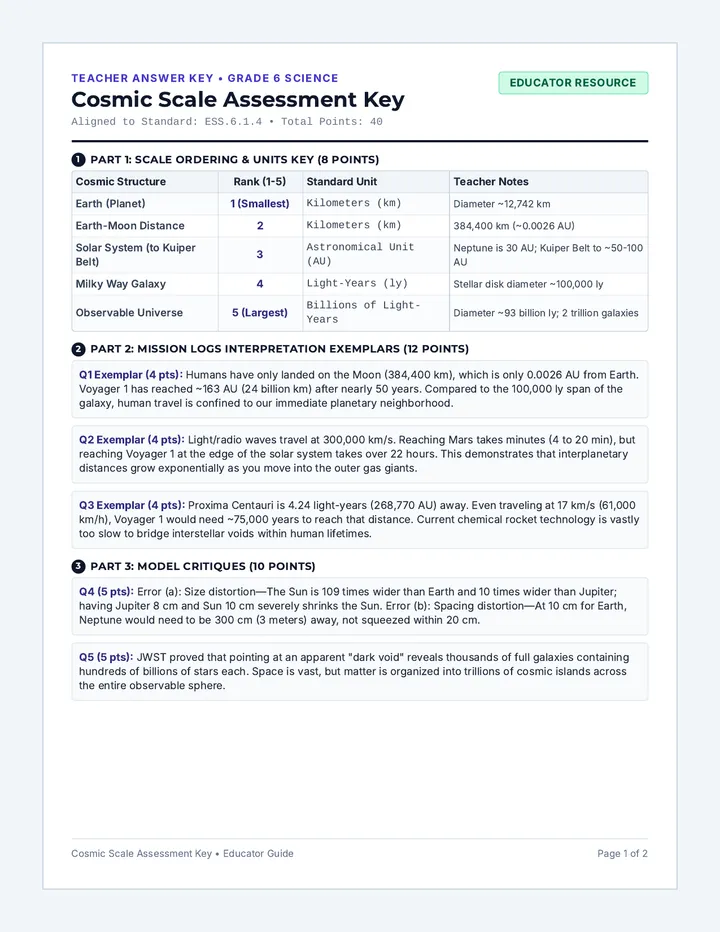
Almost every science textbook includes a diagram showing the Sun and eight planets lined up side-by-side in neat, equally spaced rows, with Jupiter looking only 4 or 5 times wider than Earth.
5. Based on today's mission data and scale strip, explain two major scientific inaccuracies in typical textbook solar system diagrams. Why are these drawings misleading?
6. Challenge Synthesis: Voyager 1 is currently traveling at approximately 17 kilometers every second. Even at that blistering speed, it took Voyager 35 years to exit the planetary realm. What evidence does this provide about the true nature of space between objects in our solar system?
Quick Check: 1 AU = Sun-to-Earth distance (~150 million km). Neptune is ~30 AU away.
ESS.6.1.4 Target 1
Cosmic Scale Quest • Grade 6 Science Page 2 of 2
Compare how long our fastest human-made probes would take to reach Proxima Centauri versus light speed beams.
2 Map the Milky Way's Disk
Plot our Sun's position relative to Sagittarius A* (the central supermassive black hole) and outer spiral arms.
Discussion Question:
"When we look at Proxima Centauri through a telescope tonight, we see light that left the star 4.2 years ago. Why is looking out into space looking backward in time?"
Write your explanation in Question 4 on your Day 2 handout.
5. Kepler & Gaia Mission Evidence: NASA's Kepler mission observed a tiny patch of the Milky Way and found thousands of exoplanets, leading astronomers to estimate there are over 100 billion planets in our galaxy alone. What does this reveal about whether our solar system is unique or ordinary in scale?
6. Scale Comparison Synthesis: A 6th-grade student draws a picture of the Milky Way galaxy, and draws Earth taking up half the width of one spiral arm. Using what you learned about the 100,000 light-year diameter of the galaxy and the 1 AU size of Earth's orbit, evaluate whether this model is accurate or deeply misleading.
Scale Hierarchy: Planet → Solar System (AU) → Interstellar Neighborhood → Milky Way Galaxy (ly)
ESS.6.1.4 Target 2
Cosmic Scale Quest • Grade 6 Science Page 2 of 2
2 Construct the Cosmic Ladder
Rank components from smallest (Earth) to largest (Universe) and identify which scientific unit belongs to each.
Critical Thinking Prompt:
"Why did NASA spend 10 billion dollars building JWST to see infrared light instead of visible light?"
Hint: As the universe expands over billions of years, what happens to light traveling across cosmic distances?
Resource: Student Handout - Cosmic Web Investigation Goal: Complete Parts 1 & 2
What It Contains
Appropriate Unit
Approximate Scale
Earth
Continents, oceans, biosphere
~12,742 km wide
Solar System
Sun, 8 planets, asteroid & Kuiper belt
~60 to 100 AU
Milky Way Galaxy
100-400 billion solar systems & nebulae
~100,000 ly across
Observable Universe
2 trillion galaxies and cosmic web
~93 billion ly across
5. Explain why a scientist cannot describe the distance to distant galaxies in Astronomical Units (AU). What happens when you try to use solar system units for intergalactic space?
6. Look-Back Time in Deep Space: The James Webb Space Telescope recently detected a galaxy whose light took 13.3 billion years to reach its mirror. Since light travels at 300,000 km/s, what does this tell us about the age and minimum size of our observable cosmos?
Key Finding: The observable universe spans 93 billion light-years, housing trillions of entire galaxies.
ESS.6.1.4 Target 3
Cosmic Scale Quest • Grade 6 Science Page 2 of 2
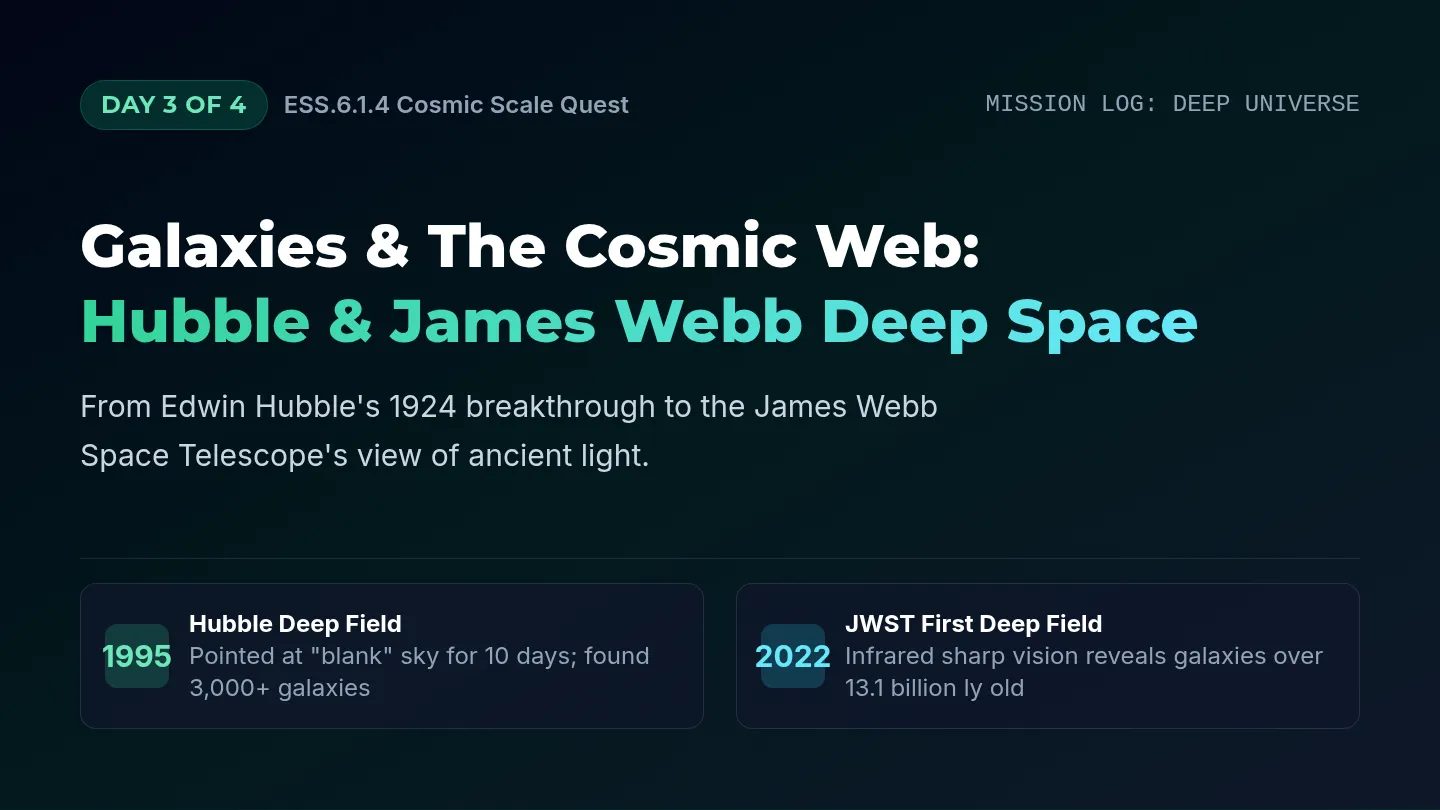
5. The James Webb Space Telescope First Deep Field image shows thousands of galaxies packed inside a pinhole area of the sky. How does this mission data disprove the idea that the night sky is mostly empty void?
4 Part 4: Extended Scientific Argument (10 Points)
Write an evidence-based scientific paragraph answering the prompt below.
Prompt: Explain why astronomers must invent larger units of measurement (from kilometers, to Astronomical Units, to light-years) as they study objects further away in space. In your response:
Define AU and Light-Year using concrete numbers.
Cite mission data from Voyager 1, Kepler/Gaia, or Hubble/JWST.
Explain what happens to numbers when using inappropriate units for cosmic distances.
Synthesizes historical (Apollo, Voyager) and modern (Kepler, JWST) data to justify scale models precisely.
Flawlessly contrasts AU, light-years, and km; clearly articulates exponential distance increases and look-back time.
3 - Proficient (30-35 pts)
Interprets mission data correctly to compare planetary, stellar, and galactic realms with minor omissions.
Correctly matches units to structures; articulates that standard units become unwieldy across interstellar space.
2 - Developing (24-29 pts)
Identifies mission names but struggles to calculate or compare relative travel durations and distances.
Confuses AU and light-years or treats light-year as a measure of time rather than physical distance.
1 - Emerging (< 24 pts)
Unable to extract evidence from mission tables; incomplete responses.
Misorders basic structures (e.g., placing solar system outside galaxy). Requires intensive reteaching.
Common Student Misconceptions to Address
"A light-year is a measure of time": Remind students that light-year has "year" in the name, but measures the distance light travels in that year (9.46 trillion km).
"The solar system and galaxy are the same thing": Use the Russian nesting doll or house-versus-city analogy. The solar system is our single house; the Milky Way is a city of 300 billion houses.
"Planets are crowded together in space": Emphasize that if the Sun is a basketball, Earth is a pinhead 26 meters away and Neptune is 780 meters away.
Support & Scaffolding (ELL/IEP)
Provide pre-drawn cosmic address nesting circles.
Use a color-coded reference card: Green = km, Blue = AU, Purple = Light-Year.
Sentence stems: "NASA uses AU because..." and "A light-year is different from a year because..."
Extensions (Advanced Learners)
Research the cosmic redshift (\(z\)) of JWST galaxy GLASS-z12.
Calculate the time required for a generational colony ship traveling at 1% the speed of light to reach Alpha Centauri.
Create an interactive digital scale slider comparing logarithmic scales.