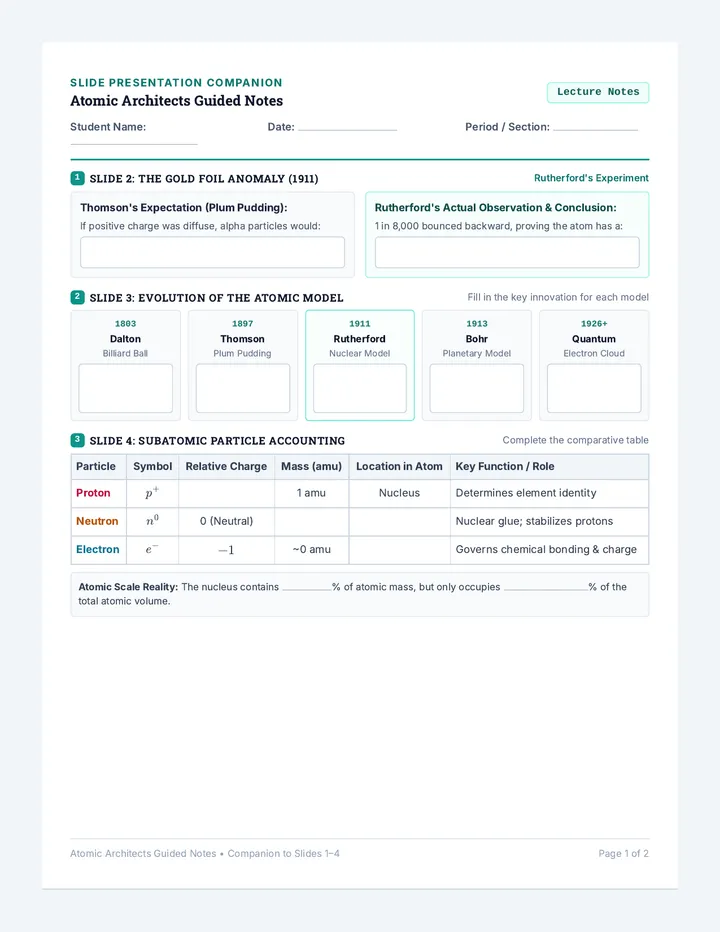
Mass: 1 amu
Location: Inside the Nucleus
Key Role: Nuclear glue; prevents proton repulsion!
Electron e⁻
Charge: −1 (Negative)
Mass: ~0 amu (1/1840th amu)
Location: Electron Cloud / Orbitals
Key Role: Controls bonding & chemical reactivity!
Nucleus holds 99.9% of mass, but only 0.0000000001% of the volume. Slide 04 / 08
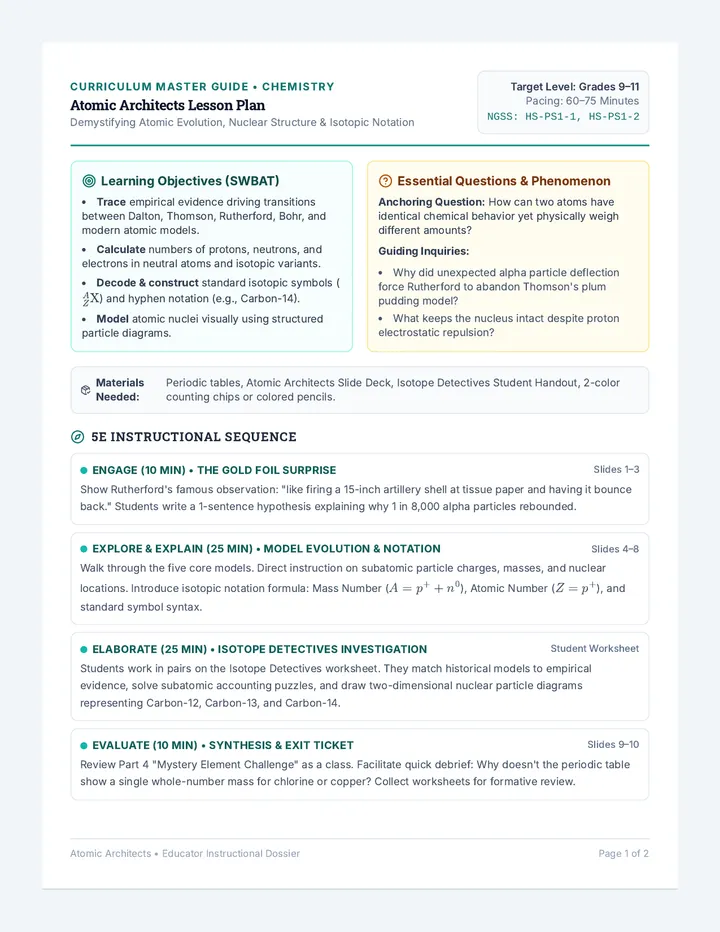
Nuclear Code
How chemists write the exact nuclear makeup of any specific atom.
Standard Isotope Symbol
14 6
C
Hyphen Name: Carbon-14
Mass Number (A) = 14 Protons + Neutrons
The total count of heavy nuclear particles. Always an integer!
Atomic Number (Z) = 6 Protons Only
Defines the element! Every Carbon atom in the universe has exactly 6 protons.
Calculating Neutrons (N) N = A − Z
Neutrons = 14 − 6 = 8 neutrons.
Rule: Protons define identity; Neutrons define isotope variant. Slide 05 / 08
Comparative Analysis
Same chemical personality, completely different nuclear masses.
Protium ¹₁H
99.98% Natural Abundance
• Protons: 1
• Neutrons: 0
• Electrons: 1
• Mass: 1 amu
Most common form on Earth
Deuterium ²₁H
0.015% Natural Abundance
• Protons: 1
• Neutrons: 1
• Electrons: 1
• Mass: 2 amu
"Heavy Hydrogen" (in D₂O)
Tritium ³₁H
Trace / Radioactive
• Protons: 1
• Neutrons: 2
• Electrons: 1
• Mass: 3 amu
Decays via beta emission (t½=12.3y)
All three form water (H₂O) with identical chemical bonding angles! Slide 06 / 08
Visual Modeling
Representing isotopes with structured nuclear particle clusters.
Carbon-12
¹²₆C • 6p⁺, 6n⁰
n
n
n
n
n
n
Ratio n/p = 1.0 (Completely stable)
Carbon-13
¹³₆C • 6p⁺, 7n⁰
n
n
n
n
n
n
n
Used in NMR Spectroscopy
Carbon-14
¹⁴₆C • 6p⁺, 8n⁰
n
n
n
n
n
n
n
n
Radiocarbon dating (t½=5,730y)
Notice: In all three, proton number remains exactly 6! Slide 07 / 08
Active Synthesis
Apply your nuclear detective skills before transitioning to the worksheet.
Question 1
An unknown isotope has 17 protons and 20 neutrons.
A. What is its Mass Number?
B. What is the element identity?
C. Write its complete isotopic symbol.
Solution: A = 37, Element = Chlorine, ³⁷₁₇Cl
Question 2
If Uranium-235 and Uranium-238 are both Uranium, how are they different?
• Both have exactly 92 protons.
• U-235 has 143 neutrons.
• U-238 has 146 neutrons (3 extra!).
Ready for the Isotope Detectives Handout!
Turn to page 1 of the Isotope Detectives Worksheet. Slide 08 / 08
8 Points
Draw nuclear particle diagrams for each pair of isotopes. Represent protons as circles with a plus sign (+) and neutrons as solid shaded circles ().
Helium-3 (\(^{3}_{2}\text{He}\)) Helium-4 (\(^{4}_{2}\text{He}\))
Nucleus Canvas
Nucleus Canvas
Difference in mass: amu
Carbon-12 (\(^{12}_{6}\text{C}\)) Carbon-13 (\(^{13}_{6}\text{C}\))
Nucleus Canvas
Nucleus Canvas
Difference in neutrons: neutron(s)
7 Points
Dossier Scenario: A forensic mass spectrometer analyzes an unknown soil sample from a meteor crash site. The instrument detects an atom with a nuclear charge of +19, an overall neutral charge, and a mass number of 40.
A. Element Name & Symbol:
B. Subatomic Breakdown:
C. Complete Nuclear Symbol:
D. Critical Thinking: This element normally exists on Earth as an isotope with mass number 39. Explain whether the meteorite specimen will exhibit different chemical reactions than Earth's normal element. Justify your answer using subatomic particle roles.
Isotope Detectives Student Investigation • Atomic Architects Series Page 2 of 2
| 18 |
| 17 |
| Chlorine-37 | \(^{37}_{17}\text{Cl}\) | 17 | 37 | 17 | 20 | 17 |
| Iron-56 | \(^{56}_{26}\text{Fe}\) | 26 | 56 | 26 | 30 | 26 |
Teacher Checkpoint: Note that for Chlorine-35 and Chlorine-37, protons and electrons remain identically 17, while neutrons shift from 18 to 20 (\(N = A - Z\)).
Isotope Detectives Teacher Solution Guide Page 1 of 2
Visual model grading criteria and conceptual explanation evaluation
4 pts per comparison box
Helium-3 vs Helium-4 Solutions:
Helium-3 (\(^{3}_{2}\text{He}\)): Must show exactly 2 protons (+) and 1 neutron (solid) in nucleus.
Helium-4 (\(^{4}_{2}\text{He}\)): Must show exactly 2 protons (+) and 2 neutrons (solid) in nucleus.
Difference in mass: 1 amu (1 neutron extra).
Carbon-12 vs Carbon-13 Solutions:
Carbon-12 (\(^{12}_{6}\text{C}\)): Must show exactly 6 protons (+) and 6 neutrons (solid).
Carbon-13 (\(^{13}_{6}\text{C}\)): Must show exactly 6 protons (+) and 7 neutrons (solid).
Difference in neutrons: 1 neutron(s).
Grading Tip: Accept any spatial packing in the canvas, as long as counts of (+) and solid dots precisely match the calculated values.
1 pt (A), 2 pts (B), 1 pt (C), 3 pts (D)
A. Element & Symbol:
Potassium (K)
Charge +19 = 19 protons = Z 19
B. Subatomic Breakdown:
p⁺: 19 | n⁰: 21 | e⁻: 19
Neutrons = 40 − 19 = 21
C. Complete Nuclear Symbol:
\(^{40}_{19}\text{K}\)
Also accept: Potassium-40
D. Chemical Reactivity Justification (3 Pts):
Model Response: "No, the meteorite specimen will NOT exhibit different chemical reactions; its chemical behavior will be virtually identical to Earth's Potassium-39. Chemical reactivity and bonding are determined entirely by an atom's electron configuration (specifically its 1 valence electron). Because both Potassium-39 and Potassium-40 possess 19 protons and 19 electrons, they form the same +1 cations and identical ionic compounds (such as KCl). The extra neutron only changes physical mass and nuclear stability, not chemical properties."
• 1 Pt: States chemical reactions are the same.
• 1 Pt: Identifies electrons (or valence shell) as driver of reactions.
• 1 Pt: Explains neutrons only change nuclear mass/stability.
Grade Scale: 36–40 (Exemplary Mastery) • 30–35 (Proficient) • 24–29 (Developing) • <24 (Needs Remediation)
Isotope Detectives Teacher Solution Guide Page 2 of 2