A hands-on investigation into the science of sound, where 3rd graders explore vibrations, how sound travels through different materials, and the mechanics of hearing through interactive experiments and instrument building.
A mini-project lesson where students act as data detectives to collect, analyze, and ethically report on classroom data.
A comprehensive guide and evaluation system for elementary students conducting science research projects. Includes a student-friendly rubric, a teacher grading sheet, and instructional slides to set students up for success.
A phonics-focused lesson where students identify and sort 2-syllable words based on whether their first syllable is open or closed. Includes a hands-on cut-and-paste activity with a space exploration theme.
Focused instruction on identifying main idea, comparing and contrasting texts, and determining story themes.
Techniques and materials to improve reading rate, accuracy, and expression for developing readers.
Tools for decoding multi-syllabic words and understanding how prefixes and suffixes change word meaning.
Strategies and practice for solving single-step and multi-operational word problems across all four basic operations.
Resources for mastering addition, subtraction, multiplication, and division facts, including specific materials for fact families and levels up to 10 and 20.
A foundational science lesson exploring the three primary states of matter—solids, liquids, and gases—through reading, visual aids, and interactive observation.
Cette séance de 2 heures permet aux élèves de distinguer qualification et compétence, d'analyser l'impact des conditions de travail sur le comportement des salariés et de mesurer la performance de l'activité humaine via des indicateurs de productivité et de climat social.
An introductory lesson exploring the eight planets of our solar system, their unique characteristics, and space-related vocabulary.
Combining electricity and magnetism to create a temporary magnet. Students follow instructions to build their own electromagnet using a battery, wire, and nail.
Identifying the path electricity takes. Students differentiate between conductors that let electricity pass and insulators that stop it, while building basic circuits.
Exploring the invisible forces of magnets. Students learn about poles (North and South) and how magnetic fields create attraction and repulsion.
Introduction to what electricity is and how it moves through wires. Focuses on the concept of energy flow and simple 'push' and 'pull' analogies.
The capstone project where students combine their coding knowledge and engineering skills. Students design a functional 'helper bot' using recycled materials and write the pseudo-code for its operations.
A hands-on engineering challenge where students apply the Engineering Design Process to build stable structures. This lesson focuses on physics, materials science, and iterative testing.
An introduction to computational thinking focusing on algorithms, sequencing, and loops. Students engage with online coding platforms and offline logic puzzles to master the basics of programming.
A step-by-step Scratch coding project where students build a physics-based bottle flip game. This lesson covers events, motion, loops, and variables through an engaging arcade-style project.
This lesson advances 4th-grade students' spreadsheet skills, moving beyond basic data entry to explore sorting, formatting, and the power of simple formulas.
Covers the four gas and ice giants (Jupiter, Saturn, Uranus, and Neptune), along with dwarf planets and a final unit review.
Explores the Sun as our central star and the characteristics of the four inner terrestrial planets (Mercury, Venus, Earth, and Mars).
Focuses on the basic movements of Earth (rotation vs. revolution), the phases of the moon, and the basics of light waves as they relate to space exploration.
A 30-minute introductory lesson on closed syllable exceptions (ild, ind, old, ost, olt) using a secret agent theme. Students identify, read, and write 'Rule Breaker' words that have long vowels despite being in closed syllables.
An introductory lesson on Microsoft Word basics, covering document creation, saving, text formatting, and clipboard actions (copy/cut/paste). Students will learn through a 'Word Wizardry' theme, transforming technical skills into creative magic.
A series of feedback and reflection tools for students, parents, and teachers to evaluate learning after completing the Wild Adventure project. It uses an explorer theme to make the assessment process engaging and collaborative.
A hands-on lesson exploring the relationship between water level and volume, teaching students how to observe, measure, and compare how much liquid a container holds.
A fast-paced, interactive 30-minute introduction to the muscular system for 3rd graders, focusing on voluntary versus involuntary muscles and how they work in pairs.
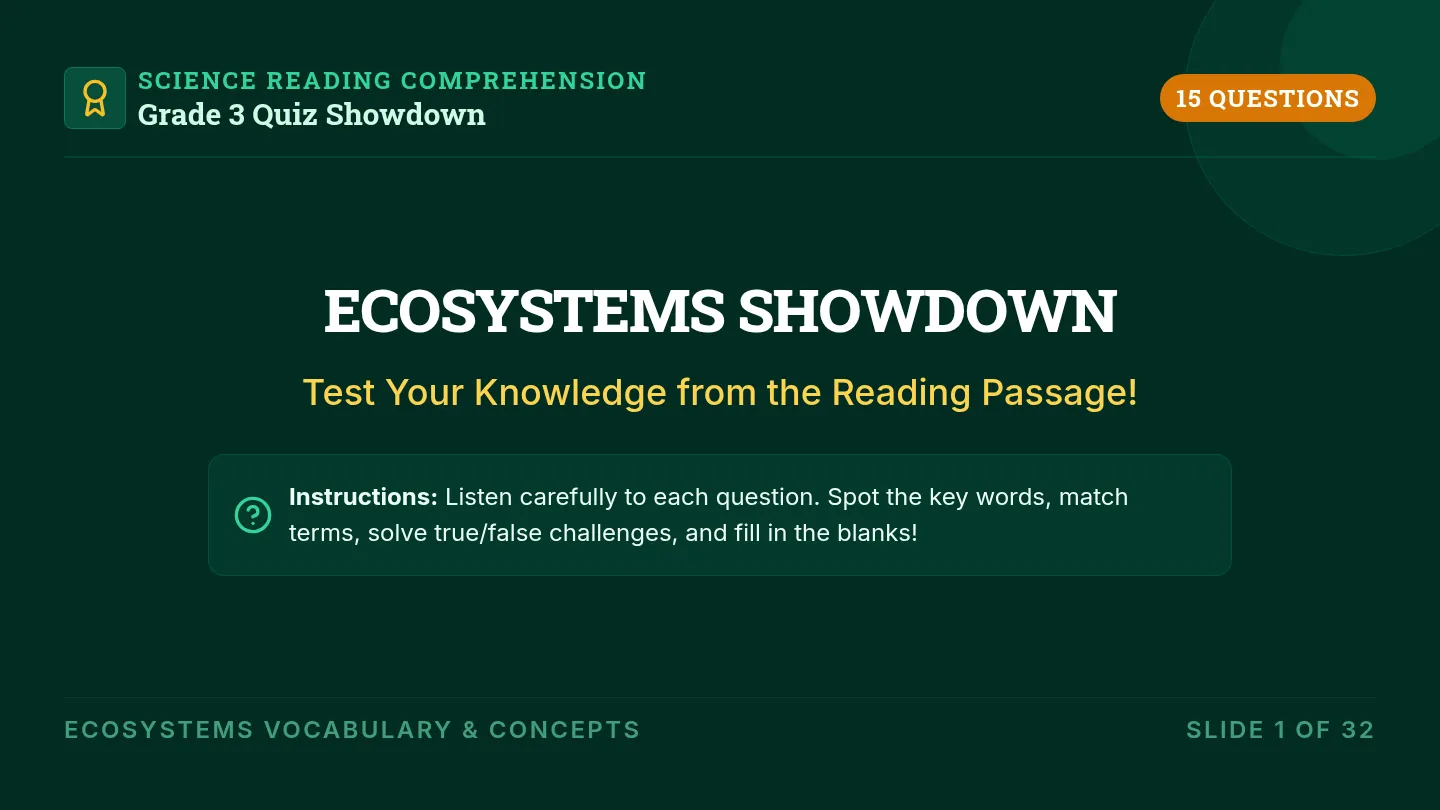
A foundational introduction to ecosystems, biomes, and the roles living things play in their environments. Students explore biotic and abiotic factors and the simple energy paths within food chains and webs.
A fun, introductory lesson on the human skeletal system focusing on four major structures: the skull, rib cage, spine, and femur. Students will learn the functions of these bones through a museum-themed presentation and a labeling activity.
A quick 30-minute introduction to the skeletal system, focusing on its main functions and the names of key bones in the human body. Students will explore how their 'internal frame' helps them move and stay protected.
A lesson exploring the diverse animals that call trees their home, focusing on identification and the specific parts of the tree they inhabit.
Students explore the ecosystem beneath the forest floor, focusing on animals that create tunnels and live among tree roots.
A lesson exploring the characteristics, classification, and social behavior of prehistoric Sabertooth cats.
A lesson focused on the formation of sedimentary rocks and how their layers serve as a timeline for life on Earth, specifically focusing on the sequence of formation and fossil aging.