A comprehensive first-grade science exploration on light and shadows. Students investigate how light travels, how opaque objects block light to create shadows, how the sun's position changes shadow length and direction, and how to create shadow puppets.
Whole Group Anchor Chart: Gather on the rug and display the Shadow Science Anchor Chart.
Key Scientific Rules to Emphasize:
Rule 1: Straight Light
Light travels in straight lines. It cannot curve around solid blocks.
Rule 2: Opposite Direction
The shadow always falls on the opposite side of the light source.
4 ELABORATE: Shadow Puppet Theater & Sun Shadows
15 Minutes
Outdoor Sun Check or Hand Puppet Studio: Guide students using the hand puppet diagrams on Slides 5–6 and anchor cards (e.g., Flying Bird, Barking Dog).
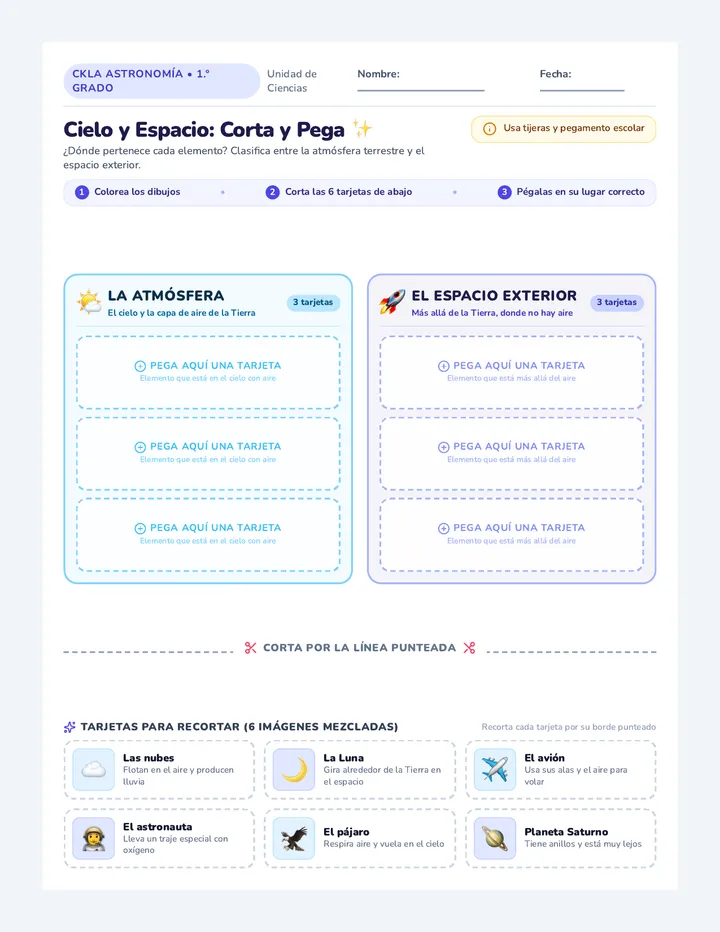
Application Activity: Students complete the Cut-and-Paste Shadow Match (Worksheet Page 2), classifying light sources, opaque objects, and matching shadows.
Formative Check: Conduct a quick "Thumbs Up / Thumbs Down" check using Slide 7 prompts.
Check for Understanding:"If you want to make your shadow bigger, do you move closer to or further from the flashlight?" Review student lab sheets for correct shadow drawing.
Differentiation & Support
ELL / Emergent Bilinguals: Use physical gestures for "light", "block", "big", and "small". Point to picture cards on Anchor Chart.
Sensory Support: Provide soft light settings for students sensitive to dim rooms or bright beams.
Extension / Early Finishers: Challenge students to create a 2-character shadow puppet dialogue with a partner.
Common Misconceptions
Misconception: "Shadows are made of dark paint or dark stuff."
→ Clarify: A shadow is simply an empty space where light was stopped.
Misconception: "Clear glass makes dark shadows."
→ Test it directly to show light passes right through.
Pro Teacher Tip: On sunny days, take students outside at 9:00 AM and again at 1:00 PM to trace their shadows on the blacktop with chalk. Compare how the sun's position changes their shadow's length and direction!