Sort Safari Slides Science Explorers • Day 1
30-Minute Cut & Paste Mission
Sort Safari! 🔍
Today we become Sorting Detectives! How do scientists organize messy things into super groups?
✂️
1. Snip Cards
🐘
2. Big or Small?
🎨
3. Glue & Share
What Does It Mean to SORT?
Detective Rule #1
To SORT Means:
To put things together into groups that share something alike!
Scientists call this classifying !
How do scientists sort things?
🐘
BIG Things
Heavy & Wide
🐜
SMALL Things
Tiny & Light
🎨
By Color
Red, Blue, Green
⭐
By Shape
Round, Square, Flat
🗣️ Quick Turn & Talk: Look around our room! What is one BIG thing and one TINY thing you see?
Classroom Cut & Paste Mission! ✂️
15 Minutes Detective Work
1
Snip the 8 Cards
Follow the dashed lines on Page 2 to cut out your 8 classroom object cards!
2
Investigate & Decide
Look at each card: Does it belong in the BIG group or the SMALL group?
3
Glue on Page 1
Use a dab of glue stick to paste each card inside its matching square on Page 1!
Can you figure out all 4 big objects and all 4 small objects?
Detective Challenge 🔍
Scientist Share-Out! 🌟
Wrap-Up & Sneak Peek
Partner Share Frame:
"I glued the ______ in the ______ group because it is..."
Scientists always explain their sorting reasons with clear evidence!
Tomorrow's Giant Mystery!
Is it ALIVE or NOT ALIVE?
Scientists sort all the amazing things on Earth into two huge kingdoms: Living Things and Nonliving Things !
🎬 BrainPOP Jr. Mystery with Annie & Moby is coming next!
Cap your glue sticks, put scissors away, and give yourself a brain cheer! 🧠✨
Sort Safari Cut Paste Sort Safari Cut & Paste 🔍
Science Detective Mission • Day 1 Object Sort
Day 1 Mission
Name:
Date:
✂️ Mission: Cut out your 8 cards from Page 2 and decide where each object belongs!
🐘 BIG Items 4 Cards
Which classroom objects are big? Find & glue 4 here!
Paste Card 130 × 130 px
Paste Card 130 × 130 px
Paste Card 130 × 130 px
Paste Card 130 × 130 px
"All 4 of these are BIG classroom things!"
🐜 SMALL Items 4 Cards
Which classroom objects are small? Find & glue 4 here!
Paste Card 130 × 130 px
Paste Card 130 × 130 px
Paste Card 130 × 130 px
Paste Card 130 × 130 px
"All 4 of these are SMALL classroom things!"
🗣️ Partner Talk: Pick one item and tell your partner: "I glued this in the Big / Small group because..."
Classroom Object Cut-Out Cards
Carefully cut along the dashed 130px lines!
130 × 130 px Exact Match
Look at each object! Snip each square, sort them by size, and glue them into the matching group on Page 1.
📚
Storybook
📎
Paper Clip
🧱
Wood Block
🧊
Math Cube
🖍️
Crayon Box
🗂️
Binder Clip
📝
Sticky Pad
🖊️
School Pen
Snip along each 130px dashed square, then glue into BIG or SMALL on Page 1! 1:1 Size Match
Sort Safari Teacher Guide Sort Safari Teacher Guide
Day 1 • 30 Minutes • Cut & Paste Sorting Lab
Zero-Prep Printable Sort
🎯 Essential Question How do scientists group things by size and traits to understand our world?
✂️ Materials & Prep Sort Safari Cut & Paste (Pages 1 & 2), child-safe scissors, glue sticks.
🗣️ Key Vocabulary Sort (group), Classify , Attribute (Big vs. Small).
30-Minute Instructional Arc
1. Engage: The Big & Small Hook (5 Mins) Slides 1–2
Hold up a real storybook in one hand and a tiny paper clip in the other. Ask: "How are these two things different?" Point out that on the cards, big things are drawn huge and small things are drawn tiny! Introduce the scientist word Classify .
🗣️ Call & Response Chant: Teacher calls: "When we classify..." Students respond: "...we group it up!" (clap twice).
2. Explore: Cut & Paste Sorting Mission (15 Mins) Sort Safari Cut & Paste
Distribute Printables: Give each student Page 1 (Sorting Board) and Page 2 (8 Cut-Out Cards: storybook, wood block, crayon box, sticky pad, paper clip, math cube, binder clip, pen).Snip & Test (8 min): Students snip along the dashed 130px squares. Before gluing, they make two piles on their desk: BIG items vs. SMALL items.1:1 Fit Glue Down (7 min): Each 130px card fits directly over a 130px dashed box on Page 1. Students use a dab of glue stick to attach each card.
3. Explain: Document Camera Share & Partner Talk (7 Mins) Slide 3
Project a completed student board under the doc cam. Model oral sentence frame: "I glued the book in the BIG group because it is heavy and wide. I glued the paper clip in the SMALL group because it fits in my finger!"
4. Wrap-Up & Day 2 Cliffhanger (3 Mins) Slide 4
Say: "Today we sorted everyday tools by size. But tomorrow, scientists have a giant mystery: How do we sort ALL things on Earth into LIVING and NONLIVING?"
Scaffolding & Differentiation
Visual Size Contrast: Big cards feature prominent 7xl graphics while small cards feature compact 3xl graphics. Extension: Fast finishers can re-sort orally by function (drawing tools vs. building tools).
Scissor & Glue Management
Use the cue: "Dot, dot, not a lot!" for glue sticks. The 130px cards match the 130px pasting boxes 1:1, making placement intuitive for young learners.
Living Detectives Slides Science Explorers • Day 2
30-Minute Hands-On Investigation
Living Detectives! 🔎
Today we solve the biggest mystery on Earth: Is it ALIVE or NONLIVING?
🎬
1. Watch & Wonder
🌱
2. Learn the 4 Clues
✂️
3. Cut, Sort & Stick!
BrainPOP Jr. Investigation! 🍿
Featured Video Lesson
Recommended Topic:
BrainPOP Jr. – Living and Nonliving Things
Join Annie and Moby as they explore parks, plants, and robotic friends to discover what makes something alive!
Approx. 4 minutes • Grade 1 Science Standard
Detective Clues to Spot in the Video:
💧 What do all living things need to drink and eat?
🌱 Do rocks or chairs grow bigger? Why not?
🤖 Is Moby the robot alive? How can you tell?
🤫 Eyes on the screen, listening ears turned all the way up!
The 4 Secret "Alive" Clues! 🔍
Scientist Rulebook
🌱
1. They GROW
Living things change and get bigger over time!
🍎💧
2. Need Food
They need food and water to have energy!
💨
3. Breathe Air
Plants breathe air, and animals breathe oxygen!
🐣
4. Make New
They make babies or seeds (reproduce)!
🌟 Nonliving things cannot do ANY of these on their own! A rock never eats lunch!
Hands-On Sorting Time! ✂️
15 Minutes Mission
1
Cut Cards
Carefully snip along the dashed lines to cut out your 8 picture cards.
2
Ask 4 Clues
Does it grow? Does it need water? Does it breathe? Does it make babies?
3
Glue & Share
Paste into Living or Nonliving columns on your clipboard!
Ready, set, investigate! 🔍✨
Living Detectives Cut Paste Living Detectives Sorting Board
1st Grade Science • Day 2 Cut & Paste Mission
Mission Board
Name:
Date:
🔍 Detective Mission: Cut out your 8 cards from Page 2 and glue them into the matching boxes!
✓ Living (Organisms) 4 Cards
🌱 Grows 💧 Food/Water 💨 Air 🐣 Babies
Glue Here
Glue Here
Glue Here
Glue Here
"All of these are alive because they need food and can grow!"
✗ Nonliving 4 Cards
🚫 Does NOT grow 🚫 Does NOT eat
Glue Here
Glue Here
Glue Here
Glue Here
"All of these are nonliving because they do not grow on their own!"
Detective Discussion: Pick one card and tell your partner: "This is living / nonliving because..."
Detective Cut-Out Cards
Carefully cut along all dotted lines!
Cards Fit Paste Boxes Exactly
Snip along each dotted line box. Each card fits right on top of a glue box on Page 1!
🌳 Oak Tree
🪨 Rock
🐻 Bear
✏️ Pencil
🌻 Sunflower
🚗 Toy Car
🐶 Puppy
🪑 Desk
Snip along each dotted square, then glue onto your sorting board! 8 Matching Square Cards
Alive Clues Exit Ticket Alive Clues Exit Ticket ⭐
1st Grade Science • Day 2 Check
Quick Check
Name:
Date:
Show what you know about living and nonliving things!
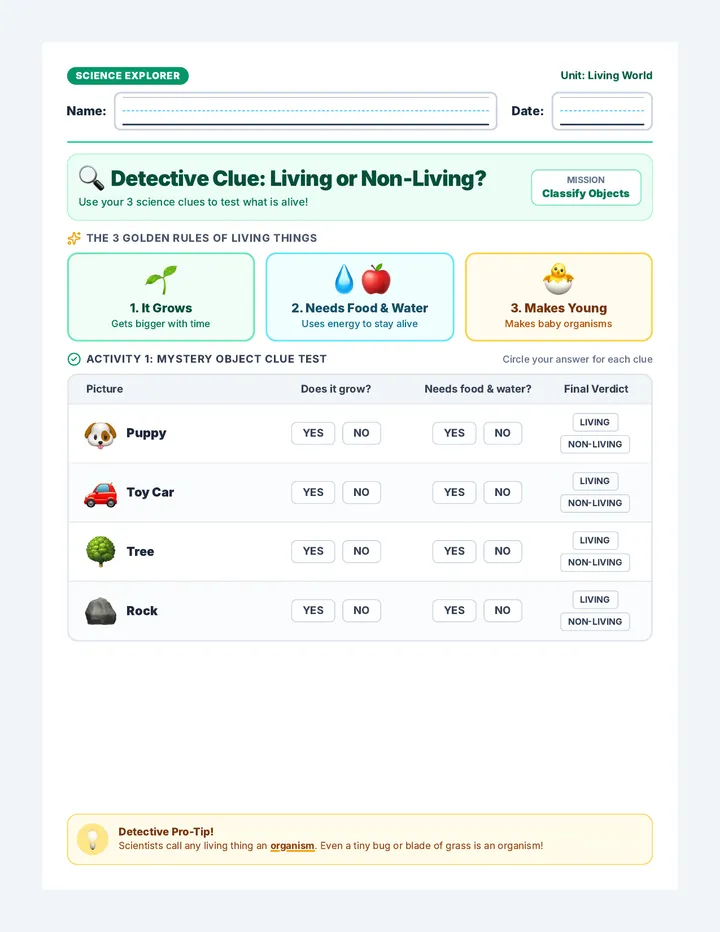
1 Circle the 3 LIVING things (Organisms):
🐕 Dog
📖 Book
🌲 Pine Tree
🖍️ Crayon
🦋 Butterfly
👟 Shoe
2 What clues tell us something is ALIVE? (Check 2 clues):
It needs food and water
It is made in a toy factory
It can grow and change
3 Draw 1 living organism you love (plant or animal):
My living organism is a:
🎉 Certified Living Detective Living vs Nonliving Unit
Living Detectives Guide Living Detectives Teacher Guide
Day 2 • 30 Minutes • 1st Grade Hands-On Science
BrainPOP Jr. & Hands-On Sort
🎬 Video Recommendation BrainPOP Jr. : Living and Nonliving Things (Annie & Moby).
✂️ Hands-On Supplies Student safe scissors, glue sticks, 1 sorting mat and card sheet per child.
🌱 4 Alive Clues Grows, needs food/water, breathes air, makes babies/seeds.
30-Minute Instructional Arc
1. Engage & BrainPOP Jr. Video (9 Mins) Slides 1–2
Screen BrainPOP Jr.: Living and Nonliving Things . Pause at 1:45: Ask: "Moby wants to feed his radio a sandwich! Why won't that work?" Have students turn and whisper to a partner.
2. Detective Rulebook: The 4 Alive Clues (5 Mins) Slide 3
Walk through the 4 Clues on Slide 3 together. Check understanding by testing two classroom examples orally: "Does an apple tree drink water and grow? Yes! Does a marker drink water and grow? No!"
3. Hands-On Sort & Stick Lab (12 Mins) Cut Paste Board
Distribute Page 1 & Page 2 of the Living Detectives Cut Paste set. Students cut their 8 enlarged picture cards and test each item against the 4 Clues before gluing. Walk around prompting: "Why is the oak tree living even though it doesn't walk?"
4. Evaluate: Alive Clues Exit Ticket (4 Mins) Exit Ticket
Independent check: Students circle the 3 organisms, check 2 alive clues, and draw one living thing with their primary name line. Collect to assess 1st grade mastery of living vs. nonliving.
Key 1st Grade Misconception
Students often think plants are nonliving because they don't walk, and toy cars are living because they roll. Emphasize: "Plants drink water and grow; toy cars have no life, cells, or growth!"
Praise & Extension
Praise students using the scientist word organism ! Early finishers can partner-share explaining why their chosen exit ticket drawing is alive.