Bendy Bodies Level 1 Reader
Bendy Bodies!
Level 1 Science Reader • Grades 1–2
Name:
Date:
Joint Where two bones meet
Cartilage Bendy, soft cushion
Ligament Ties bone to bone
Tendon Ties muscle to bone
1 What Is a Joint?
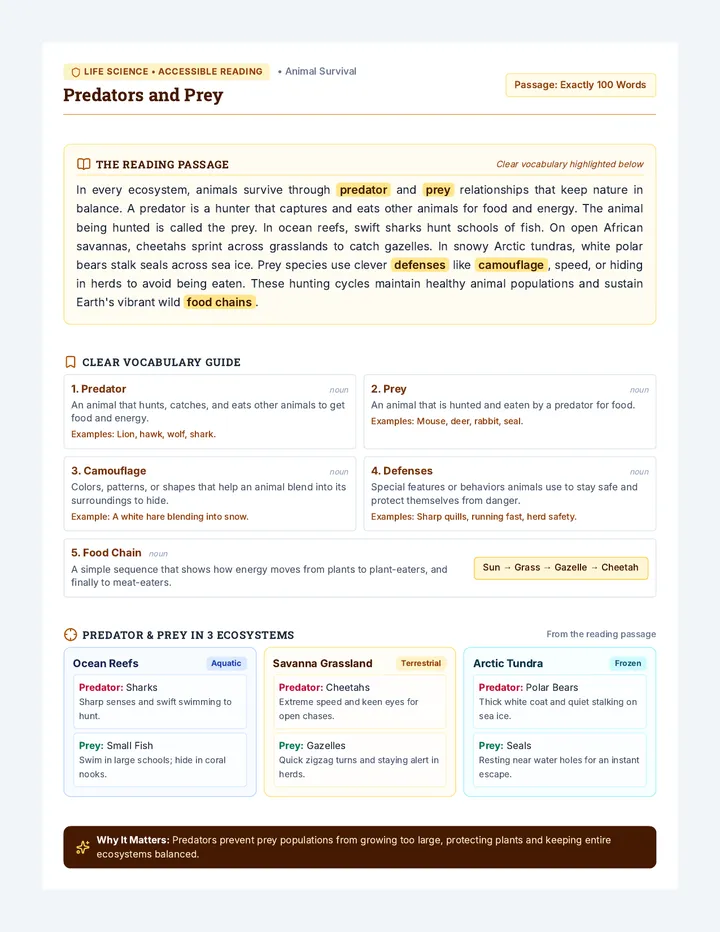
Can you bend your arm? Can you kick a ball? You have bones inside your body. The place where two bones meet is called a joint. Your knees, elbows, and shoulders are joints. Joints help you bend, jump, and dance!
2 Cartilage Is a Soft Cushion
Bones are very hard. They need a soft pad so they do not scrape together. That pad is called cartilage. Touch your ear. Bend it gently! It pops right back. That is cartilage! You also have cartilage pads between the bones in your back.
3 Ligaments and Tendons
Your body has strong helpers to keep you moving. Ligaments are like tough rubber bands that hold bone to bone. Tendons connect your muscles to your bones. When muscles pull, tendons move your bones!
4 The Achilles Heel Story
Feel the thick cord right above your heel. That is your Achilles tendon. It helps you run and leap! It is named after a Greek hero named Achilles. When Achilles was a tiny baby, his mother dipped him in a magic river to keep him safe. But she held him by his heel! His heel did not touch the water. It was his only weak spot. Today, we still name our heel tendon after him!
Quick Check Lab
Try each one and mark your answer!
1. What is a joint?
A hard muscle
Where two bones meet
A river in Greece
2. What does a tendon connect?
Muscle to bone
Bone to bone
Ear to back
3. Where is your Achilles tendon?
In your elbow
Inside your ear
Above your heel
STAAR Question (Inference) Short Constructed Response
Based on Section 4, what can you infer about why Achilles' mother dipped him in the river? Support your answer with evidence from the text.
✋ Try This: Bend your ear top down. Let it go! Did it snap right back? That is cartilage at work!
Yes!
Joints and Muscles Level 2 Reader
Joints & Mighty Movers
Level 2 Science Reader • Grades 2–3
Name:
Date:
1
Where Bones Meet: The Power of Joints
Your skeleton has more than 200 hard bones, but you can still bend, twist, and jump. A joint is any place where two or more bones meet. Your knees and elbows act like door hinges that swing back and forth. Your shoulders are ball-and-socket joints that allow your arms to swing in giant circles!
2
Cartilage (kar-tih-lij): The Body's Cushion
If bare bones bumped against each other, they would wear down. Most joints are protected by cartilage. Cartilage is a flexible tissue that is softer than bone, but stiffer than muscle. Your spine has about thirty small bones called vertebrae. Thick pads of cartilage sit between each vertebra to keep them from grinding together. You also have cartilage in your ears and nose—gently bend your ear, and it bounces right back!
3
Ligaments and Tendons: The Connectors
Ligaments (Bone to Bone)
Tough, stretchy cords that tie bones together. Ligaments in your knee secure your thigh bone to your shin bones so your joint stays stable.
Tendons (Muscle to Bone)
Strong bands that link your muscular and skeletal systems. When a muscle tightens, the tendon pulls the bone to create movement.
4
The Legend of the Achilles (uh-kil-eez) Tendon
Just above your heel is a thick, powerful cord called the Achilles tendon. It links your calf muscle to your heel bone, powering every run and leap. It is named after the ancient Greek warrior Achilles. According to myth, his mother dipped him into the magical River Styx so no spear or arrow could pierce his skin. But she held him by his heel, leaving that one spot untouched by the water. In battle, an arrow struck his unprotected heel. Today, we honor that story in the name of our heel tendon—and we still call a person's weak spot their "Achilles heel!"
Science Check & STAAR Reading Practice
TEKS 3.6(F) • STAAR Short Constructed Response
1. Connector Rules:
A connects bone to bone.
A connects muscle to bone.
Word Bank: Tendon • Ligament
2. Spine Cartilage:
Pads of cartilage cushion vertebrae so they do not against each other.
STAAR Short Constructed Response (SCR) 2-Point Rubric
Based on Section 4, what can the reader infer about why Achilles' mother dipped him into the River Styx? Support your answer with evidence from the text.
STAAR SCR Checklist:
Valid inference (answers question)
Relevant text evidence